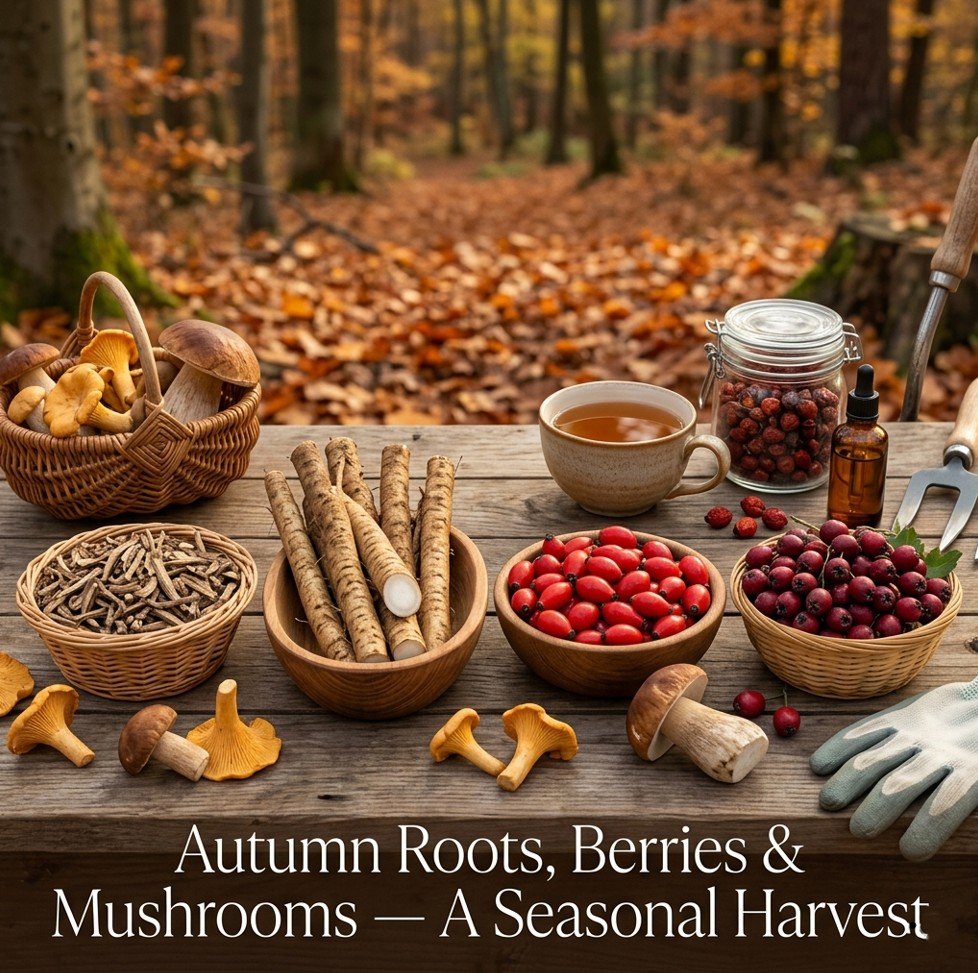
There is a quiet magic to autumn foraging. The frantic growth of spring and summer is over. Plants are drawing their energy downward, storing nutrients and active compounds in roots and berries. This is the season for digging, gathering, and preserving — building a herbal pantry for the cold months ahead.
European herbal traditions have long recognised autumn as the time to harvest specific plant parts. Roots are at their most potent after the leaves have died back. Berries are ripe and full of vitamins. Mushrooms emerge from the damp forest floor, fruiting bodies of vast underground networks.
This guide covers four important autumn wild plants: valerian root (for sleep), burdock root (for skin and digestion), rosehips (for vitamin C and immunity), and hawthorn berries (for heart health). We also discuss autumn mushroom foraging — a practice that requires expert identification and carries real risks. This is not a mushroom identification guide. It is a cautionary introduction.
What Grows in Europe During Autumn?
The following four plants are common across Europe, relatively easy to identify with care, and have well‑documented traditional uses. Mushrooms are discussed separately.
1. Valerian Root (Valeriana officinalis)
Appearance (to identify the plant, not the root): Tall perennial (1–1.5 metres). Leaves: pinnate, with 7–10 pairs of leaflets. Flowers: small, white to pale pink, in clusters, sweetly fragrant (June–August). The root is the medicinal part — harvested in autumn.
Where found: Damp meadows, riverbanks, ditches, wet woodlands. Throughout Europe.
Parts used: Root (and rhizome) — harvested in autumn after the aerial parts have died back.
Traditional use: Valerian is Europe’s most famous herbal sleep aid. It has been used since ancient Greece for restlessness, insomnia, and nervous tension. German Commission E approved valerian for restlessness and sleep disorders.
Modern interest: Mixed evidence. Some studies show modest improvement in sleep quality and reduced time to fall asleep. Others find no difference from placebo. Valerian is generally safe and may work better after 2–4 weeks of regular use.
Harvest tip: Dig roots in October–November, after the first frosts. The root smells distinctly like old socks (from isovaleric acid) — this is normal. Wash, slice, and dry slowly at low temperature (<40°C).
Preparation: Valerian root requires a decoction (simmer 10–15 minutes), not a simple infusion. Tinctures are also effective. Tea tastes unpleasant — mixing with peppermint or lemon balm helps.
Safety: Generally safe. May cause morning grogginess. Avoid with sedative medications and alcohol. Do not use during pregnancy without medical advice.
2. Burdock Root (Arctium lappa)
Appearance: Biennial plant, 1–2 metres tall in its second year. Large, broad, heart‑shaped leaves (up to 50 cm). Flowers: purple, thistle‑like, in burrs that stick to clothing (the inspiration for Velcro). The root is the medicinal part — harvested in the first autumn (before flowering).
Where found: Roadsides, waste ground, hedgerows, disturbed soil. Throughout Europe.
Parts used: First‑year root (taproot, up to 1 metre long). Harvested in autumn of the first year, before the plant flowers in its second year.
Traditional use: Burdock root has been used in European folk medicine as a “blood purifier” (mild diuretic and lymphatic support), for skin conditions (acne, eczema, boils), and as a digestive bitter. It is also eaten as a vegetable in some European cuisines (e.g., Japanese gobo, but also in parts of Europe).
Modern interest: Very limited human research. Laboratory studies show anti‑inflammatory and antimicrobial activity. Burdock contains inulin (a prebiotic fibre) and polyphenols. Evidence for skin conditions is weak but traditional use is consistent.
Harvest tip: Dig first‑year roots in autumn (October–November). The root is fleshy, brown outside, white inside. Harvest only from clean, unpolluted ground. Do not confuse with other taproots (e.g., hemlock — see safety).
Preparation: Burdock root is prepared as a decoction (simmer 15–20 minutes) or tincture. It can also be eaten as a cooked vegetable (peeled, sliced, boiled or stir‑fried). The taste is sweet, earthy, and slightly mucilaginous.
Safety: Burdock root is very safe as food and tea. However, it resembles poison hemlock (Conium maculatum) in the first year — hemlock has a smooth, purple‑spotted stem (burdock stem is hollow and ridged, not spotted). Never harvest without confident identification. Avoid if allergic to Asteraceae (rare).
3. Rosehips (Rosa canina and other wild rose species)
Appearance: Wild rose shrubs (1–3 metres). Prickly stems with hooked thorns. Leaves: pinnate with 5–7 leaflets. Flowers: pink or white (spring/summer). Fruits (hips): oval to round, 1–2 cm, bright red to orange, ripening in late summer to autumn. The hips are the medicinal part — harvested after the first frost.
Where found: Hedgerows, woodland edges, scrubland, roadsides. Throughout Europe.
Parts used: The fleshy fruit (hip) — usually the whole hip, or the outer flesh after removing the seeds and irritating hairs.
Traditional use: Rosehip tea has been used for centuries as a source of vitamin C, especially in winter to prevent colds and scurvy. Rosehip syrup is a traditional European remedy for coughs and general debility. The seeds are also used (rosehip seed oil for skin).
Modern interest: Rosehips are genuinely high in vitamin C (though levels vary). Some studies suggest that rosehip powder may reduce osteoarthritis pain and inflammation — a 2008 study found modest benefits for hip and knee arthritis. Evidence is weak but promising.
Harvest tip: Harvest hips after the first frost, when they become slightly soft and sweeter. They are usually bright red or orange. Avoid hips from roadsides (pollution). Cut hips in half and remove the seeds and irritating hairs (can cause “itchy bottom” — literally, gastrointestinal irritation if ingested). Dry the fleshy outer parts.
Preparation:
- Rosehip tea: 1–2 teaspoons dried, chopped hips per cup, steep 10–15 minutes (or decoct for stronger extraction). Strain well to remove hairs.
- Rosehip syrup: Simmer hips in water, strain, add sugar/honey, reduce to syrup.
- Rosehip powder: Dried, ground hips can be added to smoothies or porridge.
Safety: Rosehips are very safe. The hairs inside the hip are mechanical irritants — remove them before consumption. Do not eat raw whole hips (the hairs can cause digestive irritation). Not recommended for people with kidney stones (high vitamin C can increase oxalate excretion — theoretical risk).
4. Hawthorn Berries (Crataegus monogyna, C. laevigata)
Appearance: Thorny shrub or small tree (up to 10 metres). Leaves: lobed, dark green. Flowers: white or pink in spring (“mayflower”). Fruits (berries): small, 8–10 mm, dark red to deep purple, containing one seed. Ripen in September–October.
Where found: Hedgerows, woodland edges, scrubland. Very common throughout Europe.
Parts used: The berries (fruits) — also leaves and flowers (spring harvest). This article focuses on autumn berries.
Traditional use: Hawthorn has been used for centuries as a heart tonic. It is traditionally used for mild heart failure (stage 1–2), palpitations, and to support circulation. In European herbal medicine (especially German Commission E), hawthorn is approved for mild heart insufficiency.
Modern interest: Hawthorn has been studied more than many European herbs. Several clinical trials and a 2008 Cochrane review concluded that hawthorn extract (standardised) improves symptoms of mild heart failure (fatigue, shortness of breath) compared to placebo. However, do not self‑treat — heart failure requires medical diagnosis and management.
Harvest tip: Pick berries when fully ripe (deep red to purple, slightly soft) in September–October. Avoid unripe berries. Strip from the stems. Dry immediately or use fresh for tincture.
Preparation: Hawthorn berries are prepared as a decoction (simmer 15–20 minutes), tincture (alcohol extract), or syrup. The taste is slightly sweet and astringent. Commercial hawthorn extracts are standardised.
Safety: Hawthorn is generally safe at recommended doses. It may interact with heart medications (digoxin, beta‑blockers, calcium channel blockers) — do not use hawthorn without medical supervision if you have diagnosed heart disease. Mild side effects include nausea, dizziness, and headache. Not recommended during pregnancy.
Autumn Mushrooms: A Special Caution
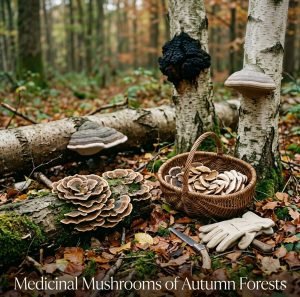
Autumn is mushroom season in Europe. Porcini, chanterelles, and other edible fungi appear in forests. Medicinal mushrooms like turkey tail (Article 8) and birch polypore (Article 4) are also present.
However, mushroom foraging is high‑risk.
Deadly look‑alikes:
- Death cap (Amanita phalloides) — responsible for most fatal mushroom poisonings in Europe. Resembles edible mushrooms. No antidote.
- Destroying angel (Amanita virosa) — pure white, deadly.
- Fool’s mushroom (Amanita verna) — another white, deadly Amanita.
Rules for safe mushroom foraging:
- Never eat a wild mushroom unless identified by an expert
- Do not rely on apps or online photos alone
- Go with an experienced mycologist (mushroom expert)
- Learn the deadly species first — not just the edible ones
- When in doubt, throw it out
Medicinal mushrooms covered elsewhere in this series:
- Birch polypore (Article 4)
- Turkey tail (Article 8)
- Artist’s conk (future Article 14)
- Chaga (future Article 20)
This article does not provide mushroom identification guidance. Foraging for medicinal mushrooms requires the same level of expertise as foraging for edible ones. If you are not confident, buy from reputable suppliers.
How to Harvest, Prepare, and Store Autumn Plants
Harvesting guidelines
| Plant | Harvest part | Best time | Sustainability tip |
|---|---|---|---|
| Valerian | Root | Oct–Nov, after die‑back | Dig carefully, replant small root pieces |
| Burdock | First‑year root | Oct–Nov | Harvest only from abundant areas |
| Rosehips | Fruit | After first frost | Leave some for birds |
| Hawthorn | Berries | Sep–Oct | Take only 20–30% from a tree |
General rules:
- Harvest only from clean areas — away from roads, agriculture, dog‑walking paths
- Take no more than 20–30% of a population
- Use clean, sharp tools (knife, scissors)
- Respect protected species (none of these are protected, but check locally)
Preparation methods
Decoction (for roots and berries):
- Roots (valerian, burdock): 1–2 teaspoons dried, sliced root per cup
- Berries (rosehips, hawthorn): 2 teaspoons dried berries per cup
- Simmer in water for 15–20 minutes (not just steep)
- Strain and drink
Tincture (alcohol extract):
- Fill a glass jar with chopped, dried root or berries
- Cover with 40–50% alcohol (vodka is fine)
- Seal and store in a dark place for 4–6 weeks, shaking daily
- Strain into a dropper bottle
- Typical dose: 1–3 ml (20–60 drops) up to three times daily
Syrup (for rosehips):
- Simmer 500 g fresh (or dried) rosehips in 1 litre water for 30 minutes
- Strain through muslin (to remove hairs)
- Add 500 g sugar or honey, simmer until slightly thickened
- Bottle and refrigerate — use within 2–3 weeks
Drying:
- Roots: slice thinly, dry at low temperature (<40°C) in dehydrator or warm, airy room
- Berries: dry whole (rosehips) or whole (hawthorn) — can take 1–2 weeks
- Store in airtight glass jars away from light
- Valerian root retains potency for 2 years; berries for 12–18 months
Seasonal Herbal Rituals and Traditional European Practices
Valerian in Germany and Britain: Valerian root was traditionally dug on St. John’s Eve (summer solstice) but autumn harvest became standard. The root was placed in homes to ward off plague (medieval belief) and used as a calming tea.
Burdock in Britain and France: “Poor man’s asparagus” — the young stalks and roots were eaten as a spring vegetable. Autumn roots were dried and used in “blood cleansing” teas.
Rosehips in Scandinavia and Britain: During World War II, when citrus imports were cut off, British schoolchildren gathered rosehips to make rosehip syrup as a source of vitamin C. The “Rosehip Syrup Harvest” was a national effort.
Hawthorn in European folklore: Hawthorn was considered a protective tree. Its berries were used in love charms, but also in medicinal wines and cordials for the heart.
These traditions are cultural heritage, not medical prescriptions.
Safety, Interactions, and When to See a Doctor
This article is for educational purposes only and does not replace medical advice, diagnosis, or treatment. Persistent, severe, or unclear symptoms should be discussed with a qualified healthcare professional.
Specific safety notes:
| Plant | Contraindications / Cautions |
|---|---|
| Valerian | Avoid with sedatives, alcohol, benzodiazepines. May cause morning grogginess. Pregnancy: avoid. |
| Burdock | Very safe as food/tea. But: resembles poison hemlock — confident ID essential. Avoid if ragweed allergy. |
| Rosehips | Safe. Remove hairs before eating. Caution with kidney stones (high vitamin C — theoretical). |
| Hawthorn | Do not use for diagnosed heart disease without medical supervision. May interact with heart medications (digoxin, beta‑blockers). |
Pregnancy and breastfeeding:
- Valerian: Avoid (insufficient safety data)
- Burdock: Food amounts likely safe; tea amounts consult doctor
- Rosehips: Safe in food/tea amounts
- Hawthorn: Avoid (insufficient safety data)
Drug interactions:
- Valerian potentiates sedatives (benzodiazepines, Z‑drugs, alcohol)
- Hawthorn may interact with cardiac medications — do not combine without medical advice
Red flags — when to see a doctor (not a forager):
- Insomnia lasting more than 3 weeks (see a doctor — not just valerian)
- Skin conditions that are severe, infected, or not healing
- Symptoms of heart disease: chest pain, shortness of breath on exertion, ankle swelling
- Any symptom that worries you
Emergency mushroom warning: If you or someone you know has eaten a wild mushroom and develops vomiting, diarrhoea, abdominal pain, or any symptoms within 6–12 hours, seek emergency medical care immediately. Do not wait. Take a sample of the mushroom if possible.
FAQ
Can I dig valerian root in spring instead of autumn?
Spring root is less potent. Autumn root has the highest concentration of active compounds. If you must dig in spring, do it before the plant grows much.
Is burdock root safe to eat raw?
Yes, but it is tough and earthy. Most people prefer it cooked (boiled, stir‑fried). Raw burdock can be grated into salads but is very fibrous.
How many rosehips do I need for a winter’s supply?
For one person, 500–1000 g of fresh rosehips dried will provide enough tea for winter. A handful of hips makes one cup of tea.
Can I use hawthorn berries and flowers together?
Yes. Traditional preparations often combine leaves, flowers, and berries. However, for heart conditions, always consult a doctor first.
What is the most dangerous autumn mushroom in Europe?
The death cap (Amanita phalloides) causes the most fatalities. It resembles edible mushrooms like the puffball or certain russulas. Never forage mushrooms without expert training.
Can I freeze autumn berries?
Yes. Rosehips and hawthorn berries freeze well. Spread them on a baking sheet to freeze individually, then transfer to a freezer bag. Frozen berries can be used for tea or syrup without thawing.
Key Takeaways
- Four European autumn plants have strong traditional use: valerian root (sleep), burdock root (skin/digestion), rosehips (vitamin C/immunity), hawthorn berries (heart support).
- Harvest roots after the first frost; harvest berries when ripe (rosehips after frost for sweetness).
- Roots require decoction (simmer 15–20 minutes); berries can be steeped or decocted.
- Hawthorn has evidence for mild heart failure but do not self‑treat — medical supervision required.
- Autumn mushroom foraging is high‑risk. Never eat a wild mushroom without expert identification. Death cap is deadly.
- This is not medical advice. Persistent or severe symptoms require a doctor.
Internal Links Used
- Herbs traditionally used for better sleep support — placed in valerian section
- Best European herbs for skin soothing — placed in burdock section
- Best European herbs for seasonal immunity support — placed in rosehips section
Sources
- European Medicines Agency (EMA) – Community herbal monographs: Valerianae radix, Bardanae radix, Rosae pseudofructus, Crataegi fructus.
- World Health Organization (WHO) – Monographs on selected medicinal plants.
- German Commission E Monographs – Valerian root, burdock root, rosehips, hawthorn berries.
- Pittler, M. H., et al. (2008). Hawthorn extract for chronic heart failure. Cochrane Database of Systematic Reviews, (1).
- Christensen, R., et al. (2008). Rosehip powder for osteoarthritis. Osteoarthritis and Cartilage, 16(11), 1275-1281.
- Royal Botanic Gardens, Kew – Medicinal plant fact sheets.
- National Institute for Health and Care Excellence (NICE) – Heart failure guidelines.