The modern world is demanding. Deadlines, notifications, family responsibilities, financial pressures – the list never ends. For most people, this is everyday stress: manageable but draining. For some, it tips over into anxiety disorders or depression, which require medical attention.
Between these extremes lies a space where gentle herbal support can help. European herbal traditions classify certain plants as nervines – herbs that nourish, tone, and support the nervous system. They are not sedatives (though some have mild sedative effects). They are adaptogens (though not in the strict sense of Panax ginseng). They are simply plants that help the body cope with stress.
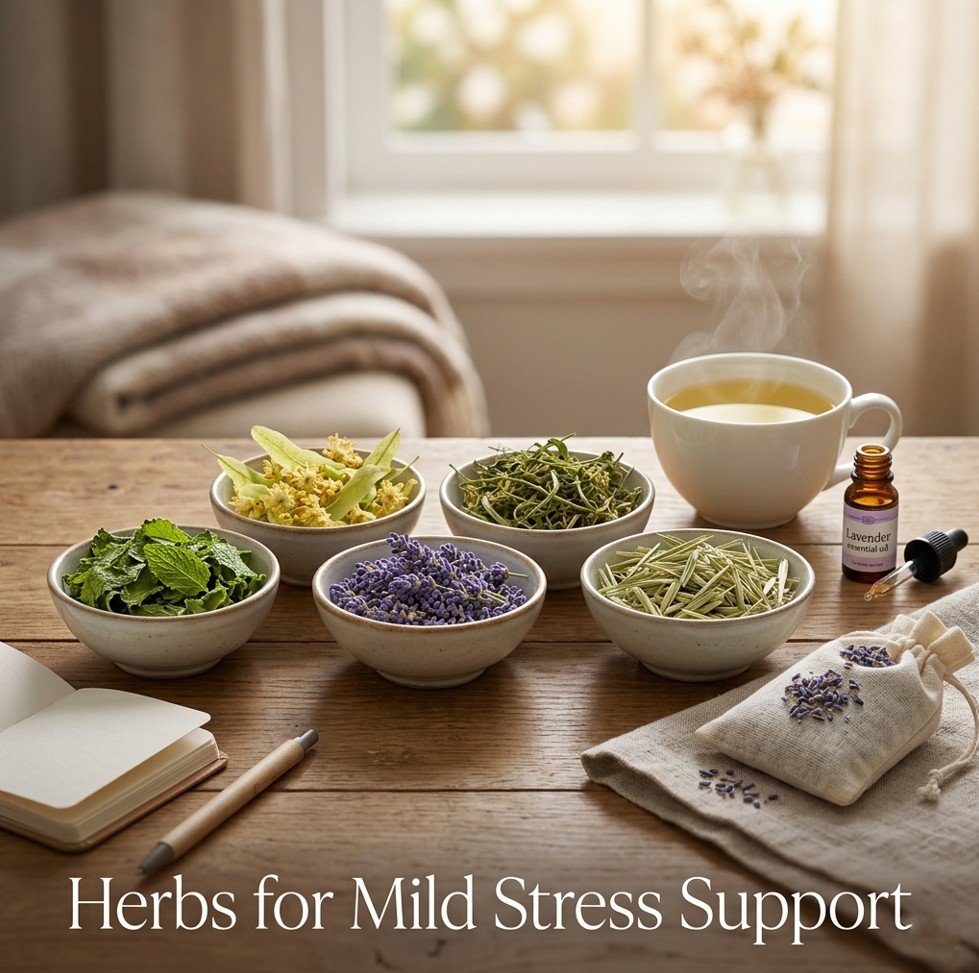
This article covers five European herbs for mild stress support: lemon balm (calming, uplifting), linden (gentle, suitable for children), lavender (aromatic, relaxing), passionflower (stronger, for racing thoughts), and oats (oat straw – nourishing, restorative). Each has a different character and strength.
What Is Stress and When Do Herbs Help?
Stress is the body’s response to a perceived threat – real or imagined. The sympathetic nervous system activates the “fight or flight” response, releasing adrenaline and cortisol. Heart rate increases, digestion slows, muscles tense.
Acute stress (short‑term) is normal and even helpful – it sharpens focus and performance. Chronic stress (long‑term) is harmful – it contributes to anxiety, depression, insomnia, digestive disorders, weakened immunity, and cardiovascular disease.
Mild, everyday stress includes:
- Feeling “wired” or tense after work
- Difficulty unwinding in the evening
- Restless thoughts at bedtime
- Irritability with family members
- Tension headaches
- Stress‑related digestive discomfort (butterflies, nervous stomach)
When is stress not “mild”? – red flags requiring professional help:
- Panic attacks (sudden, intense fear with physical symptoms)
- Persistent anxiety lasting most days for weeks or months
- Depression (low mood, loss of interest, hopelessness)
- Thoughts of self‑harm or suicide – seek immediate help
- Inability to function at work, school, or in relationships
- Stress that does not improve with lifestyle changes or herbs
What herbs can and cannot do for stress:
- Can: Take the edge off everyday tension, promote relaxation, improve stress resilience, support sleep (if stress is the cause of sleeplessness).
- Cannot: Treat panic disorder, generalised anxiety disorder (GAD), major depression, or post‑traumatic stress disorder (PTSD). These require evidence‑based treatments (therapy, medication).
Best European Herbs Traditionally Used for Mild Stress Support
The following five herbs are well‑documented in European herbal traditions for nervous system support.
1. Lemon Balm (Melissa officinalis)
What it is: A lemon‑scented perennial herb from the mint family (see full profile in Article 10).
Why it is traditionally used for stress: Lemon balm is a gentle calming herb – it eases nervous tension, lifts mood, and helps with stress‑related digestive discomfort. It has been used for centuries for “melancholy” (mild depression) and “nerves”. The name Melissa means “honey bee” – the flowers attract bees, and the herb attracts calm.
What modern research suggests: Several human studies confirm that lemon balm reduces anxiety and improves mood in acute stress situations. A 2004 study found that 300–600 mg of lemon balm extract increased calmness and reduced alertness (in a positive way – less “jittery”). A 2018 systematic review concluded that lemon balm is effective for mild to moderate anxiety.
Best use case: Daytime stress – when you feel “wired” but need to stay functional. Also excellent for stress‑related digestive issues (butterflies, nervous stomach).
How to prepare:
- Lemon balm tea: 1–2 teaspoons dried leaves per cup, steep 5–10 minutes. Drink 2–3 cups daily.
- Lemon balm tincture: 2–4 ml (40–80 drops) in water, up to 3 times daily.
Safety: Very safe. Caution with thyroid medication (see Article 10). Pregnancy: tea amounts likely safe (consult doctor).
2. Linden (Tilia cordata / T. platyphyllos)
What it is: The flowers of the European lime tree (linden). Not related to the citrus lime.
Why it is traditionally used for stress: Linden flower tea (tilleul in French) is a classic European bedtime and stress drink – especially popular in France, Germany, and Britain. It is traditionally used for nervous tension, mild anxiety, restlessness, and as a gentle sleep aid for children and the elderly. It has a sweet, honey‑like flavour and no caffeine.
What modern research suggests: Very limited human research. Laboratory studies show that linden flavonoids have mild sedative and anxiolytic (anti‑anxiety) effects. Traditional use is the main support – it is considered very safe and effective for mild stress.
Best use case: Evening stress – to unwind after work or prepare for sleep. Also suitable for children and elderly people who need a very gentle calming herb.
How to prepare:
- Linden tea: 1–2 teaspoons dried flowers per cup, steep 8–10 minutes. Drink 2–3 cups daily, especially in the evening.
- Linden bath: Add a strong infusion (4 tablespoons flowers in 1 litre water, steep 15 minutes, strain) to a warm bath. Soak for 20 minutes.
Safety: Very safe. Rare ragweed allergy. Do not harvest from urban trees (pollution). Pregnancy: insufficient safety data – avoid medicinal doses (tea in small amounts likely low risk – consult doctor).
3. Lavender (Lavandula angustifolia)
What it is: A fragrant shrub from the Mediterranean. The flowers are used. Best known as an essential oil, but tea is also used.
Why it is traditionally used for stress: Lavender has been used for centuries as a calming and sleep‑promoting herb. Dried lavender flowers were placed in pillows (“sleep pillows”). Lavender water was sprinkled on linen. The scent itself is relaxing.
What modern research suggests: Lavender is better studied as an aromatic (inhaled) than as a tea. Several clinical trials show that lavender essential oil inhalation reduces anxiety, improves mood, and promotes sleep. A 2017 meta‑analysis found that lavender oil aromatherapy significantly reduced anxiety levels in various settings (pre‑surgery, dental, ICU). Oral lavender oil capsules (Silexan) have also been studied for generalised anxiety disorder – with positive results (comparable to low‑dose benzodiazepines in some studies). However, oral lavender oil requires medical supervision.
Best use case: Acute stress – a few deep breaths of lavender aroma can calm the nervous system quickly. Also for stress that interferes with sleep (lavender pillow spray or diffuser).
How to prepare:
- Lavender tea (mild): 1 teaspoon dried flowers per cup, steep 5 minutes (longer becomes soapy). Drink 1–2 cups daily.
- Lavender aromatherapy: Add 3–5 drops of lavender essential oil to a diffuser, or put 1–2 drops on a tissue and inhale.
- Lavender bath: Add 5–10 drops of lavender essential oil to 1 tablespoon of carrier oil (or a cup of milk), add to warm bathwater. Soak for 20 minutes.
- Lavender pillow: Fill a small cloth bag with dried lavender flowers and place inside your pillowcase.
Safety: Lavender tea is very safe. Lavender essential oil is for external/inhalation use only – do not ingest undiluted. Dilute for skin application (1–2 drops per tablespoon carrier oil). Pregnancy: tea in small amounts likely safe; essential oil avoid (insufficient safety data). Children under 6 years: avoid essential oil (respiratory sensitivity). Lavender oil may have hormonal effects in prepubertal boys (theoretical, rare) – avoid prolonged use.
4. Passionflower (Passiflora incarnata)
What it is: A climbing vine native to North America, but naturalised and widely used in Europe for over 200 years. The aerial parts (leaves, stems, flowers) are used. European herbalism has fully adopted passionflower as a nervine.
Why it is traditionally used for stress: Passionflower is a stronger nervine than lemon balm or linden – it is traditionally used for restlessness, anxiety, nervous agitation, and difficulty falling asleep (when stress is the cause). The German Commission E approves passionflower for nervous restlessness.
What modern research suggests: Several clinical trials have examined passionflower for anxiety. A 2008 study found that passionflower extract was as effective as a standard benzodiazepine (oxazepam) for generalised anxiety disorder – with fewer side effects (less drowsiness). A 2017 systematic review concluded that passionflower is effective for anxiety symptoms, but the quality of evidence is low to moderate.
Best use case: Moderate stress with agitation – when you feel “wired and tired” (mentally exhausted but physically tense). Also for stress‑related insomnia.
How to prepare:
- Passionflower tea: 1–2 teaspoons dried herb per cup, steep 10–15 minutes. Drink 1–2 cups daily, especially in the evening.
- Passionflower tincture: 1–3 ml (20–60 drops) in water, up to 3 times daily. Tincture is more potent.
Safety: Passionflower is generally safe for short‑term use (up to 1–2 months). Do not use during pregnancy (may stimulate uterine contractions – traditional use as an emmenagogue). May potentiate sedatives (benzodiazepines, barbiturates, alcohol) – avoid combining. May cause mild drowsiness – do not drive if affected. Not recommended for children under 6 years.
5. Oats (Avena sativa) – Oat Straw
What it is: The common oat plant. The green, milky straw (aerial parts harvested when the seeds are unripe) is used medicinally – not the oatmeal (though oatmeal is nutritious). Also called Avena sativa or “milky oats”.
Why it is traditionally used for stress: Oat straw is a unique nervine – it is not sedating. Instead, it is a restorative – it nourishes and strengthens the nervous system over time. It is traditionally used for nervous exhaustion, burnout, “weak nerves”, and recovery from stress. It has no immediate calming effect – it works with regular use over weeks.
What modern research suggests: Limited human research. A 2011 study found that oat straw extract improved cognitive performance and mood in healthy older adults. Another study found reduced anxiety in people with substance use disorders. Laboratory studies suggest oat straw has antioxidant and anti‑inflammatory effects. Traditional use is strong – it is considered very safe.
Best use case: Chronic stress, burnout, nervous exhaustion – people who feel “drained”, “worn out”, or “on edge” after prolonged stress. Also for people recovering from illness or major life events.
How to prepare:
- Oat straw tea (infusion): 2–3 teaspoons dried herb per cup, steep 10–15 minutes. Drink 2–4 cups daily.
- Oat straw tincture (milky oat tincture – fresh plant): 2–4 ml (40–80 drops) in water, 2–3 times daily.
- Oat straw bath: Add a strong infusion to bathwater – traditional for nervous exhaustion.
Safety: Very safe. Gluten‑free (oats are gluten‑free but may be contaminated with wheat during processing – choose certified gluten‑free if coeliac). Pregnancy: safe in food and tea amounts (consult doctor). No known drug interactions.
How to Use These Herbs at Home – Matching Stress Type
For acute, “wired” stress (during the day)
Best herbs: Lemon balm (tea or tincture), lavender (aromatherapy)
Preparation:
- Lemon balm tea – 1 cup at the moment of stress
- Lavender inhaler – 1–2 drops on a tissue, inhale deeply
For evening unwinding (before bed)
Best herbs: Linden (tea), lavender (bath or diffuser), passionflower (tea – for agitation)
Preparation:
- Linden tea – 1–2 cups after dinner
- Lavender bath – 20 minutes before bed
- Passionflower tea – 1 cup 30–60 minutes before bed
For chronic stress, burnout, nervous exhaustion
Best herb: Oat straw (milky oats) – taken daily for 2–3 months
Preparation: Oat straw tea (2–4 cups daily) or tincture (2–4 ml, 2–3 times daily)
For stress with sleep difficulties
Best herbs: Linden + passionflower (evening blend)
Blend recipe: Equal parts linden flowers and passionflower herb. Use 2 teaspoons of blend per cup, steep 10 minutes. Drink 1–2 cups in the evening.
For stress with digestive symptoms (nervous stomach)
Best herbs: Lemon balm (calms both nerves and digestion)
Preparation: Lemon balm tea after meals
What to avoid:
- Do not use passionflower during pregnancy
- Do not combine multiple sedating herbs (e.g., passionflower + lavender + valerian) without caution – can cause excessive drowsiness
- Do not use herbs as a substitute for medical treatment of anxiety or depression
When the Season Matters
Most stress herbs are available dried year‑round.
Harvesting:
- Lemon balm: Harvest leaves just before flowering (late spring to summer). Dry.
- Linden: Harvest flowers in early summer (June). Dry quickly.
- Lavender: Harvest flowers when the bottom third of the spike has opened (mid‑summer). Dry.
- Passionflower: Harvest aerial parts in late summer. Dry. (Not native to Europe – buy dried.)
- Oats (oat straw): Harvest green, milky straw in late summer when seeds are soft and exude a milky sap when pressed. Dry.
Buying advice:
- All five herbs are available dried from European herbal suppliers.
- For lavender essential oil, choose 100% Lavandula angustifolia (true lavender), not lavandin (Lavandula × intermedia – has more camphor, less relaxing).
- For oat straw, look for “milky oats” tincture (fresh plant) for maximum benefit.
Storage: Store dried herbs in airtight glass jars away from light and heat. Leaves and flowers: 12–18 months.
Safety, Interactions, and When to See a Doctor
This article is for educational purposes only and does not replace medical advice, diagnosis, or treatment. Persistent, severe, or unclear symptoms should be discussed with a qualified healthcare professional.
Specific safety notes:
| Herb | Contraindications / Cautions |
|---|---|
| Lemon balm | Very safe. Caution with thyroid medication. |
| Linden | Very safe. Avoid urban harvesting (pollution). Pregnancy: insufficient data – caution. |
| Lavender | Tea: safe. Essential oil: external/inhalation only, dilute, avoid ingestion. Pregnancy: avoid essential oil. |
| Passionflower | Avoid in pregnancy. May potentiate sedatives. May cause drowsiness. |
| Oats (oat straw) | Very safe. Choose gluten‑free if coeliac. |
Pregnancy and breastfeeding:
- Lemon balm: Tea amounts likely safe (consult doctor)
- Linden: Avoid medicinal doses (insufficient data)
- Lavender: Tea small amounts likely safe; essential oil avoid
- Passionflower: Contraindicated
- Oats: Safe in food/tea amounts
Drug interactions:
- Passionflower: May potentiate benzodiazepines, barbiturates, alcohol, and other sedatives. Avoid combining.
- Lemon balm: May potentiate sedatives and thyroid medication (theoretical).
- Lavender (oral oil capsules – not tea): May potentiate sedatives.
- Linden, oats: No known interactions.
When to see a doctor – not herbs:
- Panic attacks (sudden, intense fear with palpitations, sweating, trembling)
- Persistent anxiety lasting most days for weeks or months
- Depression (low mood, loss of interest, hopelessness)
- Thoughts of self‑harm or suicide – seek immediate help (call emergency services)
- Inability to function at work, school, or in relationships
- Stress that does not improve with lifestyle changes and herbs after 4–6 weeks
FAQ
What is the best herb for everyday stress?
Lemon balm is excellent for daytime stress – it calms without drowsiness. Linden is best for evening unwinding. For acute stress (moments of high tension), lavender aromatherapy works quickly.
Can I take these herbs every day?
Lemon balm, linden, and oat straw can be taken daily for weeks to months. Passionflower is best for short‑term use (up to 1–2 months). Lavender tea is fine daily; essential oil aromatherapy can be used as needed.
Do these herbs cause drowsiness?
Lemon balm, linden, and oat straw are not sedating – they are calming without causing drowsiness. Passionflower and lavender (tea) have mild sedative effects – may cause drowsiness in sensitive individuals. Do not drive if affected.
Can I give stress herbs to children?
Linden tea is traditionally used for children. Lemon balm tea is also gentle. For children under 6 years, use small amounts (½ cup, diluted) and consult a paediatrician. Avoid passionflower and lavender essential oil.
Are these herbs addictive?
No. None of these herbs cause physical dependence or addiction (unlike benzodiazepines or alcohol). However, relying on any substance to manage stress without addressing underlying causes is not ideal – use herbs as part of a broader self‑care plan (exercise, sleep, therapy if needed).
Can I combine all five herbs together?
You can, but it is not necessary. A simpler approach: choose one or two herbs based on your stress type. Combining multiple sedating herbs (passionflower + lavender) may cause drowsiness. A safe blend: lemon balm + linden (both gentle).
How long does it take for oat straw to work?
Oat straw is a restorative – it works slowly over weeks to months. Do not expect immediate effects. Take it daily for at least 2–3 months to notice improved stress resilience.
Key Takeaways
- Five European herbs are traditionally used for mild stress support: lemon balm (daytime calm), linden (evening unwind), lavender (aromatherapy for acute stress), passionflower (stronger, for agitation), and oats (oat straw – restorative for burnout).
- These herbs are for mild, everyday stress – not for panic attacks, generalised anxiety disorder, or depression. See a doctor for persistent or severe symptoms.
- Lemon balm, linden, and oat straw are very safe and non‑sedating. Passionflower may cause drowsiness – avoid combining with sedatives. Lavender essential oil is for inhalation/external use only.
- Critical safety: Passionflower is contraindicated in pregnancy. Lavender essential oil should not be ingested.
- Herbs are tools – not substitutes for lifestyle changes (exercise, sleep, boundaries) or professional mental health care when needed.
- This is not medical advice. Persistent stress, anxiety, or depression requires professional evaluation.
Internal Links Used
- Lemon balm: calming uses and how to brew it properly — placed in lemon balm section
- Herbs traditionally used for better sleep support — placed in stress‑related insomnia section
- Best European herbs for digestion support — placed in stress‑related digestive symptoms section
- Summer medicinal flowers to gather responsibly — placed in linden harvest section
Sources
- European Medicines Agency (EMA) – Community herbal monographs: Melissae folium, Tiliae flos, Lavandulae flos, Passiflorae herba, Avenae herba.
- World Health Organization (WHO) – Monographs on selected medicinal plants.
- German Commission E Monographs – Lemon balm, linden, lavender, passionflower, oats.
- Kennedy, D. O., et al. (2004). Lemon balm for mood and cognitive performance. Psychopharmacology, 176(3-4), 475-482.
- Akhondzadeh, S., et al. (2008). Passionflower for generalised anxiety disorder. Journal of Clinical Pharmacy and Therapeutics, 33(3), 309-313.
- Donelli, D., et al. (2019). Lavender oil aromatherapy for anxiety: A meta‑analysis. Complementary Therapies in Medicine, 46, 111-117.
- National Center for Complementary and Integrative Health (NCCIH) – Stress and anxiety.