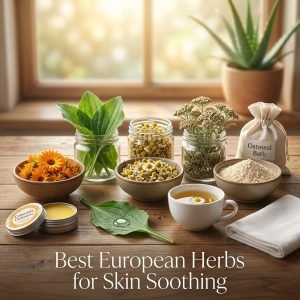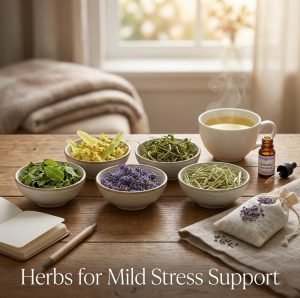
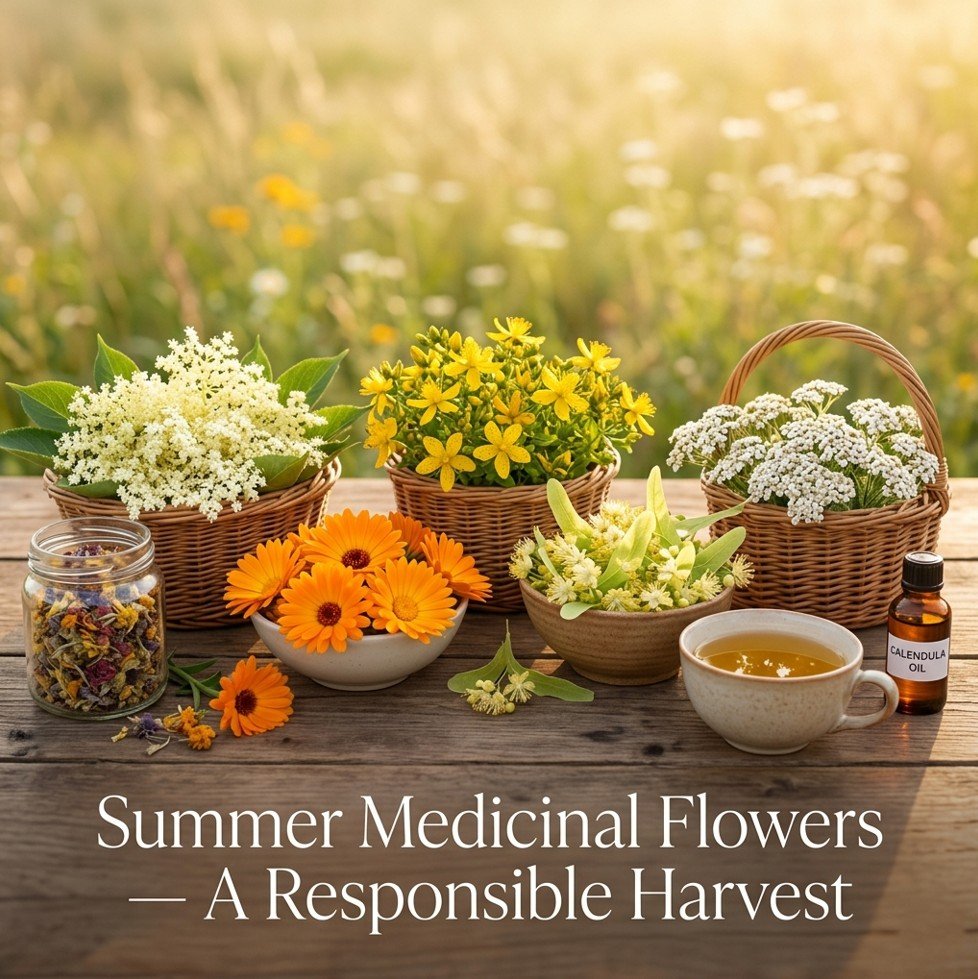
The hum of bees, the scent of blossoms, and long, warm days — summer is the season when Europe’s medicinal flowers reveal themselves. Elderflower, calendula, St. John’s wort, linden, and yarrow have been gathered for centuries, dried in barns and kitchens, and used through the winter for teas, oils, and salves.
But modern foraging requires more than tradition. It demands respect for the plant, the ecosystem, and the law. Over‑harvesting, picking from polluted ground, or misidentifying a plant can cause harm. This guide is for the responsible gatherer — someone who wants to connect with European herbal heritage without damaging nature or their own health.
We will cover identification, traditional uses, evidence level, preparation methods, sustainable harvesting, drying, and clear safety warnings.
What Grows in Europe During Summer?
The following five medicinal flowers are widespread in Europe, well‑documented in herbal tradition, and relatively easy to identify with care. They bloom from June to August in most of Europe.
1. Elderflower (Sambucus nigra)
Appearance: Large shrub or small tree (3–10 metres). Leaves: opposite, pinnate with 5–7 leaflets, with a distinctive “mousey” smell when crushed. Flowers: flat clusters (umbels) of small, creamy‑white, five‑petalled flowers with a sweet, honey‑like scent. Fruits: shiny black elderberries in late summer.
Where found: Hedgerows, woodland edges, waste ground, near human habitation. Throughout Europe.
Parts used: Fresh flowers (for tea, syrup, cordial); also berries (different use — autumn).
Traditional use: Elderflower tea is a classic European remedy for colds, fevers, and sinus congestion. In Germany, Holunderblütentee is used to promote sweating during fevers. Elderflower cordial is a traditional summer drink in Britain and Scandinavia.
Modern interest: Elderflower contains flavonoids (quercetin, rutin) and phenolic acids. Small studies suggest possible antiviral (influenza) and anti‑inflammatory activity, but high‑quality human trials are lacking. Elderflower is generally considered safe and traditionally effective for mild upper respiratory symptoms.
Harvest tip: Pick whole flower clusters on a dry, sunny morning when most flowers are open. Avoid flowers with brown patches or insects. Do not wash flowers before drying — shake gently to remove insects.
Safety: Elderflowers are safe for most people. Do not confuse with other white‑flowered shrubs (e.g., poisonous Daphne or Prunus species). Do not consume elderberries raw (they contain cyanogenic glycosides — cooking destroys them). Flowers are safe.
2. Calendula / Pot Marigold (Calendula officinalis)
Appearance: Annual or short‑lived perennial, 30–60 cm tall. Leaves: oblong, pale green, slightly sticky. Flowers: bright yellow to deep orange, with multiple rows of petals (ray florets). The flowers close at night and open in the morning.
Where found: Native to southern Europe but cultivated and naturalised throughout Europe. Commonly grown in gardens.
Parts used: Flower heads (petals and whole heads).
Traditional use: Calendula is primarily used externally. Infused oil, ointment, or cream is applied to minor wounds, nappy rash, chapped skin, and mild burns. Internally, calendula tea has been used for digestive inflammation — but external use is more evidence‑based.
Modern interest: Several studies confirm calendula’s anti‑inflammatory, wound‑healing, and antimicrobial properties in laboratory and clinical settings. A 2017 meta‑analysis found that calendula ointment was as effective as certain pharmaceutical creams for radiation‑induced dermatitis. Evidence is reasonably strong for topical use.
Harvest tip: Pick flowers when fully open, on a dry morning. Harvest regularly (calendula flowers prolifically) — removing spent flowers encourages more blooms. Use fresh for oil infusion, or dry for tea and storage.
Safety: Calendula is very safe for external use. Rare allergic reactions (Asteraceae family). Internal use (tea) is generally safe but less studied. Avoid internal use during pregnancy (traditional uterine stimulant — though evidence is weak, caution is advised).
3. St. John’s Wort (Hypericum perforatum)
Appearance: Perennial herb, 30–70 cm tall. Leaves: small, oval, opposite, with translucent dots (oil glands) visible when held to light — the “perforations”. Flowers: bright yellow, five‑petalled, with black dots on petal margins. When crushed, the flower buds produce a red‑purple liquid.
Where found: Meadows, roadsides, woodland clearings, dry grasslands. Throughout Europe.
Parts used: Flowering tops (aerial parts with flowers).
Traditional use: St. John’s wort has been used for centuries as a nervine for low mood, anxiety, and sleep difficulties. It was also applied externally to wounds and nerve pain (hence “wort” — old English for plant). In medieval Europe, it was associated with St. John the Baptist (harvested on his feast day, 24 June).
Modern interest: St. John’s wort is one of the most studied medicinal herbs. Numerous clinical trials confirm that it is more effective than placebo for mild to moderate depression and comparable to standard antidepressants (SSRIs) for some patients. However, it has major drug interactions (see safety section). Also studied for wound healing (topical) and nerve pain.
Critical note: Do not use St. John’s wort for depression without medical supervision. It interacts with many prescription drugs, including birth control pills, anticoagulants, and antidepressants.
Harvest tip: Harvest flowering tops on a dry, sunny morning around the summer solstice (late June). The red pigment (hypericin) is most concentrated just before full flowering. Cut the top 10–15 cm of the plant. Wear gloves — the red pigment stains skin.
Safety warning: See detailed section below. St. John’s wort is not safe for everyone.
4. Linden Flower (Tilia cordata / T. platyphyllos / T. europaea)
Appearance: Large deciduous tree (20–30 metres). Leaves: heart‑shaped, toothed. Flowers: small, pale yellow to cream, five‑petalled, growing in clusters attached to a pale green, leaf‑like bract (wing). Strong, sweet, honey‑like fragrance.
Where found: Planted along streets and parks, also in forests. Native to Europe.
Parts used: Flowers with the attached bract.
Traditional use: Linden flower tea (“tilleul” in French) is a classic European bedtime drink for nervous tension, mild anxiety, and as a gentle sleep aid for children and the elderly. Also used for colds (promotes sweating).
Modern interest: Very limited human research. Laboratory studies show flavonoids with mild sedative and antispasmodic effects. Traditional use is the main support. Linden is generally considered safe.
Harvest tip: Pick flowers in early to mid‑summer (June–July) when most flowers are open. Remove the bract? In traditional use, the bract is included — it adds sweetness. Harvest from trees not sprayed with pesticides. Avoid urban trees (pollution). Do not strip a tree — take only a few clusters from each branch.
Safety: Linden is very safe. Rare allergic reactions (ragweed cross‑sensitivity). Do not harvest from trees near busy roads (heavy metals). Some sources warn of heart effects in very large amounts (unlikely with normal tea use).
5. Yarrow (Achillea millefolium)
Appearance: Perennial herb, 30–80 cm tall. Leaves: feathery, fern‑like, finely divided (millefolium = thousand leaves). Flowers: small, white to pale pink, clustered in flat‑topped heads (corymbs).
Where found: Meadows, grasslands, roadsides, hedgerows. Throughout Europe.
Parts used: Flowering tops (aerial parts with flowers).
Traditional use: Yarrow is a bitter herb traditionally used to stimulate digestion before meals. It is also used for mild menstrual cramping, as a diaphoretic (sweat‑inducing) for fevers, and externally as a styptic (stops bleeding) for minor cuts.
Modern interest: Laboratory studies confirm anti‑inflammatory and antispasmodic activity. Human studies are lacking. Bitter properties (via taste receptors) are well understood. Some evidence for wound healing.
Harvest tip: Harvest when flowers are fully open (mid‑ to late summer). Cut the top 15–20 cm of the plant. Dry in shade. The taste is bitter — stronger tea is very bitter.
Safety: Yarrow is contraindicated in pregnancy (traditional emmenagogue). People with ragweed allergies may react. Avoid with blood thinners (theoretical interaction). Do not use internally for prolonged periods without professional guidance.
Best Seasonal Uses
Summer flowers are traditionally used for three main wellness roles. Warnings are noted in the herb descriptions above.
Upper respiratory comfort (colds, fevers, sinus congestion)
Herbs: Elderflower, linden, yarrow (as a diaphoretic)
How to use: Elderflower tea (2–3 cups daily) for cold symptoms. Linden tea for mild fever and restlessness. Yarrow tea (small amounts) to promote sweating — but very bitter.
Evidence level: Elderflower has traditional use and some laboratory antiviral data. Linden is mostly traditional.
Topical skin support (wounds, irritation, inflammation)
Herbs: Calendula, St. John’s wort (external), yarrow
How to use: Calendula oil or ointment for minor wounds, nappy rash, chapped skin. St. John’s wort oil (red oil) for minor burns, neuralgic pain. Yarrow powder for bleeding (styptic).
Evidence level: Calendula has the strongest evidence for topical use. St. John’s wort has some evidence for wound healing.
Nervous system support (mild anxiety, low mood, sleep)
Herbs: St. John’s wort (internal — with extreme caution), linden
How to use: Linden tea for mild nervous tension. St. John’s wort only under medical supervision — never self‑prescribe for depression.
Evidence level: St. John’s wort has strong evidence for mild to moderate depression but major drug interactions. Linden is traditional.
What to Harvest and What to Leave Alone
Responsible harvesting ensures that plant populations remain healthy for future years and for wildlife.
Do harvest sparingly:
- Take no more than 10–20% of flowers from a single plant or tree
- For elderflower and linden, take only a few clusters per branch
- For yarrow and St. John’s wort, cut only the top third of the plant
- Leave enough for bees, butterflies, and seed production
Do not harvest:
- Protected species (e.g., certain orchids, Gentiana species — check your country’s red list)
- Flowers from roadsides with heavy traffic (lead, cadmium, polycyclic aromatic hydrocarbons)
- Flowers from sprayed agricultural land, golf courses, or intensively managed parks
- Any plant you cannot identify with 100% certainty
Look‑alike dangers — summer flowers:
| Medicinal flower | Toxic look‑alike | Key difference |
|---|---|---|
| Elderflower | Daphne mezereum (poisonous) | Daphne flowers are pink/purple, grow directly on stems, not in flat clusters; leaves not pinnate |
| St. John’s wort | Hypericum species are generally safe; but some look‑alikes? Rare confusion with Senecio (ragwort) — ragwort has yellow flowers but different leaf shape | |
| Calendula | Very distinctive — no toxic look‑alikes in Europe | |
| Linden | No toxic look‑alikes with similar flowers | |
| Yarrow | May be confused with poison hemlock (Conium maculatum) — but hemlock has smooth, spotted stems, finely divided leaves but no flower clusters until later; yarrow has feathery leaves, flat flower heads. When in doubt, avoid. |
Golden rule: If you are unsure, leave it. Do not rely on plant identification apps alone. Use a reputable field guide and, if possible, go with an experienced forager.
How to Dry, Store, and Prepare Seasonal Flowers
Drying medicinal flowers correctly preserves their active compounds. Heat and light are the enemies.
Drying methods:
Air drying (best for most flowers):
- Spread flowers in a single layer on a clean drying screen (not newspaper — ink transfers)
- Place in a warm, dry, airy, shaded location (no direct sunlight)
- Turn gently every day
- Drying takes 3–10 days depending on humidity
- Flowers are ready when they feel papery and crumble easily
Oven drying (lowest heat setting, <40°C):
- Place flowers on a baking sheet lined with parchment paper
- Leave oven door slightly ajar
- Check frequently — easy to overheat and lose volatile oils
- Not recommended for delicate flowers (elderflower, linden)
Dehydrator (best for consistent results):
- Set temperature to 35–40°C
- Dry for 6–12 hours depending on flower type
Storage:
- Store completely dried flowers in airtight glass jars (not plastic)
- Keep jars away from light, heat, and moisture
- Label with herb name and harvest date
- Properly stored, most dried flowers retain good quality for 12 months
- Elderflower loses fragrance quickly — use within 6–8 months
Simple preparations:
Elderflower tea:
- 1–2 tablespoons fresh flowers (or 1 tablespoon dried) per 250 ml water
- Pour boiling water, steep 5–8 minutes
- Strain, sweeten with honey if desired
- Drink warm for cold symptoms
Elderflower cordial (traditional summer drink):
- 20–30 fresh elderflower heads, 1 kg sugar, 1.5 L water, 2 lemons (zest and juice), 50 g citric acid
- Boil water and sugar, cool slightly, add flowers and lemon, steep 24 hours, strain, bottle
- Dilute with water or sparkling water
Calendula oil (for external use):
- Fill a glass jar with dried calendula flowers (not packed tightly)
- Cover completely with olive oil or almond oil
- Place in a sunny windowsill for 2–4 weeks, shaking daily
- Strain through cheesecloth into a clean bottle
- Store in a cool, dark place — use within 6–12 months
St. John’s wort oil (external only — red oil):
- Same method as calendula oil, but use fresh flowering tops (not dried)
- The oil will turn deep red within 2–3 weeks
- Do not ingest — external use only
Linden tea:
- 1–2 teaspoons dried linden flowers per cup
- Steep 8–10 minutes
- Naturally sweet — no sugar needed
Yarrow tea (bitter):
- ½ teaspoon dried yarrow per cup
- Steep 3–4 minutes (longer becomes very bitter)
- Drink 15 minutes before meals for digestive stimulation
Seasonal Herbal Rituals and Traditional European Practices
St. John’s wort and Midsummer: In many European countries, St. John’s wort is harvested on St. John’s Eve (23–24 June). The plant was believed to ward off evil spirits and was hung over doors. The red oil was called “blood of Christ” and used for wounds.
Elderflower in Scandinavia and Britain: Elderflower cordial is a traditional summer drink. Elderflower fritters (flowers dipped in batter and fried) are a historic treat.
Linden in France: Tilleul tea is a standard after‑dinner drink in French households. The flowers are also used in herbal blends for children (“tisane pour enfants”).
Calendula in Germany: Ringelblume salve is a staple in many home medicine cabinets for minor skin issues.
These traditions are cultural heritage. They are not medical prescriptions.
Safety, Interactions, and When to See a Doctor
This article is for educational purposes only and does not replace medical advice, diagnosis, or treatment. Persistent, severe, or unclear symptoms should be discussed with a qualified healthcare professional.
General foraging safety:
- Never consume a wild plant unless 100% certain of identity
- Introduce new herbs in very small amounts (one teaspoon of tea) to test for sensitivity
- Wash flowers thoroughly? Actually, do not wash flowers before drying — shake gently to remove insects. If using fresh for syrup, a quick rinse is fine.
- Avoid harvesting from areas with dog faeces, pesticides, or industrial pollution
Specific safety notes for summer flowers:
| Herb | Contraindications / Cautions |
|---|---|
| Elderflower | Generally safe. Do not confuse with toxic look‑alikes. Do not use unripe elderberries. |
| Calendula | Avoid internal use during pregnancy (theoretical). External use safe. |
| St. John’s wort | Major drug interactions — see below. Do not use for depression without medical supervision. Photosensitivity (skin more sensitive to sun) in some people. |
| Linden | Very safe. Avoid urban harvesting (pollution). |
| Yarrow | Contraindicated in pregnancy. Avoid with blood thinners. Ragweed allergy risk. |
St. John’s wort drug interactions (critical):
St. John’s wort induces liver enzymes (CYP3A4, CYP2C9), reducing the effectiveness of many medications:
- Oral contraceptives — reduced effectiveness, risk of pregnancy
- Antidepressants (SSRIs, SNRIs) — risk of serotonin syndrome
- Anticoagulants (warfarin) — reduced effect, risk of blood clots
- Immunosuppressants (cyclosporine, tacrolimus) — reduced levels, risk of transplant rejection
- Statins — reduced cholesterol‑lowering effect
- Some heart medications, HIV drugs, cancer drugs
Do not take St. John’s wort internally without a doctor’s knowledge.
Pregnancy and breastfeeding:
- Elderflower — likely safe in tea amounts (consult doctor)
- Calendula — external use safe; avoid internal use
- St. John’s wort — avoid (drug interactions, theoretical uterine effects)
- Linden — insufficient safety data; avoid or use very sparingly
- Yarrow — contraindicated
Red flags — when herbs are not enough:
- Fever above 39°C (102°F) lasting more than 48 hours
- Severe sore throat with difficulty swallowing
- Depression with suicidal thoughts (seek immediate help)
- Wound that is deep, bleeding heavily, or showing signs of infection (redness, pus, fever)
- Persistent digestive or nervous symptoms despite herbal use
FAQ
Can I dry summer flowers in the sun?
No — direct sunlight degrades volatile oils and flavonoids. Always dry in shade with good airflow.
How long do dried flowers last?
Most dried medicinal flowers retain good potency for 12 months. Elderflower loses fragrance faster — use within 6–8 months. Calendula and yarrow last longer (up to 18 months).
Is it legal to pick wildflowers in Europe?
It depends on the country and the species. In many European countries, picking small amounts of common wildflowers for personal use is permitted, but uprooting plants is often illegal. Protected species are strictly off‑limits. Check your local regulations.
Can I use St. John’s wort oil internally?
No. St. John’s wort oil (red oil) is for external use only. Internal use requires a standardised extract under medical supervision.
What is the best time of day to harvest flowers?
Early morning, after the dew has evaporated but before the sun is high. Flowers are freshest and essential oil content is highest.
Can I freeze fresh elderflower?
Yes — freeze whole flower clusters on a baking sheet, then transfer to a freezer bag. Frozen elderflower can be used for cordial (not for tea — texture becomes mushy). Dried is better for tea.
Key Takeaways
- Five European summer medicinal flowers: elderflower, calendula, St. John’s wort, linden, yarrow.
- Each has specific traditional uses: elderflower (colds), calendula (skin), St. John’s wort (mood — with extreme caution), linden (calming), yarrow (digestion, bleeding).
- Harvest responsibly: take only 10–20%, avoid polluted areas, never pick protected species.
- Dry flowers in shade with good airflow; store in airtight glass jars away from light.
- St. John’s wort has major drug interactions — never use internally without medical supervision.
- This is not medical advice. Persistent or severe symptoms require a doctor.
Internal Links Used
- Best European herbs for seasonal immunity support — placed in elderflower section
- Spring herbs in Europe: what grows and how to use them — placed in introduction (seasonal series)
- Yarrow: wound herb and digestive bitter — placed in yarrow section
- Best European herbs for skin soothing — placed in calendula section
Sources
- European Medicines Agency (EMA) – Community herbal monographs: Sambucus nigra flos, Calendula officinalis flos, Hypericum perforatum herba, Tilia flos, Achillea millefolium herba.
- World Health Organization (WHO) – Monographs on selected medicinal plants, various volumes.
- Linde, K., et al. (2008). St. John’s wort for depression. Cochrane Database of Systematic Reviews, (4).
- Basch, E., et al. (2004). Calendula officinalis: A systematic review. Journal of Herbal Pharmacotherapy, 4(4), 31-49.
- German Commission E Monographs – Elderflower, calendula, St. John’s wort, linden, yarrow.
- Royal Botanic Gardens, Kew – Medicinal plant fact sheets.
- National Center for Complementary and Integrative Health (NCCIH) – St. John’s wort, elderberry.