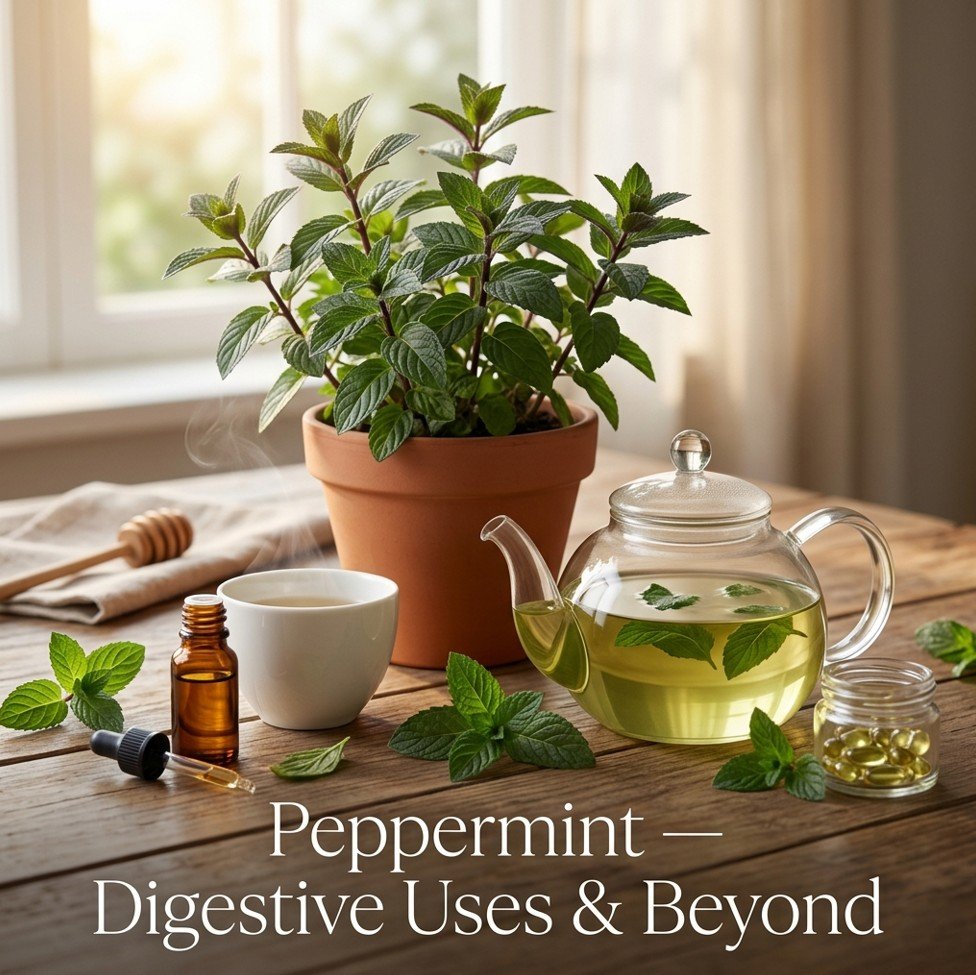
There are few herbs as widely used — and as widely misunderstood — as peppermint. Most people know it as a pleasant tea or a flavour in toothpaste. But in European herbal medicine, peppermint is a serious plant with a specific set of actions: it relaxes smooth muscle, relieves trapped gas, eases tension headaches, and helps clear respiratory passages.
However, peppermint’s strength is also its limitation. The same menthol that relaxes the intestines can relax the lower oesophageal sphincter, worsening heartburn in people with reflux. Peppermint oil is potent medicine, not a harmless flavouring.
This profile covers Mentha × piperita: its botanical identity, traditional European uses, modern research (including the strong evidence for IBS), practical preparation methods, and essential safety warnings.
What Is Peppermint?
Scientific name: Mentha × piperita (a natural hybrid of watermint M. aquatica and spearmint M. spicata)
Common names: Peppermint, menthe poivrée (French), Pfefferminze (German), mięta pieprzowa (Polish), pepparmynta (Swedish)
Appearance:
- Perennial herb, 30–90 cm tall, spreading aggressively via runners
- Stems: square (mint family), reddish‑purple, hairless or slightly hairy
- Leaves: opposite, 4–9 cm long, oval to lanceolate, serrated margins, pointed tips, dark green sometimes with purple veins
- Odour: intense, sharp, minty — much stronger than spearmint — due to high menthol content (40–50%)
- Taste: cooling, pungent, followed by a sharp, minty aftertaste
- Flowers: small, purple to pink, in terminal spikes (summer)
- Roots: shallow, spreading rhizomes
Habitat: Native to Europe (first described in England in the 17th century as a hybrid). Now cultivated worldwide. Grows in damp soils, riverbanks, gardens. Can be invasive.
Parts used: Leaves and flowering tops (aerial parts). The essential oil is extracted by steam distillation.
Distinction from spearmint: Spearmint (Mentha spicata) has lower menthol content (less than 1%) and a sweeter, milder flavour. It is used more in cooking (mint sauce, juleps). Peppermint has much higher menthol, making it more potent medicinally. Spearmint is not a substitute for peppermint in therapeutic uses.
Why “pepper” mint? The name refers to the sharp, pungent, “peppery” quality of the oil, compared to the milder spearmint.
Traditional Uses in European Herbalism
Peppermint is a relatively recent addition to European herbalism compared to ancient herbs like chamomile or nettle. It was first described as a distinct plant in 1696 in England. However, once recognised, it quickly became a staple.
Traditional European uses:
| Use | Traditional preparation | Regions |
|---|---|---|
| Digestive discomfort (bloating, gas, cramping) | Peppermint tea after meals | Throughout Europe |
| Irritable bowel syndrome (IBS) symptoms | Peppermint oil capsules (enteric‑coated) | Germany, Britain |
| Nausea and travel sickness | Peppermint tea or sniffing peppermint oil | France, Germany |
| Tension headaches | Peppermint oil applied to temples (diluted) | Germany, Austria |
| Respiratory congestion (colds, coughs) | Peppermint tea, steam inhalation | Britain, Scandinavia |
| Nervous tension and mild anxiety | Peppermint tea (less common — mainly digestive) | Various |
Historical note: Peppermint was included in the London Pharmacopoeia in 1721. By the 19th century, it was a standard household remedy across Europe and North America.
Important distinction: Traditional use focuses on tea for mild digestive issues and external oil for headaches. The use of enteric‑coated peppermint oil capsules for IBS is a modern development (20th century), based on clinical research.
What Modern Research Says
Peppermint is one of the most studied medicinal herbs. The evidence is strong for some uses (IBS, tension headaches) and weaker for others.
What has strong to moderate evidence:
1. Irritable bowel syndrome (IBS) — peppermint oil capsules
Multiple systematic reviews and meta‑analyses have concluded that enteric‑coated peppermint oil capsules significantly reduce abdominal pain, bloating, and global IBS symptoms compared to placebo. A 2019 meta‑analysis (12 trials, 835 patients) found peppermint oil to be superior to placebo for abdominal pain and overall symptom improvement. The effect size is moderate to large. Important: This applies to enteric‑coated capsules, not tea.
2. Tension headaches (topical peppermint oil)
Several clinical trials have found that applying a 10% peppermint oil solution (diluted in a carrier oil) to the forehead and temples reduces tension headache pain within 15–30 minutes. A 2016 study found it as effective as 1000 mg paracetamol (acetaminophen). The cooling sensation from menthol is thought to activate pain‑inhibiting receptors (TRPM8).
3. Digestive discomfort (tea)
Traditional use is extensive. Human studies are limited, but laboratory studies confirm antispasmodic effects on intestinal smooth muscle. Peppermint tea is reasonable for mild, occasional bloating and gas.
4. Nausea (post‑operative, motion sickness)
Several studies have examined inhaled peppermint oil for post‑operative nausea. A 2020 systematic review found that peppermint oil inhalation reduced nausea severity compared to placebo. Evidence for motion sickness is weaker.
What has limited or inconclusive evidence:
- Respiratory congestion: Traditional use is strong, but modern studies are lacking. Peppermint tea and steam inhalation are reasonable supportive measures.
- Antimicrobial activity: Laboratory studies show peppermint oil inhibits bacteria (including H. pylori) and fungi. No high‑quality human studies.
- Cognitive performance: Some studies suggest peppermint aroma improves alertness and memory, but evidence is weak.
What research does NOT show:
- Peppermint tea does not treat IBS (only enteric‑coated capsules have evidence).
- Peppermint does not cure gastrointestinal diseases (e.g., Crohn’s, ulcerative colitis).
- Peppermint oil is not safe for internal use in children (risk of choking, laryngospasm).
Main Benefits and Practical Uses
Based on traditional European practice and available evidence, peppermint is most useful for:
| Use | Traditional support | Evidence strength | Best preparation |
|---|---|---|---|
| Mild bloating and gas (occasional) | Strong | Weak‑to‑moderate (tea) | Tea: 1–2 cups after meals |
| IBS (abdominal pain, bloating) | Moderate (modern) | Strong (capsules) | Enteric‑coated capsules — medical guidance |
| Tension headaches | Moderate | Strong (topical oil) | 10% peppermint oil in carrier oil, applied to temples |
| Nausea (post‑operative, motion sickness) | Moderate | Moderate (inhalation) | Peppermint oil on a tissue, inhaled |
| Respiratory congestion | Strong | Weak | Tea or steam inhalation (few drops oil in hot water) |
What peppermint is NOT for:
- GERD or heartburn (may worsen)
- Gallstones or gallbladder disease (may stimulate gallbladder contraction — risk of pain)
- Severe IBS with diarrhoea (use with caution — may worsen diarrhoea in some)
- Infants or young children (risk of laryngospasm from oil; tea is low risk but consult doctor)
How to Prepare Peppermint
Peppermint tea (infusion) — for mild digestive support
Fresh peppermint tea (best flavour):
- 5–10 fresh peppermint leaves (about 2–3 tablespoons, loosely packed) per cup (250 ml)
- Gently crush leaves to release oils
- Pour boiling water over leaves
- Cover and steep for 5–8 minutes (longer becomes bitter)
- Strain and drink
Dried peppermint tea:
- 1–2 teaspoons (1–2 grams) dried peppermint leaves per cup
- Pour boiling water, steep 5–10 minutes, strain
Dosage: 2–3 cups daily for short‑term use (1–2 weeks).
Peppermint and chamomile blend: Mix equal parts for a gentler digestive tea.
Peppermint tincture
- Commercial tinctures (1:5, 40–50% alcohol) available
- Typical dose: 1–3 ml (20–60 drops) in water after meals
- Less common than tea — alcohol extraction extracts different compounds
Peppermint oil (external use only unless enteric‑coated capsules)
For tension headaches (topical):
- Dilute 1 drop of 100% peppermint essential oil in 10 drops of carrier oil (coconut, almond, jojoba) — this gives approximately 10% concentration
- Apply a small amount to the temples, forehead, and back of neck
- Avoid contact with eyes
- Wash hands after application
- Repeat every 30–60 minutes as needed
For respiratory congestion (steam inhalation):
- Add 2–3 drops of peppermint essential oil to a bowl of hot (not boiling) water
- Lean over the bowl with a towel over your head
- Inhale steam for 5–10 minutes
- Keep eyes closed
For nausea (inhalation):
- Put 1–2 drops of peppermint oil on a tissue or cotton ball
- Inhale gently as needed
Enteric‑coated peppermint oil capsules (for IBS)
- Available over the counter in pharmacies
- Standard dose: 1–2 capsules (0.2–0.4 ml oil each), 2–3 times daily before meals
- Enteric coating prevents the oil from releasing in the stomach (which can cause heartburn)
- Do not crush or chew capsules — this defeats the enteric coating and can cause burning sensation
- Always follow product instructions
- Important: Consult a doctor before using for suspected IBS — diagnosis is required
What to avoid:
- Do not ingest undiluted peppermint essential oil — toxic, can cause severe burning, liver damage, and breathing difficulties
- Do not give peppermint oil to children under 6 years (risk of laryngospasm, choking)
- Do not apply undiluted oil to skin — causes burning and irritation
- Do not use peppermint oil near eyes or mucous membranes
Best Season to Harvest or Buy It
Harvest season (if growing):
- Peppermint grows vigorously from late spring to autumn
- Best harvest time: just before flowering (mid‑summer, June–July) when menthol content is highest
- Harvest on a dry morning after dew has evaporated
- Cut stems 10–15 cm from the ground, leaving enough for regrowth
- You can get 2–3 harvests per season
How to dry:
- Tie stems in small bundles and hang upside down in a warm, airy, shaded location
- Or strip leaves and spread on a drying screen
- Drying takes 3–7 days
- Leaves are ready when they crumble easily
Storage:
- Store dried leaves in airtight glass jars away from light and heat
- Properly stored, peppermint retains good quality for 12–18 months
- After a year, flavour and menthol content decline
Buying advice:
- Look for organic certification
- Dried leaves should be dark green, not brown or yellow
- Strong, sharp minty aroma indicates freshness
- Avoid tea bags (often contain dust and low‑grade material)
Fresh vs dried:
- Fresh leaves have superior flavour and higher volatile oil content
- Dried leaves are more convenient and still effective
- For tea, fresh is best. For long‑term storage, dried is fine.
Safety, Side Effects, and Interactions
This article is for educational purposes only and does not replace medical advice, diagnosis, or treatment. Persistent, severe, or unclear symptoms should be discussed with a qualified healthcare professional.
General safety:
- Peppermint tea is very safe for most people in normal amounts (2–3 cups daily)
- Peppermint oil is safe for external use (diluted) and in enteric‑coated capsules (under guidance) but toxic undiluted
- Peppermint oil capsules (enteric‑coated) can cause side effects (see below)
Who should be cautious or avoid peppermint:
1. People with GERD (gastroesophageal reflux disease), hiatus hernia, or heartburn
Peppermint relaxes the lower oesophageal sphincter, allowing stomach acid to reflux into the oesophagus. This can worsen heartburn. Avoid peppermint oil capsules. Tea may also be problematic for sensitive individuals. Test with a small amount.
2. People with gallstones or gallbladder disease
Peppermint stimulates gallbladder contraction. In people with gallstones, this can cause pain (biliary colic). Avoid concentrated forms (oil, capsules). Tea in small amounts may be safe but consult a doctor.
3. People taking certain medications
Peppermint oil inhibits the liver enzyme CYP3A4. This may increase levels of certain drugs (e.g., cyclosporine, some statins, calcium channel blockers). Tea is unlikely to cause significant interaction, but inform your doctor.
4. Children under 6 years
Peppermint oil is contraindicated due to risk of laryngospasm (spasm of the vocal cords) and choking. Peppermint tea in small, diluted amounts (½ cup) may be safe for children over 2 years, but consult a paediatrician.
5. Pregnancy and breastfeeding
Peppermint tea in moderate amounts (1–2 cups daily) is generally considered safe. Peppermint oil capsules and undiluted oil should be avoided. Some herbalists suggest high doses of peppermint tea may affect milk supply (theoretical — weak evidence). Consult a doctor.
6. People with severe liver disease
Peppermint oil is metabolised by the liver. In severe liver disease, avoid concentrated forms. Tea is likely safe.
Common side effects:
| Preparation | Side effects |
|---|---|
| Peppermint tea | Very rare. Mild heartburn in sensitive individuals. |
| Enteric‑coated capsules | Heartburn (if coating fails), anal burning (from unabsorbed oil), nausea, headache. Usually mild. |
| Topical oil | Skin irritation, burning if undiluted. |
Drug interactions summary:
| Medication class | Interaction risk | Recommendation |
|---|---|---|
| CYP3A4 substrates (cyclosporine, statins, calcium channel blockers, some benzodiazepines) | Low‑to‑moderate (oil only) | Tea safe; oil capsules may increase drug levels — consult doctor |
| Antacids | Low | Enteric‑coated capsules may dissolve prematurely if taken with antacids — separate by 2 hours |
| Warfarin | No known interaction | Safe |
Red flags — when to stop peppermint and see a doctor:
- Worsening of heartburn or indigestion
- Abdominal pain that is severe or persistent
- Signs of allergic reaction (hives, difficulty breathing — rare)
- Burning sensation in mouth or throat (possible reaction or undiluted oil exposure)
FAQ
Is peppermint tea the same as peppermint oil?
No. Tea is a water infusion of the leaves, containing low concentrations of menthol and other compounds. Peppermint oil is highly concentrated (40–50% menthol) and is potent medicine. Tea is safe for most people; undiluted oil is toxic if ingested.
Can peppermint tea help with IBS?
Tea may help mild symptoms, but the evidence for IBS is based on enteric‑coated peppermint oil capsules. Tea is much weaker. If you have diagnosed IBS, discuss peppermint oil capsules with your doctor.
Does peppermint interact with blood pressure medication?
Peppermint tea is unlikely to interact. Peppermint oil capsules may inhibit CYP3A4, which metabolises some calcium channel blockers (e.g., nifedipine, amlodipine). This could increase drug levels. Consult your doctor if you take these medications.
Can I drink peppermint tea every day?
For most healthy adults, 2–3 cups daily for short periods (2–4 weeks) is safe. Long‑term daily use has not been well studied. If you have no GERD symptoms, occasional daily use is likely fine. Rotate with other herbs (chamomile, lemon balm).
Is peppermint safe for children?
Peppermint tea in small amounts (½ cup, diluted) is traditionally used for children over 2 years with digestive discomfort. Never give peppermint oil to children under 6 years — risk of laryngospasm. Always consult a paediatrician.
Does peppermint oil repel insects?
Peppermint oil has some insect repellent properties (mosquitoes, ants, spiders). However, it is less effective than DEET or picaridin. It can be used in homemade sprays diluted with water (10–15 drops per 100 ml).
Can I use peppermint oil for a migraine?
Peppermint oil has evidence for tension headaches, not migraines. Migraine is a different neurological condition. Some people find cooling relief, but it is not a substitute for migraine medication.
Key Takeaways
- Peppermint (Mentha × piperita) is a natural hybrid with high menthol content, making it more potent than spearmint.
- Strong evidence supports enteric‑coated peppermint oil capsules for IBS (abdominal pain, bloating) and topical peppermint oil for tension headaches.
- Peppermint tea is a mild, safe remedy for occasional bloating and gas — but much weaker than oil.
- Avoid peppermint if you have GERD (heartburn), gallstones, or are taking certain CYP3A4‑metabolised medications (consult doctor).
- Undiluted peppermint oil is toxic if ingested. Never give peppermint oil to young children (risk of laryngospasm).
- This is not medical advice. Persistent digestive or headache symptoms require medical evaluation.
Internal Links Used
- Herbal support for bloating and heavy meals — placed in digestive section
- Best European herbs for digestion support — placed in traditional uses section
- Herbs traditionally used for better sleep support — placed in comparison
- Lemon balm: calming uses and how to brew it properly — placed in mint family comparison
Sources
- European Medicines Agency (EMA) – Community herbal monograph on Mentha × piperita L., folium. (2020).
- World Health Organization (WHO) – Monographs on selected medicinal plants, volume 4: Mentha × piperita.
- German Commission E Monograph – Peppermint leaves (1986).
- Alammar, N., et al. (2019). Peppermint oil for irritable bowel syndrome: A meta‑analysis. Journal of Clinical Gastroenterology, 53(6), 439-448.
- Göbel, H., et al. (2016). Peppermint oil for tension headache. Neurologie und Rehabilitation, 22(2), 85-92.
- Hines, S., et al. (2020). Peppermint oil inhalation for post‑operative nausea. JBI Database of Systematic Reviews, 18(3), 568-597.
- National Center for Complementary and Integrative Health (NCCIH) – Peppermint oil.