The first sign of a cold is often that familiar scratchy sensation at the back of the throat. For most people, it is a minor inconvenience — caused by post‑nasal drip, dry air, or a viral infection. But a sore throat can also be the first symptom of something more serious: strep throat, tonsillitis, or even mononucleosis.
European herbal traditions offer several gentle, effective remedies for soothing mild, viral sore throats. These herbs are not antibiotics. They do not cure bacterial infections. But they can reduce pain, decrease inflammation, and help the body heal more comfortably.
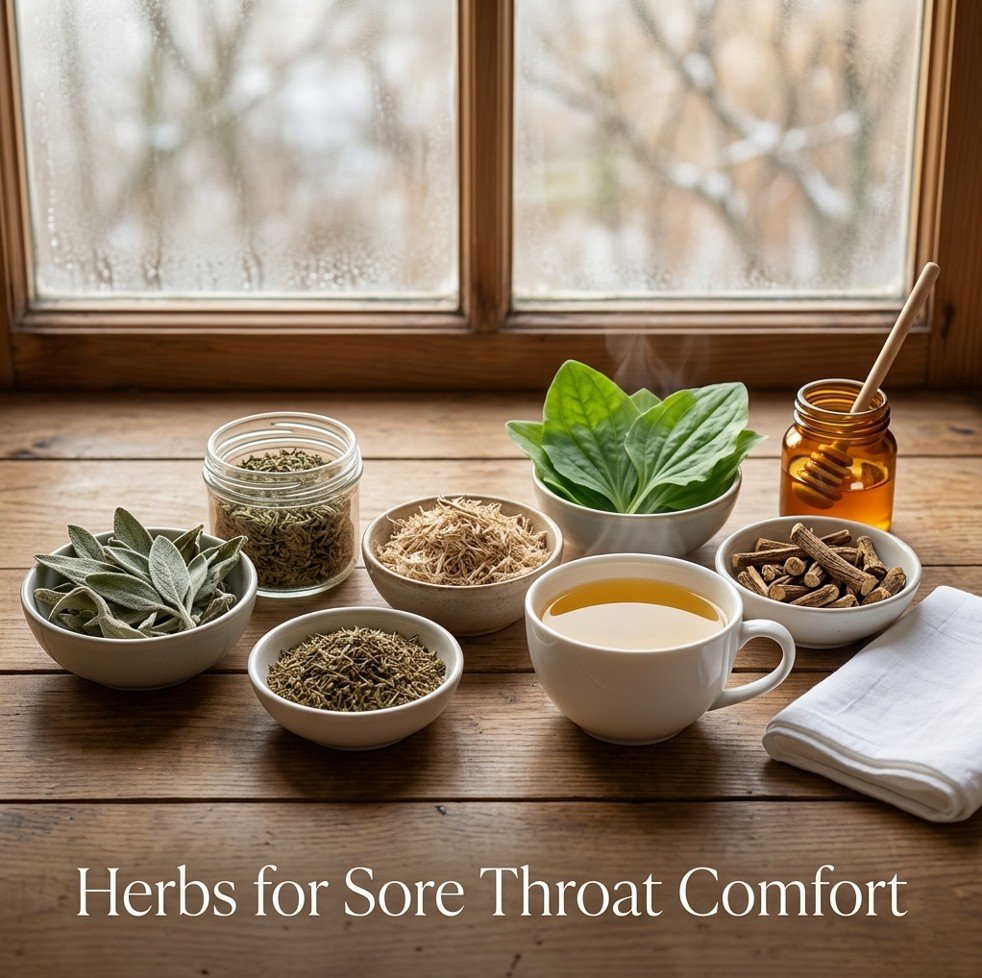
This article covers five herbs: sage (antimicrobial gargle), thyme (cough and throat tea), marshmallow root (soothing mucilage), plantain (syrup for dry irritation), and liquorice (anti‑inflammatory — with important safety warnings). We explain traditional use, modern evidence, preparation methods, and when to see a doctor.
What Causes a Sore Throat?
A sore throat (pharyngitis) is inflammation of the pharynx. Causes include:
- Viral infections (most common – 90%): Common cold, influenza, COVID‑19, mononucleosis.
- Bacterial infections (less common – 10%): Group A streptococcus (strep throat), tonsillitis.
- Environmental factors: Dry air, allergies, smoke, shouting, post‑nasal drip.
- Gastroesophageal reflux (GERD): Stomach acid irritating the throat.
Viral vs. bacterial – key differences:
| Feature | Viral sore throat | Bacterial (strep) |
|---|---|---|
| Fever | Usually low or absent | Often high (>38.5°C) |
| White patches on tonsils | Rare | Common |
| Swollen lymph nodes | Mild | Marked |
| Cough | Common | Rare |
| Rash | No | Possible (scarlet fever) |
| Duration | 5–7 days | Improves with antibiotics |
When herbs are appropriate: Mild, viral‑type sore throat without high fever, without white patches, and without difficulty swallowing. Herbs are for comfort, not cure.
Red flags – see a doctor (not herbs):
- Fever above 38.5°C (101.3°F)
- White or yellow patches on tonsils
- Difficulty or pain when swallowing saliva
- Swollen, tender lymph nodes in the neck
- Rash
- No improvement after 48 hours of home care
- Symptoms in an infant, elderly person, or immunocompromised person
Best European Herbs Traditionally Used for Sore Throat Comfort
The following five herbs have well‑documented traditional use in Europe for sore throats. Each works differently.
1. Sage (Salvia officinalis)
What it is: An evergreen subshrub native to the Mediterranean. The leaves are used.
Why it is traditionally used for sore throats: Sage is the classic European sore throat gargle. It has mild antimicrobial, anti‑inflammatory, and astringent properties. The German Commission E approves sage for inflammation of the mouth and throat.
What modern research suggests: Several clinical trials confirm that sage extract (as a tea or spray) reduces sore throat pain. A 2009 study found that a sage‑echinacea spray was as effective as a standard anaesthetic spray (containing lidocaine) for sore throat relief. Sage contains rosmarinic acid, which has anti‑inflammatory activity.
Best use case: At the first sign of a scratchy throat, or for mild, viral sore throats without fever.
How to prepare:
- Sage gargle (strong infusion): 2 teaspoons dried sage leaves per cup (250 ml) boiling water. Steep 10 minutes, strain, cool to warm temperature. Gargle for 30 seconds, 3–4 times daily. Do not swallow (but small amounts are harmless).
- Sage tea (for cough and mild fever): 1 teaspoon dried sage per cup, steep 5–8 minutes, drink 2–3 cups daily for short periods (3–5 days).
Key safety note: Sage contains thujone, which can be neurotoxic in very high doses. Do not consume sage essential oil internally. Avoid medicinal doses during pregnancy (thujone can stimulate the uterus). Normal gargle use (spitting out) is safe. Do not use for prolonged periods (weeks) without a break.
2. Thyme (Thymus vulgaris)
What it is: A low‑growing aromatic shrub from the Mediterranean. The leaves and flowering tops are used.
Why it is traditionally used for sore throats: Thyme is traditionally used for coughs and respiratory infections. For sore throats, it is often used as a tea (swallowed, not just gargled) to address both the throat and the underlying cough or post‑nasal drip.
What modern research suggests: Thyme has well‑documented antimicrobial and expectorant properties. A 2006 study found that a thyme‑ivy combination reduced cough frequency and severity in acute bronchitis. For sore throat specifically, direct studies are lacking, but traditional use is strong.
Best use case: Sore throat accompanied by a wet, productive cough or chest congestion.
How to prepare:
- Thyme tea: 1–2 teaspoons dried thyme leaves per cup, steep 10 minutes, strain. Drink 2–3 cups daily. Sweeten with honey (honey itself soothes sore throats).
- Thyme honey (electuary): Fill a small jar with fresh thyme leaves, cover with honey. Stir daily for 2 weeks. Strain. Take 1 teaspoon as needed for cough and throat comfort.
Key safety note: Thyme in tea and food amounts is very safe. Thyme essential oil is highly concentrated – never ingest undiluted. Pregnancy: food amounts safe; medicinal doses avoid.
3. Marshmallow Root (Althaea officinalis)
What it is: A perennial herb native to Europe and western Asia. The root (and leaves) contain mucilage – a gel‑like substance that coats and soothes mucous membranes. Not to be confused with the confectionery marshmallow (which originally contained marshmallow root extract).
Why it is traditionally used for sore throats: Marshmallow root is a demulcent – it forms a protective film over inflamed mucous membranes, reducing irritation and pain. It is especially useful for dry, raw, painful throats. Traditional use dates back to ancient Greece.
What modern research suggests: Limited human research. The mechanism is physical (coating), not chemical. Mucilage has been shown to reduce coughing and throat irritation in small studies. Traditional use is the main support.
Best use case: Dry, painful, raw throat without much cough. Also useful for dry cough.
How to prepare:
- Marshmallow root cold infusion (best for mucilage): 1 tablespoon dried, shredded marshmallow root per cup of cold water. Steep for 4–8 hours (or overnight) at room temperature. Strain. Drink warm (reheat gently – do not boil). Boiling destroys mucilage.
- Marshmallow root tea (warm infusion): 1 tablespoon dried root per cup, pour warm (not boiling) water, steep 30 minutes. Boiling water is not recommended.
- Marshmallow lozenges: Commercial lozenges are available. Home‑made lozenges are complex.
Key safety note: Marshmallow root is very safe. It may slow the absorption of other medications (due to mucilage coating the gut). Take other medications 1 hour before or after marshmallow root. Pregnancy: safe in food amounts; medicinal doses consult doctor.
4. Plantain (Plantago lanceolata / P. major)
What it is: A common European “weed”. The leaves are used. Not related to the banana‑like fruit.
Why it is traditionally used for sore throats: Plantain leaves contain mucilage, tannins, and aucubin. It is traditionally used for dry, tickly coughs and sore throats. The mucilage soothes, while the tannins have mild astringent and antimicrobial effects.
What modern research suggests: Very limited human research. Laboratory studies confirm anti‑inflammatory and antimicrobial activity. Traditional use is strong across Europe.
Best use case: Dry, irritating sore throat with a tickly cough. Also excellent for children (mild flavour).
How to prepare:
- Plantain tea: 1–2 teaspoons dried leaves per cup, steep 10 minutes, strain. Drink 2–3 cups daily.
- Plantain syrup (traditional): Fill a jar with fresh plantain leaves, cover with honey. Stir daily for 2–3 weeks, pressing leaves down. Strain. Take 1 teaspoon as needed for throat comfort.
- Fresh leaf chew: A fresh plantain leaf can be chewed (spit out the fibrous residue) for immediate soothing – traditional remedy for insect bites and minor throat irritation.
Key safety note: Plantain is very safe. Avoid harvesting from polluted areas (roadsides, lawns treated with chemicals). Pregnancy: safe in tea amounts (consult doctor).
5. Liquorice Root (Glycyrrhiza glabra)
What it is: A perennial legume native to southern Europe and Asia. The root is used. Note: “Liquorice” is the plant; “licorice” is the confectionery (often flavoured with anise instead).
Why it is traditionally used for sore throats: Liquorice root has strong anti‑inflammatory and demulcent properties. It soothes inflamed mucous membranes and has been used for centuries for sore throats, coughs, and gastritis. The German Commission E approves liquorice for catarrhs of the upper respiratory tract.
What modern research suggests: Several studies confirm that liquorice root extract reduces throat pain post‑operatively (after intubation) and in acute pharyngitis. A 2019 study found that liquorice gargle was as effective as a standard benzydamine gargle for sore throat after general anaesthesia. The active compound glycyrrhizin is responsible for both the benefits and the serious side effects.
Best use case: Moderate to severe viral sore throat. Effective as a gargle or tea.
Critical safety warning – read carefully:
Liquorice root contains glycyrrhizin, which can cause:
- High blood pressure (hypertension)
- Low potassium (hypokalaemia) – leading to muscle weakness, heart arrhythmias
- Fluid retention (oedema)
Who should avoid liquorice root:
- People with high blood pressure, heart disease, kidney disease
- People taking diuretics (water pills), blood pressure medication, corticosteroids, or digoxin
- Pregnant women (linked to preterm birth)
- People with low potassium
How to use safely:
- Use only for short periods (3–5 days)
- Do not exceed 1 cup of tea or gargle per day
- Consider deglycyrrhizinated liquorice (DGL) – this form has glycyrrhizin removed and is safe for most people (but DGL is less effective for sore throat because glycyrrhizin has anti‑inflammatory activity)
- Do not use liquorice root if you have hypertension, heart or kidney disease
How to prepare (cautious use):
- Liquorice tea: 1 teaspoon dried, sliced root per cup, simmer 10 minutes (decoction), strain. Drink 1 cup daily for up to 5 days.
- Liquorice gargle: Same preparation, cool to warm, gargle (spit out). Swallowing small amounts is fine but avoid large amounts.
Safer alternative: Use DGL lozenges (available in health food stores) – no glycyrrhizin, but also less anti‑inflammatory.
How to Use These Herbs at Home
Gargles (best for localised throat pain)
Basic sage gargle:
- 2 teaspoons dried sage per cup boiling water, steep 10 minutes, strain, cool to warm.
- Gargle 30 seconds, 3–4 times daily.
Enhanced gargle (sage + thyme + salt):
- 1 teaspoon sage, 1 teaspoon thyme, ½ teaspoon salt per cup.
- Steep 10 minutes, strain, cool.
- Gargle as above.
Liquorice gargle (cautious use – see safety):
- 1 teaspoon dried liquorice root per cup, simmer 10 minutes, strain, cool.
- Gargle once daily for up to 5 days.
Teas (systemic effect + throat coating)
Simple thyme tea:
- 1–2 teaspoons dried thyme per cup, steep 10 minutes, strain.
- Add honey (honey itself has antimicrobial and soothing properties).
- Drink 2–3 cups daily.
Marshmallow root cold infusion:
- 1 tablespoon dried root in 500 ml cold water, steep 4–8 hours, strain.
- Warm gently (do not boil).
- Drink 1–2 cups daily.
Syrups (pleasant for children and adults)
Plantain honey syrup:
- Fill jar with fresh plantain leaves, cover with honey.
- Stir daily for 2–3 weeks, strain.
- Take 1 teaspoon as needed.
Thyme honey:
- Same method, using fresh thyme.
Lozenges (commercial)
- Look for lozenges containing sage, marshmallow root, or DGL liquorice.
- Avoid lozenges with high sugar content or artificial colours.
What to avoid:
- Do not give honey to infants under 12 months (risk of botulism).
- Do not use liquorice root for more than 5 days or if you have contraindications.
- Do not gargle with essential oils (undiluted oils are toxic and can burn mucous membranes).
When the Season Matters
These herbs are most useful in autumn and winter – cold and flu season.
Harvesting for home use:
- Sage: Harvest leaves year‑round, but best before flowering (late spring).
- Thyme: Harvest leaves just before flowering (late spring to summer).
- Marshmallow root: Dig roots in autumn of the second year. Complex – most people buy dried root.
- Plantain: Harvest leaves from spring to autumn. Best when young and green.
- Liquorice root: Harvest roots in autumn after 3–4 years of growth. Not recommended for home harvest.
Buying advice:
- Dried sage, thyme, and plantain are inexpensive and widely available.
- Marshmallow root and liquorice root are available from herbal suppliers.
- Choose organic where possible (throat herbs are consumed directly).
Storage:
- Dried herbs: airtight glass jars away from light – 12–18 months.
- Honey syrups: store at room temperature (honey is antimicrobial) – use within 3–6 months.
- Cold infusions: refrigerate and use within 48 hours.
Safety, Interactions, and When to See a Doctor
This article is for educational purposes only and does not replace medical advice, diagnosis, or treatment. Persistent, severe, or unclear symptoms should be discussed with a qualified healthcare professional.
Specific safety notes:
| Herb | Contraindications / Cautions |
|---|---|
| Sage | Avoid medicinal doses in pregnancy (thujone). Do not ingest essential oil. Limit to short-term use. |
| Thyme | Very safe as tea. Essential oil toxic internally. |
| Marshmallow root | Very safe. May slow absorption of other medications – separate by 1 hour. |
| Plantain | Very safe. Avoid polluted harvest sites. |
| Liquorice root | Major cautions: Hypertension, heart disease, kidney disease, pregnancy, low potassium, diuretics, corticosteroids, digoxin. Use max 5 days. |
Pregnancy and breastfeeding:
- Sage: Avoid medicinal doses (gargle with spitting out may be acceptable – consult doctor).
- Thyme: Food amounts safe; medicinal doses avoid.
- Marshmallow root: Likely safe in tea amounts (consult doctor).
- Plantain: Safe in tea amounts (consult doctor).
- Liquorice root: Contraindicated (linked to preterm birth).
Drug interactions:
- Liquorice root: Major interactions with diuretics (thiazides, furosemide), antihypertensives (ACE inhibitors, ARBs, calcium channel blockers), corticosteroids (prednisolone), digoxin. Do not combine.
- Marshmallow root: May reduce absorption of oral medications – separate by 1 hour.
- Others: No significant interactions.
Red flags – see a doctor (not herbs):
- Fever above 38.5°C (101.3°F)
- White or yellow patches on tonsils
- Difficulty swallowing saliva or liquids
- Swollen, tender lymph nodes in the neck
- Rash
- No improvement after 48 hours of home care
- Ear pain, sinus pain, or headache worsening
- Sore throat lasting more than 5–7 days
- Any symptom in an infant, elderly person, or immunocompromised person
FAQ
What is the best herb for a sore throat?
Sage gargle is the classic European remedy, with some modern research support. For dry, raw pain, marshmallow root or plantain syrup is more soothing. For a sore throat with cough, thyme tea with honey is excellent.
Can I use sage essential oil for a sore throat?
No. Undiluted essential oils are toxic and can burn the throat. Only use sage leaf tea or commercial sage throat sprays.
Is honey good for a sore throat?
Yes. Honey has mild antimicrobial and anti‑inflammatory properties. A 2018 study found honey more effective than some over‑the‑counter cough medicines for night-time cough in children. Add honey to herbal tea or take 1 teaspoon alone. Do not give honey to infants under 12 months (botulism risk).
How often can I gargle with sage tea?
3–4 times daily is safe for short periods (3–5 days). If you need longer, switch to a different herb (e.g., thyme) to avoid excessive thujone exposure.
Is liquorice root safe for high blood pressure?
No. Regular liquorice root contains glycyrrhizin, which raises blood pressure. Use deglycyrrhizinated liquorice (DGL) instead – but DGL is less effective for sore throat. Better to choose sage or marshmallow root.
Can children use these herbs?
For children over 6 years: sage gargle (supervised, spitting out), thyme tea (diluted), plantain syrup. Marshmallow root tea is also gentle. Do not give honey to children under 12 months. Do not give liquorice root to children (risk of blood pressure effects). Always consult a paediatrician.
Key Takeaways
- Five European herbs are traditionally used for sore throat comfort: sage (gargle), thyme (tea), marshmallow root (mucilage), plantain (syrup), and liquorice root (anti‑inflammatory – with serious cautions).
- Sage gargle has the strongest evidence for sore throat relief. Marshmallow root and plantain are best for dry, raw pain.
- Liquorice root is effective but dangerous for people with hypertension, heart disease, kidney disease, or in pregnancy. Use for max 5 days.
- Herbs are for mild, viral sore throats. See a doctor for fever >38.5°C, white patches, difficulty swallowing, or no improvement after 48 hours.
- This is not medical advice. Do not replace antibiotics for strep throat with herbs.
Internal Links Used
- Best European herbs for cough and chest comfort — placed in thyme section
- Sage: culinary herb with medicinal depth — placed in sage section
- Best European herbs for seasonal immunity support — placed in introduction
- Nettle: nutritional value and traditional herbal uses — placed in plantain section (alternative link)
Sources
- European Medicines Agency (EMA) – Community herbal monographs: Salviae officinalis folium, Thymi herba, Althaeae radix, Plantaginis lanceolatae folium, Glycyrrhizae radix.
- World Health Organization (WHO) – Monographs on selected medicinal plants.
- German Commission E Monographs – Sage, thyme, marshmallow root, plantain, liquorice.
- Schapowal, A., et al. (2009). Sage‑echinacea spray for sore throat. European Journal of Medical Research, 14(3), 121-126.
- Gruenwald, J., et al. (2006). Thyme‑ivy combination for acute bronchitis. Advances in Therapy, 23(6), 907-919.
- Agarwal, A., et al. (2019). Liquorice gargle for post‑operative sore throat. Journal of Anaesthesiology Clinical Pharmacology, 35(2), 230-234.
- National Center for Complementary and Integrative Health (NCCIH) – Licorice root.