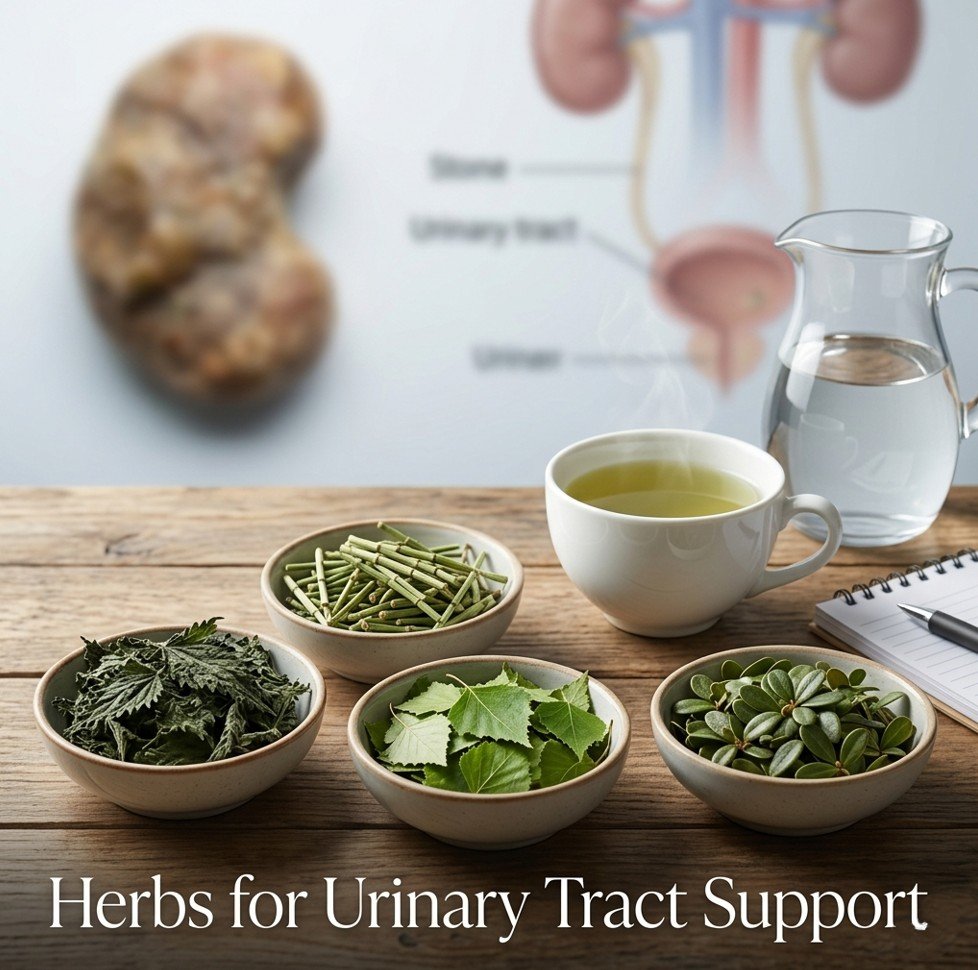
The urinary tract – kidneys, ureters, bladder, and urethra – is designed to eliminate waste while keeping bacteria out. But sometimes bacteria (most commonly E. coli) travel up the urethra and cause cystitis (bladder infection). Symptoms include burning on urination, frequent urges, cloudy or strong‑smelling urine, and lower abdominal pressure.
In uncomplicated, mild cases, some people turn to herbal support – either to prevent recurrence or to complement medical treatment. European herbal traditions offer several plants that act as mild diuretics (increasing urine flow) or, in the case of uva‑ursi, have traditional antiseptic properties.
But herbs are not antibiotics. A confirmed UTI, especially with fever or flank pain, requires medical treatment. This article is for those seeking supportive, preventive, or very mild symptomatic comfort – not for treating active, severe infections.
This guide covers four herbs: nettle leaf (mild diuretic), horsetail (diuretic, tissue healing), birch leaf (diuretic, anti‑inflammatory), and uva‑ursi (bearberry – stronger antimicrobial action, but with significant safety warnings).
What Causes Urinary Tract Discomfort?
Common causes:
- Bacterial cystitis (UTI): E. coli accounts for 80–90% of uncomplicated UTIs. Symptoms: burning, frequency, urgency, cloudy urine.
- Interstitial cystitis (painful bladder syndrome): Chronic inflammation without infection. Herbal support may help, but medical diagnosis is essential.
- Kidney stones: Can cause pain, blood in urine, and sometimes secondary infection.
- Prostatitis (men): Inflammation of the prostate.
- Dehydration: Concentrated urine can irritate the bladder.
- Irritants: Caffeine, alcohol, spicy foods, artificial sweeteners.
When is it a UTI? A urine dipstick test (available at pharmacies) can detect nitrites and leukocytes. If positive, see a doctor.
Red flags – see a doctor immediately (do not use herbs):
- Fever (above 38°C / 100.4°F)
- Flank pain (lower back, sides) – possible kidney infection
- Nausea, vomiting
- Blood in urine (haematuria) – visible or on dipstick
- Symptoms in a man (UTIs in men are often complicated)
- Symptoms in a pregnant woman
- Symptoms in a child or elderly person
- Recurrent UTIs (more than 3 per year) – needs investigation
- No improvement after 48 hours of self‑care (if mild)
What herbs can and cannot do:
- Can: Increase urine flow (mild diuretics), soothe the urinary tract lining, and (in the case of uva‑ursi) provide mild antimicrobial activity against E. coli in the bladder – but only under specific conditions (alkaline urine).
- Cannot: Cure an established UTI, replace antibiotics for kidney infection, or treat sexually transmitted infections.
Best European Herbs Traditionally Used for Urinary Tract Support
The following four herbs have well‑documented traditional use in Europe. Each has a different primary action and safety profile.
1. Nettle Leaf (Urtica dioica) – Mild Diuretic
What it is: A common European herb (see full profile in Article 6). The leaf, not the root.
Why it is traditionally used for urinary support: Nettle leaf is a mild diuretic – it increases urine output, helping to “flush” the urinary tract. It has been used in European folk medicine for “water retention”, cystitis (as a supportive measure), and to prevent kidney stones (by increasing urine volume). The German Commission E approves nettle leaf for irrigation therapy in inflammatory diseases of the urinary tract.
What modern research suggests: Several small studies confirm that nettle leaf has a mild diuretic effect (increases urine volume by 10–20%). It is not a treatment for infection but may help flush out bacteria in very mild, early cases or as a preventive. It also contains anti‑inflammatory flavonoids.
Best use case: As a supportive measure for mild urinary discomfort, or as a preventive for people prone to recurrent UTIs (alongside medical advice). Also for general urinary tract health.
How to prepare:
- Nettle leaf tea: 1–2 teaspoons dried leaves per cup, steep 10–15 minutes. Drink 2–3 cups daily.
- Nettle leaf tincture: 2–4 ml (40–80 drops) in water, up to 3 times daily.
Safety: Very safe. High in vitamin K – caution if on warfarin (see Article 6). Pregnancy: tea amounts likely safe (consult doctor).
2. Horsetail (Equisetum arvense) – Diuretic and Tissue Healing
What it is: A primitive, non‑flowering plant – a living fossil. The aerial (above‑ground) parts are used. Grows in damp places across Europe. Contains high levels of silica and flavonoids.
Why it is traditionally used for urinary support: Horsetail has a long history as a diuretic and “urinary tonic”. It has been used for cystitis, urethritis, and to prevent kidney stones. The silica content is thought to have a healing effect on connective tissue, including the urinary tract lining.
What modern research suggests: Limited human research. A 2015 study found that horsetail extract increased urine output in animals. Some small studies suggest it may be as effective as standard diuretics for mild oedema. For urinary tract infections, traditional use is the main support. Horsetail is also used externally for wounds (silica promotes healing).
Best use case: Mild urinary discomfort, or as a supportive diuretic for “flushing”. Also for people with recurrent UTIs who want to increase urine flow.
How to prepare:
- Horsetail tea: 1–2 teaspoons dried herb per cup, steep 10–15 minutes. Drink 2–3 cups daily.
- Horsetail tincture: 2–4 ml (40–80 drops) in water, up to 3 times daily.
Critical safety note: Horsetail contains thiaminase, an enzyme that breaks down vitamin B1 (thiamine). Do not use horsetail for prolonged periods (weeks to months) without a break – it can cause thiamine deficiency, leading to neurological problems. Use for 1–2 weeks at a time, then take a break. Cooking destroys thiaminase, but tea is not cooked (just steeped). Pregnant or breastfeeding: avoid (insufficient safety data). Also avoid if you have kidney disease (diuretic effect may be inappropriate).
3. Birch Leaf (Betula pendula / B. pubescens) – Diuretic and Anti‑inflammatory
What it is: Leaves of the silver birch or downy birch, common throughout Europe. The leaves are harvested in spring.
Why it is traditionally used for urinary support: Birch leaf has a strong tradition in Central and Eastern Europe as a diuretic (“flushing” herb) for cystitis, kidney stones, and rheumatism (to eliminate uric acid). It is often combined with nettle or horsetail. The German Commission E approves birch leaf for irrigation therapy in inflammatory diseases of the urinary tract.
What modern research suggests: Laboratory studies confirm that birch leaf extracts have diuretic and anti‑inflammatory activity. Human studies are limited, but traditional use is extensive.
Best use case: Mild urinary discomfort, prevention of kidney stones, or as a general urinary tract tonic.
How to prepare:
- Birch leaf tea: 1–2 teaspoons dried leaves per cup, steep 10–15 minutes. Drink 2–3 cups daily.
- Birch leaf tincture: 2–4 ml (40–80 drops) in water, up to 3 times daily.
Safety: Birch leaf is generally safe. Rare allergic reactions (pollen cross‑reactivity with birch pollen allergy – people with birch pollen allergy may react to the leaves). Pregnancy: avoid (insufficient safety data). Do not use if you have kidney disease without medical supervision.
4. Uva‑Ursi (Bearberry – Arctostaphylos uva-ursi) – Traditional Urinary Antiseptic
What it is: A small, evergreen shrub that grows in mountainous and northern regions of Europe (Alps, Scandinavia, Carpathians, Balkans). The leaves are used. The name uva‑ursi means “grape of the bear” – bears eat the berries.
Why it is traditionally used for urinary support: Uva‑ursi is the most potent European herb for urinary tract infections – but also the most dangerous. It contains arbutin, which is converted in the body to hydroquinone – a compound with antiseptic (antibacterial) activity against E. coli. It has been used for centuries for cystitis and urethritis.
What modern research suggests: Several clinical trials have examined uva‑ursi for uncomplicated lower UTIs. A 2012 systematic review found that uva‑ursi may reduce symptoms and recurrence, but the quality of studies is low. The key limitation: hydroquinone is only active in alkaline urine (pH > 7). Most people have acidic urine (pH 5–6). For uva‑ursi to work, the urine must be alkalinised – often by taking sodium bicarbonate or avoiding acidic foods. This is complex and not recommended for self‑treatment.
Best use case (traditional, with medical guidance): For uncomplicated, mild, early‑stage UTIs in adults, when antibiotics are not immediately necessary. Never use without medical supervision – self‑diagnosis of UTI is unreliable, and delaying antibiotics can lead to kidney infection.
How to prepare (traditional, not recommended for self‑use):
- Uva‑ursi tea (cold infusion – to reduce tannin extraction): 1 teaspoon dried leaves per cup of cold water, steep for 12–24 hours (cold water extracts arbutin but fewer tannins). Warm gently before drinking.
- Uva‑ursi tincture: 1–2 ml (20–40 drops) in water, up to 3 times daily for short periods.
Critical safety warnings – read carefully:
Uva‑ursi contains hydroquinone, which is:
- Hepatotoxic (liver‑damaging) in high doses or with prolonged use
- Carcinogenic in animal studies – long‑term use is not recommended
- Nephrotoxic (kidney‑damaging) – do not use if you have kidney disease
Who should absolutely avoid uva‑ursi:
- Pregnant or breastfeeding women (hydroquinone is toxic to the fetus/infant)
- Children under 12 years
- People with liver or kidney disease
- People with gastritis or stomach ulcers (tannins irritate)
- People taking medications that affect the liver or kidneys
Safe use guidelines (if used under medical supervision):
- Use only for 5–7 days maximum
- Do not repeat more than 5 times per year
- Do not use for prevention – only for acute symptoms
- Always consult a doctor before using
Safer alternatives: For mild urinary support, use nettle, horsetail, or birch leaf – they have no significant toxicity. Uva‑ursi should be a last resort, not a first choice.
How to Use These Herbs at Home (Mild Support Only)
For general urinary tract health (mild diuretic support)
Blend: Nettle leaf + birch leaf (equal parts) – gentle, safe for short periods.
Preparation: Tea – 1 teaspoon of each per 500 ml water, steep 10–15 minutes. Drink 2 cups daily for 5–7 days.
For very mild, early urinary discomfort (if you are certain it is not a full UTI)
Option 1 (safest): Nettle leaf tea alone – 2–3 cups daily. Increase water intake.
Option 2: Horsetail tea – 2 cups daily for max 7 days. Then take a break.
Option 3 (with medical guidance only): Uva‑ursi – as directed by a doctor.
What NOT to do:
- Do not use uva‑ursi without medical supervision
- Do not use horsetail for more than 7–10 days without a break
- Do not use any urinary herb if you have fever, flank pain, or blood in urine – see a doctor immediately
- Do not delay antibiotics for a confirmed UTI – kidney infections are serious
General supportive measures (non‑herbal, important):
- Drink plenty of water (2–3 litres daily) – this is the most effective “flushing” method
- Cranberry (not European, but widely used) – may help prevent recurrent UTIs by preventing bacterial adhesion. Evidence is mixed but generally safe.
- Avoid bladder irritants: caffeine, alcohol, spicy foods, artificial sweeteners
- Urinate after intercourse – reduces bacterial entry
- Wipe front to back (women)
When the Season Matters
Harvesting:
- Nettle leaf: Harvest young leaves in spring (April–May) for best quality. Dries well.
- Horsetail: Harvest aerial parts in late spring (May–June) when silica content is highest. Dries well.
- Birch leaf: Harvest young leaves in spring (April–May). Dries well.
- Uva‑ursi: Harvest leaves in spring or autumn. Not recommended for home harvest – buy from reputable suppliers.
Buying advice:
- All four herbs are available dried from European herbal suppliers.
- Uva‑ursi is less common – look for organic, European‑sourced.
- For urinary support, choose organic where possible (contaminants concentrate in urine).
Storage: Store dried herbs in airtight glass jars away from light. Shelf life: leaves 12–18 months.
Safety, Interactions, and When to See a Doctor
This article is for educational purposes only and does not replace medical advice, diagnosis, or treatment. Persistent, severe, or unclear symptoms should be discussed with a qualified healthcare professional.
Specific safety notes:
| Herb | Contraindications / Cautions |
|---|---|
| Nettle leaf | Very safe. Caution with warfarin (vitamin K). Pregnancy: tea amounts likely safe. |
| Horsetail | Avoid prolonged use (>7–10 days) – thiaminase can cause vitamin B1 deficiency. Avoid in pregnancy/breastfeeding, kidney disease. |
| Birch leaf | Generally safe. Possible allergy if allergic to birch pollen. Avoid in pregnancy. |
| Uva‑ursi | Major cautions: Pregnancy, breastfeeding, children, liver disease, kidney disease, gastritis. Use max 5–7 days, no more than 5 times/year. Medical supervision essential. |
Pregnancy and breastfeeding:
- Nettle leaf: Tea amounts likely safe (consult doctor)
- Horsetail: Avoid
- Birch leaf: Avoid
- Uva‑ursi: Contraindicated
Drug interactions:
- Nettle leaf: Potential interaction with warfarin (high vitamin K). Also with diuretics (additive effect) and lithium (theoretical).
- Horsetail: May interact with diuretics (additive effect). Also with lithium (theoretical).
- Birch leaf: May interact with diuretics (additive effect).
- Uva‑ursi: May interact with medications that affect liver or kidneys. Also with acidifying agents (e.g., vitamin C, cranberry) – these make urine more acidic, reducing uva‑ursi’s effectiveness.
Red flags – see a doctor (not herbs):
- Fever (above 38°C / 100.4°F)
- Flank pain (lower back, sides)
- Nausea, vomiting
- Blood in urine
- Symptoms lasting more than 48 hours despite self‑care
- Symptoms in a man, child, pregnant woman, or elderly person
- Recurrent UTIs (more than 3 per year)
FAQ
Can I use these herbs to treat a UTI without antibiotics?
No. If you have a confirmed UTI (positive dipstick, symptoms), you need medical evaluation. Mild, early, uncomplicated cystitis in a healthy non‑pregnant woman might resolve on its own, but delaying antibiotics risks kidney infection. Herbs like nettle and horsetail are supportive, not curative. Uva‑ursi has some antimicrobial activity but requires medical supervision and alkaline urine – not for self‑treatment.
Is uva‑ursi safe for recurrent UTIs?
No. Uva‑ursi is for acute episodes only (5–7 days), not for prevention. Recurrent UTIs need medical investigation – there may be an underlying cause. Using uva‑ursi repeatedly (more than 5 times per year) increases the risk of liver or kidney damage.
How long can I take horsetail?
Do not take horsetail for more than 7–10 days continuously. The thiaminase enzyme can cause vitamin B1 deficiency. Take a break of at least 2 weeks before resuming. If you need longer diuretic support, rotate with nettle or birch leaf.
Can I combine these herbs with cranberry?
Yes, cranberry (not European but widely used) is generally safe and may help prevent UTIs by preventing bacterial adhesion. However, cranberry acidifies the urine – which may reduce the effectiveness of uva‑ursi (requires alkaline urine). If using uva‑ursi, avoid cranberry and vitamin C.
Are these herbs safe for men?
Yes, but UTIs in men are less common and often indicate an underlying issue (e.g., prostate problems). Men with urinary symptoms should see a doctor – do not self‑treat with herbs.
Can I give these herbs to children?
No. Nettle leaf tea in small amounts (½ cup, diluted) might be considered for older children over 6 years, but urinary symptoms in children always need medical evaluation. Horsetail, birch leaf, and uva‑ursi are not recommended for children.
What is the best herb for preventing kidney stones?
Increasing fluid intake is the most effective prevention. Nettle leaf and birch leaf have traditional use for kidney stone prevention (mild diuretics that increase urine volume). Horsetail is also used. However, if you have a history of kidney stones, consult a doctor before using any herb – some herbs contain oxalates (nettle is low, but others may be high).
Key Takeaways
- Four European herbs are traditionally used for urinary tract support: nettle leaf (mild diuretic – safe), horsetail (diuretic – caution with prolonged use), birch leaf (diuretic – safe), and uva‑ursi (traditional antiseptic – significant safety warnings).
- Nettle, horsetail, and birch leaf are mild diuretics that increase urine flow – useful for “flushing” the urinary tract. They are not treatments for infection.
- Uva‑ursi has antimicrobial activity against E. coli but requires alkaline urine and medical supervision. It is contraindicated in pregnancy, liver/kidney disease, and children. Use max 5–7 days.
- Herbs are not a substitute for antibiotics. Fever, flank pain, blood in urine, or symptoms lasting >48 hours require a doctor.
- This is not medical advice. Do not self‑treat suspected UTIs without professional guidance.
Internal Links Used
- Nettle: nutritional value and traditional herbal uses — placed in nettle section
- Best European herbs for digestion support — placed in general herb series
- Best European herbs for seasonal immunity support — placed in general wellness section
- Winter herbal pantry: what to use when fresh herbs disappear — placed in storage section
Sources
- European Medicines Agency (EMA) – Community herbal monographs: Urticae folium, Equiseti herba, Betulae folium, Uvae ursi folium.
- World Health Organization (WHO) – Monographs on selected medicinal plants.
- German Commission E Monographs – Nettle leaf, horsetail, birch leaf, uva‑ursi.
- Yarnell, E. (2002). Uva‑ursi for urinary tract infections. Alternative and Complementary Therapies, 8(4), 218-223.
- Head, K. A. (2008). Natural approaches to prevention and treatment of UTIs. Alternative Medicine Review, 13(3), 227-244.
- National Center for Complementary and Integrative Health (NCCIH) – Urinary tract infections and complementary health approaches.