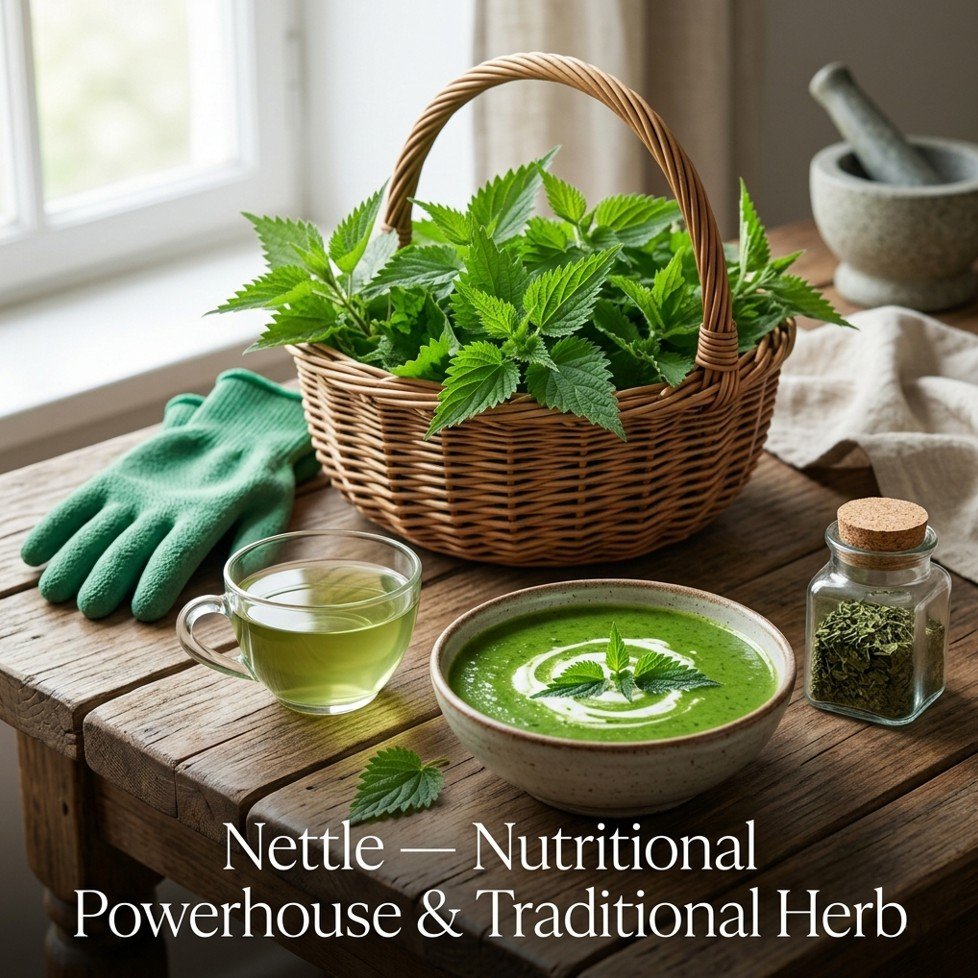
Few plants are as misunderstood as stinging nettle (Urtica dioica). To the casual walker, it is an annoyance. To the European herbalist, it is one of the most useful wild plants on the continent — a food, a medicine, and a source of fibre and dye.
Nettle grows everywhere in Europe: hedgerows, woodland edges, riverbanks, and neglected gardens. Its stinging hairs inject histamine, acetylcholine, and formic acid — enough to irritate skin but not to cause lasting harm. And once cooked or dried, the sting disappears completely, leaving behind a green, spinach‑like herb rich in minerals and vitamins.
This profile covers nettle’s botanical identity, traditional European uses, what modern research suggests, practical preparation methods, seasonal harvesting, and essential safety information.
What Is Nettle?
Scientific name: Urtica dioica (the most common medicinal species; Urtica urens is smaller but similar)
Common names: Stinging nettle, common nettle, ortie (French), Brennnessel (German), pokrzywa (Polish), brännässla (Swedish)
Appearance:
- Perennial herb growing 50–150 cm tall
- Leaves: oval to heart‑shaped, sharply toothed, 5–15 cm long
- Stems and leaves covered in hollow, silica‑tipped hairs that break on contact and inject irritants
- Flowers: small, greenish, in drooping clusters (male and female on separate plants)
- Roots: yellow, creeping rhizomes
Habitat: Throughout Europe, from sea level to subalpine zones. Prefers nitrogen‑rich soils, often near human habitation, riverbanks, and disturbed ground.
Parts used:
- Leaves (most common) — harvested in spring before flowering for best nutritional value
- Seeds — traditionally used as a tonic (less common)
- Roots — used for different purposes (benign prostatic hyperplasia — distinct from leaf uses)
Distinction: This article focuses on nettle leaf, not nettle root. The root is used for different conditions (urinary flow in older men) and has different active compounds.
Why does it sting? The hairs act like hypodermic needles, injecting a mixture of histamine, serotonin, acetylcholine, and formic acid. The sting is defensive — it discourages herbivores. Cooking, drying, or blending destroys the hairs and neutralises the irritants.
Traditional Uses in European Herbalism
Nettle has one of the longest continuous histories of use in Europe. It appears in Anglo‑Saxon medical texts, medieval herbals, and every folk tradition from Scotland to the Balkans.
Key traditional uses:
| Use | Traditional preparation | Regions |
|---|---|---|
| Spring tonic (blood “cleansing”) | Young nettle soup or tea drunk daily for 2–3 weeks in spring | Central & Eastern Europe, Scandinavia |
| Joint comfort (arthritis, rheumatism) | Nettle tea internally; nettle stings applied externally (urtication — deliberate stinging) | Britain, Germany, Alpine regions |
| Urinary tract support (mild diuretic) | Nettle leaf tea for “flushing” the urinary system | France, Germany, Poland |
| Anaemia (iron deficiency) | Nettle soup or tea for women after menstruation | Throughout Europe |
| Hay fever / seasonal allergies | Freeze‑dried nettle capsules or tea | Germany, Austria |
| Skin conditions (eczema, acne) | Nettle tea internally; cooled tea as a wash | Britain, France |
| Nosebleeds (styptic) | Dried nettle powder sniffed (historical, not recommended) | Britain |
Historical note: Urtication — deliberately stinging arthritic joints with fresh nettles — was a folk practice in Britain and Germany. Some patients reported temporary pain relief. Modern research has explored this, with mixed results.
Important distinction: Traditional use does not equal proven cure. Nettle was a supportive herb for mild complaints, not a treatment for serious disease.
What Modern Research Says
Nettle leaf has been studied more than many European herbs. However, most studies are small or have methodological limitations.
What has reasonable evidence:
1. Joint discomfort (osteoarthritis)
Several small clinical trials suggest that nettle leaf extract, either alone or combined with other herbs (e.g., devil’s claw, willow bark), may reduce mild to moderate joint pain. A 2016 systematic review concluded that nettle shows promise for osteoarthritis, but evidence is not strong enough for a firm recommendation.
2. Seasonal allergies (hay fever)
A few small studies (notably one from 1990 and a 2017 trial) found that freeze‑dried nettle leaf capsules reduced allergy symptoms such as sneezing and itching compared to placebo. However, larger, high‑quality trials are needed.
3. Mild diuretic effect
Nettle leaf increases urine output in animal studies and small human trials. This supports traditional use for “flushing” the urinary tract, but it is not a substitute for medical treatment of kidney or heart disease.
4. Nutritional supplementation
Nettle leaf is genuinely nutrient‑dense. It contains:
- Iron (1.5–2 mg per cup of tea)
- Calcium (400–500 mg per 100 g dried leaf)
- Magnesium (50–70 mg per 100 g)
- Vitamin C (30–50 mg per 100 g fresh leaf)
- Vitamin K (very high — caution for blood thinners)
- Chlorophyll, carotenoids, flavonoids
This is not a “medical claim” — it is basic nutrition. Adding nettle to the diet can contribute to daily mineral intake.
What has limited or inconclusive evidence:
- Blood pressure: Some animal studies suggest mild hypotensive effects, but human data are insufficient.
- Blood sugar: Very limited evidence; not recommended for diabetes management.
- Antioxidant effects: Laboratory studies confirm nettle contains antioxidants, but health benefits in humans are unproven.
What research does NOT show:
- Nettle does not cure arthritis or reverse joint damage.
- Nettle does not treat kidney failure or replace dialysis.
- Nettle does not cure anaemia caused by serious disease (e.g., cancer, bleeding ulcers).
Main Benefits and Practical Uses
Based on traditional European practice and available evidence, nettle leaf is most useful for:
| Use | Traditional support | Evidence strength | Best preparation |
|---|---|---|---|
| Nutritional supplementation (iron, calcium, vitamins) | Strong | Strong (nutritional analysis) | Soup, tea, smoothies |
| Mild joint discomfort (osteoarthritis) | Strong | Weak‑to‑moderate | Tea or capsules daily for 2–3 months |
| Seasonal allergy symptom relief | Moderate | Weak‑to‑moderate | Freeze‑dried capsules (follow product instructions) |
| Mild diuretic support (“spring cleanse”) | Strong | Weak | Tea, 2–3 cups daily for 1–2 weeks |
| General vitality / spring tonic | Strong | Weak (traditional) | Nettle soup or tea |
What nettle is NOT for:
- Severe joint inflammation or rheumatoid arthritis (see a rheumatologist)
- Kidney disease (nettle’s diuretic effect may be inappropriate)
- Pregnancy anaemia without medical guidance
- Replacing prescribed diuretics (e.g., furosemide)
How to Prepare Nettle
Fresh nettle stings. Always wear gloves when handling fresh leaves. Cooking, drying, or blending destroys the sting completely.
Nettle tea (infusion) — best for diuretic and mineral support
Ingredients:
- 1–2 teaspoons (1–2 grams) of dried nettle leaves per cup (250 ml)
- Alternatively: 3–5 fresh young leaves (handled with gloves)
Method:
- Place dried or fresh leaves in a teapot or cup
- Pour boiling water over the herb
- Cover and steep for 10–15 minutes (longer steeping extracts more minerals)
- Strain and drink
- Taste: grassy, slightly spinach‑like, pleasant
Dosage: 2–3 cups daily for 1–2 weeks as a spring tonic; 1–2 cups daily for longer‑term use.
Nettle soup — traditional European spring dish
Ingredients (serves 4):
- 200–300 g fresh young nettle tops (use gloves)
- 1 onion, chopped
- 2 cloves garlic, chopped
- 1 litre vegetable stock
- 2 potatoes, diced
- Salt, pepper, cream (optional)
Method:
- Wearing gloves, wash nettles and remove tough stems
- Sauté onion and garlic in butter or oil
- Add nettles (they will wilt immediately — the sting disappears with heat)
- Add stock and potatoes, simmer 20 minutes
- Blend until smooth (or leave chunky)
- Season with salt, pepper, and a swirl of cream
Nutritional note: This soup is genuinely rich in iron and calcium. It was traditionally eaten after Lent in Central Europe.
Nettle tincture (alcohol extract)
Tinctures are commercially available. Typical dose: 2–4 ml (40–80 drops) up to three times daily. Tinctures are less studied than tea, but some people prefer them for convenience.
Nettle capsules (freeze‑dried)
Freeze‑dried nettle leaf capsules are used in allergy studies. Typical dose: 300–600 mg per day. Follow product instructions. Not standardised.
External use (skin wash, hair rinse)
Nettle hair rinse (traditional for dandruff):
- Make a strong infusion: 4 tablespoons dried nettle per 500 ml water, steep 20 minutes
- Cool, strain, and use as a final rinse after shampooing
- Traditional, but evidence is lacking
Nettle compress for minor skin irritation:
- Use the same strong infusion, cool to skin temperature
- Soak a clean cloth and apply to itchy or irritated skin for 10 minutes
Important preparation notes:
- Do not eat fresh nettle leaves raw — they sting. Cooking, drying, or blending removes the sting.
- Do not boil nettle for more than 20 minutes — excessive heat degrades some vitamins.
- Dried nettle is safe to handle without gloves — the stinging hairs become brittle and harmless.
Best Season to Harvest or Buy It
Harvest season:
- Spring (March–May): The best time for young, tender leaves. Nettle is most nutritious before flowering. Pick the top 4–6 leaves of each plant.
- Summer (June–August): Leaves become larger, tougher, and slightly less palatable. Still usable but better for drying.
- Autumn: Leaves are coarse. Some foragers collect seeds in late summer/autumn (different use).
How to harvest safely:
- Wear thick rubber or leather gloves
- Use scissors to cut the top portion of the plant
- Harvest only from clean areas — away from roads, dog‑walking paths, agricultural spraying
- Take no more than 20–30% from a patch to allow regrowth
Drying:
- Spread leaves in a single layer on a drying screen
- Dry in a warm, airy, shaded location (not direct sunlight)
- Turn daily
- Drying takes 3–7 days
- Leaves are ready when they crumble easily
Storage:
- Store dried nettle leaves in airtight glass jars away from light and heat
- Properly stored, nettle retains good quality for 12–18 months
- Dried nettle loses some vitamin C but retains minerals well
Buying advice:
- Look for organic certification (nettle can accumulate heavy metals if grown in contaminated soil)
- Whole dried leaves are better than tea dust
- Green colour indicates freshness; brown or yellow leaves are old
Safety, Side Effects, and Interactions
This article is for educational purposes only and does not replace medical advice, diagnosis, or treatment. Persistent, severe, or unclear symptoms should be discussed with a qualified healthcare professional.
General safety:
- Nettle leaf in food amounts (soup, tea) is very safe for most people
- The sting is temporary and harmless (though unpleasant)
- Dried or cooked nettle has no sting
Who should be cautious or avoid nettle leaf:
1. People taking blood thinners (warfarin, clopidogrel, apixaban)
Nettle leaf is very high in vitamin K, which plays a role in blood clotting. Large amounts of nettle tea or soup can theoretically interfere with warfarin. Moderate use (1 cup of tea daily) is likely safe, but inform your doctor. Do not make sudden changes in nettle intake if you are on warfarin.
2. People with kidney disease
Nettle has a diuretic effect. In healthy people, this is harmless. In people with chronic kidney disease or kidney failure, altering urine output can be dangerous. Do not use nettle without medical supervision if you have diagnosed kidney problems.
3. Pregnancy and breastfeeding
Nettle leaf in food amounts (soup, occasional tea) is generally considered safe. However, high doses or concentrated extracts are not recommended. Nettle has traditional use as a uterine stimulant in very high doses — but this is not relevant to normal food use. Always consult a midwife or doctor.
4. People with low blood pressure (hypotension)
Nettle may lower blood pressure slightly. If you have chronically low blood pressure or take blood pressure medication, monitor your response. The effect is mild.
5. People with iron overload disorders (haemochromatosis)
Nettle is rich in iron. If you have haemochromatosis (excess iron absorption), avoid regular nettle use.
6. People with diabetes (theoretical caution)
Nettle may lower blood sugar. If you take insulin or oral hypoglycaemics, monitor blood sugar closely if using large amounts of nettle.
7. Children under 6 years
Nettle soup and tea are generally safe in small amounts. However, the high vitamin K content is not a concern. Consult a paediatrician for regular use.
Common side effects (rare at normal doses):
- Mild digestive upset (if large amounts)
- Allergic reactions (rare — possible in people with plant allergies)
- Skin rash from external use (rare)
Drug interactions summary:
| Medication class | Interaction risk | Recommendation |
|---|---|---|
| Anticoagulants (warfarin) | Moderate (vitamin K) | Inform doctor; avoid large amounts |
| Diuretics (furosemide, thiazides) | Low (additive effect) | Use caution; monitor hydration |
| Blood pressure medication | Low (additive hypotensive effect) | Monitor blood pressure |
| Diabetes medication (insulin, metformin) | Low (possible additive effect) | Monitor blood sugar |
| Lithium | Theoretical (diuretic effect) | Avoid or monitor lithium levels |
Red flags — when to stop nettle and see a doctor:
- Worsening of joint pain or swelling
- Signs of dehydration (excessive thirst, dark urine, dizziness) — unlikely from nettle alone
- Allergic reaction (hives, difficulty breathing — rare)
- Unexplained bruising or bleeding (if on blood thinners)
FAQ
Is nettle tea safe for everyone?
For most healthy adults, yes. People on blood thinners (warfarin), with kidney disease, or who are pregnant should consult a doctor first.
Does nettle really help with hay fever?
Small studies suggest freeze‑dried nettle capsules may reduce sneezing and itching. Nettle tea is less studied for allergies. Results are modest — it is not a replacement for antihistamines in severe cases.
Can I eat nettle raw?
No — fresh nettle leaves sting. Cooking, drying, or blending (e.g., in a smoothie) destroys the sting. A nettle smoothie made with a high‑speed blender is safe because the hairs are shredded.
How much iron is in nettle tea?
One cup of nettle tea (1 teaspoon dried leaf) contains approximately 1.5–2 mg of iron. This is about 10–15% of the daily requirement for an adult woman. However, the bioavailability of plant iron is lower than from meat.
Does nettle interact with thyroid medication?
No known interaction. Unlike some herbs (e.g., lemon balm), nettle does not affect thyroid function.
Can I give nettle tea to my dog?
Small amounts of cooled nettle tea (1–2 tablespoons) are generally safe for dogs. Do not give fresh nettle — the sting will irritate the mouth. Consult a veterinarian.
Key Takeaways
- Stinging nettle (Urtica dioica) is a nutrient‑dense European herb rich in iron, calcium, magnesium, and vitamins C and K.
- Traditional uses include spring tonic, joint comfort support, mild diuretic, and seasonal allergy relief.
- Modern research supports its nutritional value and shows promise for osteoarthritis and hay fever, but evidence is not strong.
- Preparation: tea (2–3 cups daily), soup, tincture, or capsules. Cooking/drying removes the sting.
- Safety: avoid large amounts if on blood thinners (warfarin) or if you have kidney disease. Consult doctor during pregnancy.
- Nettle is a supportive herb, not a cure. Persistent joint pain, urinary symptoms, or anaemia require medical evaluation.
Internal Links Used
- Best European herbs for seasonal immunity support — placed in elderflower section
- Spring herbs in Europe: what grows and how to use them — placed in introduction (seasonal series)
- Yarrow: wound herb and digestive bitter — placed in yarrow section
- Best European herbs for skin soothing — placed in calendula section
Sources
- European Medicines Agency (EMA) – Community herbal monograph on Urtica dioica L., folium.
- World Health Organization (WHO) – Monographs on selected medicinal plants, volume 3: Urtica dioica.
- German Commission E Monograph – Nettle leaf (1986).
- Upton, R. (2013). Stinging nettle leaf (Urtica dioica L.): A review of its botany, phytochemistry, pharmacology, and clinical applications. American Herbal Pharmacopoeia.
- Johnson, T. A., et al. (2016). Nettle for osteoarthritis: A systematic review. Journal of Herbal Medicine, 6(3), 115-122.
- Mittman, P. (1990). Randomized, double‑blind study of freeze‑dried Urtica dioica in the treatment of allergic rhinitis. Planta Medica, 56(6), 660-661.
- National Center for Complementary and Integrative Health (NCCIH) – Stinging nettle.