
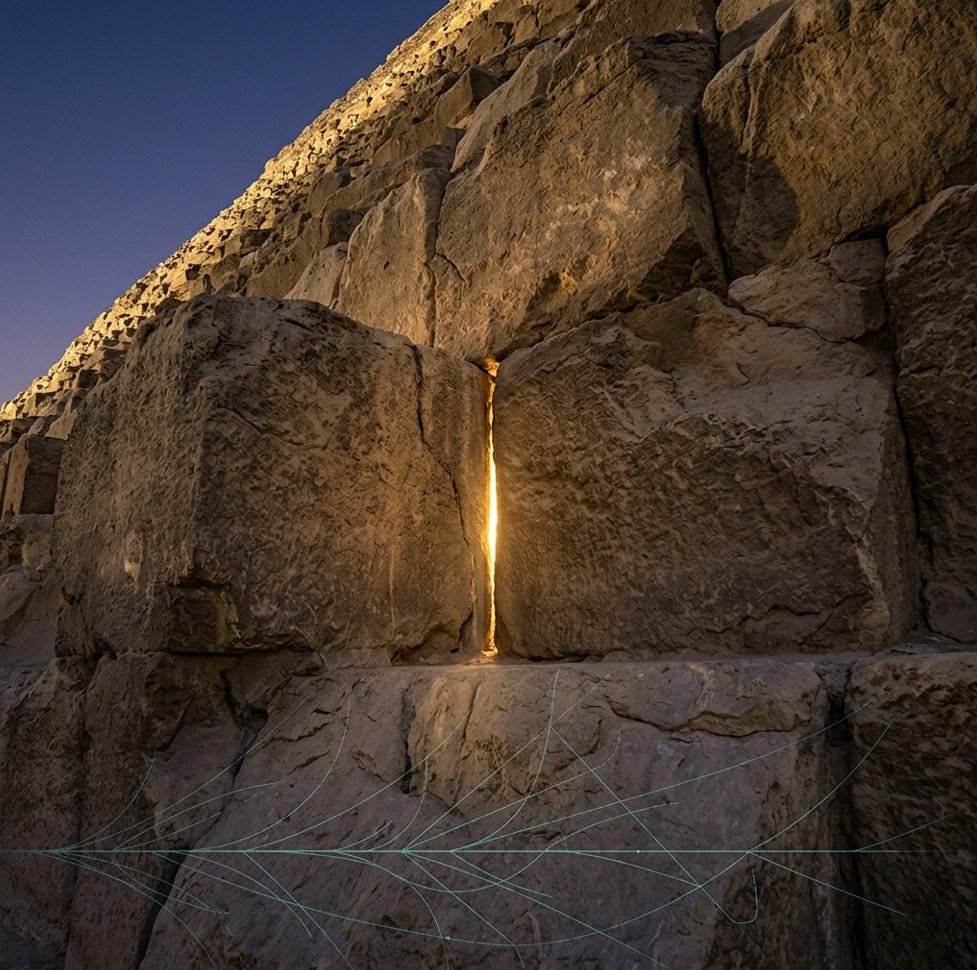
LEAD: Egyptologist Dr. Zahi Hawass has confirmed that a previously unknown 30-meter corridor inside the Great Pyramid of Khufu, detected by non-invasive muon tomography and explored by robotic probes, will be unveiled in 2026 — a discovery he says will open a new chapter in the study of ancient Egypt.
The ScanPyramids Project: A Decade of Looking Without Touching
The story of the 2026 Great Pyramid corridor does not begin with a shovel striking stone. It begins in October 2015, when the Egyptian Ministry of Antiquities, Cairo University, and the French HIP Institute launched ScanPyramids — an audacious mission to probe the internal structure of Old Kingdom pyramids without removing a single block. The founding premise was that particle physics and advanced imaging could see what no archaeologist’s eye ever could.
The project combined infrared thermography, which detects subtle temperature differences on stone surfaces that may indicate hidden cavities, with three-dimensional digital reconstruction and — most critically — muon tomography. Muons are subatomic particles produced when cosmic rays collide with Earth’s upper atmosphere. Traveling at near-light speed, they penetrate deep into solid matter but are partially absorbed depending on the density of the material they pass through. By placing detectors inside and around a pyramid, researchers can map density variations and identify empty spaces — essentially creating an X-ray of a stone mountain without exposing it to radiation or damage.
The approach yielded results quickly. In October 2016, ScanPyramids confirmed its first unknown voids using muon tomography. But the real breakthrough came in November 2017, when the collaboration published a landmark paper in the journal Nature announcing the “ScanPyramids Big Void” — a plane-sized cavity at least 30 meters long situated above the Grand Gallery. Three independent muon detection technologies confirmed the finding. It was, the authors wrote, “the first major inner structure found in the Great Pyramid since the nineteenth century.”
What made the Big Void both thrilling and frustrating was that it raised more questions than it answered. Its purpose, contents, and precise dimensions remained unknown. But the discovery validated the methodology, and the team pressed on. In March 2023, Egyptian antiquities officials confirmed another hidden corridor — this time a smaller passage about nine meters long and two meters wide, located approximately seven meters above the main entrance on the pyramid’s north face. A 2025 paper in Scientific Reports confirmed the North Face Corridor using multi-modal image fusion from three non-destructive techniques.
These incremental revelations set the stage for what Hawass now promises will be the most significant announcement yet. The international team has spent years refining its approach, guided by what one researcher called “a data-driven approach, supported by non-invasive sensors” that continues to map the pyramid’s hidden interior.
The 30-Meter Corridor and the Sealed Door
At the 44th Sharjah International Book Fair in November 2025, Zahi Hawass electrified the audience with a simple claim: a previously unknown corridor, roughly 30 meters long, had been located inside Khufu’s pyramid, and it ended at a sealed stone door.
“A great archaeological discovery that will write a new chapter in the history of the pharaohs,” Hawass told the audience, according to multiple accounts from the event. He explained that advanced scanning technologies — thermal imaging, 3D mapping, and muon radiography — had detected the passage. Remote-operated robots were then deployed to access and clean openings that had remained out of human reach for 4,500 years. The corridor’s location has been pinpointed, but its contents remain undisclosed.
The timeline Hawass laid out was deliberate. An international scientific team is conducting exhaustive analysis, and a formal report will be published before the corridor is fully opened. “Next year,” Hawass said, referring to 2026, “we will reveal to the world what lies behind that door.”
By March 2026, the first visual confirmation arrived — though not of the sealed door’s contents. Researchers guided a 6-millimeter-wide endoscope through a tiny joint between limestone blocks in the chevron structure above the pyramid’s main entrance. The camera transmitted images of a corridor with rough stone walls and a vaulted ceiling — an architectural space that had remained unseen since the pyramid rose on the Giza Plateau. The footage did not reveal treasure or inscriptions. It revealed engineering: unfinished-looking stonework, a vaulted form, and confirmation that the anomaly detected by muon imaging was, indeed, a real, air-filled void.
The sequence of verification matters. Density anomalies first appeared through muon imaging. Radar and ultrasound then helped narrow the target. Only then did the miniature camera slip into place. This layered approach — what researchers describe as “verification without excavation” — has become a defining methodology of modern archaeological science at major monuments.
What Could Lie Behind the Door?
Hawass has consistently declined to speculate on what the sealed door might conceal, and the international team has pledged to release findings only after exhaustive analysis and a scientific report. But that has not stopped the archaeological world from weighing possibilities.
One theory, grounded in structural analysis, is that the corridor and whatever lies beyond it served an engineering purpose rather than a funerary one. The Great Pyramid originally stood approximately 146 meters tall, and its builders had to manage the crushing forces generated by roughly 2.3 million stone blocks weighing an estimated 5.75 million tons. Relief spaces are already known elsewhere in the monument — most famously above the King’s Chamber, where five stacked granite cavities redistribute the immense weight of stone above. The newly confirmed passage appears to belong to that same family of architectural solutions: an internal void positioned where load needed to be redirected.
A more tantalizing possibility — one that Hawass himself has hinted at in broader comments about his archaeological ambitions — involves the discovery of a burial chamber or ritual space that predates or recontextualizes the reign of Khufu. In separate remarks, Hawass has stated that his greatest professional dream is to discover the tomb of Imhotep, the architect of the Step Pyramid of Djoser and the first known figure in history to transition from mud-brick to stone construction. He has also spoken of finding the tomb of Queen Nefertiti. Whether the sealed corridor connects to either of these long-sought goals is pure speculation, but Hawass has described the Imhotep search as potentially “the most important archaeological find in history, even greater than the discovery of Tutankhamun’s tomb.”
More cautious voices within Egyptology note that the corridor may simply be — and perhaps most importantly is — further evidence of the pyramid’s extraordinary internal complexity. The Big Void, the North Face Corridor, and now this longer passage suggest that Khufu’s pyramid is not a solid mass with a few known chambers, but a structure of layered engineering in which hidden spaces played an active role in construction and load management. As Mostafa Waziri, head of Egypt’s Supreme Council of Antiquities, told reporters after the endoscopic exploration: “We’re going to continue our scanning so we will see what we can do… to figure out what we can find out beneath it, or just by the end of this corridor.”
Frequently Asked Questions
What did Zahi Hawass announce about the Great Pyramid discovery in 2026?
At the 2025 Sharjah International Book Fair, Hawass announced that a previously unknown 30-meter corridor inside Khufu’s pyramid — detected through non-invasive scanning and ending at a sealed stone door — will be revealed to the world in 2026. Robotic probes have already accessed and cleaned the passage, but the contents behind the door remain undisclosed pending scientific analysis.
How does muon tomography detect hidden chambers inside pyramids?
Muon tomography tracks subatomic particles called muons, which are created when cosmic rays hit Earth’s atmosphere. These particles penetrate deep into stone but are partially absorbed depending on material density. By placing detectors around a pyramid, researchers can map empty spaces where more muons pass through — effectively creating a density image of the interior without any excavation.
Is this the first hidden chamber found in the Great Pyramid?
No. The ScanPyramids project discovered the “Big Void” — a plane-sized cavity above the Grand Gallery — in 2017, published in Nature. In 2023, a smaller nine-meter North Face corridor was confirmed using multiple imaging techniques and published in Scientific Reports in 2025. The 30-meter corridor with a sealed door, however, is considered more significant because it may be accessible and contains a terminus that could hold artifacts.
Editor’s Analysis
The 2026 Great Pyramid announcement sits at a peculiar intersection of rigorous science, institutional theater, and public longing for the genuinely mysterious. It is worth examining each layer — not to diminish the achievement, but to understand what kind of knowledge is being produced, and for whom.
Deep Reflections
What does this moment reveal about the architecture of archaeological knowledge itself? The ScanPyramids project represents a genuinely new way of knowing ancient structures — not through the destructive act of digging, but through the patient accumulation of particle physics data. Muon tomography is not a metaphor; it is a measurement. When three independent detection systems converge on the same density anomaly, as they did for both the Big Void and the North Face Corridor, the result approaches scientific certainty in a way that traditional archaeological inference rarely achieves. The Great Pyramid is, in a very literal sense, being read by instruments that detect the passage of cosmic particles through stone — a collaboration between the oldest surviving wonder of the ancient world and the most advanced tools of modern physics.
But the deeper question is whether this new way of seeing changes what we are actually looking at. For two centuries, Egyptology has framed the pyramids primarily as tombs — monumental expressions of pharaonic power and funerary belief. The accumulating evidence of internal voids, relief spaces, and corridors that serve structural rather than ceremonial purposes suggests a different emphasis: the pyramid as a machine, an engineered system in which hidden spaces channeled immense forces through geometries that modern structural analysis is only beginning to model. This does not make the pyramids less culturally significant. It makes them more technically astonishing.
Critical Analysis
The evidence deserves a harder look, and the timing of the announcement matters. Hawass revealed the corridor’s existence at a book fair — not at a scientific conference, not in a peer-reviewed journal. The scientific report that he promised would precede the corridor’s opening has not yet appeared in any major publication as of mid-2026. This is not inherently disqualifying; many major discoveries are teased before formal publication. But it does mean that the claims currently rest on Hawass’s authority rather than on independently verifiable data.
Several specific concerns warrant attention. First, the distinction between the “30-meter corridor” and the previously confirmed North Face Corridor (approximately nine meters) is sometimes blurred in media coverage. Are these the same feature, with the 30-meter measurement representing an extension discovered later, or are they distinct passages? The endoscopic footage from March 2026 showed a corridor roughly nine meters long — consistent with the 2023 discovery. The longer 30-meter passage described by Hawass may extend beyond the imaged section, but no visual confirmation of that extension has been publicly released.
Second, the “sealed door” is described consistently across sources, but no image of it has been published. Hawass’s refusal to speculate about what lies behind it is scientifically appropriate, but it also amplifies anticipation in ways that a published paper with detailed measurements and imaging would not. The controlled release of information — book fair announcements, media interviews, carefully worded promises — follows a pattern familiar in Egyptian archaeology, where institutional and tourism interests often shape the rhythm and framing of discoveries.
Third, the broader context of extraordinary claims at Giza demands caution. In 2025, a separate team using satellite Synthetic Aperture Radar (SAR) claimed to have detected vast underground structures — shafts, chambers, and spiral pathways — extending hundreds of meters beneath the Khafre pyramid. Hawass himself dismissed these claims as “fabrications,” and radar specialists noted that SAR cannot reliably penetrate to the depths claimed. Yet these viral narratives, however unfounded, create an atmosphere in which any pyramid announcement is received with a mixture of credulity and suspicion.
Cui Bono
The institutional incentives merit scrutiny. Hawass, a former Minister of Antiquities who has built a global public profile through documentaries, book tours, and media appearances, benefits directly from the narrative of a history-rewriting discovery — as does the Egyptian state, which has invested heavily in archaeological tourism infrastructure. The Grand Egyptian Museum, which opened its doors in November 2025 after two decades of construction and at a cost exceeding one billion dollars, now houses the complete Tutankhamun collection and positions itself as the world’s largest museum dedicated to a single civilization. A major pyramid discovery, timed to coincide with the museum’s inaugural year, is not merely an archaeological event; it is a strategic cultural asset.
The ScanPyramids collaboration — involving Cairo University, the Technical University of Munich, Nagoya University, the French Alternative Energies and Atomic Energy Commission (CEA), and corporate partners including Dassault Systèmes — also gains institutional prestige, future funding leverage, and validation of a methodology that has applications far beyond Egyptology. Muon tomography is being deployed to monitor volcanoes, inspect nuclear reactors, and scan shipping containers. Demonstrating its power on the world’s most iconic ancient monument strengthens the case for funding across multiple scientific domains.
Distraction Analysis
At the same time, this story may be crowding out a larger archaeological reality: the systematic looting, neglect, and underfunding that afflicts Egyptian heritage sites far from the Giza Plateau. While international attention fixates on hidden chambers beneath the pyramids, dozens of lesser-known tombs and excavation sites across Egypt face encroachment from urban expansion, groundwater damage, and illicit digging. The global spotlight on Giza — intensified by the Grand Egyptian Museum’s opening and Hawass’s carefully managed revelations — concentrates resources and public attention on a single necropolis that already commands disproportionate archaeological investment.
There is also a subtler distraction at work: the framing of archaeological discovery as a treasure hunt. The language of “sealed doors,” “rewriting history,” and comparisons to Tutankhamun’s tomb feeds an expectation that what lies behind the stone will be spectacular — gold, inscriptions, royal remains. But the most important discoveries may be structural: new evidence about construction techniques, load management, and the engineering sequence that built the pyramid. Those findings are harder to turn into headlines, but they may ultimately tell us more about the civilization that produced the monument.
Who Does This Not Serve?
And perhaps most importantly, this does not serve the Egyptian archaeologists, researchers, and laborers whose work is eclipsed by the singular figure of Zahi Hawass. Egyptology has long struggled with a “great man” narrative that concentrates credit — and access to international funding, publication platforms, and media attention — in the hands of a few prominent figures. The ScanPyramids collaboration is, by its nature, a large international team effort. Yet the public narrative of the 2026 discovery is overwhelmingly attached to one name. This pattern does not reflect how modern archaeological science is actually conducted, and it distorts the public’s understanding of how knowledge is produced.
It also does not serve source communities and descendant populations whose relationship to the pyramids predates modern Egyptology by millennia. The question of who has the right to open sealed spaces within a monument built by ancient Egyptians — and to control the narrative of what is found there — is not merely academic. Hawass’s own repatriation campaign, which calls for the return of the Rosetta Stone, the Bust of Nefertiti, and the Dendera Zodiac from foreign museums, articulates a powerful principle: that cultural heritage belongs to its country of origin. That principle, consistently applied, would also demand transparency about what is found, who controls access, and how benefits from discovery are distributed — questions that remain largely unanswered as the 2026 unveiling approaches.
Key Takeaways
- A sealed 30-meter corridor inside the Great Pyramid of Khufu, detected through muon tomography and explored by robotic probes, is expected to be formally unveiled in 2026 with a scientific report preceding the opening of a sealed stone door at the corridor’s end.
- The discovery builds on a decade of ScanPyramids work, including the 2017 “Big Void” detection published in Nature and the 2023 confirmation of a smaller North Face corridor, and represents the most significant pyramid interior find since the 19th century.
- While the technology — muon tomography, infrared thermography, 3D mapping, and robotic endoscopy — represents a genuine methodological breakthrough, the formal scientific publication has not yet appeared, and the “sealed door” contents remain entirely speculative pending peer-reviewed data.
- The announcement’s timing alongside the Grand Egyptian Museum’s opening and Hawass’s global media profile reflects the intersection of rigorous archaeological science with institutional, tourism, and personal incentives that shape how discoveries are framed and received.
Internal Links Used
- Rethinking human prehistory through genomic discoveries — placed in “What Could Lie Behind the Door?” section — thematically connects ancient civilization reanalysis through modern scientific techniques
- Ancient genomic analysis reshapes archaeological narratives — placed in Editor’s Analysis section — demonstrates how new technology reinterprets archaeological evidence
- AI-designed proteins revolutionize biosensor technology — placed in “ScanPyramids Project” section — illustrates how advanced computational tools intersect with scientific discovery
Sources
- Renowned Archaeologist Nears Major Pyramid Discovery Set to Rewrite Pharaohs’ History — GreekReporter.com, November 11, 2025 — high-credibility reporting
- ‘New chapter in the history of the pharaohs’: Zahi Hawass teases 2026 Great Pyramid reveal — The Jerusalem Post, November 10, 2025 — high-credibility reporting
- UAE: Big reveal inside Pyramid to be announced in 2026, says prominent Egyptologist — Khaleej Times, November 9, 2025 — high-credibility reporting
- Egypt to announce archaeological surprise in 2026 that will ‘rewrite history’: Zahi Hawass — Egypt Independent, November 9, 2025 — high-credibility reporting
- Tiny Camera Probe Reveals Hidden Corridor Inside Khufu’s Great Pyramid — Modern Engineering Marvels, March 30, 2026 — detailed technology reporting
- Discovery of a big void in Khufu’s Pyramid by observation of cosmic-ray muons — Nature, 2017;552:386-390 — peer-reviewed primary source