
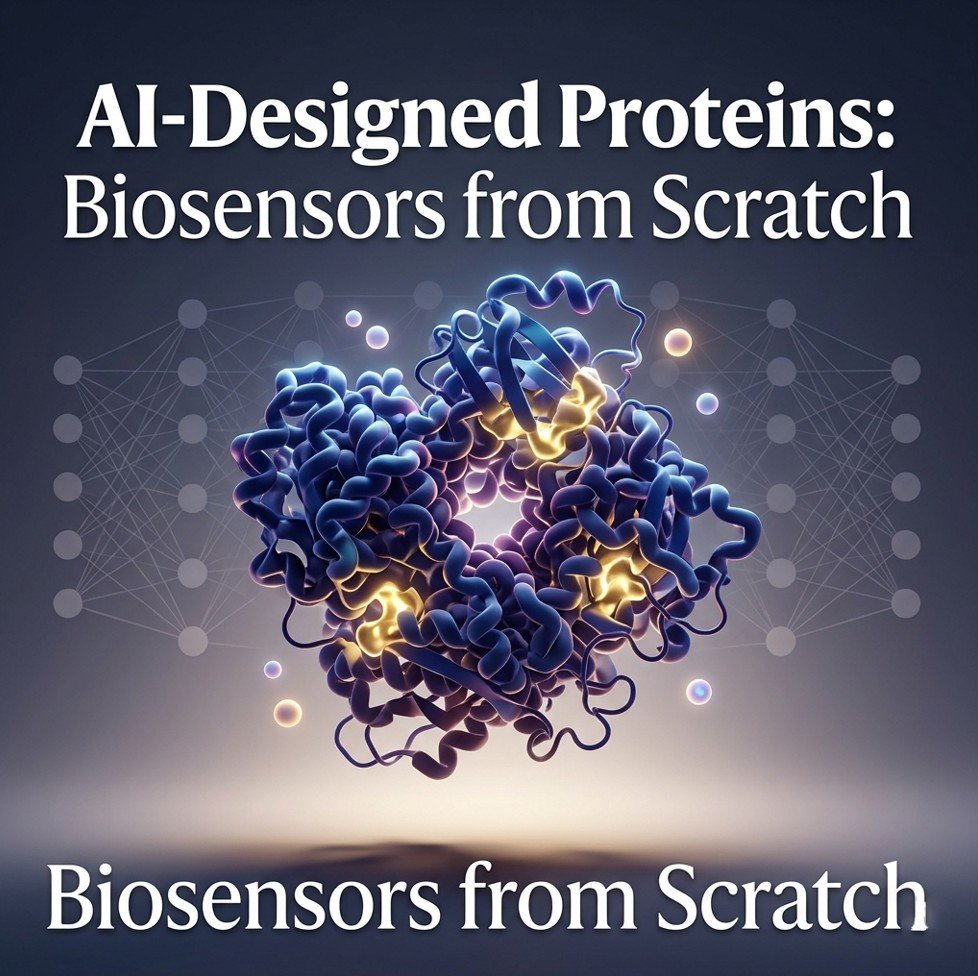
LEAD: In a landmark collaboration between KAIST and Nobel laureate David Baker’s laboratory, researchers have used artificial intelligence to design AI-designed proteins from the ground up that can selectively bind to specific small-molecule compounds, including the stress hormone cortisol, and have converted one of these binders into a functional biosensor.
The Grand Challenge of Small-Molecule Recognition
Proteins are nature’s most versatile molecular machines. They catalyze reactions, transport oxygen, fight infections, and much more. For decades, scientists have dreamed of designing entirely new proteins — ones not found in nature — that could recognize and bind to specific small molecules. Such technology would enable custom biosensors for disease markers, targeted drug delivery systems, and environmental monitors for pollutants. But the challenge is immense. Designing a protein that binds a specific small molecule requires atomic-level precision in predicting how thousands of atoms will fold and interact.
Traditional approaches relied on finding natural proteins with similar functions and then mutating them — a process akin to remodeling an existing house rather than building a new one. The success rate has been low, and the design space severely constrained. “Designing new proteins (de novo proteins) that recognize compounds has been considered a challenge in the field of protein design for a long time because it requires precise calculations at the atomic level,” notes a research summary from KAIST. That barrier has now been substantially lowered.
How AI Cracked the Binding Code
The research team, led by Professor Gyu Rie Lee of KAIST’s Department of Biological Sciences (first author) and Professor David Baker of the University of Washington (corresponding author), took a fundamentally different approach. Instead of tinkering with existing proteins, they used deep learning to generate entirely new protein structures. The core innovation was an AI model trained to understand protein-ligand interactions at an atomic level, enabling it to propose protein sequences and folds that would create precise binding pockets for specific target molecules.
The results were striking. The team designed artificial binding proteins for six different compounds, including metabolites, small-molecule drugs, and the stress hormone cortisol. Biophysical characterization revealed binding affinities ranging from nanomolar to low micromolar — comparable to many natural antibody-antigen interactions. More importantly, X-ray crystallography confirmed that the designed proteins folded exactly as intended, with atomic-level accuracy.
Perhaps the most impressive demonstration came with cortisol. The researchers designed a cortisol-binding protein, then used it to create a chemically induced dimerization (CID) system — essentially a molecular switch — that could measure cortisol levels in real time. This cortisol biosensor represents a complete validation of the design pipeline: from computational model to functional device.
From Lab Bench to Real-World Applications
The potential applications of this technology span multiple domains. In medicine, AI-designed proteins could be used to detect disease biomarkers in blood samples, enabling earlier diagnosis of conditions ranging from hormonal disorders to certain cancers. “The technology can precisely detect biomarkers in the blood to diagnose diseases early,” the research team explains. In drug development, custom binding proteins could serve as targeted delivery vehicles or as research tools to study disease mechanisms. Outside of medicine, the same platform could be used to create sensors for environmental pollutants, allowing real-time monitoring of air and water quality.
Professor Lee emphasized the transformative nature of the work: “This research experimentally proves that AI can be used to design proteins that precisely recognize specific compounds” and added that the team plans to expand the technology into “various fields such as disease diagnosis, new drug development, and environmental monitoring”. A provisional patent has already been filed in the United States.
Frequently Asked Questions
How are AI-designed proteins different from natural proteins?
Natural proteins evolved over millions of years to perform specific functions. AI-designed proteins are built from scratch using computational models that predict how a sequence of amino acids will fold into a three-dimensional structure. Unlike natural proteins, which often have multiple functions or off-target effects, AI-designed proteins can be optimized for a single, precise task — such as binding a specific drug molecule or hormone.
Can AI-designed proteins be used for disease diagnosis?
Yes, this is one of the most promising applications. The technology can create biosensors that detect specific biomarkers in blood or other bodily fluids. In the current study, the team successfully built a cortisol biosensor capable of measuring stress hormone levels. Similar sensors could be developed for cancer markers, cardiac biomarkers, or infectious disease antigens, enabling rapid, point-of-care testing.
What are the limitations of AI-designed proteins?
While the study demonstrates proof of concept, several limitations remain. The designed proteins were tested in laboratory conditions; clinical validation in humans has not yet occurred. Manufacturing costs and scalability are open questions. Long-term stability and potential immunogenicity (the risk that the immune system might recognize these artificial proteins as foreign) need further investigation. Additionally, the current study focused on only six target compounds; generalizing the approach to arbitrary small molecules remains an ongoing challenge.
Editor’s Analysis
Deep Reflections
What does this discovery reveal about how knowledge is built? This study represents a shift from discovery-based science to creation-based engineering. For most of biological history, scientists were limited to studying proteins that evolution happened to produce. AI now enables the design of proteins for which no natural template exists. This changes the epistemology of molecular biology: we are no longer just reading nature’s book but writing new volumes. The deeper question is whether this represents a true expansion of understanding or merely a new tool for solving old problems. The answer is both — but the tool itself may be more transformative than any single application.
Critical Analysis
Is the science actually solid? The study is published in Nature Communications, a peer-reviewed journal with rigorous standards. The methods combine deep learning with physics-based modeling, a hybrid approach that leverages the strengths of both. Binding affinities were measured experimentally, and X-ray crystallography confirmed structural accuracy. The sample size — six target compounds — is modest but sufficient for a proof-of-concept study. However, several caveats warrant attention. The affinities, while impressive (nanomolar to low micromolar), are not yet at the level of the best natural antibodies (picomolar). The study does not report on the stability of these proteins over time or in complex biological fluids like serum. And while the cortisol biosensor works in the lab, its performance in real-world samples (blood, saliva) has not been demonstrated. As always with early-stage research, replication by independent labs will be essential.
Cui Bono
Who benefits from this discovery or its coverage? The primary beneficiaries are the institutions involved: KAIST gains prestige as a leader in AI-driven biotechnology; the University of Washington and the Baker lab reinforce their dominance in computational protein design; the Howard Hughes Medical Institute (HHMI), which funded Baker’s work, sees its investment validated. The pharmaceutical industry stands to benefit substantially if this platform reduces drug development costs and timelines — a provisional patent has already been filed, signaling commercial intentions. The media, including this publication, benefits from a compelling narrative of AI conquering another frontier of biology.
Distraction Analysis
What bigger issue might this story be distracting from? The enthusiasm for AI-designed proteins risks overshadowing persistent problems in biotechnology: unequal access to advanced therapeutics, high drug prices, and the concentration of research in wealthy institutions. A cortisol biosensor is elegant science, but stress-related diseases are often driven by social determinants — poverty, workplace exploitation, systemic inequality — that no biosensor can fix. The focus on high-tech solutions may divert attention and resources from public health interventions that would benefit far more people at far lower cost. Additionally, the narrative of AI as a problem-solving hero obscures the reality that most biomedical AI research remains siloed in wealthy countries, with little benefit flowing to low- and middle-income nations.
Who Does This Not Serve?
Who is ignored, harmed, excluded, or left behind? The most obvious answer is patients in low-resource settings. Even if this technology matures into clinical products, the costs of manufacturing and distribution will likely place them out of reach for the majority of the world’s population. The patent filing signals commercial exclusivity, not open access. Research participants in early-stage studies — if and when human trials begin — bear risks for potential future benefits that may never materialize. Workers in traditional diagnostic manufacturing may face displacement as biosensor technologies evolve. And finally, the general public may be misled by headlines suggesting that AI has “solved” protein design, when in reality this is a promising but early step on a long road.
Key Takeaways
- AI enables de novo protein design: Researchers used deep learning to create entirely new proteins that bind specific small molecules, moving beyond modifying natural proteins.
- Functional biosensor demonstrated: The team built a cortisol biosensor using a chemically induced dimerization system, proving the technology works beyond computational prediction.
- Early-stage, not yet clinical: Binding affinities are strong, but stability, manufacturing, and clinical validation remain unproven; this is a proof-of-concept study, not a market-ready product.
Internal Links Used
- mRNA Cancer Vaccine Breakthrough 2026 — placed in the “Real-World Applications” section — Both articles involve cutting-edge biotechnology with potential therapeutic applications; the mRNA vaccine piece provides context on how platform technologies can transform medicine.
- AI Cancer Diagnosis Electronic Nose DeepRare 2026 — placed in the “Editor’s Analysis” section — This article covers another AI-driven diagnostic tool, offering readers a parallel example of how machine learning is reshaping medical testing.
- Curing Sickle Cell Anemia with Gene Therapy 2026 — placed in the “Key Takeaways” section — Both stories represent transformative approaches to disease treatment, with the sickle cell article grounding the discussion in a real-world therapeutic success.
Sources
- Small-molecule binding and sensing with a designed protein family — Nature Communications — Primary peer-reviewed study; open access — peer-reviewed
- KAIST and Nobel laureate Baker use AI to design proteins and build biosensors — Chosun Biz — Detailed institutional press release from KAIST — official
- AI-designed proteins built from scratch can recognize specific compounds — NewsBreak/Science X — High-credibility science news summary — high-credibility reporting
- AI设计蛋白质能识别特定化合物 — 财联社 — Chinese financial news outlet reporting on the study — high-credibility reporting


1 thought on “AI-Designed Proteins: From Scratch Biosensors Target Cortisol and Drugs”