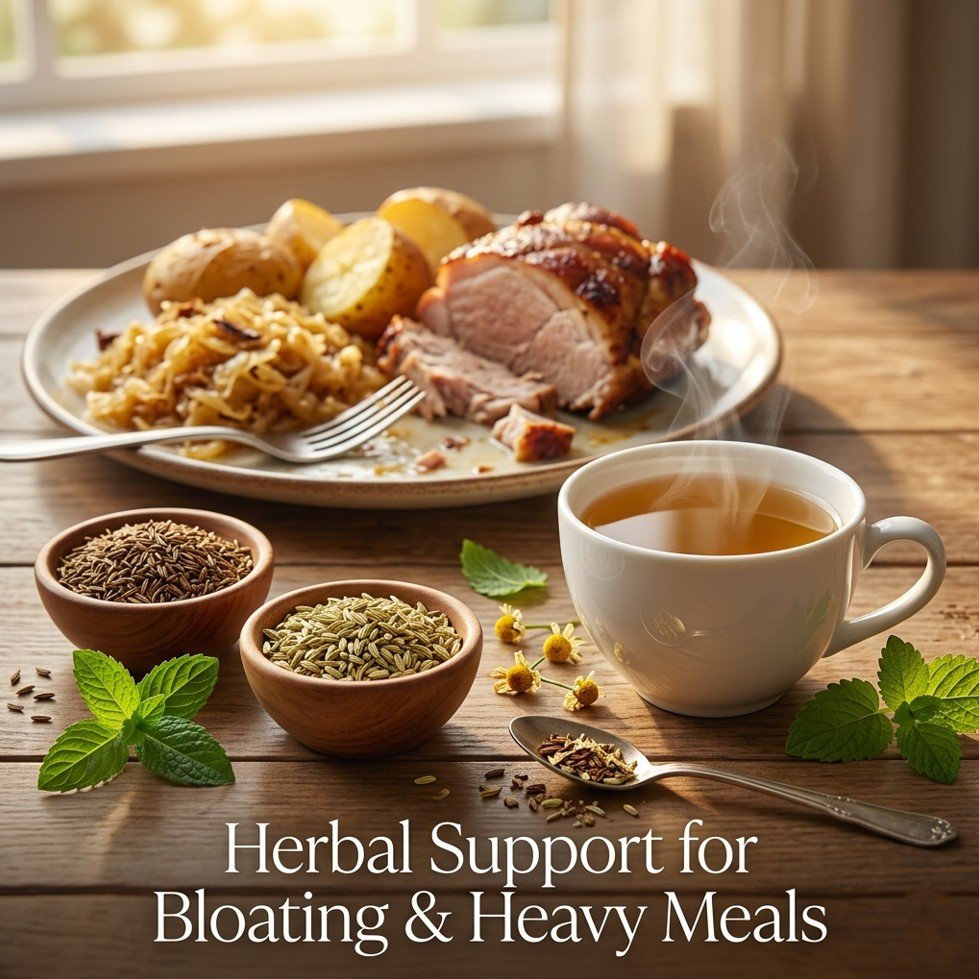
After a large meal — especially one rich in fats, proteins, or hard‑to‑digest vegetables like cabbage and beans — many people experience bloating, distension, and trapped gas. This is not usually a sign of disease. It is often simply the result of eating more than the digestive system can handle comfortably, or of swallowing air while eating quickly.
European herbal traditions offer several gentle, well‑tested remedies for this specific kind of post‑meal discomfort. The herbs described here are traditionally known as carminatives — plants that help the body expel intestinal gas and reduce the feeling of pressure and fullness.
This article covers five of the most effective European herbs for bloating and heavy meals: caraway, fennel, peppermint, lemon balm, and chamomile. We will explain why they work, how to prepare them, and when self‑care is appropriate versus when a doctor is needed.
What Causes Bloating After Heavy Meals?
Bloating after eating can have several causes. Understanding the mechanism helps explain why certain herbs are traditionally used.
Common causes of temporary, meal‑related bloating:
- Swallowed air (aerophagia): Eating quickly, talking while eating, drinking carbonated beverages, or chewing gum introduces air into the stomach. Some of this air travels to the intestines.
- Gas production from fermentation: Certain carbohydrates (fibre, starches, sugars like raffinose in beans) are not fully digested in the small intestine. When they reach the large intestine, gut bacteria ferment them, producing hydrogen, methane, and carbon dioxide — leading to gas and bloating.
- Delayed gastric emptying: High‑fat meals slow down how quickly the stomach empties, causing a sensation of fullness and pressure that lasts longer.
- Irritable bowel syndrome (IBS): People with IBS often experience bloating even after normal meals. Herbs may help symptoms, but underlying management requires medical care.
- Food intolerances: Lactose, gluten, fructose, or other intolerances can cause bloating. Herbs may mask symptoms but do not treat the cause.
When is bloating normal? Occasional bloating after a very large or gas‑producing meal is normal. If bloating occurs after every meal, is painful, or is accompanied by weight loss, diarrhoea, constipation, or blood in stool, see a doctor.
Red flags: Sudden, severe bloating with abdominal pain, nausea, vomiting, or inability to pass gas or stool could indicate a bowel obstruction — seek emergency care immediately.
Best European Herbs Traditionally Used for Bloating
The following five herbs are classic European carminatives. They work through several mechanisms: relaxing intestinal smooth muscle (antispasmodic), encouraging the expulsion of gas, and reducing fermentation.
1. Caraway (Carum carvi)
What it is: A biennial plant native to Europe and western Asia. The crescent‑shaped seeds are the medicinal part.
Why it is traditionally used for bloating: Caraway is perhaps Europe’s most specific remedy for trapped gas and post‑meal distension. In German and Austrian folk medicine, caraway is added to cabbage, pork, and other gas‑producing dishes specifically to prevent bloating. The seeds are chewed after meals.
What modern research suggests: Several clinical trials have shown that a combination of caraway oil and peppermint oil reduces symptoms of functional dyspepsia (including bloating and fullness). Caraway alone has demonstrated antispasmodic activity in laboratory studies.
Best use case: After a meal that typically causes gas (cabbage, beans, rich meat dishes). Chew ½–1 teaspoon of seeds slowly, or drink caraway tea.
Key safety note: Caraway is very safe in culinary and tea amounts. Concentrated caraway oil should be used with caution in people with liver conditions.
2. Fennel (Foeniculum vulgare)
What it is: A Mediterranean plant now naturalised across Europe. The seeds are the primary medicinal part.
Why it is traditionally used for bloating: Fennel has been used since ancient times as a carminative. In southern Europe and the Balkans, chewing fennel seeds after meals is a common habit. Fennel tea is given to adults and children for trapped gas.
What modern research suggests: Small human studies suggest that fennel seed extract reduces intestinal spasms and improves gas expulsion. The volatile oil anethole is thought to relax smooth muscle.
Best use case: A cup of fennel tea (1 teaspoon crushed seeds, steep 10–15 minutes) 30 minutes after a heavy meal. For immediate relief, chew ½ teaspoon of seeds.
Key safety note: Fennel is generally safe. Very high doses of fennel oil may have estrogen‑like effects. People with hormone‑sensitive conditions should avoid concentrated extracts. Tea is fine.
3. Peppermint (Mentha × piperita)
What it is: A natural hybrid of watermint and spearmint, widely cultivated across Europe.
Why it is traditionally used for bloating: Peppermint tea is a standard after‑dinner drink in many European countries. It relaxes the muscles of the digestive tract, allowing trapped gas to pass and reducing the sensation of pressure.
What modern research suggests: Enteric‑coated peppermint oil capsules are well studied for IBS, showing significant reduction in bloating and abdominal pain. For tea, the evidence is less strong, but traditional use is extensive. The menthol in peppermint has antispasmodic properties.
Best use case: A cup of hot peppermint tea 20–30 minutes after a meal. For people with IBS, enteric‑coated capsules (under medical guidance) may be more effective.
Key safety note: Peppermint tea is very safe. Peppermint oil in concentrated form can cause heartburn and may worsen GERD. Do not give peppermint oil to young children.
4. Lemon Balm (Melissa officinalis)
What it is: A lemon‑scented perennial herb from the mint family, native to southern Europe.
Why it is traditionally used for bloating: Lemon balm is traditionally used when bloating is linked to stress, nervous eating, or tension. It has mild antispasmodic and calming effects that can help relax the digestive tract.
What modern research suggests: Several human studies confirm lemon balm’s calming effects. Direct studies on bloating are lacking, but its antispasmodic activity has been demonstrated in laboratory research.
Best use case: When bloating is accompanied by a feeling of nervousness or “butterflies” in the stomach. Drink lemon balm tea (1–2 teaspoons dried leaves per cup, steep 5–10 minutes) after meals or when feeling tense.
Key safety note: Lemon balm is very safe. It may potentiate sedative medications and thyroid hormone replacement (rare).
5. Chamomile (Matricaria chamomilla)
What it is: One of Europe’s most widely used medicinal herbs. The flower heads are used.
Why it is traditionally used for bloating: Chamomile tea is often given after meals to prevent bloating, especially in children and the elderly. It has mild anti‑inflammatory and antispasmodic effects.
What modern research suggests: Laboratory and animal studies confirm that chamomile flavonoids (apigenin) relax smooth muscle. Human studies for bloating are limited, but traditional use is consistent across Europe.
Best use case: A gentle option for people who find peppermint too strong or who have mild GERD (chamomile does not relax the lower oesophageal sphincter as much as peppermint). Drink 1–2 cups after meals.
Key safety note: Chamomile is very safe. Rare allergic reactions in people sensitive to ragweed (Asteraceae family).
How to Use These Herbs at Home
Teas (infusions) — best for most people
Basic method for leaf/flower teas (peppermint, lemon balm, chamomile):
- 1–2 teaspoons dried herb per cup (250 ml)
- Pour boiling water over herb
- Cover and steep 5–10 minutes
- Strain and drink
For seeds (caraway, fennel):
- Lightly crush 1 teaspoon of seeds
- Pour boiling water over seeds
- Cover and steep 10–15 minutes (longer than leaves)
- Strain and drink
Timing: For bloating prevention, drink tea 20–30 minutes after finishing the meal. For relief of existing bloating, drink as soon as discomfort begins.
Chewing seeds (traditional and effective)
- After a meal, place ½–1 teaspoon of caraway or fennel seeds in the mouth
- Chew slowly for 1–2 minutes
- Swallow the softened seeds (or spit them out — traditional use is to swallow)
- This releases the volatile oils directly into the mouth and stomach
Tinctures
Commercial tinctures of caraway, fennel, peppermint, lemon balm, and chamomile are available. Typical dose: 1–3 ml (20–60 drops) in water after meals. Follow product instructions. Tinctures act faster than tea but are less pleasant.
Combinations (blends)
Classic European digestive blends often combine several carminatives:
- Caraway + fennel + peppermint (strong, for significant gas)
- Lemon balm + chamomile (gentle, for stress‑related bloating)
- Fennel + chamomile (for children and sensitive adults)
Example blend: 2 parts fennel seeds, 2 parts caraway seeds, 1 part peppermint leaves, 1 part chamomile flowers. Steep as tea.
What to avoid:
- Do not drink extremely hot tea (can irritate the oesophagus)
- Do not add milk (dairy can worsen bloating in lactose‑intolerant people)
- Do not use peppermint oil capsules (enteric‑coated) for occasional bloating — they are for IBS under medical guidance
When the Season Matters
These herbs are available in different forms depending on the season.
Fresh herbs (summer):
- Fresh peppermint, lemon balm, chamomile flowers, and fennel leaves are available in summer
- Fresh herbs make a more aromatic tea. Use 2–3 times the amount of dried herb.
- Fresh caraway seeds are not commonly available; dried is fine.
Dried herbs (year‑round):
- Most carminatives are used dried. Drying concentrates the volatile oils.
- Store dried herbs in airtight glass jars away from light and heat.
- Replace peppermint, lemon balm, chamomile every 12 months; seeds (caraway, fennel) last 18–24 months.
Harvesting (if you grow your own):
- Peppermint and lemon balm: harvest leaves just before flowering (mid‑summer). Dry in shade.
- Chamomile: pick flowers on dry mornings in summer. Dry immediately.
- Fennel and caraway: harvest seeds in late summer when they turn brown. Dry and store whole.
Buying advice: For bloating relief, quality matters. Buy organic whole seeds (not pre‑ground — they lose volatile oils quickly). Dried leaves should be green and fragrant, not brown or musty.
Safety, Interactions, and When to See a Doctor
This article is for educational purposes only and does not replace medical advice, diagnosis, or treatment. Persistent, severe, or unclear symptoms should be discussed with a qualified healthcare professional.
General precautions for carminative herbs:
- All five herbs are generally safe in food and tea amounts
- Start with a single herb to identify individual reactions
- Do not use concentrated essential oils internally (except in standardised products under guidance)
Specific safety notes:
| Herb | Contraindications / Cautions |
|---|---|
| Caraway | Very safe. Concentrated oil may affect liver in high doses — tea is fine. |
| Fennel | Very safe. Avoid high‑dose extracts in hormone‑sensitive conditions. Tea is fine. |
| Peppermint | Tea is safe. Concentrated oil: avoid in GERD, hiatus hernia, gallstones. Do not give oil to children. |
| Lemon balm | Very safe. Use caution with thyroid medication and sedatives. |
| Chamomile | Very safe. Rare ragweed allergy. |
Pregnancy and breastfeeding:
- Caraway, fennel, peppermint, lemon balm, chamomile in tea amounts are generally considered low risk by many European herbalists. However, use moderation (1–2 cups daily). Avoid concentrated extracts. Always consult a midwife or doctor.
Drug interactions (mild, theoretical):
- Peppermint oil (concentrated) may interact with cyclosporine and drugs metabolised by CYP3A4 — tea is unlikely to cause problems.
- Lemon balm may potentiate sedatives and thyroid medication — rare.
- Chamomile has rare interaction with warfarin (theoretical).
Red flags — when bloating is not just bloating:
See a doctor if you experience:
- Bloating that lasts more than a few hours after every meal
- Severe abdominal pain (not just discomfort)
- Unexplained weight loss
- Blood in stool or black, tarry stools
- Persistent diarrhoea or constipation
- Nausea and vomiting
- Fever
- Bloating that is not relieved by passing gas or having a bowel movement
- A family history of ovarian or colorectal cancer (bloating can be a symptom)
Emergency symptoms: Sudden, severe bloating with inability to pass gas or stool, accompanied by vomiting or severe pain — possible bowel obstruction. Seek immediate medical care.
FAQ
What is the fastest herb for bloating relief?
Chewing caraway or fennel seeds provides the fastest relief because the volatile oils are absorbed through the oral mucosa. Peppermint tea is also fast-acting. For most people, relief begins within 15–30 minutes.
Can I take these herbs before a meal to prevent bloating?
Yes. Drinking a cup of caraway or fennel tea 15–20 minutes before a meal can help prepare the digestive tract and reduce gas formation. Chewing seeds before eating is also traditional.
Are these herbs safe for people with IBS?
Yes, these herbs are commonly used in IBS, especially peppermint oil (enteric‑coated capsules) and fennel. However, IBS is a medical diagnosis. Do not self‑treat suspected IBS without seeing a doctor.
Can children take these herbs for bloating?
Chamomile and fennel tea are traditionally used for children with gas. For children over 6 years, a half‑cup of tea is reasonable. Caraway and peppermint tea in small amounts are also safe. Never give peppermint oil to young children. Consult a paediatrician.
Is it better to chew seeds or drink tea?
Chewing seeds acts faster (within minutes) because the volatile oils are absorbed directly. Tea is more pleasant and provides hydration. Both are effective. For severe gas, do both.
Can I combine all five herbs together?
Yes, but start with a simpler blend (2–3 herbs) to see how you respond. A five‑herb tea may be very strong and cause mild digestive upset in sensitive people. A classic combination: fennel, caraway, and peppermint.
Key Takeaways
- Five European herbs are traditionally used specifically for bloating and the sensation of overfullness after heavy meals: caraway, fennel, peppermint, lemon balm, and chamomile.
- These herbs are carminatives — they help the body expel intestinal gas and relax digestive smooth muscle.
- Chewing seeds (caraway or fennel) provides the fastest relief. Teas are gentler and more pleasant.
- Use herbs 20–30 minutes after meals for prevention, or at the first sign of bloating for relief.
- All five are very safe in tea and food amounts, but peppermint oil (concentrated) should be avoided in GERD and in children.
- Persistent, severe, or unexplained bloating requires medical evaluation — it is not normal to be bloated after every meal.
Internal Links Used
- Best European herbs for digestion support — placed in introduction
- Chamomile: benefits, uses, safety, and how to prepare it — placed in chamomile section
- Peppermint: digestive uses and beyond — placed in peppermint section
- Lemon balm: calming uses and how to brew it properly — placed in lemon balm section
Sources
- European Medicines Agency (EMA) – Community herbal monographs: Carvi fructus, Foeniculi fructus, Menthae piperitae folium, Melissae folium, Matricariae flos.
- German Commission E Monographs – Caraway, fennel, peppermint, lemon balm, chamomile.
- Madisch, A., et al. (2004). Treatment of functional dyspepsia with a fixed peppermint oil and caraway oil combination preparation. Digestion, 69(4), 245-252.
- Khanna, R., et al. (2013). Peppermint oil for irritable bowel syndrome. Cochrane Database of Systematic Reviews, (5).
- World Health Organization (WHO) – Monographs on selected medicinal plants.
- National Institute of Diabetes and Digestive and Kidney Diseases (NIDDK) – Gas and bloating.