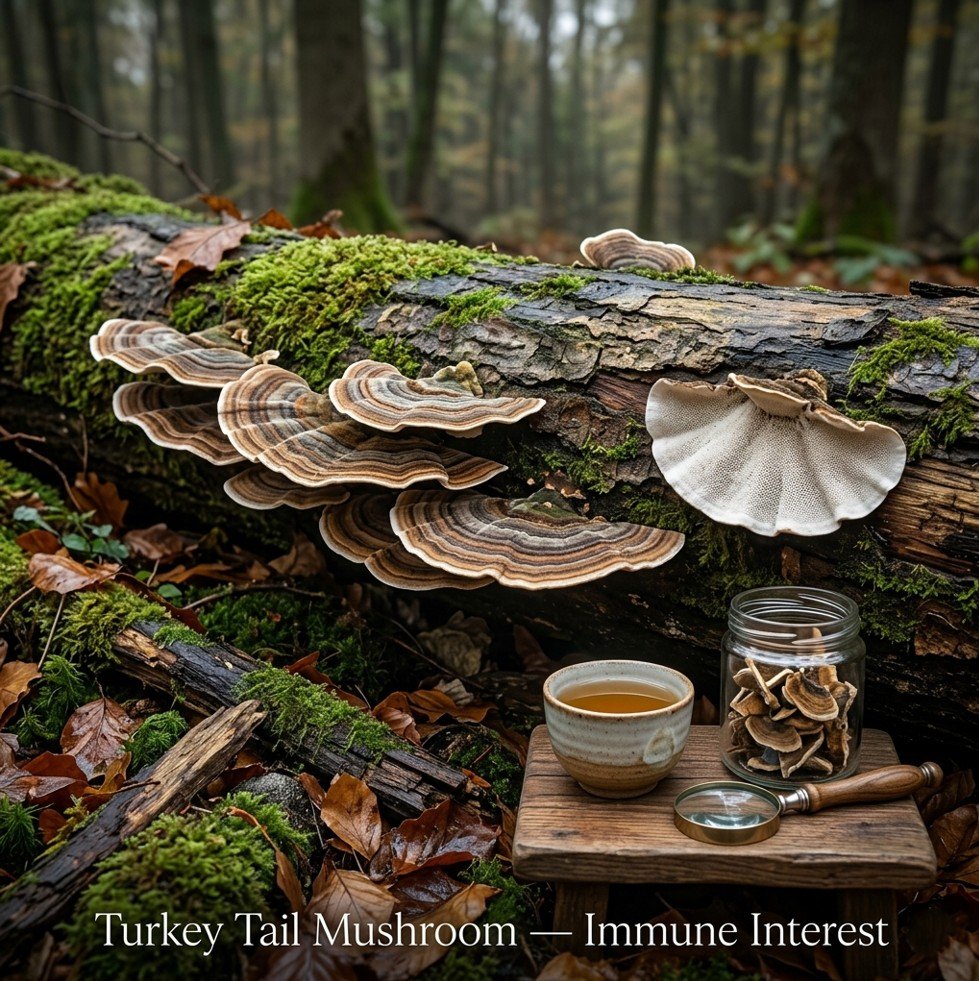
Among the bracket fungi of Europe, few are as common — and as overlooked — as turkey tail. Its name comes from its striking resemblance to a wild turkey’s tail feathers: concentric zones of varied colours, a velvety surface, and a thin, flexible bracket.
But beneath its modest appearance lies a mushroom that has attracted serious scientific interest. In Japan and China, turkey tail extracts (PSK, PSP) have been studied as adjuncts to cancer therapy. In Europe, turkey tail has a longer history as a folk remedy for general weakness, infections, and immune support.
This profile examines Trametes versicolor (also known as Coriolus versicolor). We will explore its identification, traditional European uses, the current state of research (including what the evidence does and does not show), preparation methods, and essential safety warnings for foragers.
What Is Turkey Tail Mushroom?
Scientific name: Trametes versicolor (syn. Coriolus versicolor)
Common names: Turkey tail, many‑zoned polypore, kuutio‑kääpä (Finnish), bunte Tramete (German), żagiew różnobarwna (Polish)
Appearance:
- Bracket fungus, fan‑shaped to semicircular, 2–10 cm across
- Thin (2–5 mm thick), flexible when fresh, leathery when dry
- Upper surface: velvety, with concentric zones of various colours — brown, tan, grey, chestnut, blue‑black, white
- Underside (pores): white to cream, with very small, round pores (3–5 per mm)
- Flesh: white, thin, tough
- No stem (sessile)
- Odour: mild, mushroomy
- Taste: mild, not bitter
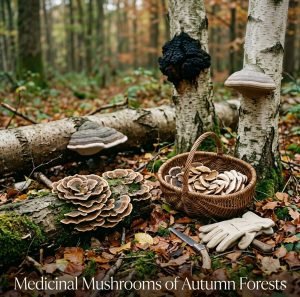
Habitat: Grows on dead hardwood logs, stumps, and fallen branches (occasionally on conifers). It causes white rot. Extremely common throughout Europe, North America, and Asia.
Season: Year‑round, but most visible in autumn and winter when leaves are off the trees. Fresh brackets appear from spring to autumn; old brackets persist through winter.
Key identification features:
- Thin, flexible bracket (not hard and woody like some polypores)
- Velvety, multicoloured, zoned upper surface
- White pore surface with very small pores
- Grows in overlapping clusters (tiers)
Distinction: Turkey tail is not edible in the culinary sense. It is too tough and leathery to eat as food. It is used as a medicinal mushroom — typically as a decoction (tea), powder, or extract.
Traditional Use in Europe
Turkey tail does not have the same dramatic folk history as birch polypore or chaga. It was not carried by mummies or celebrated in medieval texts. However, it was used in European folk medicine, particularly in rural areas.
Traditional European applications:
| Region | Traditional use |
|---|---|
| Britain | Used as a mild immune tonic, often in combination with other fungi. Also used as a tinder. |
| Germany | Bunte Tramete was occasionally used in folk medicine for general debility and “weakness”. |
| Poland & Eastern Europe | Decoction drunk for respiratory complaints and as a general strength tonic after illness. |
| Scandinavia | Less documented, but recognised as a common forest fungus with some medicinal use. |
Other traditional uses (non‑medicinal):
- Tinder for fire‑starting (though less effective than tinder fungus)
- Decorative purposes (dried brackets)
- Used in dyeing (produces brown, beige, greenish colours)
Important note: Turkey tail’s modern fame comes largely from Asian research, not European tradition. However, its presence in European folk practice justifies its inclusion in this series. The mushroom is native to Europe and has been recognised here for centuries.
What Research Is Exploring
Turkey tail is one of the most intensively studied medicinal mushrooms, but almost all high‑quality research comes from Japan, China, and Korea. European research is limited.
The key compounds:
Turkey tail contains two well‑studied polysaccharide complexes:
- Polysaccharide‑K (PSK, krestin) – isolated in Japan in the 1970s
- Polysaccharide‑P (PSP) – isolated in China
Both are proteoglycans (protein‑bound polysaccharides) that have shown immunomodulatory activity in laboratory and clinical studies.
What the research shows (and does not show):
1. Immune system support
Numerous laboratory and animal studies demonstrate that PSK and PSP can activate certain immune cells (macrophages, natural killer cells, T‑cells). This is the basis for their traditional use as “immune tonics”.
2. Adjunct to cancer therapy (most studied area)
Several clinical trials, mostly from Japan in the 1980s–1990s, have examined PSK as an adjunct to conventional cancer treatment (chemotherapy, radiation, surgery). Studies suggested improved survival rates and reduced side effects in certain cancers (gastric, colorectal, breast, lung).
Critical caveats:
- Most trials were conducted in Japan in the 1980s–90s with methodological limitations (small sample sizes, lack of blinding, publication bias concerns)
- PSK is a standardised extract, not the whole mushroom or a simple tea
- These studies do not show that turkey tail mushroom cures cancer
- PSK is approved as an adjunct cancer therapy in Japan but not in Europe or North America
3. Quality of life during cancer treatment
Some studies suggest that PSK may reduce chemotherapy‑induced immunosuppression and improve quality of life. Again, this is for a standardised extract under medical supervision — not for home‑made tea.
4. General immune support in healthy people
Very limited research. One small study found that turkey tail extract increased natural killer cell activity in healthy women. More research is needed.
What research does NOT show:
- Turkey tail does not cure cancer
- Turkey tail does not replace chemotherapy, radiation, or surgery
- Turkey tail tea has not been studied in cancer patients — only standardised extracts
- No evidence that turkey tail prevents cancer in healthy people
Level of evidence overall: Moderate for PSK extract as an adjunct to cancer therapy (but only in the context of Japanese studies). Low for whole mushroom, tea, or home‑made preparations. Turkey tail is a research subject, not a proven medicine for any condition.
How It Is Prepared
Unlike culinary mushrooms, turkey tail is not eaten fresh. It must be processed.
Traditional preparation: decoction (tea)
Method:
- Harvest clean, fresh brackets (or use dried)
- Chop or break into small pieces (the mushroom is tough — a knife or scissors may be needed)
- Use 5–10 grams of dried turkey tail per 500 ml of water
- Simmer (not boil) for 45–90 minutes (decoction, not just steeping)
- Strain through a fine sieve or cloth
- Drink warm. The taste is mild, slightly earthy, not unpleasant.
Dosage: Traditional use suggests 1–2 cups per day. No standardised dose exists.
Dried powder
- Dry turkey tail brackets completely (low heat dehydrator or air drying)
- Grind to a fine powder in a coffee grinder or mortar
- Add 1–2 teaspoons to smoothies, soups, or hot water
- Powder can also be encapsulated
Dual extraction (tincture – alcohol + water)
Some herbalists make a dual extract (alcohol followed by water decoction) to extract both polysaccharides (water‑soluble) and triterpenes (alcohol‑soluble). This is complex and not recommended for home beginners.
Commercial extracts (PSK, PSP)
These are pharmaceutical‑grade products available in some countries (not over the counter in Europe generally). Do not attempt to make PSK at home.
What you should NOT do:
- Do not eat raw turkey tail (indigestible, tough)
- Do not use turkey tail as a substitute for prescribed cancer treatment
- Do not self‑treat serious illness with home‑made turkey tail tea
Important disclaimer: AirPres does not recommend self‑treatment with turkey tail for cancer or immune disorders. The evidence for whole mushroom preparations is insufficient. If you are undergoing cancer treatment, discuss any mushroom supplement with your oncologist.
Can You Forage It Yourself?
Turkey tail is one of the easiest bracket fungi to identify — but also one of the easiest to confuse with look‑alikes.
Look‑alikes (common confusions):
| Look‑alike | Differences | Danger level |
|---|---|---|
| False turkey tail (Stereum ostrea – also called Stereum hirsutum) | Upper surface has zones but is hairy, not velvety; underside is smooth (no pores) — Stereum has a smooth, crust‑like underside. Not toxic but different. | Low (not toxic, but not medicinal) |
| Hairy bracket (Trametes hirsuta) | Similar but upper surface is distinctly hairy (velvety turkey tail is finer). Pores larger. | Low |
| Cinnabar polypore (Pycnoporus cinnabarinus) | Bright orange‑red upper surface and pores. Distinctive colour. Not toxic. | Low |
| Toothed crust fungi (various) | Underside has teeth or spines, not pores. | Low |
| Gilled polypores (Lenzites betulina) | Underside has gills (like a mushroom) rather than pores. Not toxic but different genus. | Low |
Main risks of self‑foraging:
- Confusing turkey tail with Stereum (false turkey tail) — harmless but not medicinal
- Harvesting from polluted wood (treated lumber, roadside logs — heavy metal absorption)
- Over‑harvesting (turkey tail is abundant, but take only from logs with plenty)
Identification tips:
- Look at the underside: true turkey tail has very small, round pores (3–5 per mm) — use a hand lens.
- The upper surface should be velvety (not hairy) and multicoloured.
- The bracket should be thin and flexible (not thick and woody).
- If unsure, leave it. Take clear photos and consult a mycologist.
Sustainability note: Turkey tail is extremely common and not threatened. It grows abundantly on dead wood. Responsible harvesting (taking a few brackets from a log, not stripping it) is fine.
Safety, Side Effects, and Look‑Alikes
This article is for educational purposes only and does not replace medical advice, diagnosis, or treatment. Never use turkey tail to self‑treat cancer or serious immune disorders without professional guidance.
Known side effects (from studies of PSK extract):
- Mild digestive upset (nausea, diarrhoea) in some people
- Rare allergic reactions (skin rash)
- Darkening of fingernails (reported with high‑dose PSK — harmless)
Home‑made preparations (tea, powder):
- Generally considered safe when prepared from correctly identified mushrooms
- No known serious toxicity
- However, no safety studies exist for long‑term use of whole turkey tail
Who should avoid turkey tail:
- Pregnant or breastfeeding women (no safety data)
- Children (no safety data)
- People with autoimmune diseases (theoretical risk of immune stimulation — consult doctor)
- People taking immunosuppressant medications (may interfere — consult doctor)
- People with known mushroom allergies
Potential drug interactions:
- Theoretical interaction with immunosuppressants (cyclosporine, tacrolimus, corticosteroids) — turkey tail may stimulate the immune system, potentially reducing the effectiveness of these drugs.
- No well‑documented interactions with other medications.
Contamination warning:
Wild mushrooms absorb heavy metals and pollutants. Only harvest from clean, remote forests away from roads, agriculture, and industrial sites. Never harvest from treated wood (railway sleepers, preserved lumber).
When to see a doctor — not a mushroom:
- Any cancer diagnosis — do not replace conventional treatment with turkey tail
- Unexplained weight loss, persistent fatigue, night sweats
- Any symptom that worries you
FAQ
Is turkey tail mushroom edible?
Not in the culinary sense. It is too tough and leathery to eat as food. It is used as a medicinal mushroom — typically boiled as a tea or powdered.
Can turkey tail cure cancer?
No. No mushroom cures cancer. Some research suggests that a standardised extract (PSK) may be useful as an adjunct to conventional cancer treatment (alongside chemotherapy, radiation, surgery) — but this is not a cure, and the evidence is mostly from Japanese studies with limitations. Home‑made turkey tail tea has not been studied for cancer.
Is turkey tail safe to take with chemotherapy?
If you are undergoing chemotherapy, do not take any mushroom product without discussing it with your oncologist. Some oncologists may be open to PSK extract (not available over the counter in Europe). Home‑made tea is not recommended because of unknown interactions and contamination risks.
Can I take turkey tail every day?
Short‑term use (weeks to months) of turkey tail tea or powder is likely safe for healthy adults. Long‑term daily use has not been studied. If you feel unwell, stop.
How can I tell turkey tail apart from false turkey tail (Stereum)?
Look at the underside. Turkey tail has very small, round pores. False turkey tail (Stereum) has a smooth, pore‑less underside. Use a hand lens.
Does turkey tail interact with blood thinners?
No known interaction. However, because of the lack of safety data, use caution if you are on warfarin or other anticoagulants. Inform your doctor.
Key Takeaways
- Turkey tail (Trametes versicolor) is a common European bracket fungus with a velvety, multicoloured upper surface and white pores.
- Traditional use in Europe was as a mild immune tonic and general strength remedy.
- Modern research focuses on PSK (polysaccharide‑K), a standardised extract studied in Japan as an adjunct to cancer therapy — but this is not a cure, and home‑made preparations have not been studied for cancer.
- Preparation: decoction (simmer 45–90 minutes) or dried powder. Not eaten fresh.
- Foraging is possible but requires careful identification — look for pores (not smooth underside) and velvety surface. False turkey tail (Stereum) is harmless but not medicinal.
- Turkey tail is not a substitute for medical treatment. Always consult a doctor for cancer, immune disorders, or serious illness.
Internal Links Used
- Birch polypore: traditional uses, research, and safety — placed in “other medicinal mushrooms” section
- Chaga: traditional uses, preparation, and safety — placed in comparison section
- Medicinal mushrooms of autumn European forests — placed in season/habitat section
Sources
- Hobbs, C. (2004). Medicinal Mushrooms: An Exploration of Tradition, Healing & Culture. Botanica Press.
- Kidd, P. M. (2000). The use of mushroom glucans and proteoglycans in cancer treatment. Alternative Medicine Review, 5(1), 4-27.
- Stamets, P. (2005). Mycelium Running: How Mushrooms Can Help Save the World. Ten Speed Press.
- Fritz, H., et al. (2015). Medicinal mushrooms for cancer treatment: A systematic review. Integrative Cancer Therapies, 14(5), 400-417.
- European Mycological Association – Species fact sheet: Trametes versicolor.
- National Center for Complementary and Integrative Health (NCCIH) – Turkey tail mushroom.