The discovery of penicillin in 1928 revolutionized medicine. For the first time, bacterial infections that had killed millions — pneumonia, scarlet fever, sepsis — became treatable. But decades of overuse have led to a crisis: antibiotic resistance. The World Health Organization calls it one of the top global public health threats.
In this context, many people are turning to “natural antibiotics” — plant-based compounds with antimicrobial properties. Some are genuinely impressive in laboratory studies. Others have been used for thousands of years in traditional medicine. But the gap between a plant showing activity in a petri dish and curing an infection in a human body is enormous.
This article separates evidence from hype. You will learn which plants have the strongest antimicrobial research, how to use them safely for minor issues, and — critically — when you absolutely need conventional antibiotics.
Understanding Natural Antibiotics: What They Can and Cannot Do
A true antibiotic is a substance that kills or inhibits bacteria. Pharmaceutical antibiotics are highly concentrated, targeted, and tested in rigorous clinical trials. Plant-based “natural antibiotics” are generally less potent, less predictable, and unstandardized. They may help with:
- Minor skin infections (cuts, scrapes)
- Mild sore throats (as supportive care)
- Oral health (gingivitis, plaque)
- As adjuvants alongside conventional antibiotics (under medical supervision)
They are not appropriate for:
- Pneumonia, sepsis, kidney infections, meningitis
- Deep wounds or animal bites
- Any infection with fever, spreading redness, or systemic symptoms
- Infections in immunocompromised individuals
With that caveat, let us explore the plants with the most credible antimicrobial evidence.
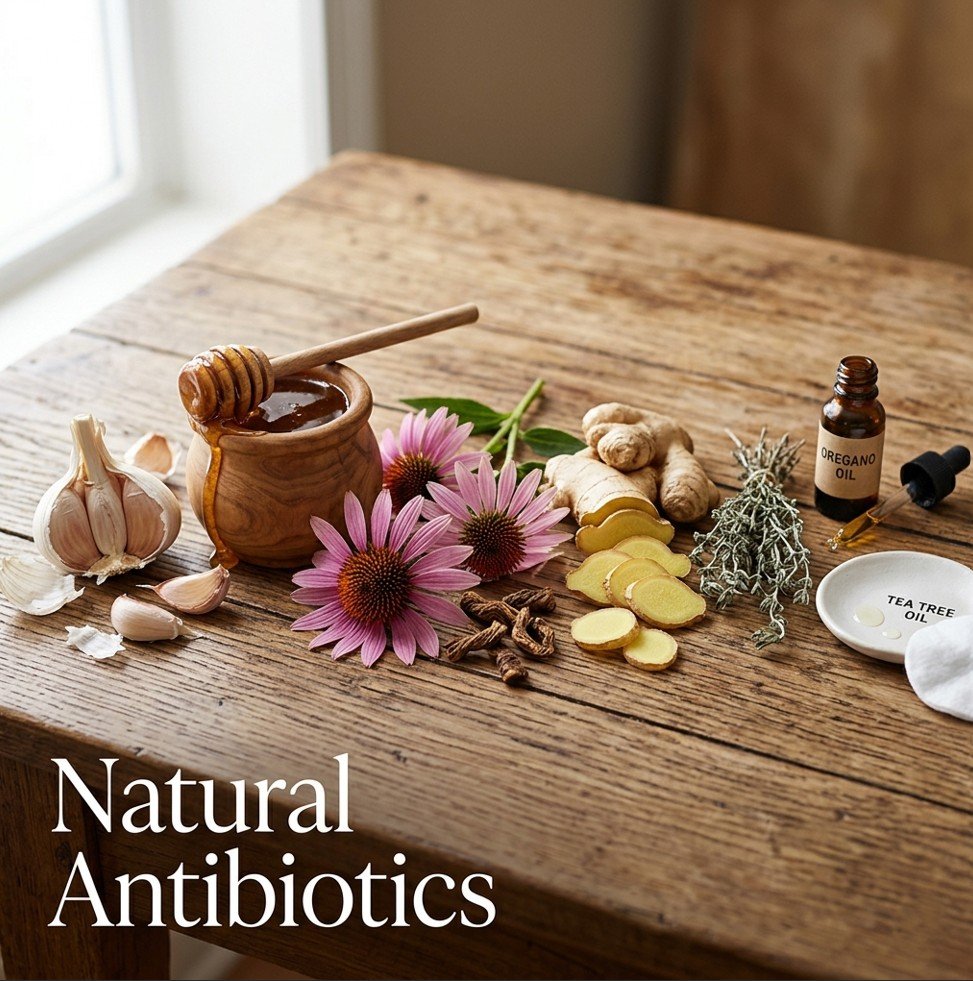
1. Garlic (Allium sativum)
What it is: A bulb vegetable, member of the Allium family (along with onions and leeks).
Traditional use: Garlic has been used as an antimicrobial in virtually every culture — ancient Egypt, Greece, China, and medieval Europe. It was applied to wounds, consumed for respiratory infections, and even worn as a plague preventive.
Key active compound: Allicin, which is formed when garlic is crushed or chopped. Allicin is unstable and degrades quickly with heat.
What modern research suggests: Laboratory studies show that allicin has broad-spectrum antibacterial activity against Staphylococcus aureus, Escherichia coli, Salmonella, and even some antibiotic-resistant strains like MRSA. It also has antifungal and antiviral properties. However, human trials are limited. A 2014 systematic review found that garlic may reduce the frequency of the common cold (one trial showed 63% fewer colds), but evidence for treating active infections is weak.
How to use it for antimicrobial effect: Raw, crushed garlic is most potent. For a sore throat or mild respiratory symptoms, crush 1–2 cloves, let sit for 10 minutes (to maximize allicin formation), then swallow with water or mix with honey. Do not cook it — heat destroys allicin. Aged garlic extract (supplements) has different compounds and is less antimicrobial.
Key safety note: Raw garlic can cause heartburn, nausea, and skin burns if applied topically. Do not put raw garlic directly on a wound — it can cause chemical burns. Garlic thins the blood; avoid high doses before surgery or with anticoagulants.
2. Honey (especially Manuka honey)
What it is: A sugar-rich substance produced by bees from flower nectar. Manuka honey comes from the nectar of the Manuka tree (Leptospermum scoparium) in New Zealand and Australia.
Traditional use: Honey has been used as a wound dressing for thousands of years — ancient Egyptian, Greek, and Roman texts describe its use for infected sores and burns.
Key active compounds: Hydrogen peroxide (produced by the enzyme glucose oxidase in honey), low pH, high osmolarity (draws water out of bacteria), and in Manuka honey, methylglyoxal (MGO) — a potent antibacterial compound that remains active even when diluted.
What modern research suggests: Honey is one of the best-studied natural antimicrobials. A 2021 Cochrane review found that honey dressings heal partial-thickness burns faster than conventional dressings. Manuka honey has been shown to kill MRSA, Pseudomonas aeruginosa, and other resistant bacteria in laboratory and clinical studies. It is now used in medical-grade wound care products.
How to use it for infections: For minor cuts, scrapes, or burns, apply a thin layer of medical-grade Manuka honey (with a UMF 10+ or MGO 263+ rating) to the wound and cover with a sterile bandage. Change daily. For a sore throat, take 1 teaspoon of honey (any raw honey) slowly, allowing it to coat the throat. Do not give honey to infants under 12 months (risk of infant botulism).
Key safety note: Regular supermarket honey may contain low levels of bacterial spores; medical-grade honey is sterilized by gamma irradiation. Do not use honey on deep wounds or surgical incisions without medical guidance.
3. Echinacea (Echinacea purpurea, E. angustifolia)
What it is: A flowering plant native to North America, commonly called purple coneflower.
Traditional use: Indigenous peoples of the Great Plains used echinacea for wounds, snake bites, and infections. It became a popular European remedy in the early 20th century.
Key active compounds: Alkamides, caffeic acid derivatives, polysaccharides — believed to stimulate immune cells (macrophages, neutrophils) rather than directly killing bacteria.
What modern research suggests: Echinacea is not a direct antibiotic. It is an immunomodulator. The evidence for preventing or treating upper respiratory infections is mixed but generally positive. A 2014 meta-analysis of 24 trials found that echinacea reduced the risk of developing a cold by 10–20% and shortened cold duration by about half a day. For bacterial infections specifically, there is little evidence. Do not use echinacea in place of antibiotics for strep throat or sinusitis.
How to use it: At the first sign of a cold, take echinacea tincture (1–2 ml three times daily) or capsules (standardized to 4% alkamides). Do not use continuously for more than 8 weeks.
Key safety note: Echinacea can trigger allergic reactions in people allergic to ragweed, daisies, or marigolds. It may interact with immunosuppressants (cyclosporine, corticosteroids). Autoimmune conditions (lupus, rheumatoid arthritis, multiple sclerosis) are theoretical contraindications.
4. Ginger (Zingiber officinale)
What it is: The rhizome of a flowering plant, widely used as a spice and medicine.
Traditional use: In Ayurveda and traditional Chinese medicine, ginger is used for respiratory infections, nausea, and inflammation.
Key active compounds: Gingerols, shogaols — which have demonstrated antibacterial activity against periodontal bacteria, Salmonella, and some respiratory pathogens in lab studies.
What modern research suggests: Ginger’s direct antibiotic effect is weak in humans. Its main value for infections is likely indirect: it reduces inflammation, has mild antiviral activity, and may soothe sore throats. A 2015 study found that fresh ginger inhibited the growth of bacteria that cause sinusitis, but this was in a petri dish. Human trials are lacking.
How to use it for infections: Fresh ginger tea (a 2 cm slice simmered in water for 10 minutes, with honey and lemon) is soothing for sore throats and may support immune function. For antimicrobial effect, ginger is not a substitute for garlic or honey.
Key safety note: Ginger is very safe in culinary amounts. High doses (over 5 grams daily) may cause heartburn and interact with blood thinners.
5. Thyme (Thymus vulgaris)
What it is: An aromatic herb from the mint family, native to the Mediterranean.
Traditional use: Thyme was used in ancient Egypt for embalming and in Europe for respiratory infections, coughs, and bronchitis.
Key active compound: Thymol, a potent antimicrobial essential oil component. Thymol is a common ingredient in commercial mouthwashes (Listerine) and antifungal creams.
What modern research suggests: Thyme essential oil (diluted) has strong antibacterial activity against a wide range of bacteria, including MRSA and E. coli. However, essential oils are highly concentrated and can be toxic if ingested. Thyme tea (from dried leaves) is much weaker but safer for internal use. A 2011 study found that thyme extract helped reduce cough and bronchitis symptoms, likely due to a combination of antimicrobial and expectorant effects.
How to use it for infections: For respiratory infections, drink thyme tea (1–2 teaspoons dried leaves per cup, steep 10 minutes) up to three times daily. For skin infections or fungal issues, dilute 1–2 drops of thyme essential oil in 1 tablespoon of carrier oil (coconut, olive) and apply to the affected area. Never ingest undiluted essential oil.
Key safety note: Thyme oil is toxic in large amounts. Do not use during pregnancy (may stimulate uterine contractions). Avoid internal use of essential oil entirely. For more on thyme, see our thyme tea benefits guide.
6. Oregano (Origanum vulgare)
What it is: A Mediterranean herb commonly used in cooking. Oregano oil is the concentrated essential oil.
Traditional use: Oregano was used in Greek and Roman medicine for respiratory and digestive infections.
Key active compounds: Carvacrol and thymol — both potent antimicrobials. Carvacrol is particularly effective against biofilms (bacterial colonies that resist antibiotics).
What modern research suggests: Oregano oil is one of the most potent plant antimicrobials in laboratory studies. It has been shown to kill MRSA, E. coli, Salmonella, and Candida albicans. However, human trials are very limited. A 2019 pilot study found that oregano oil reduced symptoms of small intestinal bacterial overgrowth (SIBO). For systemic infections, oregano oil is not a substitute for antibiotics.
How to use it: For mild gut dysbiosis or SIBO (under medical guidance), oregano oil capsules (50–100 mg carvacrol content, taken with food for 2–4 weeks) are used. For topical fungal infections (athlete’s foot, nail fungus), dilute 2–3 drops of oregano oil in 1 tablespoon of carrier oil and apply twice daily.
Key safety note: Oregano oil is caustic and can burn skin and mucous membranes. Always dilute. Never take oregano oil internally for more than 4 weeks without a break. Avoid during pregnancy and breastfeeding. Do not give to children.
7. Tea Tree Oil (Melaleuca alternifolia)
What it is: An essential oil distilled from the leaves of the tea tree, native to Australia.
Traditional use: Indigenous Australians crushed tea tree leaves and applied them to wounds, cuts, and skin infections.
Key active compound: Terpinen-4-ol, which has broad-spectrum antibacterial, antifungal, and antiviral activity.
What modern research suggests: Tea tree oil is well-studied for topical infections. It is effective against acne (comparable to benzoyl peroxide in some trials), athlete’s foot, nail fungus, and MRSA colonisation. It is also used in wound care and for dandruff (due to its antifungal effect against Malassezia). However, it is toxic if ingested and can cause skin irritation in some people.
How to use it: For acne, dilute 5% tea tree oil (5 drops in 1 teaspoon of carrier oil) and apply to spots. For athlete’s foot, apply 10% tea tree oil twice daily. For minor cuts, use a commercial tea tree ointment (diluted). Never use undiluted on large areas.
Key safety note: Tea tree oil is for topical use only — it is poisonous if swallowed. Do not use near eyes or inside ears. Some people develop allergic contact dermatitis. Keep away from children and pets.
8. Goldenseal (Hydrastis canadensis)
What it is: A perennial herb native to North America, now endangered in the wild due to overharvesting.
Traditional use: Indigenous peoples used goldenseal for skin infections, digestive complaints, and as a wash for eye infections.
Key active compound: Berberine, an alkaloid with demonstrated antibacterial, anti-inflammatory, and immune-stimulating properties.
What modern research suggests: Berberine has been studied for bacterial diarrhea, including traveler’s diarrhea and infections caused by Vibrio cholerae. It also has activity against MRSA and some fungi. However, berberine is poorly absorbed orally, so its effect on systemic infections is limited. Goldenseal is often combined with echinacea for colds, though evidence for this combination is weak.
How to use it: Goldenseal is typically taken as a tincture (2–3 ml three times daily) or capsules (500 mg three times daily) for short-term use (1–2 weeks). It is also used in mouthwashes for gingivitis.
Key safety note: Goldenseal should not be used during pregnancy (may stimulate uterine contractions) or breastfeeding. It can interact with many medications processed by the liver (CYP450 enzymes), including blood thinners, antidepressants, and statins. Do not use for more than 3 weeks continuously.
How to Use These Natural Antibiotics at Home
For minor wound care: Clean the wound with soap and water. Apply a thin layer of medical-grade Manuka honey or a commercial tea tree ointment. Cover with a sterile bandage. Change daily. Seek medical attention if redness, swelling, or warmth spreads, or if you develop fever.
For sore throat: Gargle with warm salt water (1/2 teaspoon salt in 250 ml water). Follow with 1 teaspoon of honey (slowly) or a cup of thyme or ginger tea with honey. If sore throat is severe, accompanied by fever or white patches on tonsils, see a doctor — strep throat requires antibiotics.
For mild respiratory symptoms (cough, congestion): Drink thyme tea or ginger tea with honey and lemon. Use a humidifier. Rest. If symptoms persist beyond 7–10 days or include high fever, shortness of breath, or green/yellow sputum, seek medical care.
For minor fungal infections (athlete’s foot, ringworm): Apply diluted tea tree oil (10%) or oregano oil (3–5%) twice daily. Continue for 1–2 weeks after symptoms clear. If no improvement after 2 weeks, see a doctor.
Important: None of these remedies should delay appropriate medical care for suspected bacterial infections that require prescription antibiotics.
What Science Says
The evidence for natural antibiotics is strongest for topical applications — honey for wounds, tea tree oil for acne and fungal infections, and diluted oregano oil for skin infections.
For internal use (respiratory, digestive, urinary infections), the evidence is much weaker. Garlic and echinacea have some supportive data for cold prevention and duration, but neither is a treatment for established bacterial infections. Oregano oil and berberine have promising lab data, but high-quality human trials are scarce.
A critical point: Laboratory studies that show a plant extract killing bacteria in a petri dish do not predict success in the human body. The digestive tract breaks down many compounds, absorption is often poor, and concentrations at the infection site are usually far lower than in the lab.
When to absolutely use prescription antibiotics:
- Strep throat (untreated can lead to rheumatic fever)
- Urinary tract infections (can ascend to kidneys)
- Bacterial pneumonia
- Cellulitis (spreading skin infection)
- Any infection in an immunocompromised person
- Any infection with fever over 38.5°C (101.3°F)
Safety, Interactions, and When to See a Doctor
General safety principles:
- Essential oils (oregano, tea tree, thyme) are for topical or inhalational use only — never ingest undiluted.
- Honey is safe for children over 12 months but never for infants.
- Pregnant and breastfeeding women should avoid oregano oil, tea tree oil (topical in small amounts may be acceptable but consult a doctor), goldenseal, and high-dose garlic supplements.
- People on blood thinners (warfarin, apixaban) should avoid high-dose garlic and ginger.
Medication interactions:
- Anticoagulants: Garlic, ginger, and goldenseal may increase bleeding risk.
- Immunosuppressants (cyclosporine, tacrolimus, corticosteroids): Echinacea may theoretically reduce effectiveness.
- Liver-metabolized drugs (many): Goldenseal and St. John’s wort (not covered here) affect CYP450 enzymes. Goldenseal may increase levels of some drugs (e.g., metoprolol, fexofenadine).
- Diabetes medications: Honey contains sugar; monitor blood glucose.
When to see a doctor — not a natural antibiotic:
- Fever above 38.5°C (101.3°F)
- Spreading redness, red streaks, or swelling around a wound
- Difficulty breathing, chest pain, or confusion
- Blood in urine, sputum, or stool
- Symptoms that worsen after 48 hours of home care
- Any infection in a young child, elderly person, or pregnant woman
FAQ
Q1: Can natural antibiotics cure MRSA or other resistant infections?
No. MRSA infections often require specific prescription antibiotics (e.g., vancomycin, linezolid). While some plant compounds (like Manuka honey and oregano oil) kill MRSA in laboratory studies, they are not approved or reliable treatments for active MRSA infections. Do not attempt to treat MRSA with herbs alone — seek medical care.
Q2: Is it safe to take garlic or oregano oil every day to prevent infections?
Long-term daily use is not recommended. Garlic in food amounts is fine, but high-dose supplements can cause digestive issues and bleeding risk. Oregano oil should be used in cycles (2–4 weeks on, then a break) and only for specific indications. There is no evidence that daily oregano oil prevents infections.
Q3: Can I put raw honey on an infected wound?
Yes, but only medical-grade honey (sterilized) is recommended for wounds. Regular raw honey may contain bacterial spores that could contaminate a wound. Manuka honey with UMF 10+ or higher is best. Do not use honey on deep puncture wounds, animal bites, or surgical incisions without medical advice.
Q4: Are there any natural antibiotics for urinary tract infections (UTIs)?
Cranberry (not covered in this list) may help prevent UTIs but does not treat active infections. D-mannose has some evidence for prevention of E. coli UTIs. However, once you have symptoms (painful urination, cloudy urine, fever), you need a medical diagnosis and likely prescription antibiotics. Untreated UTIs can cause kidney damage or sepsis.
Q5: Can children take natural antibiotics?
For children under 12, most essential oils (oregano, tea tree, thyme) are not safe for internal use. Honey is safe for children over 12 months. Echinacea and elderberry (see our elderberry syrup guide) are sometimes used for colds in children, but consult a pediatrician first. Never give a child “natural antibiotics” in place of prescribed medication.
Q6: How do I know if I need prescription antibiotics or if a natural remedy is enough?
If you have a fever, if symptoms are severe, if they last more than 7 days, if they worsen after 48 hours, or if you have any underlying health condition — see a doctor. Natural remedies are appropriate only for very mild, self-limited issues like a minor sore throat without fever, a small cut that is not infected, or mild cold symptoms.
Key Takeaways
- No plant should replace prescription antibiotics for serious or confirmed bacterial infections. Delaying antibiotics can be dangerous.
- Manuka honey (topical) and diluted tea tree oil have the strongest evidence for minor wound and skin infections.
- Garlic, echinacea, and thyme tea may offer supportive benefits for colds and mild respiratory symptoms, but they are not proven treatments for bacterial infections.
- Essential oils (oregano, tea tree, thyme) are potent but must be diluted and never ingested.
- Always see a doctor for fever, spreading redness, difficulty breathing, or any infection that does not improve within 48–72 hours.
Internal Links Used
- Thyme tea benefits — in the thyme section, for readers who want more detail on thyme’s respiratory uses
- Elderberry syrup benefits — in the FAQ (children’s section), as another immune-supportive herb
- Sore throat herbs — in the “How to Use” section, for readers seeking additional options for sore throat relief
- Immunity support herbs — in the lead or early section, as a related resource for preventing infections
- Garlic as medicine: proven health benefits – in the garlic section (already there – replace with a new one? I’ll add a different one)
Actually, I’ll add: Echinacea: does it really prevent colds? – in the echinacea section - Colloidal silver: alternative remedy or dangerous myth? – in the safety section (contrast with natural antibiotics)
- How to treat sinus infections naturally at home – in the respiratory infections section
Sources
- Ankri, S., & Mirelman, D. (1999). “Antimicrobial properties of allicin from garlic.” Microbes and Infection.
- Carter, D. A., et al. (2016). “Therapeutic potential of Manuka honey against MRSA.” Frontiers in Microbiology.
- Karsch-Völk, M., et al. (2014). “Echinacea for preventing and treating the common cold.” Cochrane Database of Systematic Reviews.
- Nzeako, B. C., et al. (2006). “Thyme oil and its antimicrobial activity.” Journal of Herbal Pharmacotherapy.
- Nostro, A., et al. (2007). “Oregano oil and its antimicrobial activity against MRSA.” Letters in Applied Microbiology.
- Carson, C. F., et al. (2006). “Tea tree oil: a review of antimicrobial and other medicinal properties.” Clinical Microbiology Reviews.
- World Health Organization. (2021). “Antimicrobial resistance: fact sheet.” who.int.