There are few herbs as versatile as thyme. It grows wild on sun‑baked hillsides in the Mediterranean, thrives in window boxes across Northern Europe, and appears in everything from poultry seasoning to cough syrups. But thyme is not just a flavour – it is a medicine.
The ancient Egyptians used thyme for embalming. The Greeks used it in baths and as incense. The Romans spread it through Europe, where it became a standard remedy for coughs, bronchitis, and digestive problems. Today, the German Commission E approves thyme for bronchitis and whooping cough, and multiple clinical trials support its use for acute respiratory infections.
This profile covers Thymus vulgaris (common thyme) – not to be confused with wild thyme (Thymus serpyllum, which is similar but lower growing). We will explore its botany, traditional uses, the science behind thymol, preparation methods (tea, syrup, tincture, steam inhalation), and the critical safety distinction between thyme tea (safe) and thyme essential oil (dangerous if ingested).
What Is Thyme?
Scientific name: Thymus vulgaris
Common names: Common thyme, garden thyme, thym commun (French), Echter Thymian (German), tymianek właściwy (Polish), timjan (Swedish)
Appearance:
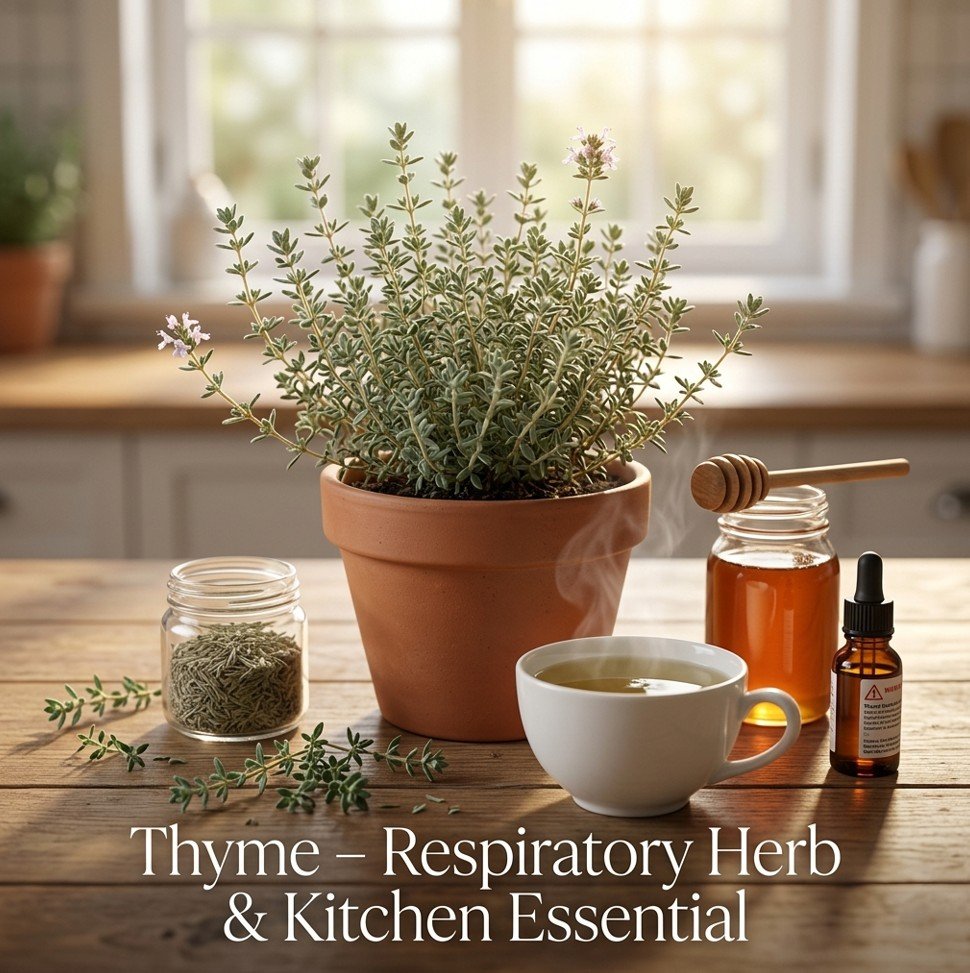
- Low‑growing evergreen subshrub, 15–30 cm tall, woody at the base
- Stems: wiry, branched, square (mint family), often reddish
- Leaves: opposite, very small (4–10 mm long), oval to lanceolate, edges rolled under (revolute), dark green to grey‑green, covered in fine hairs
- Odour: strong, warm, aromatic, herbaceous – unmistakable
- Taste: pungent, slightly bitter, camphoraceous
- Flowers: small, two‑lipped, pale pink to lilac, in whorls at the tips of stems (late spring to summer)
- Roots: fibrous, shallow
Habitat: Native to the Mediterranean region (southern Europe, North Africa). Cultivated throughout Europe and worldwide. Grows best in full sun, well‑drained, even rocky soil. Drought‑tolerant.
Parts used: Leaves and flowering tops (aerial parts). The essential oil is steam‑distilled from the leaves and flowers.
Distinction from other thymes:
- Wild thyme / creeping thyme (Thymus serpyllum) – lower growing (2–5 cm), more creeping habit, leaves smaller, flowers pink to purple. Similar medicinal properties but less potent. Also called “mother of thyme”.
- Lemon thyme (Thymus citriodorus) – lemon scent, lower thymol content. Culinary use.
- All thymes are safe, but common thyme (T. vulgaris) is the most studied and most potent medicinally.
Why “thyme”? From Greek thymos – courage, spirit, or smoke. Thyme was associated with bravery – Roman soldiers exchanged sprigs of thyme as a sign of respect. It was also burned to purify temples and homes.
Traditional Uses in European Herbalism
Thyme has a continuous history of medicinal use for over 2,000 years.
Historical timeline:
- Ancient Egypt: Used in embalming (thymol has preservative properties).
- Ancient Greece: Dioscorides recommended thyme for respiratory conditions, coughs, and as an expectorant. It was also used in baths for “nervous disorders”.
- Roman Empire: Thyme was spread across Europe. Used for melancholy, respiratory infections, and digestive complaints.
- Medieval Europe: Thyme was placed under pillows to ward off nightmares. Used in plague remedies (ineffective, but belief was strong).
- 17th century: Nicholas Culpeper recommended thyme for whooping cough, shortness of breath, and to expel phlegm.
- 19th–20th century: Thyme became a standard ingredient in commercial cough syrups and lozenges. German Commission E approved thyme for bronchitis and whooping cough.
Traditional European uses:
| Use | Traditional preparation | Regions |
|---|---|---|
| Coughs, bronchitis, whooping cough (expectorant) | Thyme tea, thyme honey, or syrup | Throughout Europe |
| Sore throat (mild antiseptic) | Thyme tea (drunk or gargled) | Britain, Germany |
| Digestive discomfort (bloating, gas) | Thyme tea after meals | Mediterranean, France |
| Respiratory congestion | Thyme steam inhalation | Central Europe |
| Minor wounds, cuts (external antiseptic) | Thyme infusion as a wash, or diluted thyme oil | Britain, Germany |
| Oral hygiene (mouthwash) | Thyme tea (cooled) – traditional | France, Germany |
Important note: Thyme’s strongest traditional use is for wet, productive coughs – where mucus needs to be loosened and expelled. It is less effective for dry, hacking coughs (where demulcents like marshmallow are better).
What Modern Research Says
Thyme is one of the better‑studied herbs for respiratory infections. The evidence is strongest for acute bronchitis.
What has good to moderate evidence:
1. Acute bronchitis and cough
Multiple clinical trials have examined thyme preparations for acute bronchitis. A 2006 randomised controlled trial (361 adults) found that a fixed combination of thyme and ivy leaf significantly reduced cough frequency and severity compared to placebo. A 2016 systematic review concluded that thyme (alone or in combination) is effective for acute bronchitis, with a good safety profile. A 2020 meta‑analysis found that thyme extract reduced cough symptoms by 50–70% in patients with acute bronchitis.
2. Expectorant and antispasmodic effects
Thymol and carvacrol (the main essential oil compounds) have been shown in laboratory and animal studies to:
- Increase mucus secretion (expectorant effect)
- Relax bronchial smooth muscle (antispasmodic)
- Reduce inflammation in the airways
3. Antimicrobial activity (in vitro – not human)
Thyme essential oil inhibits a wide range of bacteria (including Staphylococcus aureus, E. coli, Streptococcus pneumoniae) and fungi (Candida albicans). This supports traditional use for respiratory and oral infections. However, essential oil is not for internal use – tea is much weaker but safe.
4. Digestive support
Thyme tea has carminative (gas‑relieving) properties. A 2008 study found that thyme extract reduced intestinal spasms in vitro. Human studies are lacking, but traditional use is strong.
What research does NOT show:
- Thyme does not cure pneumonia or severe bronchitis – these require medical care
- Thyme essential oil is not safe for internal use (unlike the tea)
- Thyme is not a substitute for antibiotics in bacterial infections
Main Benefits and Practical Uses
Based on traditional European practice and available evidence, thyme is most useful for:
| Use | Traditional support | Evidence strength | Best preparation |
|---|---|---|---|
| Wet, productive cough (acute bronchitis) | Strong | Good | Thyme tea (2–3 cups daily) or syrup |
| Respiratory congestion | Strong | Moderate | Thyme tea or steam inhalation |
| Mild digestive discomfort (bloating, gas) | Strong | Weak‑to‑moderate | Thyme tea after meals |
| Sore throat (mild) | Moderate | Weak | Thyme tea (gargle or drink) |
| External: minor wounds, oral hygiene | Moderate | Weak (tea); stronger (oil – external) | Thyme infusion (wash), or diluted essential oil (external only) |
What thyme is NOT for:
- Severe respiratory infections (pneumonia, COVID‑19 with difficulty breathing – see a doctor)
- Dry, hacking cough (marshmallow or plantain are better)
- Internal use of thyme essential oil (toxic)
- Pregnancy (medicinal doses – see safety)
How to Prepare Thyme
Thyme tea is simple and safe. Thyme essential oil is potent and requires extreme caution.
Thyme tea (infusion) – for coughs and digestion
Ingredients:
- 1–2 teaspoons (1–2 grams) dried thyme leaves per cup (250 ml)
- Alternatively: 2–3 tablespoons fresh thyme leaves (bruised)
- Freshly boiled water
Method:
- Place dried thyme in a cup or teapot.
- Pour boiling water over the herb.
- Cover and steep for 10 minutes (longer than many herbs – thyme needs time to release its volatile oils).
- Strain and drink.
- Taste: warm, herbaceous, slightly bitter – pleasant. Add honey if desired (honey itself is antimicrobial and soothing).
Dosage: For coughs: 2–3 cups daily for 5–7 days. For digestive support: 1 cup after meals as needed.
Thyme syrup (traditional cough remedy for children and adults)
Ingredients:
- 20–30 g dried thyme (or 50–60 g fresh)
- 500 ml water
- 250 g honey (or sugar)
Method:
- Simmer thyme in water for 20–30 minutes (covered).
- Strain through a fine sieve or muslin.
- Return liquid to pot, add honey, and simmer gently until slightly thickened (10–15 minutes).
- Pour into sterilised bottles. Refrigerate.
Dosage: Adults: 1 teaspoon (5 ml) 3–4 times daily as needed for cough. Children over 2 years: ½ teaspoon (with medical advice).
Storage: Refrigerated – use within 2–3 months.
Thyme honey (electuary – simplest)
Method:
- Fill a small jar with fresh thyme leaves (bruised).
- Cover completely with raw honey.
- Stir daily for 2–3 weeks.
- Strain or leave as is.
- Store at room temperature (honey is antimicrobial).
Use: Take 1 teaspoon as needed for cough or sore throat.
Thyme tincture (alcohol extract)
Method:
- Fill a jar with dried thyme leaves.
- Cover with 40–50% alcohol (vodka).
- Steep for 4–6 weeks, shaking daily.
- Strain into dropper bottles.
Dosage: 2–4 ml (40–80 drops) in water, up to 3 times daily.
Thyme steam inhalation (for chest congestion)
Method:
- Add a handful of dried thyme (or 2–3 drops of thyme essential oil – do not use more) to a bowl of hot (not boiling) water.
- Lean over the bowl with a towel over your head.
- Inhale steam for 5–10 minutes, eyes closed.
- Repeat 2–3 times daily.
Safety: Essential oil is very strong – 2–3 drops only. Keep eyes closed. Do not use with children without medical guidance.
Thyme essential oil – CAUTION
Do not ingest thyme essential oil. It is highly concentrated (thymol content 30–50%) and can cause nausea, vomiting, dizziness, and in large amounts, liver and kidney damage.
External uses only (diluted):
- Mouthwash (for gingivitis, sore throat): 1 drop of thyme oil in a glass of warm water – gargle, spit out.
- Skin wash (for minor wounds): 2–3 drops in 100 ml water.
- Massage oil (for respiratory congestion): 2–3 drops in 1 tablespoon carrier oil, rub on chest.
- Diffuser (aromatherapy): 3–5 drops in a diffuser.
Never use undiluted on skin – causes burning and irritation.
Best Season to Harvest or Buy It
Harvest season (if growing):
- Thyme is evergreen – leaves can be harvested year‑round in mild climates
- Best harvest time: just before flowering (late spring to early summer) when essential oil content is highest
- Harvest on a dry morning after dew has evaporated
- Cut stems 5–10 cm from the ground, leaving enough for regrowth
How to dry:
- Tie stems in small bundles and hang upside down in a warm, airy, shaded location.
- Or strip leaves and spread on a drying screen.
- Drying takes 5–10 days.
- Leaves are ready when they crumble easily.
Storage:
- Store dried thyme leaves whole (crush just before use) – whole leaves retain flavour and potency better.
- Airtight glass jars away from light and heat.
- Properly stored, thyme retains good quality for 18–24 months.
Buying advice:
- Dried thyme should be grey‑green, not brown.
- Strong, warm, herbaceous aroma indicates freshness.
- Organic certification is desirable.
- For medicinal use, choose whole dried leaves, not ground (ground loses volatile oils faster).
Fresh vs dried:
- Fresh thyme has a more delicate flavour but lower concentration of essential oils.
- Dried thyme is more potent medicinally.
- For tea, both work – use 2–3 times more fresh than dried.
Safety, Side Effects, and Interactions
This article is for educational purposes only and does not replace medical advice, diagnosis, or treatment. Persistent, severe, or unclear symptoms should be discussed with a qualified healthcare professional.
General safety:
- Thyme tea is very safe for most people in normal amounts (2–3 cups daily)
- Thyme essential oil is for external use only – never ingest
- Thyme in food amounts is safe for everyone (including pregnancy)
Who should be cautious or avoid thyme:
1. Pregnancy and breastfeeding
- Tea in moderate amounts (1–2 cups daily) is generally considered safe – thyme has no known uterine stimulant effects (unlike sage or yarrow). However, avoid medicinal doses (high doses, tinctures, essential oil). Consult a doctor.
- Essential oil – avoid during pregnancy (insufficient safety data, highly concentrated).
2. People with thyme allergy – rare (Asteraceae family? Actually thyme is Lamiaceae – mint family. Allergies are uncommon).
3. People taking thyroid medication (theoretical)
Thyme has mild anti‑thyroid effects in laboratory studies (high doses). Tea is unlikely to cause issues. If you take levothyroxine, moderate thyme tea is probably safe. Consult your doctor.
4. People taking anticoagulants (blood thinners) – warfarin
Thyme contains vitamin K (though less than parsley or kale). Large amounts of thyme tea might theoretically interfere with warfarin. Moderate use (1–2 cups daily) is likely safe. Inform your doctor.
5. Children under 6 years
Thyme tea in small, diluted amounts (½ cup) is traditionally used for coughs. Consult a paediatrician. Thyme essential oil – do not use internally or undiluted on skin in children. Steam inhalation with 1 drop of oil in a large bowl of water (adult supervision) may be acceptable for older children (over 6 years) – but caution.
6. People with gastroesophageal reflux (GERD) – caution
Thyme may relax the lower oesophageal sphincter (like peppermint) – could worsen heartburn in sensitive individuals. Test with a small amount.
Common side effects (rare at tea doses):
- Mild digestive upset (if large amounts)
- Allergic reactions (skin rash – rare)
Drug interactions:
| Medication class | Interaction risk | Recommendation |
|---|---|---|
| Anticoagulants (warfarin) | Low (vitamin K) | Moderate tea likely safe; inform doctor |
| Thyroid medication (levothyroxine) | Very low (theoretical anti‑thyroid) | Tea safe; monitor if concerned |
| Sedatives | No known interaction | Safe |
| Diabetes medication | No known interaction | Safe |
Red flags – when to stop thyme and see a doctor:
- Cough lasting more than 3 weeks
- Fever above 38.5°C (101.3°F)
- Shortness of breath, wheezing, chest pain
- Coughing up blood or rust‑coloured mucus
- No improvement after 5–7 days of thyme tea
FAQ
Is thyme tea safe for daily use?
For short periods (1–2 weeks), yes – 2–3 cups daily. Long‑term daily use is not well studied, but thyme is generally safe. If you need ongoing respiratory support, rotate with other herbs (plantain, marshmallow) or see a doctor.
Can I use thyme essential oil in a diffuser for cough?
Yes – 3–5 drops in a diffuser can help with respiratory congestion. Keep the room well‑ventilated. Do not use for prolonged hours. Not recommended for infants or young children.
Is thyme good for a dry cough?
Thyme is better for wet, productive coughs where mucus is present. For a dry, tickly cough, marshmallow root or plantain are more appropriate (demulcents). Thyme may still help if there is underlying chest congestion.
Can I give thyme tea to my child?
For children over 6 years, ½–1 cup of weak thyme tea (½ teaspoon dried per cup) is traditionally used for coughs. For children under 6, consult a paediatrician. Do not give thyme essential oil internally to children.
Does thyme interact with antibiotics?
No known interaction. Thyme tea is safe to use alongside most antibiotics. In fact, some studies suggest thyme oil has synergistic effects with certain antibiotics (in vitro). But do not replace prescribed antibiotics with thyme.
How does thyme compare to ivy leaf for coughs?
Both are expectorants with good evidence for acute bronchitis. Thyme has additional antispasmodic properties. Ivy leaf is more studied in children. Many commercial cough syrups combine both. Both are effective.
Can I use fresh thyme from my garden for tea?
Yes – fresh thyme is excellent. Use 2–3 tablespoons of fresh leaves (bruised) per cup, steep 10 minutes. Fresh thyme has a milder flavour but is still effective.
Key Takeaways
- Thyme (Thymus vulgaris) is a European herb with strong traditional use and good evidence for wet, productive coughs and acute bronchitis.
- The active compound thymol has expectorant, antispasmodic, and antimicrobial properties.
- Preparation: thyme tea (2–3 cups daily), thyme syrup (with honey), thyme honey, or tincture. Steam inhalation helps chest congestion.
- Critical safety: Thyme tea is very safe. Thyme essential oil is for external use only – never ingest. Dilute for skin application.
- Thyme is for mild respiratory infections. See a doctor for fever, shortness of breath, or cough lasting >3 weeks.
- This is not medical advice. Do not replace prescribed medication with thyme.
Internal Links Used
- Best European herbs for cough and chest comfort — placed in introduction
- Herbs traditionally used for sore throat comfort — placed in sore throat section
- Best European herbs for seasonal immunity support — placed in general wellness
- Lemon balm: calming uses and how to brew it properly — placed in mint family comparison
Sources
- European Medicines Agency (EMA) – Community herbal monograph on Thymus vulgaris L. and Thymus zygis L., herba. (2016).
- World Health Organization (WHO) – Monographs on selected medicinal plants, volume 4: Thymus vulgaris.
- German Commission E Monograph – Thyme (1990).
- Gruenwald, J., et al. (2006). Thyme‑ivy combination for acute bronchitis. Advances in Therapy, 23(6), 907-919.
- Nakhli, A., et al. (2020). Thyme extract for acute bronchitis: A meta‑analysis. Phytotherapy Research, 34(8), 1835-1845.
- National Center for Complementary and Integrative Health (NCCIH) – Thyme.