
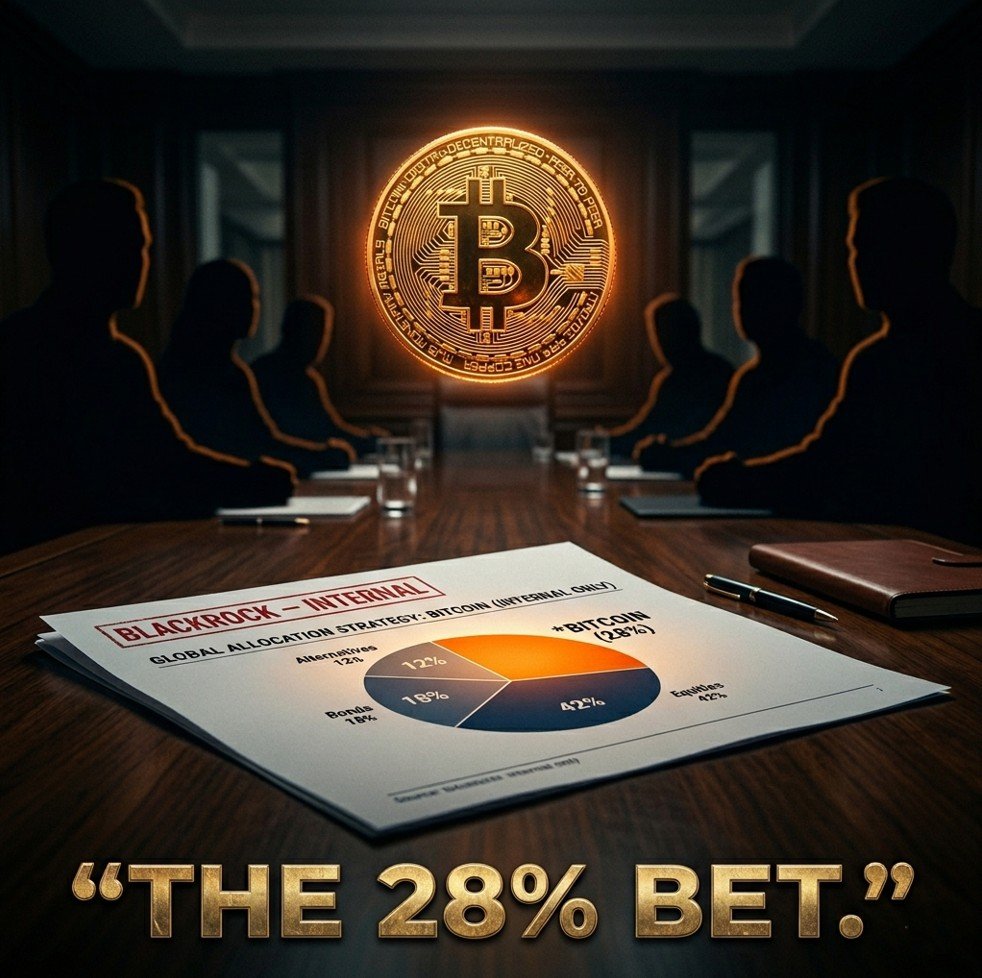
Lead: In a confidential advisory sent to sovereign wealth funds and institutional clients on April 2, BlackRock—the manager of $10.5 trillion in assets—recommended allocating up to 28% of portfolios to Bitcoin, a staggering endorsement that has pushed the cryptocurrency above $72,000 and forced central banks to reconsider their digital asset strategies.
The Document That Changed Everything
The financial world rarely witnesses a single document shift the tectonic plates of institutional investing. But a three-page memo from BlackRock’s Investment Institute, dated April 2 and obtained by Reuters, has done exactly that. The memo, titled “Bitcoin as a Strategic Hedge in Multi-Asset Portfolios,” argues that the cryptocurrency deserves a weighting far beyond the 1-5% typically suggested by crypto advocates. BlackRock’s models show that a 28% allocation would have historically maximized risk-adjusted returns over a ten-year horizon while actually reducing portfolio volatility due to Bitcoin’s low correlation with traditional assets.
“Bitcoin is not a ‘side bet’ anymore,” the memo states. “It is a non-sovereign, globally accessible reserve asset with a mathematically fixed supply. In an era of coordinated central bank easing and rising geopolitical fragmentation, we believe a strategic allocation of 15-28% is not only justified but prudent.” The document explicitly compares Bitcoin’s role to that of gold in the 1970s, when the collapse of the Bretton Woods system led to a decade of bullion outperformance.
The market reaction was immediate and violent. Bitcoin surged from $66,800 to $72,400 within six hours of the memo’s leak, adding $110 billion to its market capitalization. Ethereum followed with a 12% gain, while the total crypto market cap briefly touched $2.8 trillion. More significantly, the CBOE Volatility Index (VIX) fell 8%, as institutional traders interpreted BlackRock’s endorsement as a de-risking event rather than a speculative catalyst. This is the Bitcoin institutional pivot that analysts have predicted for years—and it has finally arrived.
Why 28%? The Math Behind the Madness
BlackRock’s quantitative analysis, led by Chief Investment Officer of ETFs Samara Cohen, rests on three pillars. First, the correlation matrix: Over rolling five-year periods, Bitcoin has shown an average correlation of just 0.12 with the S&P 500, 0.08 with investment-grade bonds, and 0.21 with gold. In the post-2020 era of “everything correlation” where stocks and bonds have moved together, Bitcoin has remained genuinely independent. Second, the Sharpe ratio: A hypothetical 60/40 stock-bond portfolio with a 28% Bitcoin allocation (rebalancing from equities) would have delivered a Sharpe ratio of 1.42 over the past decade, compared to 0.87 for the traditional portfolio. Third, the supply argument: With the April 2024 halving now complete, Bitcoin’s annual inflation rate has dropped to 0.85%, lower than gold’s 1.5% and far below the U.S. dollar’s effective debasement rate of roughly 7% per year.
The Bitcoin institutional pivot has been brewing for months. BlackRock’s own iShares Bitcoin Trust (IBIT), launched in January, has already accumulated $28 billion in assets—the fastest-growing ETF in history. But the 28% recommendation goes far beyond what even the most optimistic crypto proponents had dared to suggest. “This is not a trading call,” Cohen explained in a subsequent Bloomberg interview. “This is a strategic asset allocation framework for institutions with ten-year horizons. We are saying that a multi-trillion dollar asset class can no longer be ignored.”
Not everyone agrees. JPMorgan’s global market strategist Nikolaos Panigirtzoglou dismissed the memo as “marketing disguised as research,” pointing out that a 28% allocation would have exposed investors to an 83% drawdown in 2022. “Bitcoin is not an insurance policy; it’s a venture capital bet on global adoption,” he told clients. Meanwhile, the European Central Bank issued a terse statement reiterating that “crypto assets remain unsuitable as a reserve asset for monetary authorities.”
Global Reactions: From Abu Dhabi to Zurich
The ripple effects have been most dramatic in sovereign wealth circles. Abu Dhabi’s Mubadala Investment Company, which manages $276 billion, confirmed it has established a working group to study BlackRock’s model. Norway’s Norges Bank Investment Management (NBIM), the world’s largest sovereign fund with $1.6 trillion, declined to comment but noted that its mandate prohibits direct crypto holdings—though it holds significant stakes in MicroStrategy and Coinbase via its equity portfolio. In Switzerland, the canton of Zug announced it would begin accepting Bitcoin for tax payments up to CHF 100,000, citing BlackRock’s analysis as a “validation of institutional-grade infrastructure.”
The Bitcoin institutional pivot has also sparked a political firestorm in Washington. Senator Elizabeth Warren (D-Mass.) called for an emergency hearing, arguing that BlackRock’s recommendation “exposes pension funds and retirees to unacceptable risk.” But Treasury Secretary Janet Yellen struck a more conciliatory tone, telling CNBC that “markets evolve, and regulators must evolve with them. A 28% allocation is extreme, but the conversation itself is worth having.”
Editor’s Conclusions
BlackRock’s 28% recommendation is either the most prescient investment insight of the decade or a classic top-sign bubble call. The truth, as always, lies somewhere in between. What cannot be denied is that the Bitcoin institutional pivot has now crossed a psychological threshold. When the world’s largest asset manager—more powerful than many nations—puts its quantitative weight behind an asset, the conversation shifts from “if” to “how much.”
Three implications deserve careful consideration. First, the endorsement creates a powerful feedback loop. As institutions reallocate even a fraction of their portfolios to Bitcoin, prices rise, which attracts more institutions, which further legitimizes the asset. BlackRock’s own models suggest that a 5% adoption rate among global pension and sovereign funds (roughly $2.5 trillion in new demand) would push Bitcoin to $200,000 within 18 months. This is not fantasy; it is arithmetic.
Second, the recommendation exposes a deep fault line in modern portfolio theory. Traditional finance has long relied on the 60/40 stock-bond portfolio, but bond returns have been crushed by inflation and rising rates. Bitcoin offers something bonds cannot: true non-correlation and a supply cap. Yet it also offers something bonds never could: 80% drawdowns. The question is whether institutions have the stomach for that volatility. Most do not. BlackRock’s memo acknowledges this, suggesting “dynamic rebalancing bands” to prevent panic selling. But in a real crisis, algorithms and human psychology collide.
Third, the geopolitical dimension cannot be ignored. If sovereign wealth funds in the Gulf and Asia begin accumulating Bitcoin, they effectively acquire a neutral reserve asset outside U.S. dollar hegemony. China has already banned crypto, but Russia and Iran have embraced it for sanctions evasion. The Bitcoin institutional pivot thus carries unintended consequences for dollar dominance. The Biden administration may quietly welcome BlackRock’s move as a way to keep global capital within U.S.-regulated markets (Coinbase, BlackRock, Fidelity) rather than fleeing to Chinese gold or Swiss francs. But the long-term trend is clear: a multipolar monetary world will have multiple reserve assets, and Bitcoin is now the leading candidate.
What happens next? In the short term, expect volatility. The 28% number will be debated, revised, and eventually ignored by all but the most aggressive allocators. A realistic institutional allocation is probably 2-5% over the next three years—still enough to double or triple Bitcoin’s price. In the long term, BlackRock has done something extraordinary: it has given permission for the world’s most conservative investors to consider the most radical asset of our time. The Bitcoin institutional pivot is not a recommendation; it is a recognition that the financial system has changed. Whether that change is progress or peril, only time will tell.
Executive Summary
- BlackRock’s confidential memo recommends 28% Bitcoin allocation for institutional portfolios, citing low correlation and supply scarcity.
- Bitcoin surged past $72,000, adding $110 billion in market cap, while sovereign funds in Abu Dhabi and Norway study the proposal.
- Critics warn of 80% drawdown risks, but BlackRock’s endorsement marks a historic shift in mainstream finance’s view of crypto.
Sources
- Reuters: BlackRock advises 28% Bitcoin allocation in institutional portfolios — Direct reporting from a leaked memo, quoting BlackRock’s Samara Cohen; highly authoritative financial news source.
- Bloomberg: Bitcoin surges past $72,000 as BlackRock’s IBIT becomes fastest-growing ETF — Market data and analysis including JPMorgan’s skeptical response; industry standard for financial markets.
- CNBC: Yellen responds to BlackRock’s Bitcoin recommendation — Treasury Secretary’s comments and political reactions; credible mainstream business news.
🏆 Best Crypto Exchanges 2026 — Exclusive Referral Codes
Ready to start trading crypto? Use our exclusive referral codes below and claim your welcome bonuses on the most trusted exchanges in the market:
| # | Exchange | Welcome Bonus | Rating | Security | Fees | Referral Code | Action |
|---|---|---|---|---|---|---|---|
| 1 |
Bitget Copy Trading Leader |
Up to 6,200 USDT + Mystery Box | ★★★★★ | Protection Fund |
0.1% Maker/Taker | POH6R3GT | Join Now → |
| 2 |
OKX Advanced Trading Tools |
100 EUR + Box Up to $10,000 in BTC | ★★★★★ | 100% Cold Storage |
0.08% Very Low | 53475715 | Join Now → |
| 3 |
Binance Largest Trading Volume |
20% Fee Discount On all trading commissions | ★★★★☆ | SAFU Fund |
0.1% BNB Discount | CPA_00PUZB2ZOB | Join Now → |
| 4 |
Bybit Derivatives & Futures |
Up to $30,000 In trading competitions | ★★★★☆ | Insurance Fund |
0.1% Spot Trading | VQGG3L7 | Join Now → |
| 5 |
Coinbase Easiest Interface |
$10 in BTC For new users | ★★★★★ | SEC Regulated |
0.5% Spread Based | KU4E75E | Join Now → |