Lead: In a landmark move on April 1, the European Commission circumvented a Hungarian veto to adopt preparatory steps for a €90 billion Ukraine loan, allocating €28.3 billion specifically to accelerate drone production and signaling a strategic shift toward a protracted industrial conflict.
Bypassing the Veto: Brussels’ Endgame
The corridors of Brussels witnessed a masterclass in political ingenuity on Wednesday. With Hungary blocking the full €90 billion Ukraine Support Loan, the European Commission did not wait. Instead, it adopted the necessary preparatory steps to mobilize part of the funding for 2026 and bypass the political deadlock that has crippled the bloc’s decision-making for months. This is a defining moment of the EU defense pivot—a calculated move to treat Ukraine’s security as a matter of existential urgency for the entire continent.
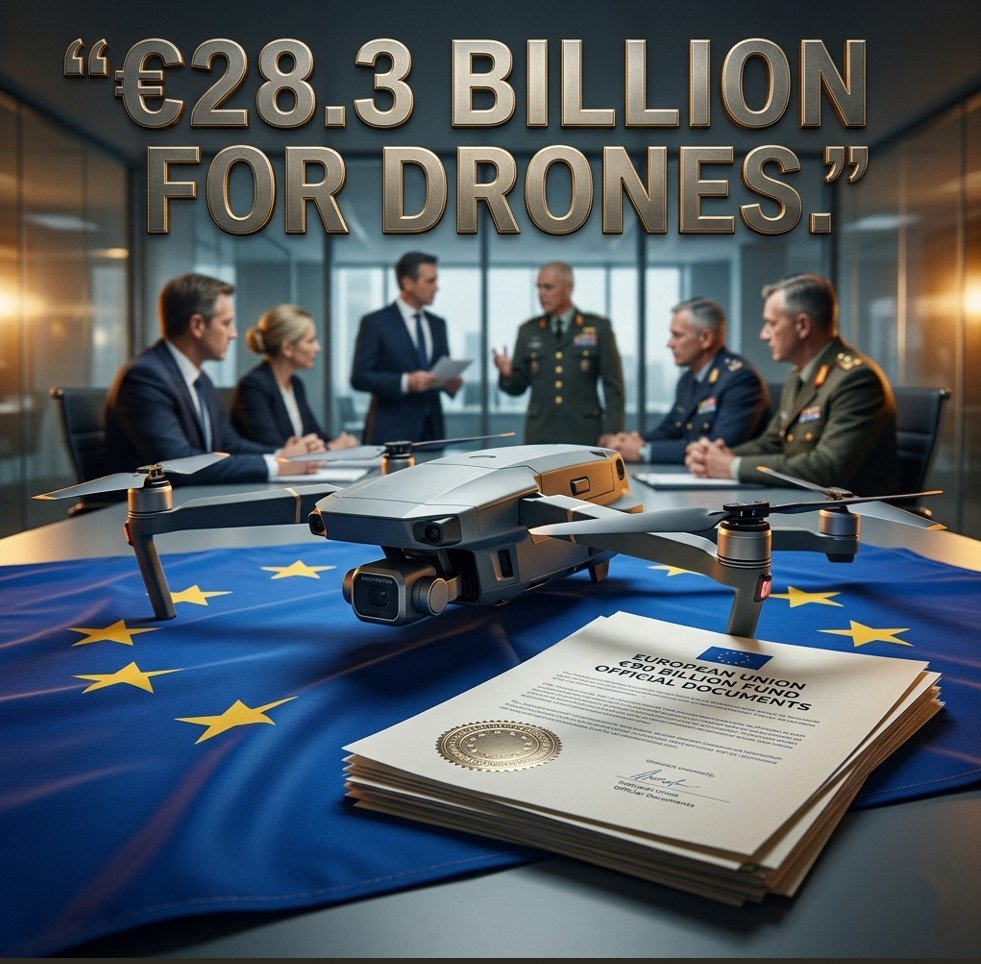
The Commission’s proposal, announced on April 1, 2026, envisages providing €45 billion to Ukraine by December 31 of this year, exactly half of the total €90 billion loan. Of this amount, €16.7 billion will support Ukraine’s beleaguered state budget, ensuring that hospitals, schools, and pensions remain funded despite the ravages of war. But the headline figure is the remaining €28.3 billion, earmarked for military, defense, and weapons production. This is not aid in the traditional sense; it is an investment in a co-production alliance.
The political context is electric. Hungary, led by Prime Minister Viktor Orbán, has tied its approval of the full loan to the restoration of Russian oil transit through the Druzhba pipeline. Orbán has effectively held the entire package hostage, demanding inspections that Kyiv has rejected, citing damage from a Russian strike. Slovakia’s Prime Minister Robert Fico has also signaled he could block further loans. Yet Brussels has moved forward regardless, sending a clear message: the EU defense pivot will proceed with or without Budapest’s blessing.
Derogations and Fast-Track Procurement: The Drone Revolution
The most operationally significant element of the Commission’s decision is the authorization for Ukraine to use procurement derogations. In plain language, this means Kyiv can buy drone components from outside the European Union if no equivalents are available within the bloc. This is a seismic shift in EU procurement law, which typically prioritizes European suppliers. But the Commission has acknowledged a brutal reality: Ukraine is a country at war, and its capacity to defend its territory depends on the rapid availability of critical products in the required quantities and within very short timeframes.
This decision will support the preparations for the first urgent defense procurements under the new instrument, with additional product schedules for missiles and ammunition expected in the coming months. The focus on drones is deliberate. After three years of full-scale war, both sides have learned that the skies above the front lines belong to unmanned systems. From first-person-view (FPV) attack drones to long-range reconnaissance platforms, drones have fundamentally reshaped modern warfare. Europe is now betting billions on the proposition that the side which can mass-produce drones most effectively will win the artillery duel that defines this war.
The numbers are staggering. The €28.3 billion allocated for defense industrial capacity is not a one-time grant. It is designed to create a permanent, integrated defense industrial base linking European manufacturers with Ukrainian production lines. This is the EU defense pivot becoming flesh: a shift from donating aging stockpiles to co-producing the weapons of the future.
Political Repercussions and the Rule of Law Conditionality
The loan is not a blank check. The Commission has attached stringent conditionality to the budgetary support component, linking disbursements to progress on the rule of law, anti-corruption reforms, economic resilience, and sustainability. This dual-track approach—fast-track military procurement alongside strict governance benchmarks—reflects Brussels’ determination to avoid the mistakes of previous aid packages, where funds were sometimes misappropriated or wasted.
European Commission President Ursula von der Leyen framed the decision as a statement of resolve. “We will deliver on the €90 billion loan to Ukraine. Today, we are taking the necessary preparatory steps to mobilize this year’s budget and procure defense equipment, with a focus on Ukraine’s cutting-edge drone industry,” she said. “With this we send a clear message: the Commission stands ready to move forward.” Her words were carefully chosen. By emphasizing that the Commission “stands ready” rather than announcing finalized disbursements, she signaled that the ball is now in the court of the EU Council, where member states must still agree on the allocation of funds for 2026.
The geopolitical message is unmistakable. Despite Hungarian obstruction, despite Slovak threats, despite the ongoing war in the Middle East diverting global attention, Brussels is signaling that Ukraine remains a top-tier priority. The EU defense pivot is not a reaction to the war’s third anniversary; it is a preparation for the fourth, fifth, and sixth. Europe is settling in for a long conflict, and it is spending accordingly.
Editor’s Conclusions
The Commission’s move on April 1 is not merely a bureaucratic workaround. It is a strategic document that reveals how Brussels thinks about the next phase of the war. Three conclusions emerge.
First, the EU defense pivot confirms that European leaders have abandoned any hope of a quick Ukrainian military breakthrough. The emphasis on drones, missiles, and ammunition—rather than tanks or aircraft—reflects a sober assessment: this war will be decided by industrial attrition, not by operational maneuver. Europe is building a production line, not a parade ground. The €28.3 billion for defense industrial capacity is designed to outlast Russia’s willingness to sustain its own losses. This is a bet on time, not territory.
Second, the use of procurement derogations marks the end of “Buy European” as a sacrosanct principle in wartime. By allowing Ukraine to purchase drone components from non-EU suppliers if European equivalents are unavailable, Brussels has acknowledged a painful truth: European defense industry is not yet capable of meeting wartime demand. The EU defense pivot will require a painful restructuring of European manufacturing, away from just-in-time commercial logic toward just-in-case military readiness. This transition will take years and cost billions.
Third, the loan’s conditionality on rule of law and anti-corruption reforms is a double-edged sword. On one hand, it is essential to prevent waste and ensure that Ukrainian taxpayers and European donors see results. On the other hand, it creates a potential choke point: if Kyiv falters on reforms, Brussels could suspend disbursements at a critical moment. The Commission has learned from Afghanistan and Iraq that unconditional aid breeds dependency and corruption. But in a war of survival, conditionality can feel like a luxury. Balancing accountability with urgency will be the defining challenge of the EU defense pivot.
What happens next? In the short term, the EU Council must approve the proposal. Hungary may continue to block, but the Commission has demonstrated that it can move forward with preparatory steps even without unanimous consent. In the medium term, expect a surge in drone production across Europe and Ukraine, with new factories opening in Poland, Romania, and western Ukraine. In the long term, the EU defense pivot will reshape European defense procurement forever, moving from a fragmented, nationally oriented system to a centralized, EU-led industrial policy. The €90 billion loan is not just about Ukraine’s survival. It is about Europe’s emergence as a military power in its own right.
Executive Summary
- The European Commission adopted preparatory steps for a €90 billion Ukraine loan on April 1, allocating €28.3 billion for defense industrial capacity and drone production.
- Procurement derogations allow Ukraine to buy drone components from outside the EU, accelerating weapons deliveries despite Hungarian and Slovak political obstruction.
- The loan ties budgetary support to rule-of-law and anti-corruption reforms, signaling Brussels’ commitment to accountable aid in a protracted conflict.
Sources
- European Commission: Preparatory steps on financial support for Ukraine and boosting drone production — Official EU source detailing the €90 billion loan, €28.3 billion defense allocation, and procurement derogations; highly authoritative.
- AA.com.tr: EU Commission moves forward with Ukraine $104B loan plan as political deadlock persists — News report quoting Ursula von der Leyen and explaining Hungary’s veto over Druzhba pipeline issues; credible international news agency.
- RBC-Ukraine: EU prepares new loan for Ukraine despite Orbán’s veto — Detailed breakdown of €16.7 billion budget support and €28.3 billion military allocation; reliable Ukrainian outlet.