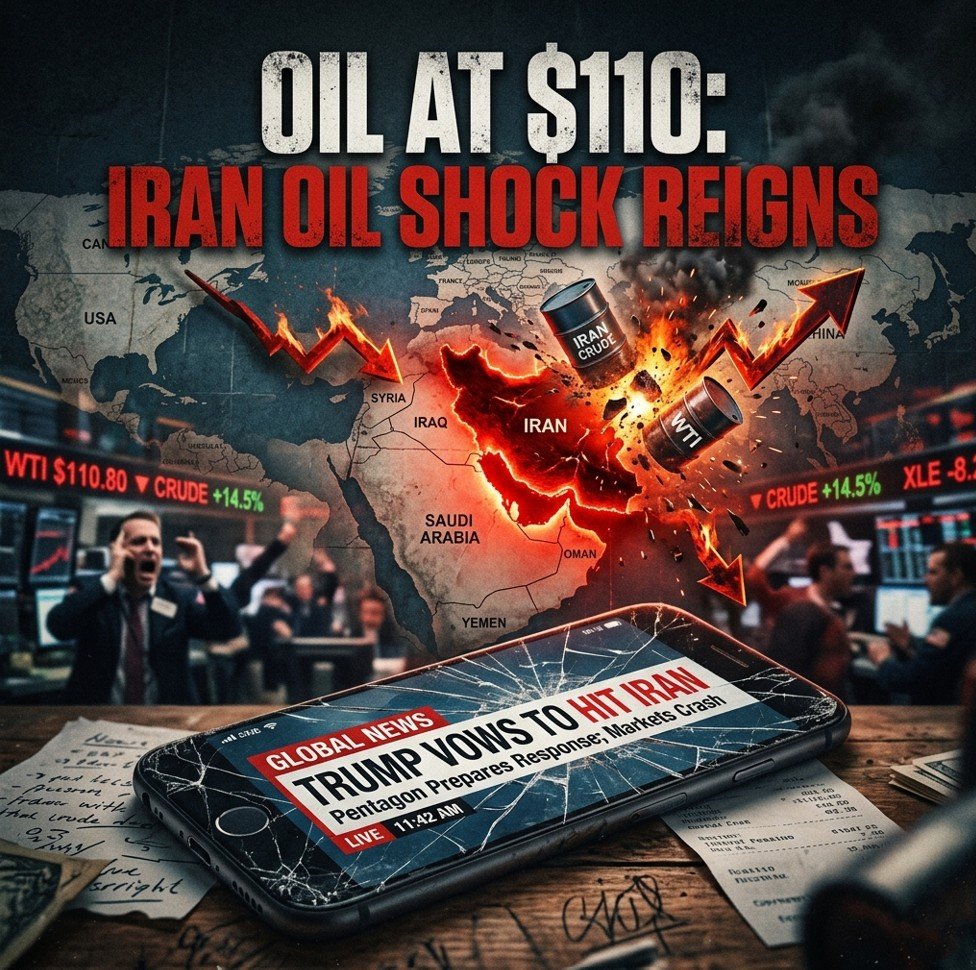
Lead: President Trump’s prime‑time pledge to hit Iran “extremely hard” over the next two to three weeks has shattered investor hopes for a quick end to the Middle East war, sending oil prices back above $109 a barrel and wiping more than $1 trillion off global stock markets.
The Return of Energy Fear
The relief rally that lifted stock markets earlier this week has been brutally reversed. In a 19‑minute address from the White House on Wednesday evening, U.S. President Donald Trump told Americans that Washington would intensify its military campaign against Tehran, vowing to “bring them back to the Stone Ages where they belong.” Those words, coming only a day after he had hinted at a possible withdrawal, plunged financial markets back into the same panic that characterized most of March. Brent crude, the global benchmark, leapt more than 7% to trade above $109 a barrel – a price level last seen during the initial shock of the conflict last autumn.
The strait of Hormuz, through which roughly a fifth of the world’s oil and liquefied natural gas passes, remains effectively closed. Trump reiterated that the U.S. does not need the gateway, saying it “will open naturally once the conflict is over.” But that assurance did little to calm investors. Prashant Newnaha, senior rates strategist at TD Securities, noted: “The only thing that really matters is whether the Strait of Hormuz will open soon. Trump’s speech doesn’t imply this is likely to happen as quickly as the markets were expecting.”
Global Markets Bleed, Safe Havens Return
Wall Street’s S&P 500 futures pointed 1.4% lower and the Nasdaq dropped 1.9%, while energy stocks – the sole sector to have gained since the war erupted – rallied again, with Exxon Mobil and Chevron each up about 3%. The pan‑European FTSEurofirst 300 tumbled 1.3% to 1.8%, and Asian equities took an even heavier beating. Japan’s Nikkei closed down 2.4%, while South Korea’s Kospi index plunged 4.7%, reflecting the region’s heavy reliance on Middle Eastern energy.
Government bond yields jumped as investors priced in a prolonged inflation shock that could force central banks to raise interest rates or at least keep them on hold. The U.S. 10‑year Treasury yield climbed 5 basis points to 4.376%, while benchmark European yields rose a similar amount to just over 3%. The dollar, reasserting its safe‑haven role, pushed the euro down 0.5% to $1.1526 and sterling below $1.32. Gold and silver, which had bounced on hopes of de‑escalation, fell 3% and 5.7% respectively, as the dollar index climbed back above 100.05.
A New Phase in the Iran Oil Shock
The renewed rhetoric marks a critical turning point in what analysts now call the “Iran oil shock.” Over the past 48 hours, Tehran and Washington have exchanged a cacophony of statements, some suggesting rising odds of de‑escalation, yet kinetic action has continued unabated. BCA Research’s Felix‑Antoine Vezina‑Poirier advises: “Stick to the facts. First, shipping through Hormuz has picked up over the past few days. Second, Iran is deliberately shifting away from GCC targets toward Israeli ones.”
For emerging markets, the urgency is growing. India’s central bank moved to ban trading of so‑called “non‑deliverable” oil derivatives in an effort to shield the rupee from further volatility. Meanwhile, the European Commission took preparatory steps on a €90 billion Ukraine Support Loan, accelerating urgent defence procurement, with a particular focus on drone production, even as political deadlock among member states remains.
Editor’s Conclusions
The past 48 hours have demonstrated a brutal but simple lesson: geopolitical risk premia are back, and they are not easily unwound. When President Trump told Reuters on Tuesday that the U.S. would be “out of Iran pretty quickly,” markets allowed themselves a brief, hopeful rally. That hope was extinguished in a 19‑minute speech that offered no timeline for the reopening of the Strait of Hormuz and no clarity on when the bombing would stop. Investors who had added risk this week were forced to scramble for exits, sending stocks tumbling and oil soaring.
What does this mean for the months ahead? First, we are likely entering a period of sustained high energy prices. Brent crude at $110 is not a peak; if the strait remains closed for another 60 days, prices could test the $130‑$150 range, with devastating consequences for import‑dependent economies in Europe and Asia. Second, the Federal Reserve and the European Central Bank will face an impossible choice: tighten into an energy‑induced slowdown (stagflation) or look through the spike and risk unanchoring inflation expectations. Neither path is attractive.
Third, the Iran oil shock is already reshaping global alliances. India’s move to ban non‑deliverable oil derivatives is a sign of desperation; similar steps may follow in Indonesia, the Philippines, and even Japan. The European Union’s €90 billion loan to Ukraine, partly aimed at accelerating drone production, underscores that the war in the Middle East is directly impacting Europe’s ability to defend its eastern flank. Finally, investors should brace for more volatility. The Good Friday holiday will thin liquidity, and any weekend escalation – a missile strike, a tanker incident – could trigger a gap move in oil and stocks.
In the long run, this crisis will accelerate the search for alternative energy sources and the decoupling of global trade from Middle Eastern chokepoints. But in the short term, the world is once again reminded that a single speech from a U.S. president can send oil to $110 and erase billions in market value overnight. The Iran oil shock is far from over.
Executive Summary
- President Trump’s prime‑time vow to intensify strikes on Iran sent Brent crude above $109 a barrel and wiped out the week’s stock market gains.
- Global equities tumbled, with Japan’s Nikkei down 2.4% and South Korea’s Kospi plunging 4.7%, while the dollar and U.S. Treasury yields rose.
- Analysts warn that a prolonged closure of the Strait of Hormuz could push oil to $130‑$150, forcing central banks into a stagflation dilemma.
Sources
- Reuters: Oil leaps back towards $110, stocks tumble as Trump vows to keep hitting Iran — Reuters‑sourced report with direct quotes and market data, highly authoritative.
- Investing.com: Morning Bid – Prime‑time disappointment — Reuters analysis of market reaction, including strategist commentary.
- European Commission: Preparatory steps on €90 billion Ukraine Support Loan and drone production — Official EU source detailing the defense procurement acceleration, highly credible.