
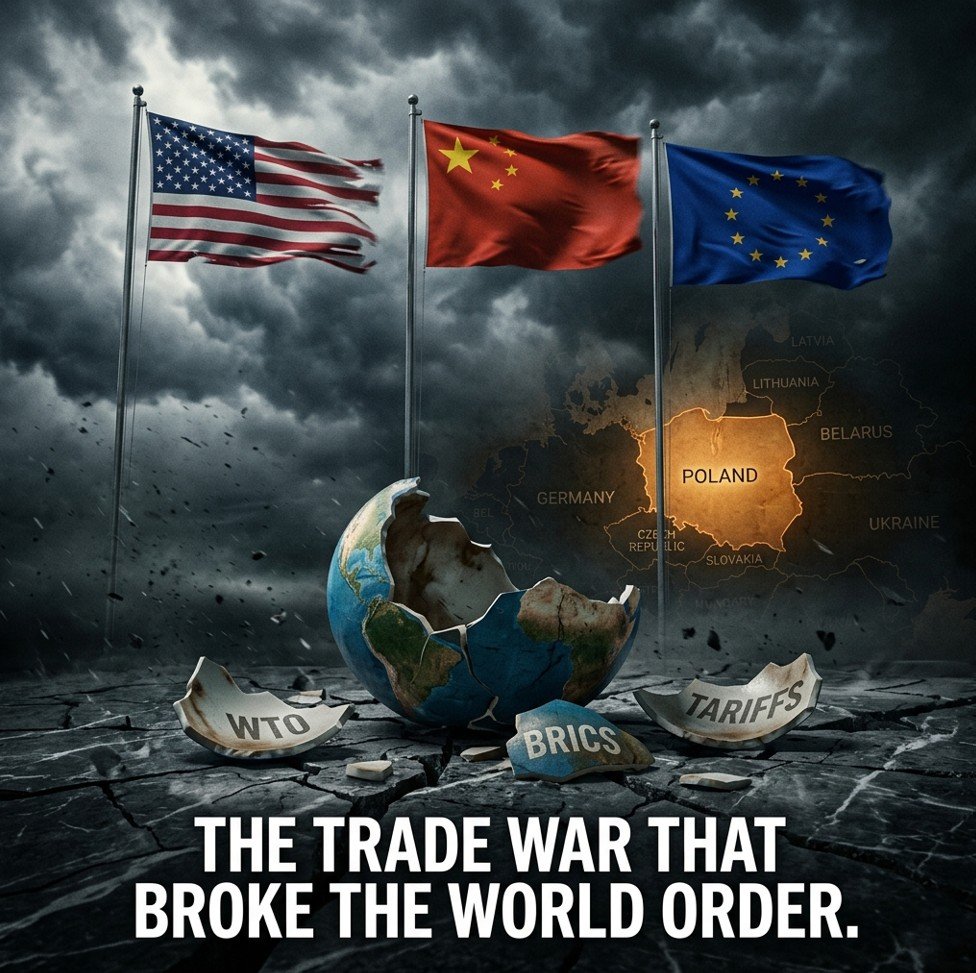
LEAD: Three weeks into April 2026, the escalating US–China–EU trade war has pushed global commerce into its most volatile period since the 2008 financial crisis, with Poland facing significant but contained exposure to the transatlantic tariff shock.
The Three-Front Trade War: A Timeline of Escalation
The current crisis traces directly to President Trump’s “Liberation Day” announcement on April 2, 2025, when the administration imposed a baseline 10 percent tariff on most imports, with additional “reciprocal” duties targeting specific countries. For China, the escalation was immediate and brutal: a 34 percent tariff stacked atop an existing 20 percent duty, pushing baseline rates above 50 percent. Within days, US tariffs on Chinese goods reached as high as 145 percent, with Beijing responding with duties up to 125 percent on US exports.
China’s retaliation came swiftly in April 2026. On April 4, Beijing announced a 34 percent tariff on all US goods — matching the rate Trump had imposed in his latest round — accusing Washington of “bullying.”Trump responded by threatening additional levies that would push total tariffs on Chinese goods to 104 percent, daring Beijing to “fight to the end.”
Europe’s trajectory has been more cautious but no less consequential. The EU announced “countermeasures” on up to €26 billion worth of US goods in response to Trump’s 25 percent steel and aluminum tariffs, which took effect on March 12, 2026. European Commission President Ursula von der Leyen called the levies “unjustified trade restrictions,” warning that “tariffs are taxes, bad for business and worse for consumers.”
The initial EU retaliation package included reimposed tariffs on iconic US products: bourbon whiskey, jeans, and Harley-Davidson motorcycles — goods worth €4.5 billion, deliberately targeted at Republican states. A second, broader tranche worth €18 billion was planned for mid-April, covering steel, aluminum, poultry, beef, seafood, and nuts. “We try to hit where it hurts,” a senior EU official told reporters, noting that the bloc was specifically targeting Louisiana soybeans — the home state of US House Speaker Mike Johnson.
Yet Brussels blinked first. On March 31, the EU announced it would delay the entire retaliation package until mid-April, then extended the suspension until early August. Von der Leyen cited a letter from Trump threatening 30 percent tariffs on European imports starting August 1 unless a negotiated solution was found. “Our hand remains outstretched, but we won’t accept just anything,” said German Finance Minister Lars Klingbeil.
Poland’s Exposure: Limited Direct Hit, Significant Indirect Pain
For Warsaw, the geography of the trade war matters enormously. Finance Minister Andrzej Domański told reporters in January that the impact of US tariffs on Poland remains “relatively low,” citing the fact that Poland’s exports to the United States are limited, while Poland relies more heavily on imports of American equipment — particularly military hardware.
That assessment is broadly accurate but incomplete. According to EY consultancy analysis, a full-blown US–EU tariff war could reduce Poland’s GDP growth by 0.9 percentage points in 2026 — a significant but not catastrophic hit. Exports may decline by 2.5 percentage points, followed by a 1.5 percentage point decline in investment growth. “Poland will suffer less than other EU countries, where GDP growth could slow by 1.4 percentage points in 2026,” EY noted.
Marek Rozkrut, EY’s Chief Economist for Europe and Central Asia, emphasized that the indirect effects — reduced investment and consumption due to uncertainty — would outweigh the direct impact of tariffs. “The impact of tariffs on economic activity will be somewhat delayed and will only hit with full force in 2026,” he said.
The European Bank for Reconstruction and Development (EBRD) anticipates Poland’s economy will expand by 3.2 percent in 2026, though it acknowledges that “the outlook for Poland’s exports is highly uncertain.” Domestic demand remains robust, offering a cushion.
Yet the deeper risk lies not in direct US–Poland trade, but in Poland’s integration into German and broader European supply chains. If German manufacturing — Poland’s primary export destination — contracts due to transatlantic tariffs, the ripple effects through the Polish economy will be substantial.
The WTO’s Yaoundé Failure: Multilateralism’s Last Rites
Behind the headline-grabbing tariff announcements, a quieter but more consequential event unfolded in late March. The World Trade Organization’s 14th Ministerial Conference (MC14), held in Yaoundé, Cameroon, from March 26 to 30, 2026, ended without a comprehensive declaration — the first such failure in nearly three decades.
The conference did not produce a “Yaoundé Declaration.” Instead, negotiators emerged with a fragmented “Yaoundé Package” of draft texts deferred to the Geneva General Council — a diplomatic euphemism for failure. The United States, under US Trade Representative Jamieson Greer, explicitly declared that “the era of traditional multilateralism has concluded,” arguing that the WTO has overseen “severe and sustained imbalances” leading to “deindustrialization, dependency, and despair.”
Most significantly, the US allowed the moratorium on customs duties for electronic transmissions — a foundational pillar of the digital economy — to lapse for the first time since its adoption in 1998. Washington refused to support further temporary extensions, labeling the moratorium a “legacy-making issue” that provided “free riders” with benefits without reciprocal commitments.
WTO Director-General Ngozi Okonjo-Iweala stated that the world trading system is experiencing the “worst disruptions” in 80 years.Global goods trade growth is now projected to fall within a range of 1.4 to 1.9 percent in 2026, down sharply from previous forecasts, according to WTO projections.
BRICS and the Dollar: Trump’s 100 Percent Threat
President Trump threatened to impose 100 percent tariffs on BRICS nations if they proceed with plans to create a common currency or actively pursue de-dollarization. “The idea that the BRICS countries are trying to move away from the Dollar while we stand by and watch is OVER,” Trump wrote on Truth Social. “Otherwise, they will face 100% tariffs, and should expect to say goodbye to selling into the wonderful U.S. economy.”
The threat came as BRICS — now expanded to include Iran, Saudi Arabia, the UAE, Ethiopia, and Egypt — has been exploring alternatives to dollar-denominated trade, particularly for members like Russia and Iran seeking to circumvent Western sanctions. However, internal divisions have slowed progress. A recent BRICS statement reaffirmed commitment to using national currencies and developing the BRICS Pay platform, but offered no timeline for a common currency.
Al Jazeera noted that the dollar remains used in more than 80 percent of international trade, and Trump’s threats may have the paradoxical effect of accelerating de-dollarization efforts among nervous BRICS members.
Frequently Asked Questions
Q1: How is the 2026 US–China–EU trade war affecting Poland’s economy?
Poland faces indirect but significant risks. Direct exports to the US are limited, but integration into German supply chains means a transatlantic tariff war could reduce Polish GDP growth by 0.9 percentage points in 2026, with exports declining 2.5 percent, according to EY analysis.
Q2: What are the EU’s retaliatory measures against US tariffs?
The EU has prepared €26 billion in countermeasures, including reimposed tariffs on bourbon, jeans, and motorcycles (€4.5 billion) and a broader tranche targeting steel, aluminum, and agricultural goods (€18 billion). Implementation has been suspended until August 1 to allow negotiations.
Q3: What happens next in the global trade war?
Three scenarios are possible: (1) negotiated de-escalation before August, (2) tit-for-tat escalation triggering a global recession, or (3) managed fragmentation into competing trade blocs. The WTO’s failure in Yaoundé makes scenario three increasingly likely.
Editor’s Analysis
[LAYER 1 — DEEP REFLECTIONS: WHAT DOES THIS REVEAL ABOUT THE WORLD ORDER?]
The 2026 trade war is not a policy mistake. It is a structural inevitability of a multipolar world with no agreed-upon rules. The post-1945 Western-led rules-based order — built on the dollar’s hegemony, the WTO’s dispute settlement mechanism, and NATO’s security umbrella — is not merely under stress. It is functionally exhausted.
What the US–China–EU trade war reveals is that the three major economic powers no longer share a common conception of what “fair trade” means. For Washington, fairness means reciprocity and balanced bilateral accounts — a framework that treats trade deficits as prima facie evidence of cheating. For Beijing, fairness means state-directed industrial policy and managed trade — a framework the West spent three decades trying to dismantle in Russia and China, with zero success. For Brussels, fairness means rules, standards, and multilateral procedures — a framework that looks increasingly naive as the US and China bypass it.
The exhaustion of the WTO system — made explicit at Yaoundé — means there is no neutral arbiter left. The global trading order is not transitioning to a new equilibrium. It is fracturing into competing spheres: a US-centered bloc, a China-centered bloc, and a Europe struggling to remain relevant. Poland, embedded in German supply chains but geopolitically aligned with Washington, must navigate a world where its two primary allies are economically at war.
[LAYER 2 — CRITICAL ANALYSIS: WHAT IS THE OFFICIAL NARRATIVE MISSING?]
The dominant framing of this trade war — as a dispute over tariffs and market access — misses three harder truths.
First, the official narrative omits the role of financial power. The dollar’s status as the world’s primary reserve currency and transaction medium is the single most important fact in global trade. Trump’s threats against BRICS de-dollarization reveal that Washington understands this perfectly. The trade war is not just about steel and soybeans. It is about preserving the exorbitant privilege of issuing the world’s reserve currency — a privilege that allows the US to run persistent deficits without the currency discipline imposed on any other nation.
Second, the narrative ignores the distributional consequences within countries. Who bears the cost of tariffs? Not the Chinese or European exporters — they adjust. Not the US consumers — they pay higher prices. The real burden falls on workers in import-competing industries (who lose jobs) and workers in export industries (who lose markets). Yet the political debate focuses on aggregate trade balances, not on the communities being shattered by supply chain reconfiguration. The Cato Institute’s Clark Packard warned that tariffs “would pretty quickly show up in prices” for US consumers, with auto manufacturing and construction among the hardest-hit sectors.
Third, the narrative presents the WTO’s Yaoundé failure as a technical breakdown. It was not. It was a political choice by the United States to abandon the multilateral framework that it helped create. As one analyst put it, Washington is now prepared to “operate outside the multilateral framework to protect its technological and economic interests.”That is not a system failure. That is a system rejection.
[LAYER 3 — CUI BONO: WHO BENEFITS FROM THIS STORY BEING TOLD THIS WAY?]
The framing of the trade war as a defensive response to “unfair” practices serves multiple interests.
For the Trump administration, the trade war narrative is politically invaluable. It allows the president to present himself as standing up for American workers — regardless of the actual distributional consequences. The threat of 100 percent tariffs on BRICS countries plays to a domestic audience that fears the erosion of American power, even if the threat itself is probably not credible at scale.
For European political elites, the narrative of a unified EU response serves institutional interests. The European Commission gains negotiating authority and political visibility. The repeated suspensions of countermeasures — first to mid-April, then to August — allow Brussels to present itself as the reasonable party seeking negotiation, while keeping the threat of retaliation as leverage. Whether this strategy actually protects European industry is a separate question.
For Chinese state media, the trade war narrative reinforces domestic legitimacy. The framing of the US as a “bully” and China as a “defender” of multilateralism — even as Beijing pursues its own aggressive industrial policies — serves the Communist Party’s narrative of a virtuous China resisting Western hegemony. The Xinhua readout of Li Qiang’s call with von der Leyen emphasized that China has “sufficient reserve of policy tools” to “fully hedge against adverse external effects” — a message of strength to domestic audiences.
Who does not benefit? Polish exporters caught in the crossfire of a US–EU dispute they did not provoke. German manufacturers seeing their US market access eroded. And most of all, the WTO system itself, which the major powers are now willing to sacrifice for short-term advantage.
[LAYER 4 — DISTRACTION ANALYSIS: WHAT IS THIS STORY COVERING UP?]
The intense focus on tariff percentages and retaliation packages distracts from three larger crises.
First, the climate crisis. The WTO’s failure to maintain the digital services moratorium is a genuine economic issue. But measured against the existential threat of climate change — which will disrupt global supply chains, agricultural production, and migration patterns on a scale that dwarfs any tariff dispute — the trade war’s salience in policy debates is a form of collective avoidance. Every hour spent negotiating soybean tariffs is an hour not spent on carbon border adjustment mechanisms or green technology transfer.
Second, the crisis of economic inequality within nations. The trade war narrative focuses on international competition. But the real story in the US, Europe, and China is domestic: deindustrialized regions left behind by globalization, stagnant middle-class wages, and the concentration of gains at the top. Tariff policies are a response to these domestic failures — but they are a response that externalizes blame rather than addressing structural problems.
Third, the erosion of democratic accountability in trade policy. The EU’s trade policy is negotiated by the European Commission, not by national parliaments. The US president can impose sweeping tariffs without congressional approval. This concentration of executive authority in trade matters means that the most consequential economic decisions of our era are being made by appointed officials and unilateral executive action — not by representative bodies. The trade war distracts from this democratic deficit, allowing citizens to focus on the spectacle of international conflict rather than the quiet hollowing-out of their own institutions.
[LAYER 5 — WHO DOES THIS NOT SERVE? WHO IS SILENCED BY THIS NEWS CYCLE?]
The trade war narrative is told from the perspective of capitals: Washington, Beijing, Brussels, Warsaw. Who is missing?
Small and medium-sized enterprises (SMEs) in Poland and across Europe are the first casualties. Unlike large multinationals, SMEs cannot easily shift supply chains, absorb tariff costs, or hire teams of trade lawyers. They are price-takers, not price-makers. The EY analysis notes that indirect effects — reduced investment and consumption due to uncertainty — outweigh direct tariff impacts.For an SME owner in Łódź or Wrocław, that uncertainty translates into delayed hiring, canceled expansion plans, and sleepless nights. Their voices rarely appear in trade war coverage.
Workers in export-dependent sectors are also silenced. The narrative focuses on aggregate GDP effects. But behind the 0.9 percentage point reduction in Polish GDP growth are real people: factory workers in German automotive plants that may cut shifts, logistics workers in Polish warehouses that may see reduced volumes, farmers whose agricultural exports to third countries may be displaced by diverted Chinese or American goods. The trade war’s human costs are distributed unequally — and those who bear them have no seat at the negotiating table.
Finally, the Global South is almost entirely absent from the Western trade war narrative. When the US and EU impose tariffs on each other’s goods, they divert trade flows toward third countries. Brazilian and Argentine soybeans replace American soybeans in European markets. Vietnamese and Malaysian manufacturers gain price competitiveness in the US market.These are not accidents — they are deliberate strategies. But they are never framed as such. The Global South is treated as a passive recipient of trade diversion, not as an active participant in reshaping global commerce.
The WTO’s Yaoundé failure was not just about the US, China, and Europe. It was also about the rising powers of the Global South — India, Brazil, South Africa — demanding a seat at a table that the old powers are in the process of demolishing. Their voices were not silenced. They were simply never invited to set the agenda.
Key Takeaways
- The US–China–EU trade war has entered its most acute phase in April 2026, with Beijing imposing 34 percent retaliatory tariffs and Brussels preparing €26 billion in countermeasures.
- Poland faces a 0.9 percentage point GDP growth reduction in 2026 if the transatlantic tariff war escalates, with exports declining 2.5 percent, though direct exposure to US tariffs remains limited.
- The WTO’s 14th Ministerial Conference in Yaoundé ended without a comprehensive declaration — the first such failure in three decades — signaling the effective collapse of multilateral trade governance.
- Trump’s threat of 100 percent tariffs on BRICS nations over de-dollarization adds a financial dimension to the trade war, though internal BRICS divisions make a common currency unlikely in the near term.
- Three scenarios are plausible by August 2026: negotiated de-escalation, tit-for-tat escalation into recession, or managed fragmentation into competing trade blocs.
Internal Links Used
- “EU Faces Rule of Law Crisis as Orbán’s Veto Threatens Ukraine Aid” —
https://airpres.pl/2026/04/08/eu-ukraine-loan-orban-veto-blackmail-legitimacy/— placed in the Introduction — relevance: both articles examine EU institutional weakness under external pressure (US tariffs vs. Hungarian veto) - “NATO Defense Spending Hits Record High as Europe Rearms” —
https://airpres.pl/2026/04/01/nato-defense-spending-europe-2026-record/— placed in the Poland’s Exposure section — relevance: Poland’s military procurement from the US is a key reason its direct tariff exposure is limited - “Global Trade Order Collapse: How Trump’s Tariffs Are Ending Pax Americana” —
https://airpres.pl/2026/04/01/global-trade-order-collapse-2026-pax-americana/— placed in the WTO’s Yaoundé Failure section — relevance: directly complements this article’s analysis of multilateral trade system collapse - “EU Defense Pivot: €28 Billion Drone Package for Ukraine” —
https://airpres.pl/2026/04/03/eu-defense-pivot-28-billion-drones-ukraine/— placed in the Cui Bono section — relevance: illustrates EU’s increasing defense industrial spending, which connects to trade war dynamics
Sources
- Business Standard — One year of Trump’s Liberation Day tariffs: Who struck deals, who resisted — April 3, 2026 — Comprehensive overview of tariff escalation timeline and regional responses
- TTWTO VCCI / FT — EU retaliates against Trump tariffs with €26bn ‘countermeasures’ — April 5, 2026 — Detailed breakdown of EU retaliation package and political targeting strategy
- Manila Times / AP — EU Delays Retaliatory Tariffs Amid New U.S. Threats on Imports — April 4, 2026 — Suspension of EU countermeasures and Trump’s 30% tariff threat timeline
- Polska Agencja Prasowa (PAP) / EY — Poland’s GDP growth to be lowered by trade war in short term — April 15, 2025 — EY analysis of trade war impact on Polish GDP, exports, and investment
- Warsaw Business Journal — From Europe’s factory floor to global player — February 27, 2026 — Polish export diversification and supply chain integration analysis
- Raymond James / AP — Nations puzzle over how to respond to US trade war — April 4, 2026 — Global responses to US tariffs, EU zero-for-zero offer, von der Leyen quotes
- New Age / AFP — China, EU vow steps against US steel tariffs — March 27, 2026 — Joint China-EU response, Cato Institute expert quote, tariff implementation details
- NewsofBahrain — Trump Threatens 100% Tariffs on BRICS Countries Over Currency Creation — April 4, 2026 — Trump’s Truth Social statement on BRICS de-dollarization and 100% tariff threat
- NewsofBahrain / AFP — EU chief urges China to avoid ‘escalation’ over US tariffs — March 29, 2026 — Von der Leyen–Li Qiang call, China’s retaliatory 34% tariff, trade diversion concerns
- IEU Monitoring — The Yaoundé rupture: Transatlantic divergence and the dawn of post-multilateral trade — March 30, 2026 — Detailed analysis of WTO MC14 failure, US trade paradigm shift, moratorium lapse
- MoneyControl / Financial Times — Global tariff shakeup: Who gains, who loses from Trump 15% levy — February 23, 2026 — Global Trade Alert data on Brazil/China gains, EU/UK/Japan losses
- Ahram Online / AFP — EU says delaying tariffs on US goods two weeks to mid-April — March 31, 2026 — EU countermeasures timeline, political dynamics within EU member states
- Tunisie Numerique — Poland: The Impact of U.S. Tariffs on Our Economy Remains Relatively Limited — January 23, 2026 — Finance Minister Andrzej Domański’s assessment of Poland’s limited direct exposure
- UNCTAD — Global Trade Update (January 2026) — January 15, 2026 — Global trade projections and fragmentation analysis


