Across Europe, the arrival of spring has always meant more than longer days. For centuries, people have gathered the first wild greens — not because they had to, but because these fresh, bitter, and nutrient‑dense plants were believed to wake up the body after winter’s heavy meals and limited fresh vegetables.
From Poland to Provence, spring herbs have been used as gentle digestive tonics, mild diuretics, and nutritional supplements. But modern foraging requires more than tradition. It demands correct identification, respect for sustainability, and an understanding that these herbs support wellness — they do not cure disease or replace medical care.
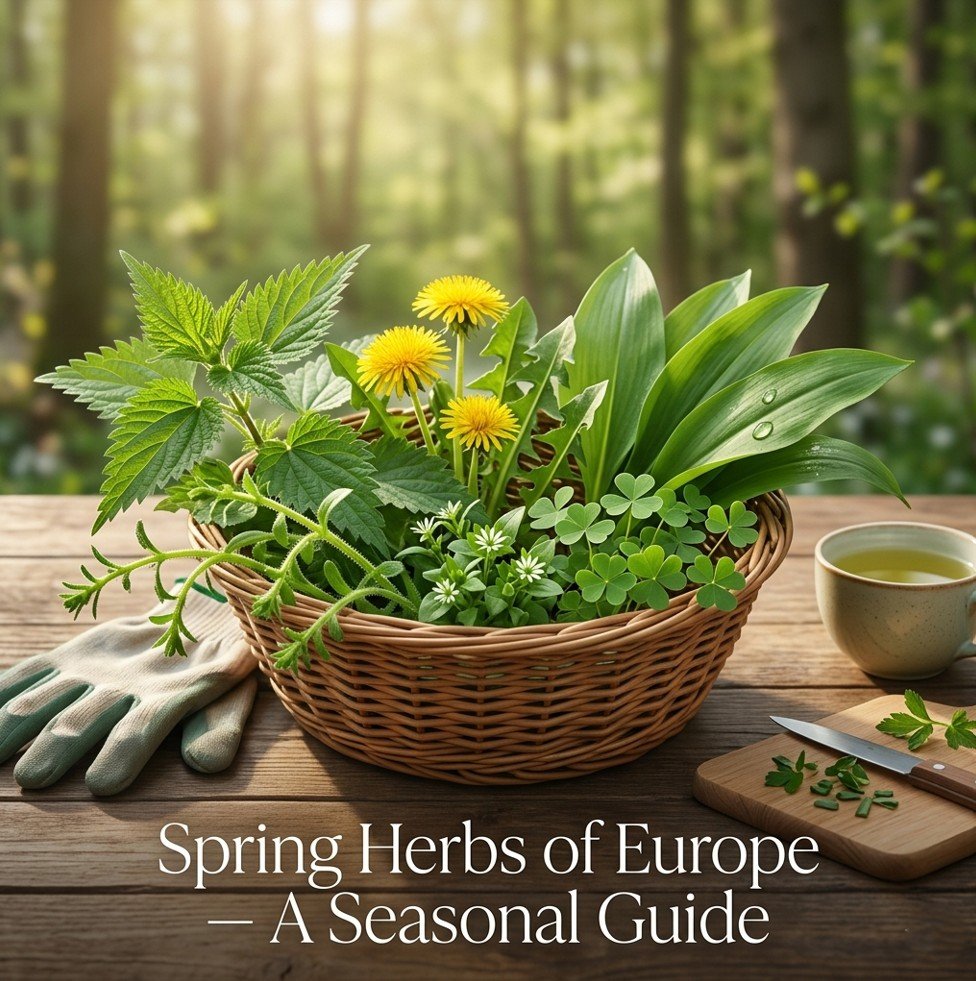
This guide covers seven common European spring herbs: nettle, dandelion, wild garlic, cleavers, ground ivy, chickweed, and wood sorrel. You will learn how to recognise each one, which parts to harvest, traditional and modern uses, and critical safety warnings – each warning appears only once, in the most relevant section.
What Grows in Europe During Spring?
Spring herbs typically appear between March and May in most of Europe, depending on latitude and altitude.
1. Stinging Nettle (Urtica dioica)
Appearance: Upright plant, leaves oval and toothed with stinging hairs. Traditional use: Spring tonic, blood‑building herb (iron content), mild diuretic. Nettle soup across Central/Eastern Europe. Modern interest: Rich in vitamins A, C, K, iron, calcium. Harvest tip: Wear gloves. Pick young leaves from clean areas. Safety: Stinging hairs cause skin irritation (cooking removes sting). Rare allergic reactions.
2. Dandelion (Taraxacum officinale)
Appearance: Rosette of toothed leaves, yellow flowers, hollow stems with milky sap. Traditional use: Bitter salad to stimulate digestion and liver function. French pissenlit (diuretic). Modern interest: Bitter compounds increase bile flow. Harvest tip: Young spring leaves less bitter. Avoid sprayed lawns. Safety: Generally safe. May cause contact dermatitis in sensitive individuals.
3. Wild Garlic / Ramsons (Allium ursinum)
Appearance: Broad, lance‑shaped leaves (2–5 cm) with strong garlic smell when crushed. White star‑like flowers. Traditional use: Spring blood cleanser, digestive herb. German Bärlauch soup. Modern interest: Contains allicin. Critical safety warning: Resembles lily of the valley (deadly) and autumn crocus (deadly). The garlic smell is the only reliable distinction. If no garlic smell, discard immediately. Do not dig bulbs – take leaves only.
4. Cleavers / Goosegrass (Galium aparine)
Appearance: Trailing plant with sticky, bristly stems, leaves in whorls of 6–8. Traditional use: Mild diuretic, lymphatic herb. Modern interest: Very limited research. Harvest tip: Harvest before flowering (April–May). Safety: Safe in tea amounts. Large amounts may cause mild digestive upset.
5. Ground Ivy (Glechoma hederacea)
Appearance: Creeping perennial with kidney‑shaped scalloped leaves, purple flowers, square stems (mint family). Traditional use: Tea for coughs, sinus congestion, mild digestive discomfort. British “alehoof”. Modern interest: No high‑quality human studies. Safety: Avoid during pregnancy. Limit to tea amounts (not daily for months).
6. Chickweed (Stellaria media)
Appearance: Small sprawling plant with oval leaves, tiny white star‑shaped flowers. Traditional use: Eaten raw in spring salads or as a poultice for minor skin irritations. Modern interest: Very little research. Harvest tip: Harvest before flowering. Wilts quickly. Safety: Safe in salad amounts. Excessive amounts may cause diarrhoea due to saponins. Avoid large amounts during pregnancy (traditional emmenagogue use).
7. Wood Sorrel (Oxalis acetosella)
Appearance: Delicate, clover‑like leaves (three heart‑shaped leaflets) with sour taste. White flowers with purple veins. Traditional use: Fresh spring tonic, thirst quencher. Modern interest: No significant research. Safety: Limit to small amounts (handful or less daily) due to oxalates. Avoid if you have kidney stones or gout.
Best Seasonal Uses (No Duplicate Warnings)
Spring herbs are traditionally used for three main supportive roles. Warnings are listed above – here we focus only on how to use.
Gentle digestive stimulation (bitters)
Herbs: Dandelion leaf, ground ivy, wood sorrel (small amounts)
How to use: Eat a small handful of fresh dandelion leaves before a meal, or drink a cup of ground ivy tea 20 minutes before eating. The bitter taste stimulates saliva, gastric juices, and bile flow – a traditional “spring cure” for sluggish digestion.
Mild diuretic support (spring cleansing)
Herbs: Nettle, dandelion, cleavers
How to use: Drink 2–3 cups of nettle or cleavers tea daily for 1–2 weeks. These herbs increase urine output slightly – they are not a substitute for medical treatment of kidney or heart disease.
Nutritional supplementation
Herbs: Nettle, wild garlic, chickweed
How to use: Add chopped young nettle leaves to soups, omelettes, or smoothies. Use wild garlic like spinach. Chickweed in salads.
What to Harvest and What to Leave Alone
Sustainable foraging is not optional.
Do harvest sparingly:
- Take no more than 10–20% of a patch
- Harvest from abundant populations only
- Leave enough for regeneration and wildlife
Do not harvest:
- Protected species (check your country’s red list)
- Plants near busy roads (heavy metals)
- Plants from sprayed agricultural land
- Any plant you cannot identify with 100% certainty
Look‑alike dangers – spring is high risk:
| Edible herb | Toxic look‑alike | Key difference |
|---|---|---|
| Wild garlic | Lily of the valley (deadly) | Wild garlic smells of garlic; lily of the valley has no garlic smell and has bell‑shaped flowers later |
| Wild garlic | Autumn crocus (deadly) | No garlic smell, flowers appear in autumn |
| Chickweed | Spurge (irritant) | Spurge has milky sap; chickweed does not |
| Dandelion | Hawkbit, cat’s ear | Dandelion has hollow, leafless flower stems; look‑alikes have branched or solid stems |
Golden rule: If unsure, leave it. Do not rely on apps alone – use a reputable field guide.
How to Dry, Store, and Prepare Seasonal Herbs
Fresh use (best)
- Use within 2–4 hours of harvest, or refrigerate in a damp cloth for up to 24 hours
- Wash thoroughly
Drying
- Nettle, dandelion, cleavers, ground ivy, chickweed can be dried
- Spread in a single layer in warm, airy, shaded place
- Store in airtight glass jars away from light
- Wild garlic does not dry well – freeze in oil or butter instead
Simple preparations
Nettle soup (traditional Central European):
- Sauté 1 chopped onion in butter
- Add 500 g young nettle leaves (gloves until cooked)
- Add 1 litre vegetable stock, simmer 10 minutes, blend, add cream
Dandelion leaf salad:
- Mix young dandelion leaves with milder greens, add hard‑boiled egg, bacon, warm vinaigrette
Wild garlic pesto:
- Blend 100 g wild garlic leaves, 50 g pine nuts, 50 g Parmesan, 100 ml olive oil, salt
Cleavers tea:
- 2 tablespoons fresh cleavers (or 1 tablespoon dried) per 250 ml water, steep 10 minutes
Seasonal Herbal Rituals and Traditional European Practices
Poland & Eastern Europe: Zielone święta (Green Week) – spring herbs blessed for homes and livestock. Nettle soup (zupa pokrzywowa) eaten for vitality.
Germany: Bärlauch festivals – wild garlic in soups, breads, sausages.
France: Pissenlit (dandelion) salads with bacon and warm vinaigrette.
Britain: “Cleaning the blood” with nettle and cleavers – outdated phrase, but mild diuretic effects have a rational basis.
These traditions are cultural knowledge, not medical prescriptions.
Safety, Interactions, and When to See a Doctor
This article is for educational purposes only and does not replace medical advice, diagnosis, or treatment. Persistent, severe, or unclear symptoms should be discussed with a qualified healthcare professional.
General foraging safety:
- Never eat a wild plant unless 100% certain of identity
- Introduce new herbs in very small amounts (one teaspoon of tea or one small leaf)
- Wash all foraged plants thoroughly
- Avoid areas with dog faeces, pesticides, or industrial pollution
Pregnancy and breastfeeding:
- Nettle leaf (food amounts) and dandelion (food amounts) – likely safe
- Wild garlic (food amounts) – likely safe
- Cleavers, ground ivy, wood sorrel – insufficient safety data. Avoid or consult a professional.
- Chickweed – avoid large amounts during pregnancy
When to see a doctor – not a forager:
- Persistent digestive symptoms lasting more than 2 weeks
- Unexplained weight loss, blood in stool or urine
- Kidney pain or history of kidney stones (avoid wood sorrel)
- Any symptom that worries you
FAQ
Can I eat spring herbs raw?
Yes – nettle must be cooked or dried to remove sting; all others can be eaten raw in small amounts. Wash thoroughly.
Is “spring cleansing” with herbs medically real?
The traditional idea of “blood cleansing” is not supported by modern medicine. However, mild diuretic herbs (nettle, dandelion) and bitter herbs (dandelion, ground ivy) have genuine physiological effects – they support normal digestive and urinary function, not “detox”.
How much wild garlic is safe to eat?
A handful of leaves (20–30 grams) in a meal is fine. Larger amounts may cause digestive upset or mild garlic odour. No serious toxicity.
Can I freeze spring herbs?
Yes. Wild garlic freezes well in oil or butter. Nettle and dandelion freeze acceptably for soups. Cleavers and chickweed do not freeze well.
Are there any protected spring herbs I should not pick?
Yes – wild orchids, snowdrops (if wild), and some rare spring ephemerals are protected in many European countries. None of the seven herbs listed here are protected – they are common.
Can children eat foraged spring herbs?
Children over 6 years can eat small amounts of properly identified spring herbs in food (e.g., nettle soup, a few dandelion leaves). Avoid herbal teas or large amounts. Never give foraged herbs to infants.
Key Takeaways
- Seven common European spring herbs have traditional use: nettle, dandelion, wild garlic, cleavers, ground ivy, chickweed, wood sorrel.
- Spring herbs are best used fresh, in food amounts, as gentle digestive stimulants, mild diuretics, or nutritional supplements – not as cures.
- Correct identification is critical, especially with wild garlic (toxic look‑alikes exist).
- Sustainable foraging: take only 10–20%, avoid protected species, never harvest from polluted ground.
- Each herb has specific safety warnings – these are listed only once in the guide above (in the herb descriptions).
- Persistent or severe symptoms require a doctor, not a spring herb tonic.
Internal Links Used
- Nettle: nutritional value and traditional herbal uses — placed in nettle section
- Best European herbs for digestion support — placed in digestive stimulation section
- How to dry summer flowers for winter use — placed in drying section
- Summer medicinal flowers to gather responsibly — placed in wild garlic safety warning
Sources
- Allen, D. E., & Hatfield, G. (2004). Medicinal Plants in Folk Tradition. Timber Press.
- European Food Safety Authority (EFSA) – Compendium of botanicals (2022).
- Grądziel, T., & Kukula‑Koch, W. (2020). Spring herbs in Polish folk medicine. Journal of Ethnopharmacology, 258, 112–119.
- Royal Botanic Gardens, Kew – Urtica dioica monograph.
- Grieve, M. (1931). A Modern Herbal (historical traditional use).