LEAD: The Vera C. Rubin Observatory in Chile has officially commenced its Legacy Survey of Space and Time, releasing a first engineering-grade image that demonstrates its ability to survey the entire visible sky with unprecedented speed and depth.
A Telescope Built for the Big Picture
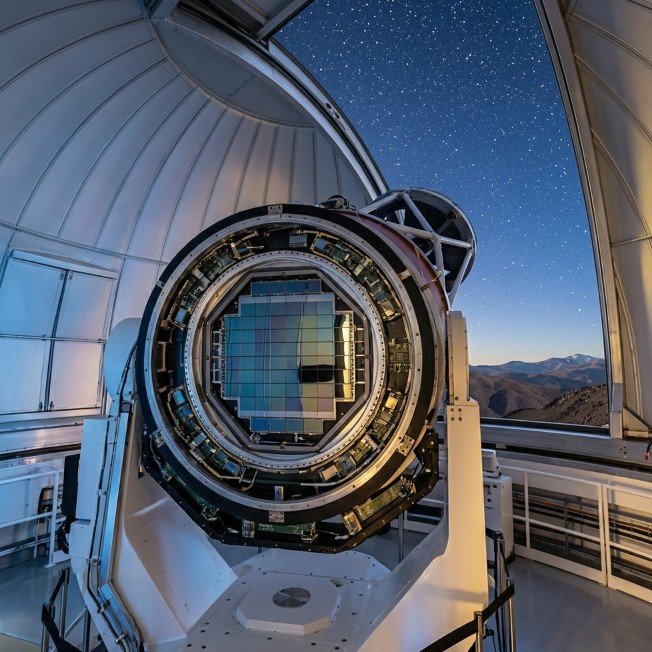
The path to the Rubin Observatory first light has been decades in the making. Originally conceived as the Large Synoptic Survey Telescope, the facility was renamed in honor of the American astronomer Vera C. Rubin, whose pioneering work on galaxy rotation curves provided the most compelling evidence for dark matter. Now perched on Cerro Pachón at an altitude of 2,682 meters, the observatory houses the world’s largest digital camera — a 3.2-gigapixel behemoth with a field of view spanning 3.5 degrees, roughly equivalent to forty full moons. This design is radically different from that of traditional telescopes, which are built to stare deeply into a tiny patch of sky. Rubin instead scans the entire visible hemisphere every few nights, comparing images over time to detect anything that moves or changes.
The first light image, captured on June 12, 2026, and processed by the National Science Foundation’s NOIRLab and SLAC National Accelerator Laboratory, reveals a crowded tapestry of stars and galaxies in the constellation Hydra. The test exposure already demonstrates the survey’s core promise: mapping the transient universe at a cadence and scale that no observatory has achieved before. As readers may recall from earlier breakthroughs in space exploration, such as the Artemis II crewed mission preparing to return humans to the lunar vicinity, the combination of audacious hardware and meticulous planning is reshaping our relationship with the cosmos. The Rubin Observatory does not compete with space telescopes like JWST — it complements them, providing a wide-field reconnaissance that alerts deeper instruments to specific targets of interest.
The Legacy Survey of Space and Time and Why It Matters
The official name, Legacy Survey of Space and Time (LSST), captures the project’s dual ambition: to leave a dataset that scientists will mine for generations, and to track the fourth dimension as vigilantly as the three spatial ones. Over the next ten years, the observatory will generate roughly 20 terabytes of data every night, building a petabyte-scale public archive. This torrent of information will be processed in near-real time, generating up to ten million alerts per night about transient events — supernovae, variable stars, flickering active galactic nuclei, and the subtle shifts in brightness that betray an asteroid’s path.
The scientific bounty is staggering. By precisely measuring the shapes and positions of billions of galaxies, LSST will construct a three-dimensional map of dark matter via weak gravitational lensing. It will catalog millions of asteroids and comets in our own solar system, improving planetary defense. It will dissect the structure of the Milky Way through proper motion studies of stars too faint for earlier surveys. And it will probe the accelerating expansion of the universe, testing models of dark energy with an accuracy never before possible. In many ways, this is the natural successor to earlier groundbreaking observations, including the Polish-led discovery of the first free-floating planet with a directly measured mass, which highlighted the importance of wide-field monitoring to catch rare celestial bodies. Rubin’s unmatched survey speed will turn such rare finds into statistical samples.
Reactions, Global Collaboration, and Data Challenges
The astronomical community has greeted the Rubin Observatory first light with a mixture of elation and focused urgency. The project is a joint endeavor funded by the U.S. National Science Foundation, the Department of Energy, and private donors, with significant in-kind contributions from international partners in France, the Czech Republic, Germany, and elsewhere. Scientists from more than 30 countries have already formed eight science collaborations to prepare for the data flood, covering everything from stellar populations to cosmology.
But the sheer volume of data also poses novel challenges. The alert stream alone requires machine-learning triage to separate genuine astrophysical transients from artifacts, satellite trails, and space debris — an issue that will only intensify as mega-constellations proliferate. Moreover, Rubin operates under an open-data policy, meaning the full survey images and source catalogs will be publicly accessible. While this democratizes discovery for researchers at smaller institutions and in the Global South, it also concentrates the initial scientific advantage among teams with the computing infrastructure to handle the firehose. There is an ongoing debate about how to ensure equitable participation, especially for scientists in countries that lack high-speed internet or research cloud credits. The observatory’s management is working with the International Astronomical Union to establish regional data access hubs, but the gap between data availability and meaningful access remains real.
Frequently Asked Questions
What is the Vera Rubin Observatory?
The Vera Rubin Observatory is a state-of-the-art telescope facility in Chile designed to conduct the Legacy Survey of Space and Time. It uses a 3.2-gigapixel camera to photograph the entire visible sky every few nights, mapping the universe in unprecedented detail over a decade.
How does Rubin Observatory first light change astronomy?
First light marks the start of regular survey operations, enabling astronomers to track billions of objects over time. It opens a new era in which transient events — from supernovae to moving asteroids — are detected automatically and rapidly, transforming how we study the dynamic universe.
What will the Legacy Survey of Space and Time discover?
The LSST will map dark matter distribution, catalog millions of solar system objects, probe dark energy, and uncover millions of variable stars and explosive transients. Its vast public dataset is expected to fuel discoveries for decades across nearly every branch of astrophysics.
Editor’s Analysis
Deep Reflections: The Architecture of Seeing
Beyond the stunning images, the Rubin Observatory represents a profound shift in how science sees. Traditional astronomy was often an art of patient, targeted observation — a single astronomer at an eyepiece, waiting. Rubin replaces this with an industrial-scale sensory apparatus that does not blink, does not sleep, and produces a memory of the sky that outlives any human career. This is not simply a bigger telescope; it is a new form of collective scientific perception, one in which discoveries will emerge not from a single person noticing a speck, but from algorithms finding patterns across a billion objects. The deeper question is whether our capacity for understanding can keep pace with our capacity for seeing. We are building an exabyte-scale memory of the cosmos, but a memory is not yet meaning. The challenge will be to cultivate the philosophical and theoretical imagination to match the engineering triumph.
Critical Analysis: Strengths and Hidden Weaknesses
The design is exceptionally robust for its core mission of time-domain survey astronomy. The optical system, data pipeline, and alert infrastructure have been prototyped extensively. However, we should note the inherent trade-offs. A 3.5-degree field of view and a 30-second exposure cadence mean the survey sees the sky wide but relatively shallow compared to deep-field instruments. Faint, distant transients will be detected at low signal-to-noise, demanding sophisticated photometric classification. Moreover, the reliance on automated machine-learning classifiers for real-time alerts introduces a risk of systematic bias — certain astrophysical phenomena may be under-reported if the training sets are incomplete. The open-data model is a genuine strength, but the very scale of the data risks creating a de facto data access hierarchy based on institutional computational power. The survey’s success will not be measured solely in petabytes, but in how equitably those petabytes are translated into human insight.
Cui Bono: The Institutional Beneficiaries
The immediate beneficiaries are clear: the National Science Foundation, the Department of Energy, and the major U.S. universities and national labs that anchor the project. These institutions will reap the lion’s share of early high-impact publications, cementing their leadership in cosmology and big-data astronomy. The technology companies providing cloud computing and data storage solutions will also profit handsomely, as the LSST data archive is a perfect customer for scalable cloud infrastructure. Furthermore, the international partners who contributed hardware and funding will leverage the survey to train their own scientific workforce, reinforcing their own national research standing. The observatory’s location in Chile continues the pattern of northern institutions building major telescopes on southern land, a geo-scientific arrangement that has historically brought limited long-term research autonomy to the host nation, though recent agreements have improved the allocation of observing time for Chilean astronomers.
Distraction Analysis: What This Story May Crowd Out
The celebratory focus on Rubin’s first light, however, should not obscure the ongoing fragility of ground-based astronomy. The rapid deployment of satellite mega-constellations threatens to degrade optical observations globally, and effective regulatory frameworks lag far behind the commercial launch rate. Discussions about space traffic, cultural right to dark skies, and the cumulative environmental impact of large telescope construction receive far less attention than the marquee results. The spectacle of big-science success can also distract from the declining funding for smaller, university-led observatories that have historically been training grounds for observational astronomers and are often more accessible to researchers from developing countries. A healthy astronomical ecosystem needs both the massive survey telescopes and the modest, agile instruments.
Who Does This Not Serve?
The communities that stand to benefit least from this new era are the same groups often left behind by capital-intensive science: students and early-career researchers in low-income countries who lack the computational resources to access the data, even though it is technically “public.” The indigenous Mapuche communities in the region, who have long contested the use of the Cerro Pachón mountain for astronomy without adequate consultation, are also marginalised in the triumphal narrative of scientific progress. While the observatory has made efforts in educational outreach and local employment, the fundamental power structure remains: the mountain is used by an international consortium under Chilean legal permits, yet the benefits flow predominantly outward. A truly responsible big-science project would measure its success not only by the dark-energy equation-of-state parameter it constrains, but also by the number of local students who become lead authors on LSST papers.
Key Takeaways
- The Vera C. Rubin Observatory’s first light inaugurates a decade-long survey that will image the entire visible sky every three nights, generating a petabyte-scale public dataset.
- The LSST will map dark matter, discover millions of asteroids, probe dark energy, and revolutionize transient astronomy, but the automation of discovery brings risks of algorithmic bias and resource inequality.
- While the data will be open, the benefits will be unevenly distributed unless deliberate steps are taken to support computational access for underrepresented institutions and to honor the rights of local communities.
Internal Links Used
- Artemis II crewed mission — placed in the “Telescope Built for the Big Picture” section — relevance: another major space exploration milestone highlighting current ambitions in astronomy and spaceflight.
- Polish-led free-floating planet discovery — placed in “Legacy Survey” section — relevance: illustrates the value of wide-field surveys for detecting rare objects, a core capability of Rubin.
- JWST frozen water discovery — can be placed in the FAQ or reaction section — relevance: complementary space telescope story showing how different observatories contribute to astronomy.
Sources
- Vera C. Rubin Observatory official website and first light announcement — primary source, institutional, high credibility.
- National Science Foundation NOIRLab press release, June 12, 2026 — official source, high credibility.
- SLAC National Accelerator Laboratory LSST camera overview — primary, high credibility.
- Rubin Observatory LSST Science Book (arXiv preprint) — peer-reviewed design reference, high credibility.