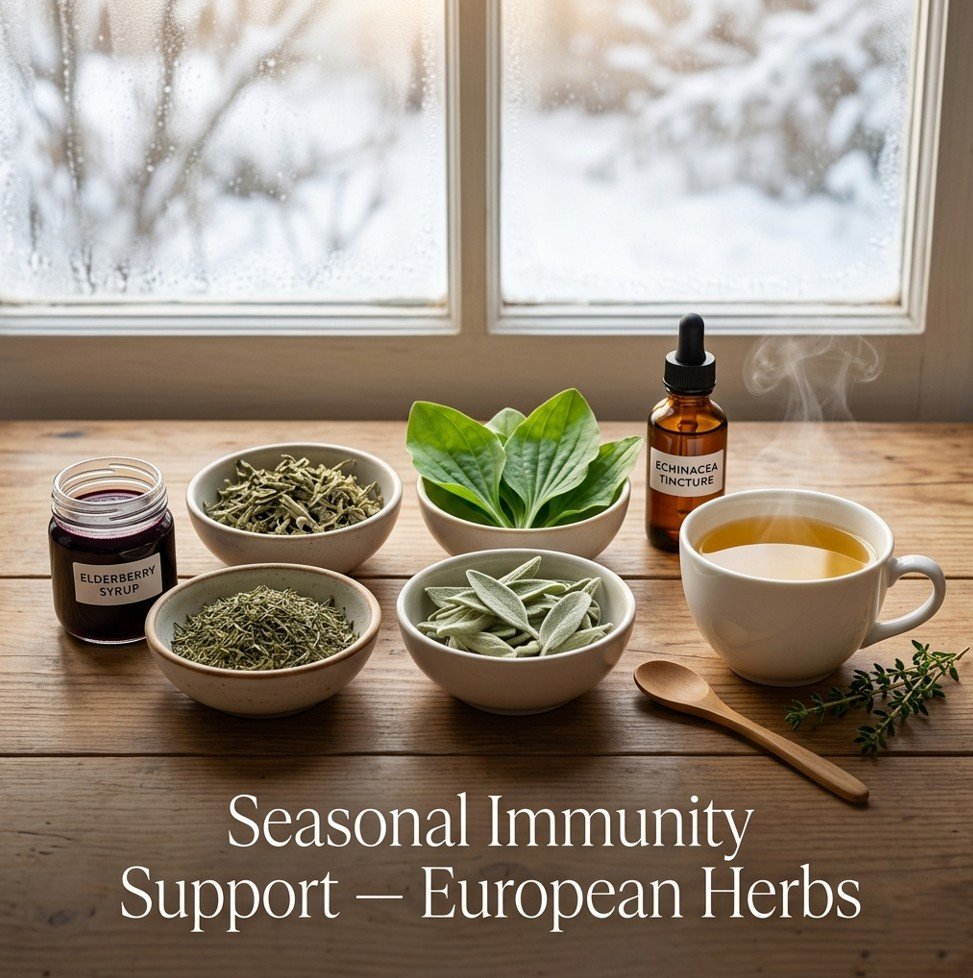
Winter brings coughs, colds, and the familiar scratchy throat. While modern medicine offers vaccines and effective treatments for serious infections, European herbal traditions have long provided gentle, supportive remedies for mild, seasonal illnesses.
The herbs described here are not cures. They do not replace antibiotics (which are ineffective against viruses anyway) or medical care for pneumonia, influenza complications, or bacterial infections. Instead, they are traditionally used to support the body’s own immune responses, soothe sore throats, reduce the duration of mild colds, and provide comfort during illness.
This article covers five herbs: elderberry, thyme, sage, plantain, and echinacea (the last is not native to Europe but has been cultivated and used here for decades). We explain traditional use, modern evidence, preparation methods, and critical safety information.
What Causes Seasonal Colds and Immune Stress?
The common cold is caused by viruses — most often rhinoviruses, but also coronaviruses (not SARS‑CoV‑2), adenoviruses, and others. Colds are more common in winter for several reasons:
- Indoor crowding: People spend more time indoors, increasing virus transmission.
- Lower humidity: Dry air may impair the immune function of nasal passages.
- Less vitamin D: Reduced sunlight in winter leads to lower vitamin D levels, which plays a role in immune regulation.
- Cold air: Breathing cold air may constrict blood vessels in the nose and reduce immune cell activity.
What herbs can and cannot do:
- Can: Support immune function, soothe sore throats, reduce cough frequency, possibly shorten cold duration by a day or two.
- Cannot: Cure colds, replace vaccines, treat bacterial infections like strep throat or pneumonia, or prevent COVID‑19.
Red flags — when to see a doctor (not herbs):
- Fever above 39°C (102°F) lasting more than 48 hours
- Difficulty breathing or wheezing
- Severe sore throat with white patches (possible strep)
- Symptoms lasting more than 10 days without improvement
- Ear pain, sinus pain that worsens
- Cough producing thick, green, or bloody mucus
- Chest pain or shortness of breath
Best European Herbs Traditionally Used for Immunity Support
The following five herbs are well‑documented in European and Western herbal traditions for seasonal wellness.
1. Elderberry (Sambucus nigra)
What it is: The dark purple berries of the elder tree, a shrub native to Europe. The flowers are also medicinal (see Article 7), but berries are the focus here.
Traditional use: Elderberry syrup has been a European winter staple for centuries. It is traditionally used at the first sign of a cold — for its warming, immune‑supporting properties. In Scandinavia and Britain, elderberry cordial is a traditional winter drink.
What modern research suggests: Several small clinical trials have examined elderberry extract for colds and influenza. A 2016 meta‑analysis (of 4 trials) found that elderberry significantly reduced the duration of cold symptoms (by about 2–4 days) and reduced symptom severity. However, the quality of these studies was moderate — some had small sample sizes and potential bias. A 2019 trial found no benefit for influenza. Evidence is promising but not conclusive.
Best use case: At the first sign of a cold (scratchy throat, runny nose). Take 1–2 teaspoons of elderberry syrup 3–4 times daily. Also useful during flu season as a preventive (though evidence is weaker).
Key safety note: Do not eat raw elderberries. Raw berries contain cyanogenic glycosides (sambunigrin) that can cause nausea, vomiting, and diarrhoea. Cooking (simmering) destroys these compounds. Syrups, jams, and cooked preparations are safe. Avoid in pregnancy (insufficient safety data). May theoretically interact with immunosuppressants.
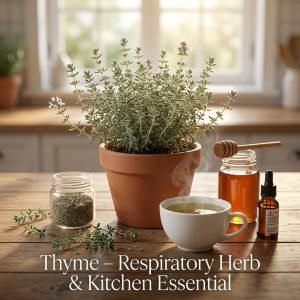
2. Thyme (Thymus vulgaris)
What it is: A low‑growing, aromatic shrub native to the Mediterranean. The leaves and flowering tops are used.
Traditional use: Thyme has been used for thousands of years for respiratory infections — coughs, bronchitis, and sore throats. In European folk medicine, thyme tea was given for whooping cough and chest congestion. The essential oil (thymol) is a strong antiseptic.
What modern research suggests: Several clinical trials have examined thyme preparations for cough and bronchitis. A 2006 study found that a thyme‑ivy combination reduced cough frequency and severity in acute bronchitis. Thyme’s expectorant and antispasmodic properties are well established. The German Commission E approves thyme for bronchitis and whooping cough.
Best use case: Thyme tea (1–2 teaspoons dried leaves per cup, steep 10 minutes) for wet, productive coughs and chest congestion. Thyme syrup (see preparation below) is a traditional children’s remedy. Thyme gargle for sore throat.
Key safety note: Thyme in tea and food amounts is very safe. Thyme essential oil is very concentrated — never ingest undiluted. Do not use thyme oil internally without professional guidance. Pregnancy: food amounts safe; medicinal doses avoid.
3. Sage (Salvia officinalis)
What it is: An evergreen subshrub native to the Mediterranean. The leaves are used.
Traditional use: Sage is best known for sore throat relief. Sage tea or gargle has been used for centuries to soothe inflamed mucous membranes. It is also traditionally used for excessive sweating (menopause night sweats) and digestive complaints.
What modern research suggests: Several clinical trials confirm that sage extract (as a tea or spray) reduces sore throat pain. A 2009 study found that a sage‑echinacea spray was as effective as a standard anaesthetic spray for sore throat. Sage has antimicrobial and anti‑inflammatory properties.
Best use case: Sage gargle for sore throat (strong infusion: 2 teaspoons dried sage per cup, steep 10 minutes, cool, gargle 3–4 times daily). Sage tea for coughs and mild fever. Also useful for night sweats (not immunity, but a common winter complaint).
Key safety note: Sage is safe in tea and food amounts. However, sage contains thujone, a compound that can be neurotoxic in very high doses. Do not consume sage essential oil internally. Avoid medicinal doses during pregnancy (thujone can stimulate the uterus). Do not use for prolonged periods (weeks) without a break. Normal tea use is fine.
4. Plantain (Plantago lanceolata / P. major)
What it is: A common “weed” found in lawns, meadows, and roadsides across Europe. The leaves are used. Not to be confused with the banana‑like plantain fruit.
Traditional use: Plantain has been used for centuries as a cough remedy and wound healer. The leaves contain mucilage — a gel‑like substance that soothes irritated mucous membranes. Plantain syrup is a traditional European remedy for dry, tickly coughs.
What modern research suggests: Very limited human research. Laboratory studies confirm that plantain has anti‑inflammatory, antimicrobial, and expectorant properties. Traditional use is the main support. It is considered safe and effective by many European herbalists.
Best use case: Plantain syrup (see preparation below) for dry, irritating coughs. Plantain tea (1–2 teaspoons dried leaves per cup, steep 10 minutes) for coughs and mild respiratory irritation. Also used externally for insect bites and minor skin irritations (crushed fresh leaf applied directly).
Key safety note: Plantain is very safe. Avoid harvesting from polluted areas (roadsides, lawns treated with chemicals). Pregnancy: food amounts safe; medicinal doses consult doctor. No known drug interactions.
5. Echinacea (Echinacea purpurea / E. angustifolia)
What it is: A flowering plant native to North America, but widely cultivated in Europe for over 100 years. It is now a standard herb in German and Polish herbal medicine. The root, leaves, and flowers are used.
Traditional use: Echinacea was used by Native Americans for infections and wounds. European herbalists adopted it in the early 20th century, and it became one of the most popular herbs for immune support, particularly in Germany.
What modern research suggests: Echinacea is one of the most studied immune herbs — but results are mixed. A 2014 Cochrane review (24 trials, 4,631 participants) concluded that echinacea may slightly reduce the risk of catching a cold and may shorten cold duration by about half a day to a full day. However, the evidence is not strong, and many individual trials show no benefit. Some experts believe that certain echinacea preparations (standardised to alkylamides) are more effective than others.
Best use case: At the first sign of a cold, take echinacea tincture (1–2 ml, 20–40 drops) or capsules 3 times daily for 7–10 days. Not recommended for long‑term daily use (immune system may become less responsive). Choose a product standardised to alkylamides (check label).
Key safety note: Echinacea is generally safe. People with ragweed or Asteraceae allergies may react (rare). Echinacea may theoretically interact with immunosuppressants (cyclosporine, corticosteroids) — avoid if you have an autoimmune disease (rheumatoid arthritis, lupus, multiple sclerosis) unless under medical supervision. Not recommended for long‑term daily use. Avoid during pregnancy (insufficient data).
How to Use These Herbs at Home
Elderberry syrup (traditional winter staple)
Ingredients:
- 500 g fresh or 250 g dried elderberries
- 1 litre water
- 500 g honey (or sugar)
- Optional: 1 cinnamon stick, 3 cloves, 1 cm fresh ginger
Method:
- Simmer berries and spices in water for 30–40 minutes
- Mash berries, strain through a fine sieve or muslin
- Return liquid to pan, add honey, simmer gently until slightly thickened (10–15 minutes)
- Pour into sterilised bottles
- Store in refrigerator — use within 2–3 months
Dose: Adults: 1–2 teaspoons (5–10 ml) 3–4 times daily at first sign of cold. Children (over 2 years): ½–1 teaspoon (with medical advice).
Thyme tea and syrup
Thyme tea:
- 1–2 teaspoons dried thyme leaves per cup
- Pour boiling water, steep 10 minutes, strain
- Drink 2–3 cups daily for coughs
Thyme syrup:
- Make a strong thyme decoction (simmer 20 g dried thyme in 500 ml water for 20 minutes)
- Strain, add 250 g honey, simmer gently until syrupy
- Store in refrigerator — use within 2–3 weeks
- Dose: 1 teaspoon as needed for cough
Sage gargle and tea
Sage gargle (for sore throat):
- 2 teaspoons dried sage leaves per cup
- Steep 10 minutes, strain, cool to warm temperature
- Gargle for 30 seconds, 3–4 times daily
- Do not swallow (but small amounts are harmless)
Sage tea (for coughs and mild fever):
- 1 teaspoon dried sage per cup, steep 5–8 minutes
- Drink 2–3 cups daily for short periods (3–5 days)
Plantain syrup
- Fill a glass jar with fresh plantain leaves (pack loosely)
- Cover with honey (warm honey flows better)
- Stir daily for 2–3 weeks, pressing leaves down
- Strain through muslin, bottle
- Store at room temperature (honey is antimicrobial)
- Dose: 1 teaspoon as needed for dry, tickly coughs
Echinacea tincture
Commercial tinctures are available. Follow product instructions. Typical dose: 1–2 ml (20–40 drops) in water, 3 times daily for 7–10 days at first sign of cold.
When the Season Matters
These herbs are most relevant in autumn and winter — the cold and flu season.
Harvesting for home use:
- Elderberries: Harvest in late summer to early autumn (August–September). Only fully ripe, dark purple berries. Wear gloves (stems can irritate). Do not harvest from roadsides.
- Thyme: Harvest leaves just before flowering (late spring to summer). Dries well.
- Sage: Harvest leaves year‑round but best before flowering (late spring).
- Plantain: Harvest leaves from spring to autumn. Best when young and green. Avoid old, tough leaves.
- Echinacea: Root is harvested in autumn after 3–4 years of growth. Not recommended for home harvest (complex processing).
Buying advice:
- Elderberry syrup is widely available from European health food stores — check sugar content.
- Dried thyme, sage, and plantain are inexpensive and store well.
- Echinacea products vary widely in quality. Look for standardised extracts (alkylamides) from reputable European brands (e.g., A.Vogel, Salus, Dr. Wolz).
Storage:
- Dried thyme, sage, plantain: airtight glass jars away from light — 12–18 months.
- Elderberry syrup: refrigerate, use within 2–3 months.
- Echinacea tincture: store in cool, dark place — 2–3 years.
Safety, Interactions, and When to See a Doctor
This article is for educational purposes only and does not replace medical advice, diagnosis, or treatment. Persistent, severe, or unclear symptoms should be discussed with a qualified healthcare professional.
Specific safety notes:
| Herb | Contraindications / Cautions |
|---|---|
| Elderberry | Raw berries toxic — cook first. Avoid in pregnancy (insufficient data). |
| Thyme | Very safe as tea. Essential oil toxic internally. |
| Sage | Safe in tea amounts. Avoid medicinal doses in pregnancy (thujone). Do not take essential oil. |
| Plantain | Very safe. Avoid polluted harvest sites. |
| Echinacea | Avoid in autoimmune diseases (theoretical). Avoid long‑term daily use. Possible ragweed allergy. |
Pregnancy and breastfeeding:
- Elderberry (cooked syrup) — avoid or use only after consulting doctor (insufficient data)
- Thyme — food amounts safe; medicinal doses avoid
- Sage — avoid medicinal doses (thujone); food amounts safe
- Plantain — likely safe in tea amounts (consult doctor)
- Echinacea — avoid (insufficient safety data)
Drug interactions:
- Echinacea may theoretically interact with immunosuppressants (cyclosporine, tacrolimus, corticosteroids)
- Sage in high doses may interact with diabetes medications (lowers blood sugar) and anticonvulsants (theoretical)
- Others have no known significant interactions
When to see a doctor (not herbs):
- Fever above 39°C (102°F) for more than 48 hours
- Difficulty breathing, wheezing, chest pain
- Severe sore throat with white patches (possible strep)
- Symptoms lasting more than 10 days without improvement
- Cough producing thick green, yellow, or bloody mucus
- Ear pain or sinus pain that worsens
- Any symptom in an infant, elderly person, or person with chronic illness
FAQ
Does elderberry really help with colds?
Small to moderate studies suggest elderberry may shorten cold duration by 2–4 days and reduce symptom severity. However, the evidence is not conclusive. It is a reasonable supportive measure, not a cure.
Can I take echinacea every day to prevent colds?
No. Most experts do not recommend long‑term daily echinacea. It may reduce effectiveness over time and has not been shown to prevent colds. Use it at the first sign of a cold for 7–10 days.
Is sage safe for children?
Sage tea in small amounts (½ cup, diluted) is traditionally used for coughs and sore throats in children over 6 years. However, due to thujone content, limit use to 3–5 days. For young children, plantain or thyme are gentler.
Can I make elderberry syrup from dried berries?
Yes. Use 250 g dried elderberries (instead of 500 g fresh). Simmer longer (45–60 minutes) to rehydrate and extract.
What is the best herb for a dry, tickly cough?
Plantain syrup or tea is excellent for dry, irritating coughs. The mucilage soothes the throat. Thyme is better for wet, productive coughs.
Can I combine these herbs?
Yes. A classic winter blend: elderberry syrup (taken separately) + thyme tea for cough + sage gargle for sore throat. Do not take multiple herbs in high doses without professional guidance.
Key Takeaways
- Five herbs are traditionally used for seasonal immunity support: elderberry, thyme, sage, plantain, and echinacea.
- Elderberry syrup may shorten cold duration (moderate evidence). Thyme and sage are effective for coughs and sore throats (good traditional evidence, some modern support).
- Plantain is excellent for dry, tickly coughs. Echinacea is widely used but evidence is mixed — use at first sign of cold for 7–10 days.
- Raw elderberries are toxic — always cook them. Sage contains thujone — avoid medicinal doses in pregnancy.
- Herbs are supportive, not curative. See a doctor for high fever, difficulty breathing, or symptoms lasting more than 10 days.
- This is not medical advice. Do not replace vaccines, antibiotics, or medical care with herbs.
Internal Links Used
- Summer medicinal flowers to gather responsibly — placed in elderflower vs elderberry distinction
- Thyme: respiratory herb and kitchen essential — placed in thyme section
- Sage: culinary herb with medicinal depth — placed in sage section
- Best European herbs for sore throat comfort — placed in sage and plantain sections
Sources
- European Medicines Agency (EMA) – Community herbal monographs: Sambuci fructus, Thymi herba, Salviae officinalis folium, Plantaginis lanceolatae folium, Echinaceae purpureae herba.
- World Health Organization (WHO) – Monographs on selected medicinal plants.
- German Commission E Monographs – Elderberry, thyme, sage, plantain, echinacea.
- Vlachojannis, J. E., et al. (2016). Elderberry for colds and influenza. Phytotherapy Research, 30(10), 1601-1610.
- Karsch‑Völk, M., et al. (2014). Echinacea for preventing and treating the common cold. Cochrane Database of Systematic Reviews, (2).
- Gruenwald, J., et al. (2006). Thyme‑ivy combination for acute bronchitis. Advances in Therapy, 23(6), 907-919.
- Schapowal, A., et al. (2009). Sage‑echinacea spray for sore throat. European Journal of Medical Research, 14(3), 121-126.
- National Center for Complementary and Integrative Health (NCCIH) – Elderberry, echinacea.