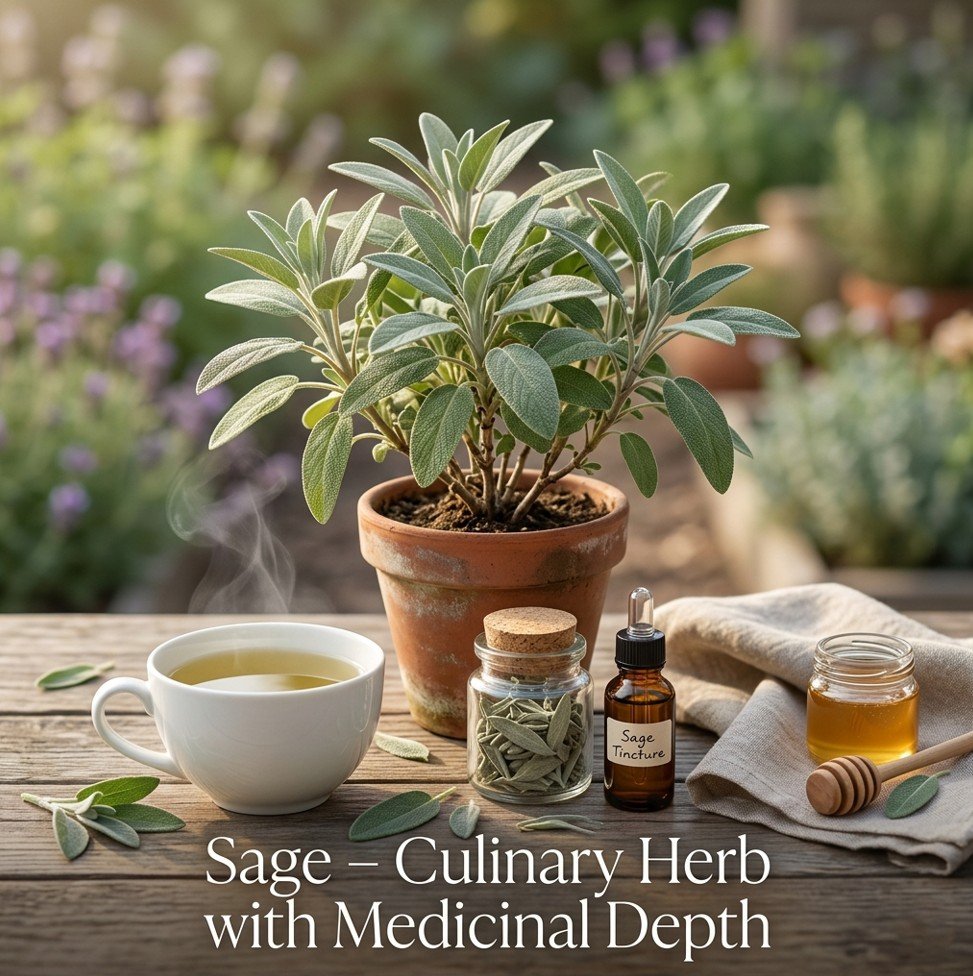
In every herb garden, there is a grey‑green, velvety‑leaved shrub that smells of earth and camphor. This is sage – a plant so woven into European culture that it appears in proverbs (“Why should a man die whilst sage grows in his garden?”) and in the oldest herbals.
Sage is not a gentle herb. Its flavour is bold, its medicinal action is strong, and its safety profile requires respect. Used correctly – as a tea for sore throats, a gargle for mouth inflammation, or a tincture for night sweats – it is effective and safe. Used excessively or during pregnancy, it can cause harm.
This profile covers Salvia officinalis (garden sage), not to be confused with other salvias (e.g., Spanish sage, Salvia lavandulifolia, which has different chemistry). We explore its botany, traditional European uses, what research confirms, practical preparations, and the crucial warnings about thujone.
What Is Sage?
Scientific name: Salvia officinalis
Common names: Garden sage, common sage, sauge officinale (French), Echter Salbei (German), szałwia lekarska (Polish), salvia (Italian, Spanish)
Appearance:
- Evergreen subshrub, 30–60 cm tall, woody at the base
- Stems: square (mint family), white‑woolly when young
- Leaves: opposite, 3–8 cm long, oblong to lanceolate, grey‑green, covered in fine hairs (velvety texture), with a wrinkled surface. Leaf margins are entire (not serrated).
- Odour: strong, aromatic, camphor‑like, slightly bitter
- Taste: warm, camphoraceous, bitter, astringent
- Flowers: purple, blue, pink, or white, in whorls on spikes (late spring to early summer)
- Roots: fibrous, shallow
Habitat: Native to the Mediterranean region (Dalmatia, Italy, Greece, Spain). Cultivated throughout Europe and worldwide. Grows best in well‑drained, sunny locations.
Parts used: Leaves (fresh or dried). The flowering tops are also used, but leaves are the primary medicinal part.
Distinction from other salvias: There are over 900 Salvia species. Spanish sage (Salvia lavandulifolia) has lower thujone content and is sometimes preferred for cognitive uses. Clary sage (Salvia sclarea) is different – used for hormonal support and as an essential oil. This article refers only to common garden sage, Salvia officinalis.
Why “sage”? From Latin salvia, derived from salvere – “to be well” or “to heal”. The plant’s reputation as a life‑extending herb gave rise to the saying: “He who would live for aye, must eat sage in May.”
Traditional Uses in European Herbalism
Sage has been used for thousands of years. The ancient Greeks and Romans valued it as a diuretic and wound healer. In the Middle Ages, it was a monastery garden staple. By the 17th century, it was a standard European remedy.
Historical timeline:
- Ancient Egypt: Used as a fertility remedy (limited evidence).
- Ancient Greece and Rome: Dioscorides recommended sage for wounds, ulcers, and menstrual disorders. Pliny the Elder called it a “sacred herb”.
- Medieval Europe: “Why should a man die whilst sage grows in his garden?” – sage was believed to extend life. Used for fevers, liver complaints, and memory loss.
- Renaissance: Paracelsus praised sage for its healing properties.
- 19th century: Sage was a standard treatment for sore throat, mouth ulcers, and excessive sweating (night sweats, especially in tuberculosis patients – known as “phthisis”).
Traditional European uses:
| Use | Traditional preparation | Regions |
|---|---|---|
| Sore throat, tonsillitis, mouth ulcers | Sage gargle (strong infusion) | Throughout Europe |
| Night sweats, menopausal hot flushes | Sage tea or tincture (internal) | Germany, France, Britain |
| Digestive discomfort, bloating | Sage tea after meals | Mediterranean, Germany |
| Coughs, bronchitis | Sage tea (often with honey) | Britain, Eastern Europe |
| Memory and cognitive support | Sage tea or tincture – “herb of remembrance” | Britain, Germany (Renaissance) |
| Excessive salivation (drooling) | Sage tea (astringent effect) | France, Germany |
| Inflammation of gums (gingivitis) | Sage gargle or mouthwash | Throughout Europe |
Important note: Sage’s use for night sweats was particularly important historically, as sweating was a debilitating symptom of tuberculosis. Today, it is used for menopausal hot flushes.
What Modern Research Says
Sage has been studied more than many European herbs. The evidence is strongest for sore throat and excessive sweating.
What has strong to moderate evidence:
1. Sore throat and pharyngitis
Multiple clinical trials confirm that sage extract (as a tea, gargle, or spray) reduces sore throat pain. A 2009 study found that a sage‑echinacea spray was as effective as a standard lidocaine spray for sore throat relief. A 2017 systematic review concluded that sage is effective for acute pharyngitis. This is the best‑supported use.
2. Excessive sweating (hyperhidrosis, menopausal night sweats)
Several clinical trials have examined sage for sweating. A 2011 study found that a sage tablet (containing fresh sage extract) reduced sweating severity by 50% compared to placebo. A 2015 study found that sage‑alfalfa combination reduced hot flushes in menopausal women. The mechanism is thought to involve oestrogen‑like effects (phytoestrogens) and astringent tannins.
3. Cognitive function and memory
Several studies have examined sage for memory enhancement. A 2003 study found that sage oil capsules improved memory performance in healthy young adults. A 2018 study found that a sage extract improved cognitive function in older adults with mild to moderate Alzheimer’s disease (small trial, needs replication). Evidence is promising but not conclusive.
4. Antimicrobial activity
Laboratory studies confirm that sage extract inhibits bacteria (including Streptococcus mutans, a cause of dental plaque) and fungi (Candida). This supports traditional use for mouth and throat infections.
What has limited or inconclusive evidence:
- Digestive support: Traditional use is strong, but human studies are lacking. Sage’s bitter compounds stimulate digestive secretions – mechanism understood, but specific trials are few.
- Blood sugar control: Some small studies suggest sage may lower blood glucose in type 2 diabetes, but evidence is weak. Do not use sage as a substitute for diabetes medication.
- Cholesterol: Very weak evidence.
What research does NOT show:
- Sage does not cure Alzheimer’s disease.
- Sage is not a substitute for antibiotics for bacterial throat infections (e.g., strep throat).
- Sage does not replace hormone replacement therapy for severe menopausal symptoms.
Main Benefits and Practical Uses
Based on traditional European practice and available evidence, sage is most useful for:
| Use | Traditional support | Evidence strength | Best preparation |
|---|---|---|---|
| Sore throat, pharyngitis | Strong | Strong | Gargle (strong infusion) or spray |
| Night sweats, menopausal hot flushes | Strong | Moderate | Tea or tincture (internal) |
| Mouth ulcers, gingivitis | Strong | Moderate | Gargle or mouthwash |
| Mild digestive discomfort | Strong | Weak | Tea after meals |
| Memory and concentration | Moderate | Weak‑to‑moderate | Tea or tincture (short‑term) |
What sage is NOT for:
- Severe sore throat with fever and white patches (possible strep – see a doctor)
- Severe menopausal symptoms (hormone replacement therapy is more effective)
- Pregnancy (contraindicated – see safety)
- Children under 6 years (insufficient safety data)
- Long‑term daily use (weeks or months) without a break
How to Prepare Sage
Sage is very strong. Use smaller amounts than you would with chamomile or peppermint.
Sage tea (for internal use – night sweats, digestion, cognitive support)
Ingredients:
- 1 teaspoon (0.5–1 gram) dried sage leaves per cup (250 ml)
- Freshly boiled water
Method:
- Place dried sage leaves in a cup
- Pour boiling water over the leaves
- Cover and steep for 5–8 minutes (longer becomes very bitter and increases thujone extraction)
- Strain and drink
- Taste: warm, camphoraceous, bitter, astringent – not pleasant for everyone. Add honey if desired.
Dosage: 1–2 cups daily for short periods (3–5 days). Do not exceed 2 cups per day. For night sweats, drink 1 cup in the evening.
Sage gargle (for sore throat, mouth ulcers, gingivitis)
Ingredients:
- 2 teaspoons dried sage leaves per cup (250 ml) – double strength
- Freshly boiled water
Method:
- Place sage leaves in a cup
- Pour boiling water over the leaves
- Steep for 10 minutes
- Strain and cool to warm temperature
- Gargle for 30 seconds, 3–4 times daily
- Spit out – do not swallow (small amounts are harmless, but large amounts of strong infusion are not intended for internal use)
Note: The stronger concentration is for gargling only. Swallowing small amounts is fine, but do not drink this as a tea.
Sage tincture (alcohol extract)
- Commercial tinctures (1:5, 40–50% alcohol) available
- Typical dose: 1–2 ml (20–40 drops) in water, 1–2 times daily for short periods
- Tincture is convenient for night sweats and cognitive support
Sage honey (for sore throats – gentler than gargle)
Method:
- Fill a small jar with fresh sage leaves
- Cover with honey
- Stir daily for 2 weeks
- Strain or leave as is
- Take 1 teaspoon as needed for sore throat
Storage: Room temperature (honey is antimicrobial) – use within 6 months.
Sage essential oil – CAUTION
Do not ingest sage essential oil internally. It is highly concentrated (40–60% thujone) and can cause seizures, kidney damage, and nervous system toxicity. External use only, diluted (e.g., 1–2 drops in a carrier oil for massage). Not recommended for home use.
What to avoid:
- Do not exceed 2 cups of tea per day (thujone limit)
- Do not use for more than 2 weeks continuously without a break (theoretical risk of thujone accumulation)
- Do not use during pregnancy or breastfeeding (contraindicated)
- Do not give to young children
- Do not ingest essential oil
Best Season to Harvest or Buy It
Harvest season:
- Sage is evergreen – leaves can be harvested year‑round in mild climates
- Best harvest time: just before flowering (late spring to early summer) when essential oil content is highest
- Harvest on a dry morning after dew has evaporated
- Pick individual leaves or cut stems 10–15 cm from the ground
How to dry:
- Spread leaves in a single layer on a drying screen
- Dry in a warm, airy, shaded location (not direct sunlight)
- Turn daily
- Drying takes 5–10 days
- Leaves are ready when they crumble easily
Storage:
- Store dried leaves whole (crush just before use) – whole leaves retain flavour and potency better
- Airtight glass jars away from light and heat
- Properly stored, sage retains good quality for 18–24 months
Buying advice:
- Dried sage should be grey‑green, not brown
- Strong, camphoraceous aroma indicates freshness
- Organic certification is desirable (sage is sometimes sprayed in conventional farming)
Fresh vs dried:
- Fresh sage has a milder flavour and lower thujone content
- Dried sage is more concentrated and more potent medicinally
- For tea and gargle, dried is better. For culinary use, fresh is fine.
Safety, Side Effects, and Interactions
This article is for educational purposes only and does not replace medical advice, diagnosis, or treatment. Persistent, severe, or unclear symptoms should be discussed with a qualified healthcare professional.
The thujone issue – critical safety information
Sage contains thujone (specifically alpha‑thujone and beta‑thujone), a compound that is neurotoxic in high doses. Thujone can cause:
- Seizures (in very high doses – rare from tea)
- Dizziness, confusion, rapid heartbeat
- Kidney and liver damage (with prolonged excessive use)
Safe use guidelines:
- Do not exceed 2 cups of sage tea per day
- Do not use for more than 2 weeks continuously – take a break
- Do not use during pregnancy (thujone can stimulate the uterus and may be neurotoxic to the fetus)
- Do not use sage essential oil internally – this is where real toxicity occurs
What is a safe dose of thujone? European Medicines Agency (EMA) guidelines suggest a daily thujone intake of <0.1 mg/kg body weight. One cup of sage tea (1 teaspoon leaves) contains approximately 1–3 mg of thujone depending on the plant and preparation. This is within safe limits for short‑term use.
Who should be cautious or avoid sage:
1. Pregnancy and breastfeeding – CONTRAINDICATED
Sage has traditional use as an emmenagogue (menstrual stimulant) and can stimulate uterine contractions. Thujone may also cross the placenta. Do not use medicinal doses of sage during pregnancy (culinary amounts in food are safe). Breastfeeding: sage can reduce milk supply (theoretical) – avoid large amounts.
2. People with epilepsy or seizure disorders
Thujone is a known convulsant in high doses. While tea is unlikely to trigger seizures at normal doses, individuals with epilepsy should avoid sage in medicinal amounts. Culinary use is fine.
3. People taking diabetes medication
Sage may lower blood sugar. If you take insulin or oral hypoglycaemics (metformin, sulfonylureas), monitor blood sugar closely if using sage regularly.
4. People with hormone‑sensitive conditions
Sage has phytoestrogenic effects (weak oestrogen‑like activity). In theory, this could affect conditions like breast cancer, uterine fibroids, or endometriosis. Evidence is weak, but caution is advised. Discuss with your doctor.
5. People taking sedatives or anticonvulsants
Theoretical interaction – thujone may antagonise the effects of sedatives and anticonvulsants (opposite effect). Clinical significance is unknown.
6. Children under 6 years
Insufficient safety data. Avoid medicinal use. Culinary amounts in food (small quantities) are fine.
Common side effects (rare at normal doses):
- Mild digestive upset (nausea, stomach pain)
- Allergic reactions (skin rash – rare)
- Dizziness (if excessive amounts)
Drug interactions summary:
| Medication class | Interaction risk | Recommendation |
|---|---|---|
| Diabetes medication (insulin, metformin, sulfonylureas) | Low (additive blood sugar lowering) | Monitor blood sugar |
| Anticonvulsants (phenytoin, carbamazepine, valproate) | Theoretical (thujone may lower seizure threshold) | Avoid medicinal use |
| Sedatives (benzodiazepines, barbiturates) | Theoretical (thujone may reduce sedative effect) | Use caution |
| Anticoagulants (warfarin) | No known interaction | Safe |
Red flags – when to stop sage and see a doctor:
- Severe sore throat with fever, white patches, or difficulty swallowing (possible strep throat)
- Night sweats accompanied by fever, weight loss, or night-time cough (possible infection or lymphoma)
- Any symptom that persists despite sage use
FAQ
Is sage tea safe to drink every day?
For short periods (3–5 days, up to 2 weeks), yes – 1–2 cups daily. For long‑term daily use, no – thujone can accumulate. Take breaks. If you need daily support for night sweats, consider rotating with other herbs (e.g., lemon balm, linden) or consulting a doctor.
Can I use sage for hot flushes during menopause?
Yes – several studies suggest sage reduces hot flush frequency and severity. A typical dose is 1–2 cups of tea daily or 1–2 ml of tincture. However, if hot flushes are severe and interfering with sleep, discuss hormone replacement therapy or other medical options with your doctor.
Is it safe to gargle with sage during pregnancy?
No. Even gargling, some of the infusion is inevitably swallowed. Avoid medicinal sage entirely during pregnancy. Culinary amounts (sprinkling dried sage on food) are safe.
How does sage compare to thyme for sore throats?
Both are effective. Sage has stronger evidence specifically for sore throat pain. Thyme is better for coughs and chest congestion (expectorant). For a pure sore throat, choose sage. For sore throat with a wet cough, thyme may be better.
Can I give sage tea to my child?
For children over 6 years, a very weak sage gargle (½ teaspoon per cup) may be used for sore throats under adult supervision. Do not give sage tea internally to children. Safer options for children: chamomile, linden, or thyme (for coughs). Consult a paediatrician.
Does sage interact with blood pressure medication?
No known interaction. However, if you take blood pressure medication, sage’s mild diuretic and blood sugar‑lowering effects are unlikely to cause problems. Monitor blood pressure if using sage long‑term (which you should not do – take breaks).
Can I use sage essential oil for aromatherapy?
Yes, diluted and diffused. Sage essential oil is strong – use 1–2 drops in a diffuser. Do not apply undiluted to skin (can cause irritation). Do not ingest. Pregnant women should avoid sage essential oil entirely.
Key Takeaways
- Sage (Salvia officinalis) is a European herb with strong traditional use for sore throat (gargle), night sweats/menopausal hot flushes (tea), mouth ulcers, and digestive discomfort.
- Modern research supports its effectiveness for sore throat (strong evidence) and excessive sweating (moderate evidence). Cognitive effects are promising but preliminary.
- Critical safety: Sage contains thujone, which is neurotoxic in high doses. Limit to 1–2 cups of tea daily for short periods (max 2 weeks). Contraindicated in pregnancy.
- Do not ingest sage essential oil – highly toxic.
- Sage is not a substitute for medical treatment of strep throat, severe menopausal symptoms, or Alzheimer’s disease.
- This is not medical advice. Persistent or severe symptoms require a doctor.
Internal Links Used
- Best European herbs for sore throat comfort — placed in sore throat section
- Best European herbs for seasonal immunity support — placed in introduction
- Thyme: respiratory herb and kitchen essential — placed in comparison section
- Summer medicinal flowers to gather responsibly — placed in harvest section
Sources
- European Medicines Agency (EMA) – Community herbal monograph on Salvia officinalis L., folium. (2010).
- World Health Organization (WHO) – Monographs on selected medicinal plants, volume 4: Salvia officinalis.
- German Commission E Monograph – Sage leaves (1990).
- Schapowal, A., et al. (2009). Sage‑echinacea spray for sore throat. European Journal of Medical Research, 14(3), 121-126.
- Bommer, S., et al. (2011). Sage extract for excessive sweating. European Journal of Medical Research, 16(2), 81-85.
- Rahte, S., et al. (2013). Sage for cognitive function. Phytotherapy Research, 27(12), 1777-1785.
- National Center for Complementary and Integrative Health (NCCIH) – Sage.