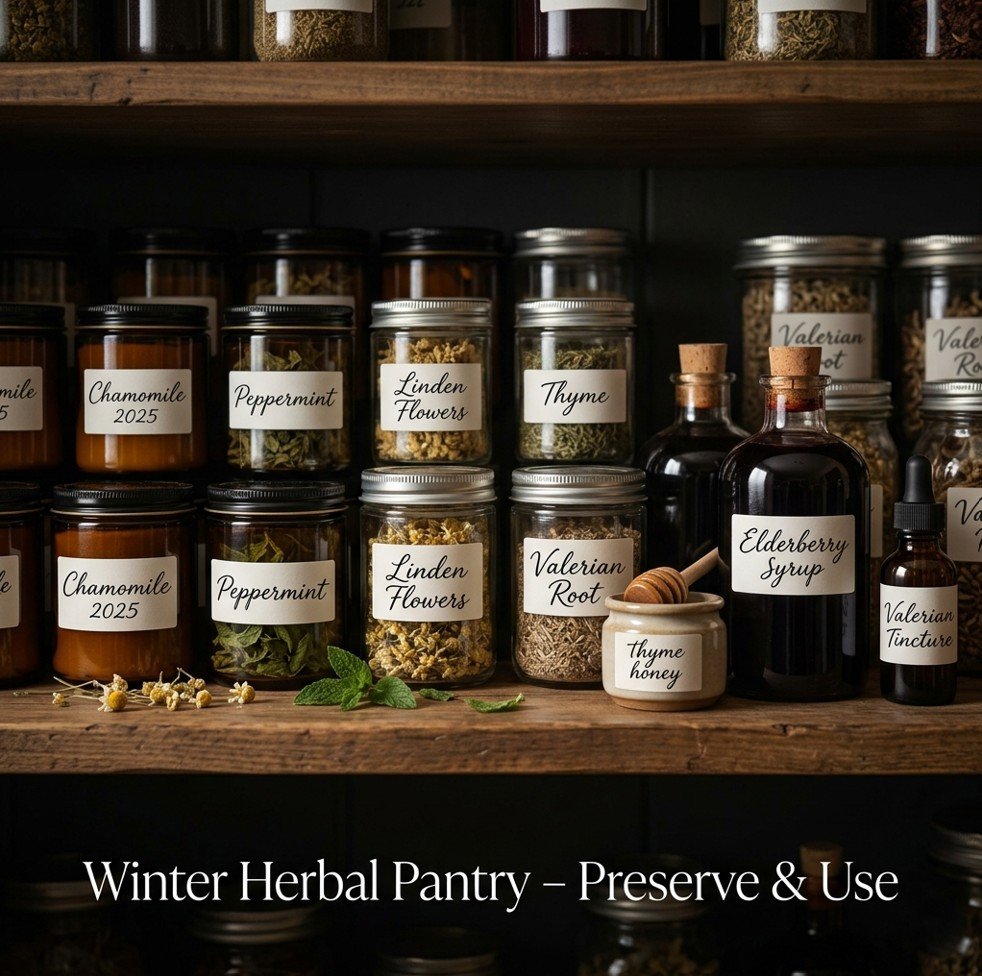
The first hard frost signals the end of the fresh herb season. The lush nettles of spring are gone. The summer flowers of chamomile and linden have been harvested and dried. The autumn roots – valerian, burdock – are stored in jars.
For those who use herbs for wellness, winter is not a time of scarcity. It is a time of using what was preserved. A well‑organised winter herbal pantry means you never have to run to the shop for a tea bag when a cough or sleeplessness strikes.
This guide covers the essentials of a European‑style winter herbal pantry: the best dried herbs to keep, how to store them (light, heat, moisture are the enemies), how to make and store syrups, honeys, and tinctures, and how to use preserved herbs effectively when fresh is not available.
What Grows in Winter? Very Little – But You Prepared
In most of Europe, winter offers no fresh medicinal herbs for foraging (except perhaps some evergreen leaves like pine or spruce, which are not covered here). The herbal pantry is entirely dependent on what was harvested, dried, or preserved in spring, summer, and autumn.
The principle: Harvest at the peak, preserve well, use through the winter. This is not new – it is how humans have survived for millennia.
What you should have stocked by late autumn:
| Herb | Part used | Harvest season | Preservation method | Winter use |
|---|---|---|---|---|
| Chamomile | Flowers | Summer | Dried | Sleep, digestion, calming |
| Peppermint | Leaves | Summer | Dried | Digestion, nausea, headaches |
| Lemon balm | Leaves | Summer | Dried (or tincture) | Stress, sleep, nervous digestion |
| Linden | Flowers | Early summer | Dried | Calming, sleep, mild fevers |
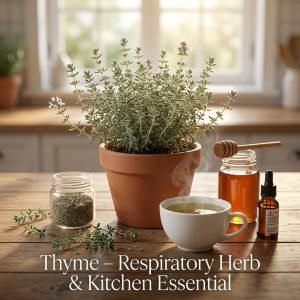
| Thyme | Leaves | Summer | Dried | Coughs, respiratory infections |
| Sage | Leaves | Spring–summer | Dried | Sore throats (gargle), night sweats |
| Nettle | Leaves | Spring | Dried | Nutritional support, mild diuretic |
| Yarrow | Flowering tops | Summer | Dried or tincture | Digestion, fevers (diaphoretic) |
| Elderberry | Berries | Autumn | Syrup (frozen or shelf‑stable) | Cold and flu support |
| Rosehips | Fruits | Autumn | Dried or syrup | Vitamin C, immune support |
| Valerian | Root | Autumn | Dried or tincture | Sleep support |
| Marshmallow | Root | Autumn | Dried | Sore throat, dry cough |
This list is not exhaustive but represents the core of a European winter herbal pantry.
Best Dried Herbs for Winter – And How to Store Them
Drying is the oldest and most reliable preservation method for leaves and flowers. Roots and berries are often dried as well, though syrups and tinctures are alternatives.
Which herbs dry well (retain potency through winter)
| Herb | Drying method | Storage life (proper conditions) | Notes |
|---|---|---|---|
| Chamomile | Air dry, shade | 12 months | Loses fragrance after 6–8 months |
| Peppermint | Air dry, shade | 12–18 months | Menthol declines slowly |
| Lemon balm | Air dry, shade | 12 months | Volatile oils fade – use within year |
| Linden | Air dry, shade | 12 months | Sweetness fades after 8 months |
| Thyme | Air dry, shade | 18 months | Very resilient |
| Sage | Air dry, shade | 18 months | Thujone content stable |
| Nettle | Air dry, shade | 18 months | Minerals remain; vitamin C declines |
| Yarrow | Air dry, shade | 12–18 months | Bitterness persists |
| Rosehips | Low heat dehydrator | 12–18 months | Vitamin C degrades over time |
| Valerian root | Low heat (<40°C) | 2 years | Smell strengthens with age – normal |
| Marshmallow root | Low heat | 2 years | Mucilage stable |
Which herbs do NOT dry well (better preserved as syrup or tincture)
- Elderflower: Dried elderflower is fine for tea but loses much of its delicate aroma. Freezing or making cordial is better.
- St. John’s wort: Dried flowering tops are fine, but the red oil (fresh plant in oil) is a different preparation. Tincture is more potent.
- Fresh herbs with high water content (basil, parsley): Not medicinal in the European herb sense, but if you want to preserve culinary herbs, freezing in oil is better.
Storage rules – the enemies of dried herbs
Light: UV radiation degrades volatile oils, flavonoids, and other active compounds. Store in amber glass jars or in a dark cupboard. Clear glass jars are fine if kept inside a closed, dark cabinet.
Heat: High temperatures accelerate chemical degradation. Store at room temperature or cooler (15–20°C). Do not store above the stove or near a radiator.
Moisture: Dried herbs are hygroscopic – they absorb moisture from the air. Moisture leads to mould and loss of potency. Store in airtight jars. Do not open jars in a steamy kitchen. Use completely dry spoons to remove herbs.
Oxygen: Oxygen slowly oxidises compounds. Fill jars as full as possible and seal tightly. Vacuum sealing is ideal but not necessary for short‑term storage.
Storage containers:
- Best: Amber glass jars with airtight lids (e.g., Kilner, Weck, or recycled brown glass jars).
- Acceptable: Clear glass jars kept in a dark cupboard.
- Avoid: Plastic bags (not airtight, can leach chemicals), paper bags (not airtight), plastic containers (static can attract herb dust, and some plastics absorb essential oils).
Label everything – include herb name and harvest/drying date. Replace herbs after 12–18 months (roots up to 2 years).
Syrups, Honeys, and Tinctures – Long‑Lasting Winter Preparations
Dried herbs are not the only option. Syrups (preserved with sugar or honey), herbal honeys (electuaries), and tinctures (alcohol extracts) can last through winter and beyond.
Elderberry syrup – winter immunity staple
Why it is ideal for winter: Cooked elderberry syrup is shelf‑stable (refrigerated) for 2–3 months. It can also be frozen in ice cube trays for longer storage.
Recipe summary:
- Simmer 500 g fresh or 250 g dried elderberries in 1 litre water for 30–40 minutes
- Strain, add 500 g honey or sugar, simmer gently until slightly thickened
- Bottle in sterilised jars, refrigerate
Winter use: At the first sign of a cold, take 1–2 teaspoons (adults) 3–4 times daily.
Storage life: Refrigerated – 2–3 months. Frozen – up to 12 months.
Rosehip syrup – vitamin C support
Why it is ideal for winter: Rosehips are high in vitamin C, but vitamin C degrades in dried hips over months. Syrup preserves more of the vitamin.
Recipe summary:
- Simmer 500 g fresh or dried rosehips in 1 litre water for 30 minutes
- Strain through muslin (to remove irritating hairs)
- Add 500 g sugar or honey, reduce to syrup
- Bottle
Winter use: 1 teaspoon daily as a winter tonic, or 2–3 teaspoons daily during a cold.
Storage life: Refrigerated – 2–3 months.
Herbal honeys (electuaries) – simple and long‑lasting
Method:
- Fill a glass jar with fresh or dried herbs (e.g., thyme, plantain, sage, lemon balm)
- Cover completely with raw honey (warm honey flows better)
- Stir daily for 2–3 weeks
- Strain or leave as is (the honey will preserve the herbs)
Winter use: Take 1 teaspoon as needed for coughs, sore throats, or digestive discomfort.
Storage life: At room temperature – up to 12 months (honey is antimicrobial). Keep in a dark cupboard.
Best herbs for winter honeys:
- Thyme honey – for coughs and respiratory congestion
- Sage honey – for sore throats
- Plantain honey – for dry, tickly coughs
- Lemon balm honey – for stress and nervous digestion
- Ginger honey – for nausea and warming (ginger is not European but widely used)
Tinctures (alcohol extracts) – the longest storage
Why tinctures are ideal for winter: Alcohol extracts many active compounds and preserves them for years. A tincture made in summer can be used for 2–5 years without significant degradation.
Basic method (simpler folk method – not standardised):
- Fill a glass jar with chopped fresh or dried herb
- Cover with 40–50% alcohol (vodka is fine)
- Seal and store in a dark place for 4–6 weeks, shaking daily
- Strain into dropper bottles
Winter use: 1–3 ml (20–60 drops) in water, up to 3 times daily.
Storage life: 2–5 years (if stored away from light and heat).
Best herbs for winter tinctures:
- Echinacea – immune support (use at first sign of cold)
- Valerian – sleep support
- Lemon balm – stress and anxiety
- Yarrow – digestive bitter, fever support
- Marshmallow root – but tincture is less effective than cold infusion (mucilage extracts better in water)
Note on safety: Tinctures contain alcohol. Not suitable for children, pregnant women, or people in recovery from alcohol use disorder. Alcohol‑free glycerites are available commercially.
How to Use Dried Herbs in Winter – Preparation Tips
Dried herbs are not the same as fresh. They require slightly different preparation.
Tea from dried herbs (infusion)
General rule: Use 1–2 teaspoons of dried herb per cup (250 ml) of boiling water. Steep for 5–10 minutes (longer for roots and seeds).
Winter tip: Dried herbs can be less aromatic than fresh. Do not over‑steep to compensate – it will become bitter. Instead, use a slightly larger amount (up to 2 tablespoons for mild herbs like linden).
Blending: Winter is the perfect time for blends. Combine:
- Sleep blend: Valerian root + lemon balm + chamomile
- Cough blend: Thyme + plantain + a pinch of liquorice (caution – see Article 15)
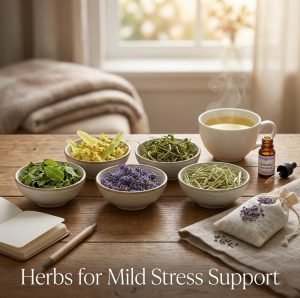
- Stress blend: Lemon balm + linden + chamomile
- Digestive blend: Peppermint + fennel + caraway
Decoctions (for roots and berries)
Roots (valerian, marshmallow, liquorice) and berries (rosehips, hawthorn) require simmering, not just steeping.
Method:
- Use 1–2 teaspoons of dried root/berries per cup of cold water
- Bring to a boil, then simmer for 10–20 minutes
- Strain and drink
Rehydrating dried herbs for external use
For compresses or poultices, dried herbs can be rehydrated with warm water. They will not be as potent as fresh, but they work.
Compress: Make a strong infusion (2 tablespoons herb per cup), steep 15 minutes, strain, soak cloth.
What to Do If You Run Out – Winter Foraging Options
In most of Europe, winter foraging for medicinal herbs is very limited. However, a few options exist:
- Pine needles (Pinus sylvestris): High in vitamin C. Make tea (crush needles, steep 10 minutes). Not a traditional European medicinal herb in the same sense, but a useful wilderness survival remedy.
- Birch polypore (old brackets): Old brackets from autumn can still be used for decoction (see Article 4). They persist through winter.
- Turkey tail (Trametes versicolor): Also persists on dead logs through winter (see Article 8).
Do not forage in winter unless you are an expert. Many toxic plants (e.g., hemlock) have dead stems that look similar to harmless plants.
Better solution: Plan ahead next year. Start your winter pantry in summer and autumn.
Seasonal Herbal Rituals – Winter Traditions
Advent and Christmas teas: In Germany and Austria, Weihnachtstee (Christmas tea) blends are popular – often containing linden, lemon balm, chamomile, and orange peel.
New Year’s health wishes: In Poland, it is traditional to drink a cup of linden or elderflower tea on New Year’s Day for health in the coming year.
Winter solstice: In Nordic countries, warming herbal teas (ginger, cinnamon, elderberry) are consumed during the darkest days.
These traditions are cultural, not medical.
Safety, Storage Failures, and When to Discard
Signs that dried herbs have gone bad:
| Sign | What it means | Action |
|---|---|---|
| Musty or mouldy smell | Moisture damage, mould | Discard immediately – mould can produce toxins |
| Brown or black colour (herbs that should be green) | Oxidation, age | Discard – little potency left |
| No smell (herbs that should be aromatic) | Volatile oils degraded | Discard – won’t work |
| Visible mould (white, grey, black fuzz) | Contamination | Discard immediately – do not use |
| Clumping (herbs sticking together) | Moisture absorption | Use soon if no mould; otherwise discard |
How to avoid waste:
- Buy or harvest only what you will use in 12–18 months
- Store properly (airtight, dark, cool, dry)
- Check your pantry every 6 months – rotate older herbs forward
- Compost old, non‑mouldy herbs – do not use them medicinally
Emergency winter substitute – commercial products
If you have no dried herbs or syrups, high‑quality commercial herbal teas and tinctures are available in health food stores and pharmacies. Look for reputable European brands (e.g., Salus, A.Vogel, Pukka, Sonnentor). They are a reasonable backup.
FAQ
Can I use dried herbs that are 2 years old?
Dried leaves and flowers lose potency significantly after 12–18 months. Roots and seeds may last up to 2 years. If they still smell aromatic and look normal, they are safe but weaker. Use double the amount. If they smell musty or look brown, discard.
Do I need to refrigerate dried herbs?
No – refrigeration introduces moisture. Store in airtight jars in a cool, dark cupboard. Freezing is not recommended for leaves and flowers (ice crystals damage cell structure), but you can freeze syrups and fresh herbs (e.g., lemon balm leaves in oil).
Can I make tea from frozen fresh herbs?
Yes. If you froze fresh lemon balm or mint leaves, use them directly in boiling water – no need to thaw. The texture will be mushy, but the flavour is still good.
What is the best way to store elderberry syrup?
Refrigerate and use within 2–3 months. For longer storage, freeze in ice cube trays, then transfer cubes to a freezer bag. Each cube is approximately 1 tablespoon (15 ml). Thaw as needed.
How do I know if my dried chamomile is still good?
Good chamomile should be bright yellow in the centre (the disc florets) and have a sweet, apple‑like smell. If it is brown, dull, or smells like hay, discard.
Can I use dried herbs for a compress?
Yes. Make a strong infusion (2–3 tablespoons herb per cup of water), steep 15 minutes, strain, cool to skin temperature. Dried herbs work well for compresses.
Key Takeaways
- A winter herbal pantry relies on dried herbs, syrups, honeys, and tinctures preserved from spring, summer, and autumn harvests.
- Essential dried herbs for winter: chamomile, peppermint, lemon balm, linden, thyme, sage, nettle, yarrow, rosehips, valerian root.
- Store dried herbs in airtight glass jars in a cool, dark, dry place. Light, heat, and moisture are the enemies.
- Syrups (elderberry, rosehip) and herbal honeys (thyme, plantain) are excellent for winter coughs and colds. Tinctures last for years.
- Discard any dried herb that smells musty, shows mould, or has lost colour and aroma.
- Winter foraging is limited. Plan ahead – build your pantry in summer and autumn.
Internal Links Used
- Summer medicinal flowers to gather responsibly — placed in drying section
- Autumn roots, berries, and mushrooms in herbal tradition — placed in root and berry section
- Best European herbs for seasonal immunity support — placed in elderberry syrup section
- Herbs traditionally used for sore throat comfort — placed in herbal honeys section
Sources
- European Medicines Agency (EMA) – Guidelines on quality of herbal medicinal products (storage stability).
- World Health Organization (WHO) – Guidelines on good agricultural and collection practices for medicinal plants.
- Grieve, M. (1931). A Modern Herbal – sections on drying and storing herbs.
- Hoffmann, D. (2003). Medical Herbalism: The Science and Practice of Herbal Medicine. Healing Arts Press.
- Royal Botanic Gardens, Kew – Plant preservation and storage fact sheets.
- National Center for Complementary and Integrative Health (NCCIH) – Herbal supplements: storage and safety.