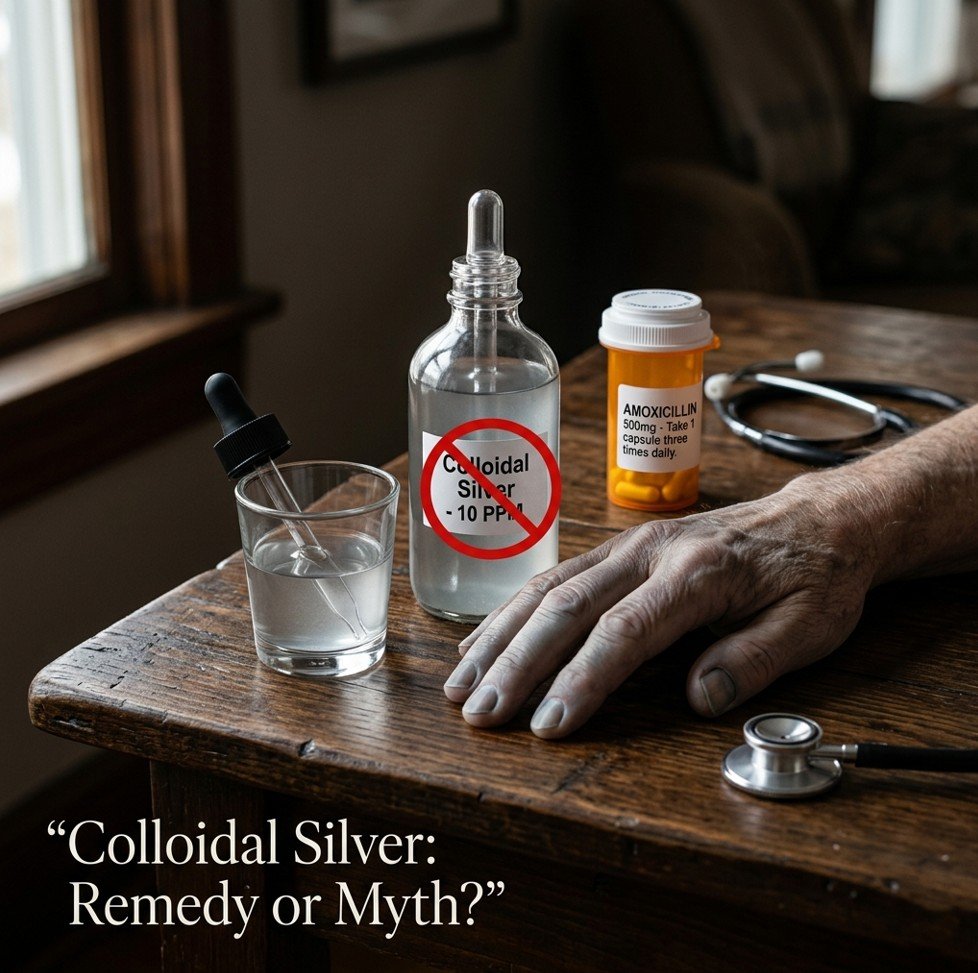
Colloidal silver is a solution consisting of tiny particles of metallic silver suspended in a liquid base, typically distilled water. Before the advent of modern antibiotics in the 1930s and 1940s, silver compounds were widely used as topical antiseptics to treat wounds and prevent infections. Physicians used silver nitrate drops in newborns’ eyes to prevent gonococcal ophthalmia, and silver foil dressings were applied to burns.
Today, colloidal silver has experienced a resurgence in popularity, largely driven by internet marketers and alternative medicine proponents who claim it can cure or prevent hundreds of diseases, including cancer, HIV/AIDS, diabetes, COVID-19, Lyme disease, tuberculosis, and the common cold. These products are sold as dietary supplements, nasal sprays, throat sprays, topical gels, and even solutions for nebulizers.
This article provides an evidence-informed assessment of colloidal silver, examining the gap between laboratory findings and clinical reality, the well-documented toxicity, and the definitive position of major health authorities. The conclusion is clear: colloidal silver offers no proven health benefits and carries substantial, irreversible risks.
Historical Context: From Antiseptic to “Cure-All”
Silver has been recognized for its antimicrobial properties for millennia. Ancient civilizations in China, Egypt, Greece, and Rome used silver vessels to keep water and food fresh. In the 19th and early 20th centuries, silver compounds were standard medical tools: silver nitrate was used to prevent eye infections in newborns, and colloidal silver was marketed as a treatment for gonorrhea, tonsillitis, and other infections.
The discovery and widespread availability of antibiotics — starting with penicillin in the 1920s — rendered silver-based internal treatments obsolete. Antibiotics were more effective, better understood, and had fewer side effects than the poorly characterized silver solutions of the era. By the 1970s, colloidal silver had disappeared from official drug formularies such as the United States Pharmacopeia.
The modern resurgence of colloidal silver began in the 1990s, driven by multilevel marketing companies that made extraordinary claims: that colloidal silver could safely kill over 650 pathogens, that it acted as a “second immune system,” that bacteria could never develop resistance, and that it was absolutely safe for humans. These claims have no scientific basis and have been the subject of numerous warning letters from the FDA and the Federal Trade Commission.
How Colloidal Silver Works: Laboratory Evidence vs. Clinical Reality
Laboratory (In Vitro) Antimicrobial Activity
In controlled laboratory settings — petri dishes and test tubes — silver ions do demonstrate antimicrobial activity. The positively charged silver ions bind to bacterial cell walls, disrupt membrane integrity, interfere with DNA replication, and inactivate essential enzymes. This multimodal mechanism of action makes it difficult for bacteria to develop resistance in vitro.
A 2025 study exploring metal ions as antimicrobial agents against Mycoplasma bovis found that colloidal silver inhibited 81.25% of isolates at 1.5 mg/L, while silver ions inhibited 93.7% of isolates at concentrations above 1.5 mg/L. A 2021 study investigating colloidal silver against chronic rhinosinusitis pathogens found that it was effective against methicillin-resistant Staphylococcus aureus (MRSA) and Pseudomonas aeruginosa biofilms in vitro, with minimal inhibitory concentration (MIC) values between 11 and 44 parts per million (ppm).
A 2022 review of silver as an antibiotic-independent antimicrobial confirmed that silver’s mechanism of action provides a low risk for bacterial resistance. However, the same review noted that “high local and uncontrolled concentrations have shown toxicity” and that “early forms of silver have more limited utility because of their uncontrolled release of silver ions and potential for systemic toxicity.”
The Critical Gap: No Clinical Evidence in Humans
Despite promising laboratory results, there is no clinical evidence that oral colloidal silver is effective for treating any disease or condition in humans. The National Center for Complementary and Integrative Health (NCCIH) states that “silver has no known functions or benefits in the body when taken by mouth” and that “there is no clinical evidence supporting the use of colloidal silver to prevent or treat COVID-19.”
The FDA has been unequivocal: since its 1999 Final Rule, the agency has declared that “over-the-counter drug products containing colloidal silver ingredients or silver salts are not generally recognized as safe and effective” for treating or preventing any disease. The agency has issued numerous warning letters to companies making unproven health claims.
The scientific reasons for this gap between laboratory and clinical efficacy include:
- Poor and variable absorption: Orally administered silver is absorbed in a range of only 0.4% to 18% in mammals, with a human value of approximately 18%. This means that even if a product has antimicrobial activity in a test tube, the amount that reaches the bloodstream is highly variable and generally insufficient to kill pathogens in the body.
- Protein binding: Absorbed silver binds rapidly to blood proteins (albumin), forming complexes that are transported to tissues but are no longer available as free ions to fight infection.
- Accumulation and slow elimination: Silver accumulates in the body and is cleared very slowly. One human patient was found to be excreting silver in urine three months after discontinuing use. This accumulation leads to toxicity long before it could provide therapeutic benefit.
The “Antibiotic Resistance” Claim
Some colloidal silver marketers claim that bacteria can never develop resistance to silver because of its multimodal mechanism of action. This claim is false. While resistance is less common than with single-target antibiotics, laboratory studies have demonstrated that bacteria can and do develop resistance mechanisms to silver, including efflux pumps and silver-binding proteins. The claim of “no resistance” is not scientifically valid.
What the Evidence Says: No Proven Efficacy for Any Condition
Cancer
Memorial Sloan Kettering Cancer Center states unequivocally: “Colloidal silver cannot cure cancer, AIDS, or diabetes.” Despite in vitro studies showing that silver nanoparticles can damage tumor cells in petri dishes, there is no scientific proof that colloidal silver is a safe or effective remedy against any cancer. The FDA has taken legal action against companies making false marketing claims about colloidal silver for cancer treatment. No approved oral drug contains colloidal silver for cancer or any other indication.
COVID-19
The NCCIH has stated: “There is no scientific evidence that any of these alternative remedies can prevent or cure COVID-19.” The FDA and Federal Trade Commission have sent warning letters to companies selling colloidal silver products that fraudulently claim to prevent, treat, or cure COVID-19. Major medical organizations, including the Mayo Clinic and Cleveland Clinic, explicitly warn against using colloidal silver for COVID-19.
HIV/AIDS
There is no scientific evidence to support the use of colloidal silver for treating HIV/AIDS. Memorial Sloan Kettering Cancer Center lists “AIDS” under “No scientific studies support this use.” The FDA has warned that colloidal silver is not safe or effective for treating any disease, including HIV.
Diabetes
No clinical data support the use of colloidal silver for diabetes. Memorial Sloan Kettering lists “Diabetes” under “No data to support this use.” The Cleveland Clinic notes that colloidal silver has been touted as a treatment for diabetes, along with cancer, COVID-19, HIV, and Lyme disease, but there is no scientific proof.
Respiratory Infections and Sinusitis
While some small studies have evaluated colloidal silver nasal sprays for chronic sinusitis, they did not demonstrate meaningful improvements. A 2023 systematic review found insufficient evidence to recommend colloidal silver for upper respiratory infections. The Mayo Clinic notes that “little research has been done to study these health claims.”
Tuberculosis and Lyme Disease
Despite historical use and anecdotal claims, there is no clinical evidence that colloidal silver is effective for tuberculosis or Lyme disease. The Cleveland Clinic explicitly lists these among the unproven claims, noting that “folk have billed colloidal silver as a remedy for 650 different conditions, according to the FDA.” Taking colloidal silver instead of evidence-based antibiotics for serious infections can have fatal consequences.
How Colloidal Silver Is Used: Routes of Administration
Despite the lack of evidence and known risks, colloidal silver is marketed and used in multiple ways:
- Oral ingestion (most dangerous): Swallowed as a dietary supplement, often daily for “immune support” or disease prevention.
- Nasal spray: Marketed for sinus infections, allergies, and congestion.
- Throat spray: For sore throats and upper respiratory symptoms.
- Nebulized/inhaled: Aerosolized and inhaled directly into the lungs (extremely dangerous).
- Topical (skin): Applied to wounds, burns, cuts, acne, or skin infections (less dangerous than internal use, but still not FDA-approved for these indications).
- Eye drops: Marketed for conjunctivitis and other eye conditions (dangerous; can cause permanent eye discoloration).
The most serious risks are associated with chronic oral ingestion, inhaled use, and use during pregnancy. Topical use of approved silver compounds (e.g., silver sulfadiazine for burns) is medically accepted, but these are not colloidal silver products.
Safety, Side Effects, and Toxicity
Silver is not an essential mineral. The human body has no biological need for silver, and it serves no physiological function. When ingested, it accumulates in tissues and causes dose-dependent toxicity.
Argyria: Permanent Blue-Gray Skin Discoloration
The most common and visually striking side effect of chronic colloidal silver ingestion is argyria — the deposition of silver salts in the skin, eyes, and internal organs, causing a permanent blue-gray or slate-gray discoloration. The discoloration begins on the gums and sun-exposed areas of the skin, then progresses to the nails, conjunctivae, corneae, and eventually all internal organs.
Argyria is typically permanent. No treatment effectively removes silver deposits from the skin. The condition is primarily a cosmetic concern, but it can be psychologically devastating. Case reports document argyria following as little as several months of daily colloidal silver ingestion.
Organ Toxicity
Animal studies and human case reports have documented silver accumulation in multiple organs, leading to toxicity:
- Kidney damage: Silver can cause acute kidney injury, chronic kidney disease, and glomerulonephritis. A 2025 study of a commercial colloidal silver product found that estimated intake levels may exceed safety thresholds, particularly in high-concentration products with insufficient labeling. A case report described a 79-year-old female with stage V chronic kidney disease resulting from years of colloidal silver use.
- Liver toxicity: Silver accumulates in the liver and can cause hepatotoxicity, abnormal liver enzymes, and hepatic necrosis.
- Neurological toxicity: Silver crosses the blood-brain barrier and deposits in neuronal and glial cells of the central nervous system. Reported neurological effects include seizures, neuropathy (burning pain in hands and feet), optic neuropathy (vision damage), peripheral neuropathy, and encephalopathy.
- Cardiac toxicity: Animal studies have reported enlarged hearts and ventricular hypertrophy following silver exposure.
- Bone marrow suppression: Silver is toxic to bone marrow and may be associated with agranulocytosis.
A 2025 review of oral silver toxicity reported the following dose-dependent animal toxicity findings: death, weight loss, hypoactivity, altered neurotransmitter levels, altered liver enzymes, altered blood values, enlarged hearts, and immunological effects.
Seizures and Neurological Events
Multiple case reports document seizures following colloidal silver ingestion. One 71-year-old man ingested an ounce of homemade colloidal silver daily for four months, was brought to the emergency department because of a seizure, had repeated seizures, remained in a coma, and died. Autopsy showed high concentrations of silver in his brain. Memorial Sloan Kettering Cancer Center reports myoclonic seizures in a 75-year-old man following self-medication with silver.
Fatal Toxicity
While most cases of colloidal silver ingestion result in argyria rather than death, fatalities have been reported. The EPA considers silver a toxic substance and has established an oral reference dose (RfD) of approximately 5 µg/kg of body weight per day. Doses that meet or exceed this level should be considered potentially toxic.
A 2025 toxicological risk assessment of a commercial colloidal silver solution with a high concentration (1000 mg/L) found that estimated intake levels may exceed safety thresholds, particularly in high-concentration products with insufficient labeling or unclear usage guidelines. The study emphasized the need for stricter regulatory measures and greater public awareness.
Drug Interactions
Colloidal silver can interfere with the absorption and effectiveness of several prescription medications:
- Antibiotics: Colloidal silver may reduce the absorption of quinolone antibiotics (e.g., ciprofloxacin) and tetracycline antibiotics (e.g., doxycycline), potentially reducing their effectiveness against bacterial infections.
- Levothyroxine (thyroid medication): Colloidal silver can decrease the absorption of levothyroxine, reducing its effectiveness in treating hypothyroidism.
- Penicillamine: May interact with colloidal silver, increasing the risk of adverse effects.
The mechanism is believed to be binding in the gastrointestinal tract, preventing drug absorption. Patients taking these medications should avoid colloidal silver.
Contamination and Quality Control Issues
Colloidal silver products are not regulated by the FDA as drugs. There is no standardization of particle size, concentration, or purity. Some products have been found to contain contaminants that could be toxic. Consumers have no way of knowing the actual silver concentration, particle size, or the presence of impurities.
Who Should Avoid Colloidal Silver
Based on the available evidence, the following populations should absolutely avoid colloidal silver:
- Pregnant and breastfeeding women: Silver may cross the placenta and has been linked to abnormal development of the ear, face, and neck in the fetus. Pregnant women should not consume colloidal silver. It is also unsafe during breastfeeding.
- Children: Case reports document argyria in children as young as 5 years old following colloidal silver ingestion. Products containing colloidal silver are not generally recognized as safe for children.
- People with kidney disease: Silver is nephrotoxic and can worsen existing kidney impairment.
- People with liver disease: Silver accumulates in the liver and can cause further damage.
- People with neurological conditions: Silver crosses the blood-brain barrier and may exacerbate seizures or other neurological disorders.
- People taking antibiotics or levothyroxine: Colloidal silver interferes with drug absorption, potentially reducing effectiveness.
- Anyone with a serious medical condition: Colloidal silver should never replace evidence-based medical treatment for cancer, infections, diabetes, or any other serious disease.
Comparison with Conventional Antibiotics
| Aspect | Colloidal Silver | Conventional Antibiotics (e.g., amoxicillin) |
|---|---|---|
| Evidence for internal use | None (no clinical trials) | Extensive (RCTs, meta-analyses) |
| FDA approval | Not approved for any internal use | Approved for specific bacterial infections |
| Mechanism | Silver ions (in vitro activity) | Targeted bacterial pathways (e.g., cell wall synthesis) |
| Bacterial resistance | Can develop resistance | Known and monitored |
| Safety profile | Poor: argyria, organ toxicity, seizures, death | Good: well-characterized side effects |
| Regulation | Unregulated as dietary supplements | Strictly regulated |
| Drug interactions | Reduces absorption of other drugs | Well-documented interactions |
Position of Major Health Authorities
- U.S. Food and Drug Administration (FDA): In its 1999 Final Rule (21 CFR 310.548), the FDA declared that “there is a lack of adequate data to establish general recognition of the safety and effectiveness of colloidal silver ingredients or silver salts for OTC use in the treatment or prevention of any disease.” Products containing colloidal silver are considered new drugs requiring approved applications. The FDA has warned that colloidal silver is not safe or effective for treating any disease or condition.
- National Center for Complementary and Integrative Health (NCCIH): States that “silver has no known functions or benefits in the body when taken by mouth” and that “there is no clinical evidence supporting the use of colloidal silver to prevent or treat COVID-19.” The NCCIH notes that topical silver has appropriate medical uses (e.g., in bandages for burns), but not colloidal silver.
- Environmental Protection Agency (EPA): Considers silver a toxic substance and has established an oral reference dose (RfD) of 5 µg/kg of body weight per day. Doses exceeding this level are considered potentially toxic.
- Mayo Clinic: States that “taking colloidal silver by mouth is not thought to be safe or effective for any of the health claims that many manufacturers make.” The clinic notes that it can build up in body tissues, causing argyria, and in rare cases can cause kidney damage and seizures.
- Cleveland Clinic: Advises unequivocally: “You should not take it internally — swallowed as an over-the-counter supplement — under any circumstances. It can cause harm.”
- Memorial Sloan Kettering Cancer Center: States that “colloidal silver cannot cure cancer, AIDS, or diabetes” and that “taking too much colloidal silver by mouth can cause skin discoloration, seizures, and kidney damage.”
FAQ
Q1: Is colloidal silver safe to take internally?
No. The FDA, NCCIH, Mayo Clinic, Cleveland Clinic, and numerous other health authorities state that colloidal silver is not safe for internal use. It can cause permanent skin discoloration (argyria), kidney and liver damage, seizures, and in rare cases, death. Silver has no known function in the body and is not an essential mineral.
Q2: Can colloidal silver cure cancer?
No. There is no scientific evidence that colloidal silver cures cancer. Memorial Sloan Kettering Cancer Center explicitly states that “colloidal silver cannot cure cancer.” In vitro studies showing that silver nanoparticles can damage tumor cells in a petri dish do not translate to effectiveness in the human body. Relying on colloidal silver instead of evidence-based cancer treatment can be fatal.
Q3: Does colloidal silver work for COVID-19?
No. The NCCIH has stated that “there is no scientific evidence that any of these alternative remedies can prevent or cure COVID-19.” The FDA and FTC have issued warning letters to companies making false claims about colloidal silver for COVID-19. The only proven ways to prevent severe COVID-19 are vaccination and, for high-risk individuals, antiviral medications prescribed by a healthcare provider.
Q4: What is argyria, and is it reversible?
Argyria is the permanent blue-gray or slate-gray discoloration of the skin, eyes, nails, and internal organs caused by the deposition of silver salts following chronic silver exposure. It is typically irreversible. No treatment effectively removes silver deposits from the skin. Argyria is primarily a cosmetic concern, but it can be psychologically devastating and may be misdiagnosed as cyanosis or other conditions.
Q5: Can colloidal silver be used topically on wounds?
Topical silver compounds — such as silver sulfadiazine cream for burns — have accepted medical uses and are FDA-approved for specific indications. However, these are not the same as over-the-counter colloidal silver products. The safety and efficacy of commercial colloidal silver products for topical wound care have not been established. For minor wounds, standard first aid with soap, water, and antibiotic ointment is appropriate. For serious wounds or burns, seek medical attention.
Q6: Are there any legitimate medical uses for silver?
Yes, but not oral colloidal silver. Silver sulfadiazine cream (Silvadene) is FDA-approved for the prevention and treatment of wound infections in second- and third-degree burns. Silver-coated catheters and other medical devices reduce the risk of associated infections. Silver nitrate eye drops are still used to prevent ophthalmia neonatorum in newborns. These are regulated pharmaceutical products, not dietary supplements, and they are used topically, not orally.
Key Takeaways
- Colloidal silver has no proven clinical benefits for any disease or condition. Despite in vitro antimicrobial activity, there is no evidence that oral colloidal silver is effective in humans.
- The FDA has declared that colloidal silver is not safe or effective for treating any disease or condition. It is not an approved drug for any internal use.
- Serious risks include: argyria (permanent blue-gray skin discoloration), kidney and liver damage, seizures, neuropathy, and potentially fatal toxicity.
- The EPA has established a toxicity reference dose (5 µg/kg body weight per day) and considers silver a toxic substance. Accumulation in the body is slow to clear.
- Do not use colloidal silver if you are pregnant, breastfeeding, a child, or have kidney or liver disease. It can interfere with antibiotics and thyroid medication.
- Colloidal silver should never replace evidence-based medical treatment for serious conditions such as cancer, infections, diabetes, or COVID-19. Delaying or avoiding effective treatment can be fatal.
Internal Links Used
- Natural antibiotics: plants that fight infections — in the historical context section, as contrast to proven natural antimicrobials
- Homeopathy: real treatment or placebo? The evidence — in the regulation and evidence discussion
- Medicinal mushrooms: lion’s mane, reishi and chaga explained — in the evidence comparison section
- Natural antibiotics: plants that fight infections – in the historical context (already there)
Add: Homeopathy: real treatment or placebo? The evidence – in the unproven remedies section - Echinacea: does it really prevent colds? – in the immune section
- Bach flower remedies: what are they and do they work? – in the pseudoscience section
Sources
- U.S. Food and Drug Administration. “Over-the-counter drug products containing colloidal silver ingredients or silver salts.” 21 CFR 310.548. (1999).
- National Center for Complementary and Integrative Health (NCCIH). “Colloidal Silver: What You Need To Know.”
- Cleveland Clinic. “What You Should Know About Colloidal Silver.”
- Mayo Clinic. “The truth about colloidal silver.”
- Memorial Sloan Kettering Cancer Center. “Colloidal Silver.”
- Hadrup, N., et al. (2014). “Oral toxicity of silver ions, silver nanoparticles and colloidal silver—a review.” Regulatory Toxicology and Pharmacology.
- Poison Control. “What is colloidal silver? Is it safe?”
- Hasoon Alkhallawi, M. F., et al. (2025). “Exploring Metal Ions as Potential Antimicrobial Agents to Combat Future Drug Resistance in Mycoplasma bovis.” Microorganisms.
- Feizi, S., et al. (2021). “Colloidal silver combating pathogenic Pseudomonas aeruginosa and MRSA in chronic rhinosinusitis.” Colloids and Surfaces B: Biointerfaces.
- Vishwanath, N., et al. (2022). “Silver as an Antibiotic-Independent Antimicrobial: Review of Current Formulations and Clinical Relevance.” Surgical Infections.
- Potential Toxicological Risk Associated with the Oral Use of Colloidal Silver Dietary Supplements. (2025). Toxics.
- Dömötör, M., et al. (2025). “Argyria cutis following colloidal silver treatment in two patients with in situ melanoma.” Orvosi Hetilap.
- EMRA Case Report. “Severe Chronic Argyria Secondary to Silver Supplement Use.”
- Quackwatch. “Colloidal Silver: Risk Without Benefit.”
- NCCIH. “COVID-19 and ‘Alternative’ Treatments: What You Need To Know.”
- Healthline. “Colloidal Silver and Cancer.”
- Augusta Health. “Colloidal silver supplements: Are they safe?”