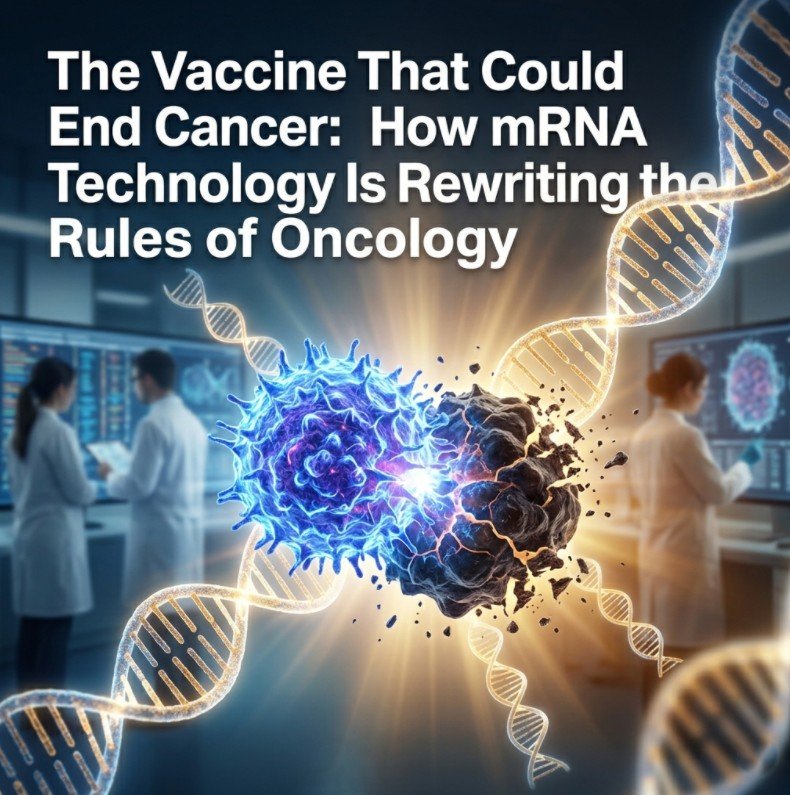
LEAD: Moderna and Merck’s personalized mRNA cancer vaccine has now demonstrated a nearly 50% reduction in the risk of death or recurrence in late-stage melanoma patients over five years — and with over 400 global clinical trials now active, the mRNA cancer vaccine revolution is accelerating faster than any medical development since the COVID-19 pandemic.
From Pandemic Hero to Cancer Killer: The mRNA Revolution Continues
The mRNA cancer vaccine story begins, paradoxically, with a virus. When Moderna and BioNTech deployed messenger RNA technology to produce COVID-19 vaccines in record time in 2020, they did more than end a pandemic. They proved, at global scale and under intense scrutiny, that mRNA platforms could be manufactured rapidly, deployed safely, and modified almost infinitely to target different biological markers. What virologists had demonstrated in theory for years was suddenly validated by billions of doses administered to billions of people. The oncology world took careful note.
The concept of a cancer vaccine is not new. Researchers have pursued immune-based cancer therapies since the 1890s, when American surgeon William Coley first observed that some cancer patients experienced tumour regression after bacterial infections — suggesting the immune system could, under the right conditions, attack cancer cells. But the fundamental challenge has always been the same: cancer cells are not foreign invaders. They are the body’s own cells, mutated. Teaching an immune system to attack its own tissue — precisely and selectively — without triggering dangerous autoimmune responses is one of the hardest problems in medicine.
mRNA technology changes the equation fundamentally. Rather than introducing a weakened pathogen to train immunity — the classical vaccine approach — mRNA cancer vaccines deliver molecular instructions directly into the patient’s cells, commanding them to produce specific proteins called neoantigens: molecular markers unique to that patient’s tumour. The immune system learns to recognise these markers as foreign and mounts a targeted attack. Critically, because each patient’s tumour has a unique mutational signature, the most effective mRNA cancer vaccines are personalised — built from a biopsy of the patient’s own tumour, sequenced, analysed for unique antigens, and manufactured individually. The process, once taking months, now takes as little as six weeks thanks to AI-accelerated antigen discovery pipelines.
The Melanoma Data That Changed Everything
The clinical results that have the oncology world’s attention come from Moderna and Merck’s mRNA-4157 (V940) vaccine — a personalised mRNA therapy combining Moderna’s custom antigen platform with Merck’s immunotherapy drug Keytruda (pembrolizumab), which blocks PD-1 proteins that tumours use to hide from immune cells. The five-year follow-up data, presented in early 2026, showed that patients with high-risk, resected stage III/IV melanoma who received the combination therapy had a 49.1% reduction in the risk of death or recurrence compared to Keytruda alone — a result that exceeded even optimistic projections from the trial’s Phase 2 design.
Professor Mansoor Amiji, distinguished professor of pharmaceutical sciences at Northeastern University and lead author of a comprehensive review of 220 cancer vaccine studies published in Biomaterials in March 2026, described the Moderna-Merck result as “a watershed moment” for the field: “This clinical success demonstrates that antigen-based cancer vaccines have the potential to genuinely improve patient outcomes. We are entering a new era driven by AI-enabled antigen discovery, mRNA delivery platforms, and combination immunotherapy.”
The market response has been immediate. Moderna’s share price jumped 18% following the five-year data release. Merck confirmed it is expanding the vaccine program to additional tumour types, including renal cell carcinoma, non-small cell lung cancer, and colorectal cancer — collectively among the most common and lethal cancers globally. The National Library of Medicine’s clinical trials database currently lists more than 400 active trials testing cancer vaccines globally, the majority initiated in the last three years — a volume of research investment that has no precedent in oncology history.
The AI dimension is accelerating the timeline further. Machine learning models — trained on vast genomic datasets — can now screen tumour biopsies and identify the most immunogenic neoantigens in hours rather than weeks, dramatically compressing the personalised vaccine manufacturing pipeline. Dr. Zhongkun Zhang, postdoctoral researcher at Northeastern University, told MedicalXpress: “AI-assisted models screen antigens in tumours to identify what vaccines should target — and can simultaneously optimise delivery systems to ensure the vaccine reaches the right cells without attacking healthy tissue.”
Global Impact: A New Era of Cancer Treatment
The implications of mRNA cancer vaccine success extend across the entire oncology landscape — and far beyond melanoma. The Dana-Farber Cancer Institute in Boston, one of the world’s premier cancer research institutions, confirmed in January 2026 that personalised mRNA vaccines are among the top 10 cancer research priorities for the year, alongside RAS inhibitors for pancreatic cancer and bispecific antibodies for gastroesophageal cancer.
The European Medicines Agency is monitoring the Phase 3 trial data for mRNA-4157 closely, with a potential fast-track approval pathway under consideration for high-risk melanoma indications if Phase 3 results confirm the Phase 2 magnitude of benefit. The World Health Organization’s 2026 cancer initiative — which identifies personalised oncology as a critical health equity priority — has flagged manufacturing scalability and cost as the central challenges that must be solved before mRNA cancer vaccines can reach patients in low- and middle-income countries.
That cost challenge is real. A personalised mRNA cancer vaccine, manufactured individually for each patient, currently costs an estimated $100,000–$200,000 per course in development-stage pricing. The path to affordability runs through automation, AI-driven manufacturing efficiency, and regulatory frameworks that incentivise broad access — none of which are guaranteed. But the trajectory of mRNA COVID vaccine manufacturing — which dropped from over $30 per dose to under $3 in two years through scale economies — offers a precedent for how rapidly costs can compress once industrial infrastructure is established.
At the broader scientific level, researchers at the American Association for Cancer Research noted in their January 2026 forecast that 2026 represents the most exciting year for cancer immunology since the first checkpoint inhibitor approvals in 2011. The convergence of mRNA platforms, AI antigen discovery, and next-generation immunotherapy combinations is creating a research landscape where clinical breakthroughs are arriving faster than regulatory and reimbursement systems are designed to process them.
Editor’s Conclusions
Let me be direct: the mRNA cancer vaccine data from Moderna and Merck represents the most significant advance in oncology since the development of checkpoint inhibitor immunotherapy — and possibly since chemotherapy itself.
A 49% reduction in death or recurrence over five years, in a cancer type that was almost universally fatal at late stage just a decade ago, is not an incremental improvement. It is a transformation. Melanoma killed approximately 57,000 people globally in 2023. If the Phase 3 trial confirms the Phase 2 result — and the biological rationale strongly suggests it will — we are looking at a therapy that could prevent tens of thousands of deaths annually from melanoma alone. Multiply that across the additional cancer types now entering trials — lung, colorectal, renal, pancreatic — and the potential scale of impact becomes genuinely historic.
But I want to be honest about what comes next, because the gap between a Phase 2 triumph and a widely available therapy is filled with obstacles that the celebratory coverage tends to gloss over. The most important is access. The personalised mRNA cancer vaccine works because it is tailored to each patient’s individual tumour. That individualisation is also what makes it expensive, logistically complex, and dependent on genomic sequencing infrastructure that does not exist uniformly even in wealthy countries — let alone in sub-Saharan Africa, South Asia, or rural Latin America. A therapy that saves 49% of rich patients and 0% of poor ones is a medical breakthrough, but it is also a health equity catastrophe in slow motion.
The second obstacle is tumour heterogeneity — the fact that cancer, even within a single patient, is not a uniform entity. As Professor Amiji notes, cancer vaccines can fail when tumours contain subclones with different mutational signatures not captured in the initial biopsy, or when the tumour’s immune microenvironment is suppressive enough to neutralise even a strong vaccine response. The combination with checkpoint inhibitors like Keytruda is a partial answer to the suppression problem — but it adds cost, side effects, and regulatory complexity. The science is not finished, even if today’s results are extraordinary.
The third consideration is regulatory speed. The FDA and EMA were built for an era when drug development moved in decade-long cycles. mRNA platforms, AI antigen discovery, and adaptive trial designs are compressing those cycles dramatically. The regulatory question for the next five years is not whether mRNA cancer vaccines work — the data increasingly confirms that they do — but whether approval, reimbursement, and manufacturing scale-up can move fast enough to match the pace of the science. Patients who could benefit today are dying while regulatory processes designed for yesterday’s science catch up.
What gives me genuine optimism, despite these caveats, is the convergence happening in real time. AI antigen discovery is already halving the manufacturing timeline. The mRNA platform built for COVID has given every major pharmaceutical manufacturer on earth the infrastructure to produce these vaccines at scale. Regulatory agencies are implementing adaptive pathways. And the commercial incentive — a cancer therapy market worth hundreds of billions of dollars annually — is sufficient to attract the capital investment required to solve the manufacturing and cost problems. The mRNA cancer vaccine is not a distant promise. It is an approaching reality. The question is not whether it arrives. It is whether it arrives for everyone.
Executive Summary
- Moderna and Merck’s personalised mRNA cancer vaccine showed a 49% reduction in death or recurrence in late-stage melanoma patients over five years — the strongest long-term clinical result ever recorded for a cancer vaccine, now moving into Phase 3 trials across multiple tumour types
- Over 400 global clinical trials testing cancer vaccines are now active — with AI-accelerated antigen discovery compressing the personalised vaccine manufacturing timeline to as little as six weeks, and programs targeting lung, colorectal, renal, and pancreatic cancers already underway
- The central challenge is access, not science: at an estimated $100,000–$200,000 per course, personalised mRNA cancer vaccines risk becoming a breakthrough only wealthy patients and wealthy nations can access — making manufacturing scalability and health equity the defining policy challenge of the next decade in oncology
Sources
- Moderna and Merck mRNA cancer vaccine — 5-year melanoma trial results and expert analysis, MedicalXpress March 2026 — MedicalXpress reproduces peer-reviewed university research directly from Northeastern University, providing the primary expert commentary and clinical data on Moderna-Merck’s mRNA-4157 vaccine cited throughout this article.
- Euronews Health: personalised mRNA melanoma vaccine shows lasting survival benefits — January 2026 — Euronews Health provides independently verified science journalism contextualising the Phase 2 trial design, Keytruda combination mechanism, and EMA fast-track regulatory considerations cited in this article.
- AACR experts forecast cancer research and treatment advances 2026 — American Association for Cancer Research — The AACR is the world’s leading professional organisation for cancer researchers; its 2026 forecast provides institutional validation for the broader cancer vaccine pipeline and clinical trial volume data cited.