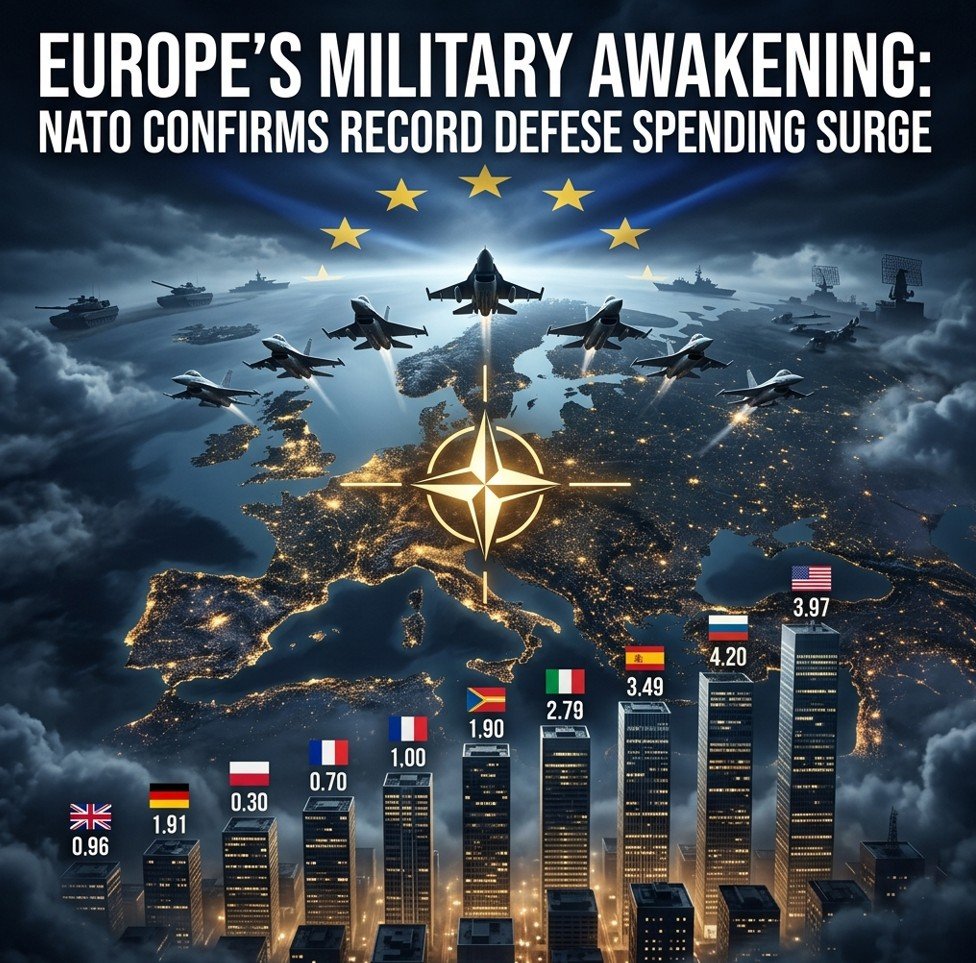
LEAD: On March 26, 2026, NATO Secretary General Mark Rutte confirmed that every single NATO member state exceeded the alliance’s 2% GDP defense spending target for the first time since it was set in 2014 — with European allies and Canada delivering a 20% real-terms increase in military budgets in 2025, representing $574 billion in combined defense investment and signaling Europe’s most dramatic strategic reorientation since the end of the Cold War.
From Free Riders to Frontline Spenders: Europe’s Strategic Shock
The story of European NATO defense spending is, at its core, a story about fear finally becoming louder than inertia. For decades, the United States carried the alliance’s financial weight while European governments quietly benefited from American security guarantees without proportionate contribution. In 2014, following Russia’s annexation of Crimea, NATO members formally pledged to spend at least 2% of GDP on defense. For over a decade, most European members failed to meet it. Germany, the continent’s largest economy, spent barely 1.5% of GDP on defense as recently as 2022, prompting open frustration from Washington.
Russia’s full-scale invasion of Ukraine in February 2022 began to change the calculus — but the pace accelerated dramatically in 2025, driven by a second and equally significant factor: the return of President Donald Trump to the White House in January 2025, and his explicit and repeated suggestion that the United States might not automatically defend NATO allies who failed to meet spending commitments. Trump’s rhetoric — however strategically ambiguous — functioned as a galvanizing force for European defense planning in a way that years of American diplomatic pressure had not. The message that Europe could no longer assume unconditional American protection landed with unmistakable clarity in Berlin, Paris, Warsaw, and Brussels.
The result is the data that NATO Secretary General Mark Rutte presented at alliance headquarters in Brussels on March 26, 2026: a 2.77% collective GDP average across the alliance, a 20% real-terms surge in European and Canadian defense budgets compared to 2024, and — for the first time in the 12 years since the 2% pledge was made — 100% compliance across all 32 member states. As Rutte stated plainly: “The figures speak for themselves. NATO is stronger today than it has ever been.”
The Numbers: Who Is Spending What — and How Fast
The headline 20% real-terms increase in European NATO and Canadian defense spending translates to a combined contribution of $574 billion (approximately €500 billion) in 2025 — up from approximately $478 billion in 2024. That single-year increase of nearly $100 billion is larger than the entire annual defense budget of every country in the world except the United States and China.
Poland leads the alliance in proportional terms, spending an extraordinary 4.12% of GDP on defense — the highest of any NATO member, driven by its frontline position bordering both Russia’s Kaliningrad exclave and Belarus, and by a government that has explicitly structured its entire foreign policy around military deterrence. Estonia, Latvia, and Lithuania — the Baltic states that share borders with Russia or its close ally Belarus — all spend above 3.5% of GDP, already meeting the new 3.5% target that the Hague summit last year set as an interim goal on the path to 5% by 2035.
Germany’s transformation has been the most dramatic in absolute terms. Following Chancellor Friedrich Merz’s announcement of a historic €1 trillion special defense and infrastructure fund in March 2025 — a constitutional amendment that suspended Germany’s infamous debt brake to allow unprecedented military investment — German defense spending reached 3.0% of GDP in 2025, up from 2.1% in 2023. The Bundeswehr is now in the process of its largest rearmament program since the 1950s, with orders placed for Eurofighter jets, Leopard 2 tank upgrades, naval vessels, and an entirely new long-range missile capability.
France, which has consistently maintained spending above 2% and prioritized nuclear deterrence, reached 2.6% of GDP in 2025. The United Kingdom — operating outside the EU but firmly within NATO — maintained 2.5% of GDP, while announcing in February 2026 a plan to raise spending to 3.0% by 2030. Complementing individual national increases, the European Union’s ReArm Europe program — a €800 billion collective defense investment framework approved in 2025 — is beginning to direct capital toward shared capability gaps: air defense systems, ammunition production, drone technology, and secure communications infrastructure.
The Ankara Summit and the Road to 5%
The data released on March 26 arrives as preparation intensifies for the NATO Ankara Summit, scheduled for June 2026 in Turkey — the alliance’s first summit hosted by Ankara in over three decades. The summit’s central agenda item will be progress toward the 5% of GDP defense investment target agreed at The Hague in 2025, a figure that, if achieved uniformly across the alliance, would represent the largest peacetime military buildup in Western history.
The 5% target — initially proposed by Trump as a condition for sustained US engagement — was accepted by European leaders with a mixture of shock and strategic calculation. For Poland and the Baltic states, it was already within reach. For Germany, it implies defense spending of approximately €220 billion annually by 2035 — a figure that would make the Bundeswehr the largest conventional military force in Europe. For Italy and Spain, which currently spend closer to 1.8–2.1% of GDP, the path to 5% requires structural shifts in national budget priorities that will generate significant domestic political resistance.
Rutte, speaking at the March 26 briefing, acknowledged the challenge while maintaining optimism: “We have made significant progress on defense investment, and we must maintain momentum. The security environment demands nothing less.” NATO’s drone warfare assessment — also released this week — identified critical gaps in European air defense and counter-drone capabilities, confirming that spending levels, while rising, must be accompanied by strategic investment in technologies that reflect 21st-century battlefield realities, not Cold War-era force structures.
Editor’s Conclusions
What NATO’s March 26 data confirms is something historians will record as a genuine inflection point: Europe has decided to defend itself.
That sentence requires unpacking, because it carries profound implications across multiple dimensions — strategic, economic, political, and social — that extend far beyond the GDP percentages in Rutte’s annual report.
Strategically, European rearmament changes the alliance’s fundamental character. NATO was designed, in the famous formulation of its first Secretary General Lord Ismay, to keep “the Americans in, the Russians out, and the Germans down.” All three of those objectives are now under active revision. The Americans are, for the first time, signaling genuine conditionality about their commitment. The Russians are engaged in active warfare on European soil — or its immediate border. And the Germans are spending a trillion euros on their military. The NATO of 2026 is structurally different from the NATO of 2021, and the 100% compliance milestone is the statistical expression of that transformation.
Economically, the implications are enormous and underappreciated. A sustained European defense spending surge at 20% annual real-terms growth — if maintained for five years — would represent one of the largest fiscal stimulus programs in European economic history, directed toward industrial production: ammunition factories, shipyards, aerospace plants, electronics manufacturers, and the defense technology supply chains that feed them. European defense stocks have been among the best-performing assets on the continent in 2025–2026. Rheinmetall, the German defense contractor, has seen its share price increase over 400% since the Ukraine invasion began. The economic multiplier effects of sustained defense investment — in skilled manufacturing jobs, R&D spending, and industrial capacity — will reshape parts of the European economy that have been stagnant for decades.
Politically, however, the tensions are equally significant. Defense spending of 3%, 4%, or 5% of GDP requires trade-offs. Every euro spent on tanks and missiles is a euro not spent on hospitals, schools, green energy transition, or social welfare. In countries with aging populations, strained public finances, and electorates that associate European integration with prosperity rather than military sacrifice, the politics of rearmament will be contested. The rise of far-right and far-left parties across Europe — many of which oppose NATO commitments, oppose aid to Ukraine, or oppose US security dependence from opposite ends of the political spectrum — represents the principal risk to the momentum Rutte celebrated on March 26.
The deepest question is whether Europe’s military awakening is durable or contingent. If Trump’s second term ends in January 2029 with a return to conventional US security guarantees under a more Atlantic-minded successor, will European defense budgets retreat back toward 2%? The institutional answer should be: not if the investment has been made in industrial capacity that cannot be easily dismantled. But the political answer is less certain. Europe’s strategic autonomy, if it is truly to mean something, must be built on a consensus that transcends any single American administration — and that consensus, while growing, is not yet secured.
Executive Summary
- For the first time since the 2% GDP pledge was made in 2014, every NATO member exceeded the target — with European allies and Canada delivering a 20% real-terms defense spending increase in 2025, totaling $574 billion, confirmed by Secretary General Mark Rutte on March 26, 2026
- Poland leads the alliance at 4.12% of GDP, Germany reached 3.0% following its historic €1 trillion defense fund, and 3 members already hit the new 3.5% interim target — with the Ankara Summit in June 2026 focused on the path to the agreed 5% GDP goal by 2035
- European rearmament is simultaneously a strategic, economic, and political transformation — with €800 billion in EU ReArm Europe funding, booming defense industrial production, and deep questions about whether political consensus for sustained military investment can survive domestic trade-off pressures across the continent
Sources
- Reuters: NATO confirms 20% surge in European and Canadian defense spending in 2025 — Reuters is the world’s leading wire service and the primary independent source for the NATO annual report figures, Secretary General Rutte’s statements, and alliance-wide spending data cited throughout this article.
- DW: European NATO defense spending rose by almost 20% in 2025 — full breakdown — Deutsche Welle provides authoritative country-by-country spending analysis, Rutte’s direct quotes, and the $574 billion total contribution figure with real-terms methodology explained.
- EU Perspectives: NATO defence spending hits 2.77% of GDP — Ankara Summit preview — EU Perspectives offers specialist European policy analysis contextualising the 2.77% collective NATO GDP figure, the 5% target roadmap, and the upcoming Ankara summit agenda.