LEAD: The highly anticipated humanoid robots factory 2026 deployment has officially begun as Toyota activates a fleet of autonomous bipedal androids on its Canadian RAV4 assembly line, shifting the artificial intelligence revolution from digital screens into the physical world.
Sci-Fi Meets the Assembly Line
For years, the promise of humanoid robots in manufacturing felt perpetually delayed—relegated to controlled laboratory demos, highly edited viral marketing videos, and distant corporate roadmaps. That era officially ended this week. Beginning this April, Toyota Motor Manufacturing Canada (TMMC) has deployed seven humanoid “Digit” robots, developed by Agility Robotics, at its high-volume RAV4 production facility in Woodstock, Ontario. This milestone humanoid robots factory 2026 integration represents the crossing of a critical threshold: autonomous bipedal machines are now operating alongside human workers in an uncontrolled, real-world industrial environment.
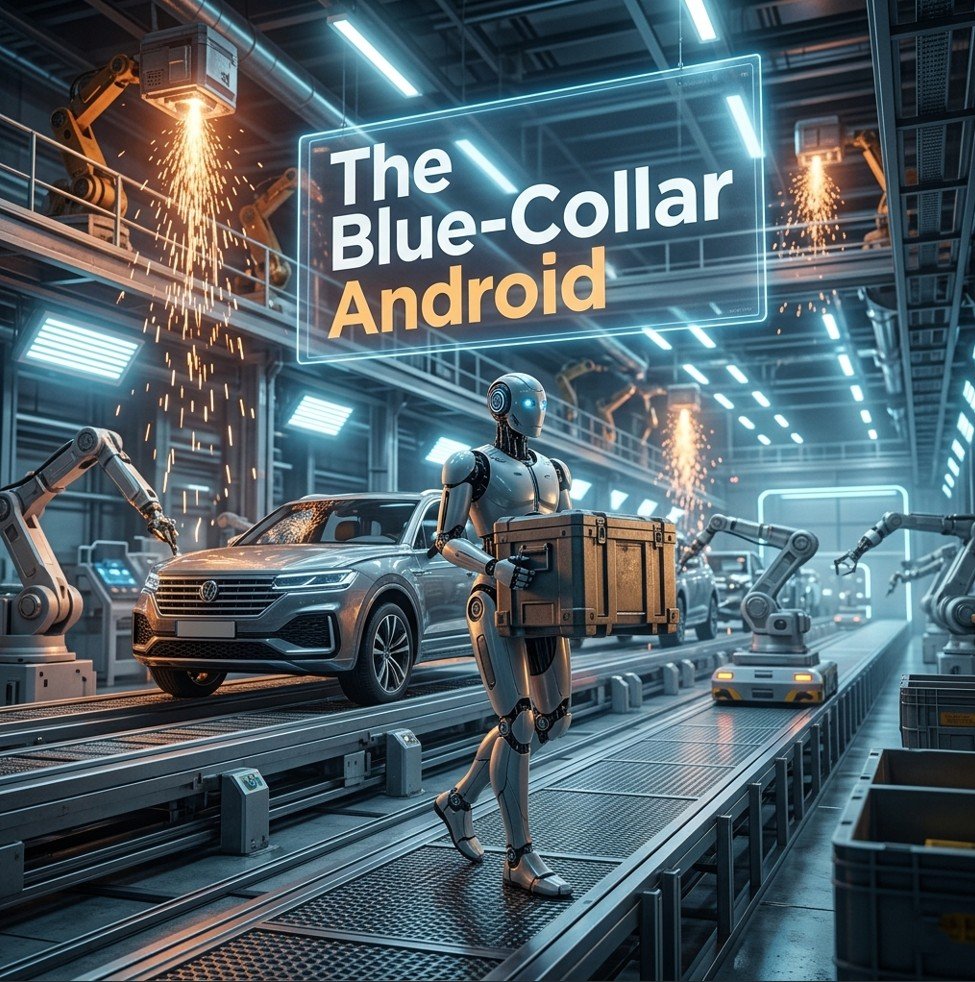
The Digit robots are specifically engineered to navigate spaces built for people. Standing 5 feet 9 inches tall and equipped with advanced machine vision powered by neural networks, these androids are initially assigned to repetitive material-handling tasks. Their primary duty involves lifting, carrying, and loading heavy tote bins of auto parts between staging areas and the active assembly line. This is a highly repetitive, ergonomically taxing job that historically leads to human musculoskeletal injuries and high turnover rates. Unlike traditional industrial robotic arms, which must be bolted to the floor and caged off for safety, Digit is designed to walk dynamically through the same aisles as its human counterparts, adapting its path in real-time to avoid obstacles, forklifts, and personnel.
This rollout follows a rigorous year-long pilot program in which Toyota evaluated the safety, reliability, and battery endurance of the Agility Robotics models. The successful transition from pilot to full commercial deployment confirms that the spatial processing software powering “physical AI” has finally caught up with the mechanical hardware. These androids can now process complex environmental data instantaneously, navigating tight factory corridors without requiring constant human oversight or rigidly pre-programmed waypoints.
Economics of Physical AI
The driving force behind the humanoid robots factory 2026 phenomenon is not merely technological novelty, but a radical shift in unit economics. Toyota is operating the Digit robots under a modern “Robots-as-a-Service” (RaaS) leasing model. Under this agreement, Agility Robotics charges approximately $30 per hour per robot—a comprehensive fee that covers the hardware, maintenance, real-time software updates, and cloud computing infrastructure.
When compared to the fully loaded cost of a human autoworker in North America—which encompasses hourly wages, healthcare benefits, pensions, and payroll taxes—the financial arithmetic becomes impossible for corporate boards to ignore. Financial analysts project that at $30 per hour, Toyota achieves a return on investment (ROI) in under two years for every human role replaced or augmented by a Digit unit. Furthermore, these androids do not require shift breaks, cannot suffer repetitive strain injuries, and can operate for multiple consecutive shifts with simple, automated battery swaps, significantly increasing overall factory throughput and operational consistency.
The broader automotive industry is already moving aggressively to replicate this financial model. Following Toyota’s lead, Hyundai Motor Group recently showcased its production-ready, fully electric Atlas humanoid robot—developed by its subsidiary Boston Dynamics—and announced a mandate to deploy these machines at its new manufacturing plant in Georgia by 2028. Hyundai’s ambition is staggering: the company plans to establish a dedicated factory capable of producing 30,000 humanoid robots annually to supply its own global supply chain and push into the “physical AI” market. As the production volume of the robots themselves scales up, manufacturing analysts predict the hourly operating cost could plummet below $15 per hour by the end of the decade, permanently altering the baseline cost of industrial production.
Global Labor Market Reactions
The arrival of the humanoid robots factory 2026 era has sent shockwaves through the global labor market, particularly among the 8,500 human workers at the Woodstock TMMC plant and the millions of manufacturing employees worldwide. The integration of autonomous androids touches a deep societal nerve regarding automation and job displacement, prompting immediate, polarized reactions from major labor unions and industry advocates alike.
Proponents of the technology, including Toyota management, argue that these robots are deployed to perform the “dull, dirty, and dangerous” tasks that humans increasingly do not want to do. Across North America, Europe, and Japan, manufacturers are facing acute blue-collar labor shortages driven by aging populations and shifting generational preferences away from grueling physical labor. In this light, humanoid robots are framed not as job killers, but as necessary capacity gap-fillers. By offloading physically destructive tasks to machines like Digit, companies claim they can extend the healthy working years of their human employees and upskill them into supervisory, maintenance, or quality-control roles.
However, labor organizations view the deployment with justifiable caution. While the initial wave of seven robots in Ontario is numerically small, the precedent it sets is vast. Union leaders are urgently pushing for new collective bargaining frameworks that include “algorithmic transparency” and automated-labor taxes to fund robust worker retraining programs. They warn that as the capabilities of physical AI expand beyond simple box-lifting to complex assembly tasks, the ratio of human-to-robot workers on the factory floor could invert within a single generation. The success of this Canadian deployment serves as the undeniable proof-of-concept that will likely accelerate humanoid adoption across logistics hubs, fulfillment warehouses, and eventually, consumer retail environments.
Editor’s Conclusions
We are witnessing a profound inflection point in the history of human labor. For the past three years, the world’s attention has been entirely captivated by the explosive rise of generative AI—large language models like GPT-4 and the newly minted GPT-5 that threatened white-collar cognitive work. But the quiet, steady maturation of physical AI, perfectly embodied by the humanoid robots factory 2026 integration, will arguably have a much more visceral, structural impact on the global economy.
The significance of Toyota’s decision to put Agility Robotics’ Digit on a live production floor cannot be overstated. A modern automotive factory is an environment defined by orchestrated chaos, tight physical tolerances, and zero margin for error. If a bipedal robot can successfully navigate a RAV4 assembly line while carrying payload bins, it can navigate a FedEx distribution center, a commercial construction site, and eventually, a hospital corridor. The fundamental engineering moat has been breached. What remains is simply an exercise in scaling manufacturing and driving down the unit cost of the robots themselves.
Geopolitically, the race to dominate humanoid robotics is the equivalent of a new space race. The United States currently holds the software and hardware edge with companies like Agility Robotics, Boston Dynamics, and Tesla’s Optimus program. However, China’s Ministry of Industry and Information Technology has officially designated humanoid robots as a disruptive technology critical to national security, aggressively funding domestic competitors aiming for mass production by 2027. The nation that controls the supply of infinitely scalable, reliable physical labor will possess an insurmountable industrial advantage in the 21st century. As demographic collapse shrinks the working-age populations of global superpowers, androids will become the ultimate geopolitical equalizer.
From a societal perspective, we must urgently prepare for the deflationary shock this technology will introduce. If the marginal cost of physical labor trends toward the cost of electricity and basic maintenance, the price of manufactured goods, home construction, and physical services will plummet. This is an economic miracle on paper, but a potential crisis for the established social contract. The working class has historically traded physical labor for economic mobility. As that trade becomes technologically obsolete, governments will be forced to rethink the fundamentals of income distribution, corporate taxation, and human purpose in a post-labor economy. April 2026 will be remembered not just as the month a robot lifted a tote bin in Ontario, but as the moment the physical economy was permanently decoupled from human biology.
Executive Summary
- Historic Deployment: In April 2026, Toyota Motor Manufacturing Canada became the first major automaker to commercially deploy humanoid robots, integrating Agility Robotics’ Digit androids to handle repetitive material handling on its RAV4 assembly line.
- Compelling Economics: Operating under a Robots-as-a-Service model at approximately $30 per hour, these robots offer a fully loaded cost significantly lower than human workers, delivering projected returns on investment in under two years while eliminating ergonomic injuries.
- The Dawn of Physical AI: The successful rollout signals a massive shift from digital AI to physical automation, prompting competitors like Hyundai to target the production of 30,000 robots annually and forcing global labor unions to confront a rapidly changing industrial landscape.
🎵 Listen While You Read
Sources
- Metaintro: Toyota Hires Humanoid Robots for Factory Work — An authoritative tech and labor market analysis detailing Toyota’s historic April 2026 deployment of Digit robots and the underlying RaaS economics.
- Reuters: Hyundai Motor Group plans to deploy humanoid robots at US factory — A globally trusted financial news wire providing verified context on Hyundai and Boston Dynamics’ aggressive manufacturing timeline for humanoid deployment.
- ScienceDaily: AI breakthrough could replace rare earth magnets in electric vehicles — Leading science publication demonstrating the parallel physical AI and materials science breakthroughs currently driving the robotics and EV revolution.