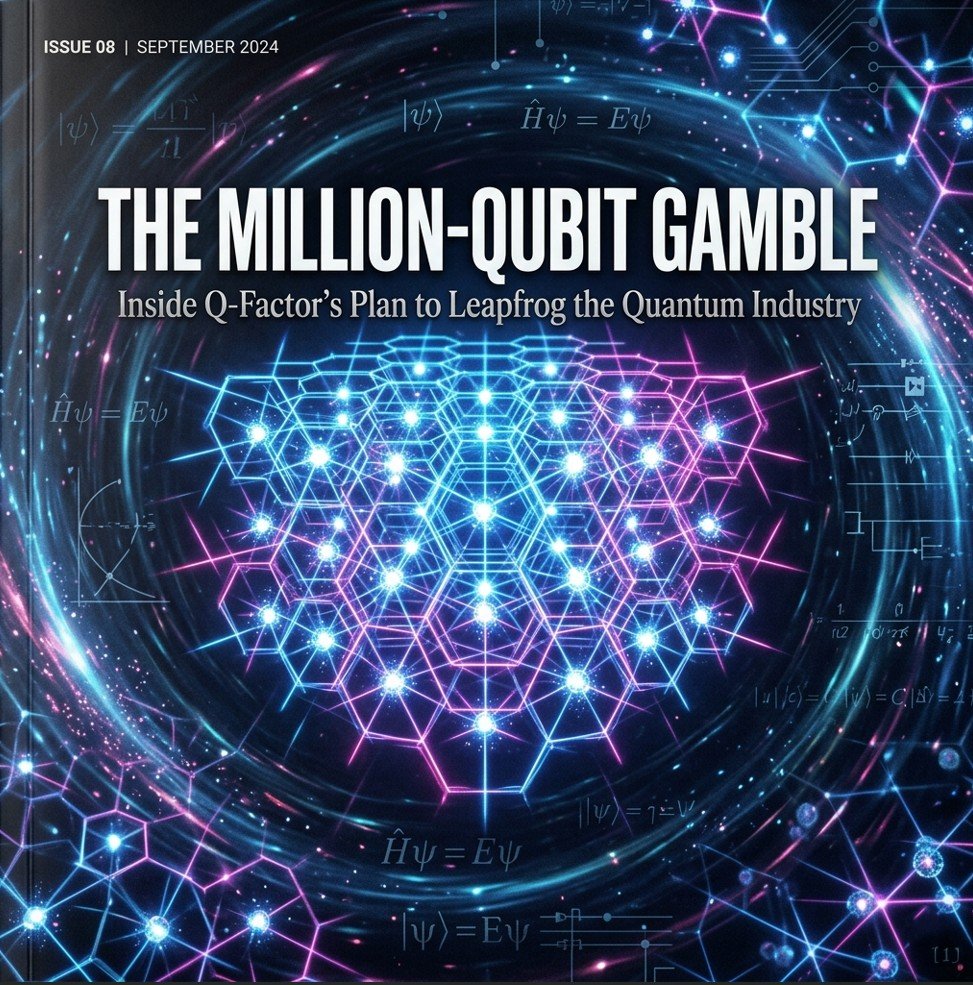
LEAD: On April 6, 2026, a stealth Israeli startup named Q‑Factor announced a $24 million seed round to build a million‑qubit neutral‑atom quantum computer, challenging the incremental roadmaps of industry giants and raising urgent questions about who truly benefits from a quantum future.
The Neutral‑Atom Alternative
For years, the quantum computing race has been dominated by superconducting qubits—tiny circuits chilled to near absolute zero, used by Google, IBM, and Amazon. But these systems face a brutal scaling limit: as you add more qubits, wiring and crosstalk become unmanageable. Neutral‑atom platforms take a different path. They trap individual atoms (typically rubidium or cesium) with focused laser beams called optical tweezers, then manipulate them using Rydberg interactions. Because atoms are naturally identical and don’t require complex on‑chip wiring, they promise far cleaner scalability. Companies like QuEra and Pasqal have already demonstrated systems with a few hundred qubits, but Q‑Factor argues that even “thousands” is a dead end without a fundamental architectural redesign. “The quantum computing industry needs a revolution, not an evolution,” said Prof. Ofer Firstenberg, co‑founder and chief scientist of Q‑Factor. “Current systems are too small to deliver on the promise of quantum computing, and incremental improvements alone aren’t going to close that gap.”
The Q‑Factor team—four physicists from the Weizmann Institute and Technion, all graduates of the elite Talpiot program—has spent years analyzing why existing neutral‑atom platforms cannot surpass a few thousand qubits. Their conclusion: the bottleneck is not atom control but system architecture. Conventional designs rely on modular arrays that require frequent mid‑circuit measurements and complex shuttling of atoms, which introduces errors and limits coherence. Q‑Factor’s proprietary techniques in atom transport and Rydberg interactions aim to create a continuously scalable architecture that eliminates these handoff points, allowing the machine to grow like a classical chip—not in discrete jumps but in a smooth, Moore’s‑Law‑like curve.
From Stealth to Stardom: The $24 Million Vote of Confidence
The seed round, led by NFX and TPY Capital with significant participation from Intel Capital, Korea Investment Partners, Deep33, and the Matias family, also includes a grant from the Israel Innovation Authority. Intel Capital’s involvement is particularly telling: the chip giant has long sought a quantum architecture that mirrors semiconductor scaling, and its investment director, Lisa Cohen, stated that Q‑Factor was selected because their design “addresses the hardest remaining problem in the field: absolute scale.” For a deeper look at how quantum hardware is reshaping the threat landscape, read our earlier analysis of Google’s encryption‑cracking breakthrough, which showed that a quantum computer with just 500,000 physical qubits could extract a Bitcoin private key in minutes.
But $24 million is pocket change in quantum hardware—IBM has invested billions, and Google’s Quantum AI campus alone cost over $1 billion to build. Q‑Factor’s founders are well aware of the gap. Their plan is not to immediately fabricate a million‑qubit chip but to validate their architectural principles in a large‑scale prototype over the next 18–24 months. If successful, the company expects to raise a Series A round ten times larger, potentially drawing strategic investment from Intel’s manufacturing arm. The startup is also leveraging the technology transfer arms of its founding universities—Yeda (Weizmann) and the Technion—which remain shareholders, ensuring that foundational patents are already in place.
Why a Million Qubits Changes Everything
The leap from today’s few‑hundred‑qubit noise‑prone machines to a million‑qubit fault‑tolerant system is not just quantitative; it is qualitative. At around 1,000 logical qubits (roughly 50,000 physical qubits, depending on error correction overhead), a quantum computer could simulate a modest protein folding event, unlocking new drug candidates. At 10,000 logical qubits, it could break RSA‑2048, the encryption standard that secures global banking, email, and most internet traffic. At 100,000 logical qubits, it could model the electronic structure of high‑temperature superconductors, potentially delivering room‑temperature superconductivity. And at one million qubits, the machine enters a regime where it can solve optimization problems that are literally impossible for classical supercomputers—from designing new battery chemistries to cracking the neural code of the human brain.
Yet this power comes with a dark side. As we reported in our deep dive on the quantum apocalypse, the same hardware that enables breakthroughs also dismantles the cryptographic foundation of the digital economy. A million‑qubit machine running Shor’s algorithm would break elliptic curve cryptography (used by Bitcoin, Ethereum, and every HTTPS connection) in hours. The National Institute of Standards and Technology (NIST) has been standardizing post‑quantum cryptography since 2022, but migration is slow: less than 10% of global systems had transitioned as of early 2026. Q‑Factor’s timeline—if realized—would compress the remaining window dramatically, potentially to less than five years.
Editor’s Analysis
Deep Reflections — What does this discovery reveal about humanity?
The pursuit of a million‑qubit quantum computer is not merely a technical ambition; it is a mirror reflecting our species’ oldest drive: to master the invisible forces of nature. From chipping flint to splitting the atom, each leap in computational power has redefined what it means to be human. Quantum computing promises to solve problems that classical machines cannot even formulate—protein folding, materials design, climate modeling—effectively granting us a new sense organ for the universe’s underlying logic. Yet the very act of seeking such power reveals a profound ambivalence: we want to cure cancer, but we also want to crack any encryption; we want to simulate the brain, but we also want to control it. Q‑Factor’s million‑qubit goal forces us to confront the dual‑use nature of all transformative technologies. The startup’s founders speak of “Moore’s Law‑like trajectories” and “continuous scalability,” but they rarely mention that the same scaling curve leads straight to the end of privacy as we know it. Humanity’s reflex is always to build first and ask questions later. The quantum race suggests we have not evolved past that instinct.
Critical Analysis — Is the science actually solid?
The core physics behind Q‑Factor’s approach—neutral atoms, optical tweezers, Rydberg blockade—rests on decades of peer‑reviewed research. The founding team’s credentials are impeccable: three professors who have led neutral‑atom labs at top‑tier institutions and a fourth with deep‑tech startup experience. Their diagnosis of the scaling bottleneck is plausible. However, the leap from a paper architecture to a million‑qubit machine is astronomical. No neutral‑atom system has yet demonstrated even 1,000 qubits in a fully operational, error‑corrected configuration. The world record for logical qubits (error‑corrected) is still in the dozens. Q‑Factor has not released any preprints or technical specifications, and the company declined to comment on whether they have built a working prototype of even 100 qubits. The $24 million seed round, while impressive for a stealth startup, is less than 0.2% of what IBM has spent on quantum R&D since 2016. Investors are betting on the team, not the hardware. That is a high‑risk, high‑reward wager, but it is not yet evidence of scientific breakthrough.
Cui Bono — Who benefits from this discovery or its coverage?
The most immediate beneficiaries are the investors and the founding team. Intel Capital gains a hedge against its own superconducting qubit investments, effectively betting on two rival horses in the same race. NFX and TPY Capital secure early access to a potentially disruptive architecture at a bargain valuation. The Weizmann Institute and Technion receive royalty streams and enhanced prestige, reinforcing their positions as global leaders in quantum science. But the broader winners, if the technology succeeds, are the corporations and governments that can afford to buy or rent time on a million‑qubit machine. Pharmaceutical giants, energy conglomerates, and defense contractors will likely capture most of the economic surplus, while small businesses and individuals are left with the security costs (broken encryption) and few of the direct benefits. The coverage of Q‑Factor’s announcement has focused heavily on the “holy grail” narrative, with most outlets repeating the founders’ claims without independent verification. This benefits the startup by generating hype that attracts talent and further funding, but it also distorts public understanding of how far quantum computing still has to go.
Distraction Analysis — What is this story distracting us from?
While journalists rush to cover the “million‑qubit startup,” several equally important but less glamorous quantum stories are being ignored. First, the steady progress in error correction—the real bottleneck—receives scant attention because it is incremental and technical. Second, the alarming lack of post‑quantum cryptography adoption gets buried under excitement about new hardware. The most urgent quantum threat today is not a million‑qubit machine but a relatively modest one that could break blockchain signatures using improved algorithms—something Google already showed is possible with just 1,200 logical qubits. Third, the environmental cost of quantum computing (dilution refrigerators, high‑power lasers, and rare‑earth materials for optics) is never discussed. A million‑qubit facility could consume as much electricity as a small data center, yet the narrative remains one of clean, abstract progress. Finally, the concentration of quantum expertise in a handful of countries (USA, China, Germany, Israel) widens the technological gap between nations, but this geopolitical dimension is rarely mentioned in startup‑focused coverage.
Who Does This Not Serve? — Who is ignored or harmed?
Q‑Factor’s million‑qubit quantum computer, if built, will serve a very narrow slice of humanity. It does not serve the billions without reliable internet access, let alone quantum literacy. It does not serve the communities whose traditional encryption methods (often older than RSA) will be rendered obsolete overnight with no migration path. It does not serve the researchers in low‑ and middle‑income countries who cannot afford even classical supercomputing time, let alone quantum access. And it does not serve the workers whose jobs in cryptography maintenance, blockchain validation, and secure communications will be automated out of existence by quantum‑enabled systems. The harms are also asymmetric: a quantum computer powerful enough to break public‑key encryption can be used by authoritarian regimes to surveil dissidents, by cybercriminals to empty cryptocurrency wallets, and by military forces to decapitate command‑and‑control networks. The startup’s press materials celebrate “unlocking new frontiers” but never mention who gets locked out—or locked up.
Key Takeaways
- Q‑Factor aims to build a million‑qubit quantum computer using neutral‑atom technology, claiming a fundamental architectural breakthrough that sidesteps current scaling limits.
- The $24 million seed round, backed by Intel Capital, validates the approach in venture circles, but no working prototype has been demonstrated, and the company has not released technical specifications.
- A million‑qubit machine would revolutionize drug discovery and materials science while simultaneously breaking nearly all public‑key encryption, a dual‑use dilemma that current coverage largely ignores.
Internal Links Used
- Google’s encryption‑cracking breakthrough — placed in “From Stealth to Stardom”
- deep dive on the quantum apocalypse — placed in “Why a Million Qubits Changes Everything”
- brain‑inspired nanoelectric breakthrough — placed in “Why a Million Qubits Changes Everything”
Sources
- Q-Factor Emerges from Stealth with $24M Seed Round — Quantum Computing Report, credible industry publication with direct access to the press release.
- Israeli startup claims breakthrough path to million-qubit quantum computer, raises $24M — Ynetnews, mainstream Israeli news outlet with original reporting.
- Q-Factor Emerges From Stealth With $24 Million and Backing From Intel Capital — The Quantum Insider, specialized quantum computing news with detailed technical context.
- Google Suggests Quantum Attacks on Cryptocurrency Encryption May Require Fewer Resources — The Quantum Insider, for the context on encryption breaking.
- Google Cuts Quantum Cracking Timeline 20x, Renewing Bitcoin and Crypto Security Debate — Coinspeaker, for additional encryption context.