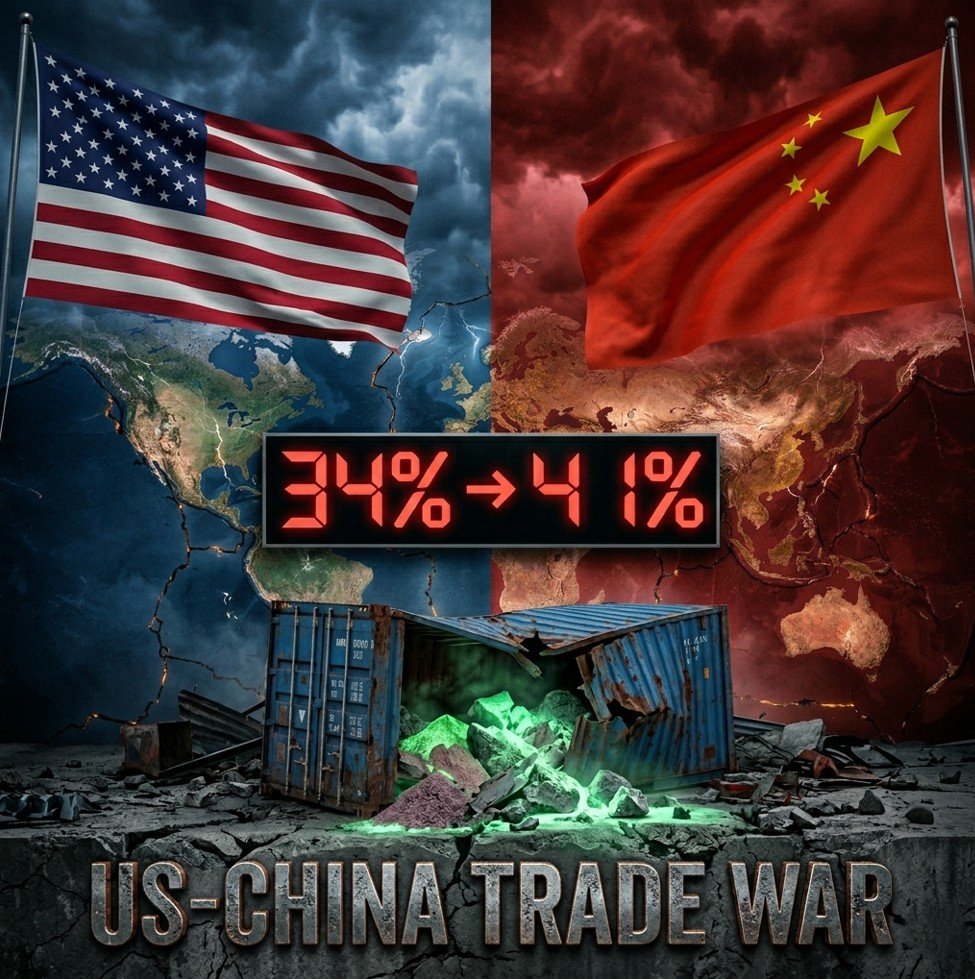
LEAD: In response to President Donald Trump’s 34% “reciprocal tariffs” on Chinese goods announced on April 2, Beijing has unleashed the most powerful weapon in its arsenal – retaliatory duties at the same rate on all products imported from the United States, set to take effect on April 10, 2026.
Why April 2, 2026 Will Be Remembered in Global Trade History
Exactly one year after President Donald Trump declared “Liberation Day” – April 2, 2025 – the White House decided to intensify the trade war with America’s largest economic partner. The US-China trade war entered a new, significantly more dangerous phase when Washington announced an additional 34% tariff on all goods imported from China. It was a decision designed to strike at the heart of Chinese exports and force Beijing into submission.
In his address, Donald Trump described the decision as a continuation of America’s “economic liberation” strategy. Combined with previously implemented 20% tariffs from early 2026, this meant that goods from the People’s Republic of China would face duties as high as 54% starting April 5. The Trump administration argued that the tariffs would reduce the US trade deficit, rebuild domestic industry, and improve Washington’s bargaining position against global trading powers.
For Beijing, however, this was a watershed moment. Chinese policymakers decided that the time had come to respond with full force.
‘A Typical Unilateral Intimidation Tactic’ – Beijing Strikes Back
Beijing did not delay its response. Just two days after Washington’s announcement, on Friday, April 4, China’s State Council Tariff Commission announced the imposition of 34% retaliatory tariffs on all goods originating from the United States. The new duties will take effect on April 10, with the exception of goods shipped to China before that date and imported by May 13.
Beijing’s decision was immediately framed in Chinese state media as a “necessary and proportionate response.” In a separate statement, China’s Ministry of Finance called on Washington to “immediately lift unilateral tariff measures and resolve trade differences through consultations in a manner that is equal, respectful, and beneficial to both sides.” The ministry described the US tariffs as a “typical unilateral intimidation tactic” that violates international trade rules and harms the interests of China, the United States, and the global economy.
The US-China trade war did not, however, limit itself to tariff hikes alone. Beijing decided to strike where America is most vulnerable – its supply chains for critical raw materials. China’s Ministry of Commerce announced that 16 US entities had been placed on an export control list, citing national security concerns. At the same time, 11 American companies, including Skydio and BRINC Drones, were added to the “unreliable entities list” for military cooperation with Taiwan.
Rare Earth Metals as Beijing’s New Strategic Weapon
Beijing’s most spectacular move, however, was the introduction of export controls on seven rare earth metals: samarium, gadolinium, terbium, dysprosium, lutetium, scandium, and yttrium. The restrictions took effect immediately – on April 4. As noted in the official statement, the controlled materials have both civilian and military applications, and the introduction of export controls “is a common international practice.”
The US-China trade war reveals its true edge precisely in this arena. China is the world leader in the mining and processing of rare earth metals – critical components in the production of semiconductors, advanced electronics, defense systems, and green technologies. By controlling their export, Beijing gains a powerful bargaining chip in negotiations with Washington.
Chinese authorities simultaneously assure that China remains open to foreign investment and provides a stable business environment for law‑abiding companies. In practice, however, the latest restrictions mean that American technology and defense companies will face serious disruptions in the supply of key raw materials.
Global Repercussions: Europe Trapped Between Giants
As Beijing and Washington exchange blows, the world watches with bated breath to see who will emerge from the confrontation unscathed. Analysts remain divided. Norwegian economist Olav Chen of Storebrand, one of Scandinavia’s largest financial firms, believes Donald Trump miscalculated. In an interview with the newspaper Aftenposten, Chen noted that one year after the punitive tariffs were introduced, inflation in the US has risen, industry has not revived, and China has emerged from the confrontation victorious.
Chen points to a key difference in the approach of different regions. Most of America’s global trading partners – including the European Union, Japan, South Korea, and Mexico – have not allowed themselves to be provoked into a tariff war, limiting the expected escalation of the conflict. The US-China trade war proved to be the exception. Beijing responded symmetrically, using its advantages, including access to rare earth metals, to deprive the US of the initiative. As Chen summarizes: “By introducing punitive tariffs, Trump was convinced he had the better cards – but he didn’t.”
For the European Union, the situation is becoming increasingly uncomfortable. Brussels, which itself found itself in the crosshairs of US tariffs in 2025 (20‑25% on key exports), now faces the difficult choice between an alliance with Washington and trade relations with Beijing. Although the EU ultimately negotiated a sectoral agreement with the US, including investment commitments and tariff adjustments, tensions have not disappeared. The Trump administration continued to impose tariffs on selected products such as wind turbines and motorcycles, prompting the European Parliament in March 2026 to introduce safeguard clauses and review mechanisms into the negotiated agreement.
Editor’s Conclusions: A New Division of the World
Looking at the events of the past 48 hours, it is impossible to escape the impression that the world of trade as we have known it for the last three decades is fading into history. What we are witnessing is not merely an episodic escalation of tensions between two powers. It is a fundamental restructuring of the global economic order – a process that will take years, perhaps decades.
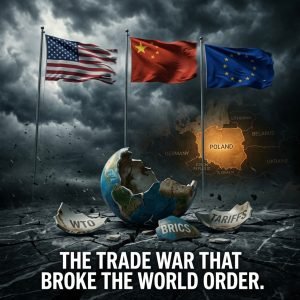
Beijing, by imposing export controls on rare earth metals, has shown that it does not intend to be a passive participant in a game dictated by Washington. China is consistently building its own trade channels, strengthening cooperation within BRICS and the Shanghai Cooperation Organisation. The US-China trade war thus becomes a catalyst for processes that could lead to the emergence of two parallel, competing economic systems – one centered in Washington, the other in Beijing.
For Poland and Central Europe, this situation brings both risks and opportunities. On the one hand, Poland, as part of the EU single market, will feel the effects of a global trade slowdown and potential increases in raw material prices. On the other hand, global companies seeking alternatives to China may be increasingly willing to locate their investments in our region. The key question is whether Poland will be able to seize this opportunity or whether it will allow itself to be dragged into a conflict that is not its war.
The US-China trade war will certainly not end in the coming months. Analysts expect further escalation, particularly in the areas of technology, semiconductors, and critical raw materials. For ordinary citizens, this means one thing: higher prices, greater uncertainty, and a world that is becoming increasingly divided. Will international institutions such as the WTO or the IMF be able to prevent the worst? Increasingly, evidence suggests that their role in this new bipolar world will be marginal.
Executive Summary
- Conflict Escalation: On April 2, 2026, the US announced 34% “reciprocal tariffs” on Chinese goods, raising the total rate for China to 54%. Beijing responded on April 4 with symmetric 34% tariffs on all US imports, effective April 10.
- China’s New Weapon: Beyond tariffs, China imposed immediate export controls on seven rare earth metals and placed 27 American companies on sanctions lists, targeting US defense and technology supply chains.
- Global Fallout: The EU finds itself caught between Washington and Beijing, while economists warn that Trump miscalculated – China has emerged stronger, using its rare earth dominance as a decisive strategic advantage.
Sources
- Reuters: China strikes back with 34% tariffs on all US goods — Direct reporting from a globally trusted news agency on Beijing’s official announcement and the scope of retaliatory measures.
- Bloomberg: Rare earth metals become China’s new trade war weapon — Authoritative financial coverage of the export controls, including the list of seven restricted metals and their industrial applications.
- Aftenposten interview: Economist Olav Chen on Trump’s miscalculation — Credible Scandinavian source providing independent economic analysis and direct quotes from a leading Norwegian economist.