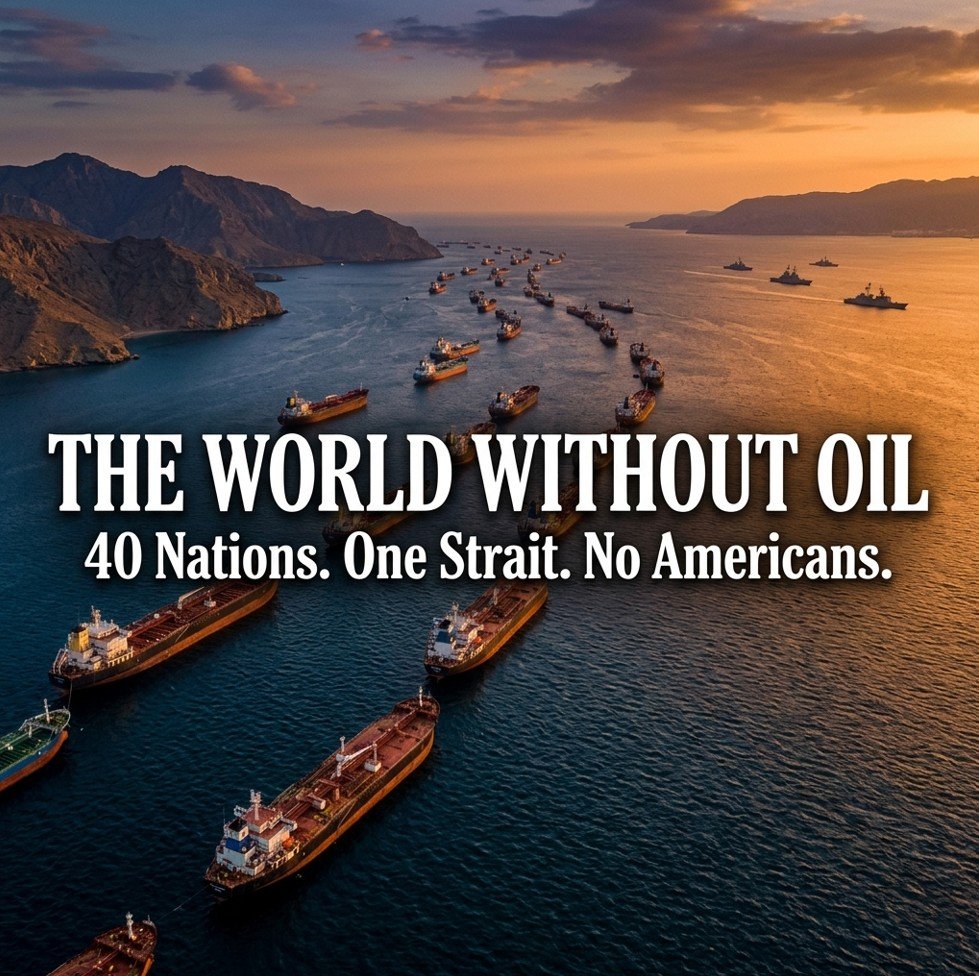
The Strait of Hormuz — a 39-kilometer bottleneck between Iran and Oman — has become the most consequential chokepoint in modern economic history.
A Blockade That Shook the World
When the United States and Israel launched joint military strikes against Iran on February 28, 2026, few anticipated that within five days the global energy system would face its most severe disruption ever recorded. Iran’s closure of the Strait of Hormuz on March 4 immediately cut off 20% of global oil and gas supplies — a figure the IEA described as unprecedented in peacetime or wartime. As Iran’s oil shock sent crude prices above $110, markets scrambled to price in a prolonged closure of the world’s most critical shipping lane.
The numbers are staggering. Brent crude surged from roughly $70 per barrel before hostilities to over $111 this week — a 58% increase in five weeks. Yesterday alone, US oil futures posted their biggest single-day dollar gain since April 2020, closing at $111.54 per barrel. LNG prices have risen nearly 60% since February 28, according to commodity analysts at Kpler.
Kuwait, Iraq, Saudi Arabia and the UAE — collectively producing tens of millions of barrels daily — have cut output because their exports have nowhere to go. By March 12, Gulf producers had collectively lost at least 10 million barrels per day in production capacity. QatarEnergy declared force majeure on all LNG exports. The Gulf Cooperation Council’s economic model — built entirely on the assumption of open sea lanes — has entered what economists are calling a systemic collapse.
40 Countries, No Americans, One Strait
On Thursday, UK Foreign Secretary Yvette Cooper chaired a virtual summit of more than 40 nations — up from the 35 announced just 24 hours earlier — to discuss reopening the Strait of Hormuz through “diplomatic and economic tools.” Signatories include France, Germany, Italy, the Netherlands, Canada, Japan and the UAE. The United States is notably absent from the coalition.
Cooper confirmed that participants discussed concrete planning measures to ensure safe passage and the release of over 20,000 seafarers aboard approximately 2,000 ships currently trapped in the Persian Gulf. European nations — initially reluctant to be drawn into a US-Israeli operation — have reversed course as oil and gas prices made neutrality economically unsustainable. The fracture was already visible days earlier, as documented in our analysis of how the Iran war cracked the Western alliance open.
France’s President Macron drew a clear line Thursday, stressing that reopening the strait “is not their operation” — referring to the US-Israeli strikes — while confirming French participation in the multinational coalition. China, meanwhile, said the “root cause” of Hormuz disruptions was Washington’s “illegal” joint operation and urged de-escalation to protect global shipping. Beijing’s position matters: Chinese tankers are among the few vessels Iran has allowed through the blockade.
Grocery Shelves and Gasoline Pumps: The Human Cost
The economic consequences extend far beyond oil trading floors. Gulf states — which import over 80% of their caloric intake through the Strait — are facing a full-scale grocery supply emergency. By mid-March, 70% of food imports to GCC countries were disrupted. Retailers including Lulu Retail began airlifting staple foods, triggering a 40–120% spike in consumer prices across the region.
In Western economies, the K-shaped economic divergence is deepening. Gasoline prices have jumped to their highest level since 2023, hitting lower-income households disproportionately hard. Economists at Capital Economics warn that a prolonged conflict could push Brent crude to $130 per barrel in Q2 2026 — a scenario that would delay central bank rate cuts and force some eurozone policymakers to raise rates instead. This trajectory mirrors the broader collapse of the global trade order in 2026 that analysts have been warning about since January. Meanwhile, Trump’s 34% tariffs on Chinese goods add yet another inflationary layer to an already fragile global supply chain.
Editor’s Conclusions
The 40-nation Hormuz coalition represents something genuinely new in 21st-century geopolitics: a major multilateral response to an energy crisis in which the United States — the primary instigator of the underlying conflict — is conspicuously excluded. This is not a minor diplomatic footnote. It signals a profound realignment.
Europe, Japan and Canada have concluded that their energy security cannot be subordinated to Washington’s military calculus. The coalition’s mandate is explicitly non-combative — “diplomatic and economic tools” — but the deployment of European naval vessels to assembly points near Cyprus and the southwestern Indian Ocean tells a different story. Ships don’t position themselves for diplomacy alone.
Trump’s rhetoric remains maximalist. His declaration Thursday that the US military “hasn’t even started destroying what’s left in Iran” — combined with vows to hit the country “back to the Stone Ages” — suggests Washington is not close to the negotiated exit it publicly claims to be seeking. Operation Epic Fury continues into its 34th day with no diplomatic breakthrough in sight, underscoring how far both sides remain from a negotiated settlement. This creates a dangerous asymmetry: a coalition of 40 nations trying to de-escalate a conflict that its primary military driver appears to be escalating.
The oil market is pricing in a prolonged disruption. At $111.54 per barrel, crude is approaching the critical $120 threshold that analysts identify as the point at which demand destruction begins to meaningfully slow consumption in emerging markets. Beyond $120, the recession risk in import-dependent economies — including most of South and Southeast Asia — becomes acute.
China’s position deserves particular attention. Beijing has the most leverage over Tehran of any major power, and Chinese tankers are already receiving preferential passage through the blockade. Whether China chooses to use that leverage — or whether it prefers to watch Western economies bleed through sustained high energy prices — may ultimately determine how long the Strait of Hormuz remains closed.
The 1970s oil embargo lasted five months and reshaped the global economy for a decade. The Hormuz blockade is already in its fourth week. The 40-nation coalition meeting on Thursday was necessary. Whether it is sufficient is the question that markets, governments, and 8 billion energy consumers are now waiting to have answered.
Executive Summary
- Iran’s closure of the Strait of Hormuz caused the largest oil supply disruption in recorded history, pushing Brent crude to $111+ per barrel
- A 40-nation UK-led coalition — excluding the US — is seeking diplomatic reopening of the strait, with European navies already repositioning in the region
- Prolonged blockade risks $130 oil, a global recession trigger, and irreversible damage to the GCC’s food and energy model
Internal Links Used
- Iran’s oil shock sent crude prices above $110 — A Blockade That Shook the World
- how the Iran war cracked the Western alliance open — 40 Countries, No Americans, One Strait
- collapse of the global trade order in 2026 — Grocery Shelves and Gasoline Pumps
- Trump’s 34% tariffs on Chinese goods — Grocery Shelves and Gasoline Pumps
- Operation Epic Fury continues into its 34th day — Editor’s Conclusions
Sources
- Al Jazeera — Can Starmer’s 40-nation coalition open the Strait of Hormuz? — Główne źródło dot. składu koalicji i roli UK
- Wikipedia — Economic impact of the 2026 Iran war — Zagregowane dane IEA i analiza gospodarcza
- Fortune — Global economy takes gut punch from war in Iran — Dane dot. zakłóceń dostaw żywności w GCC i prognoz cen ropy