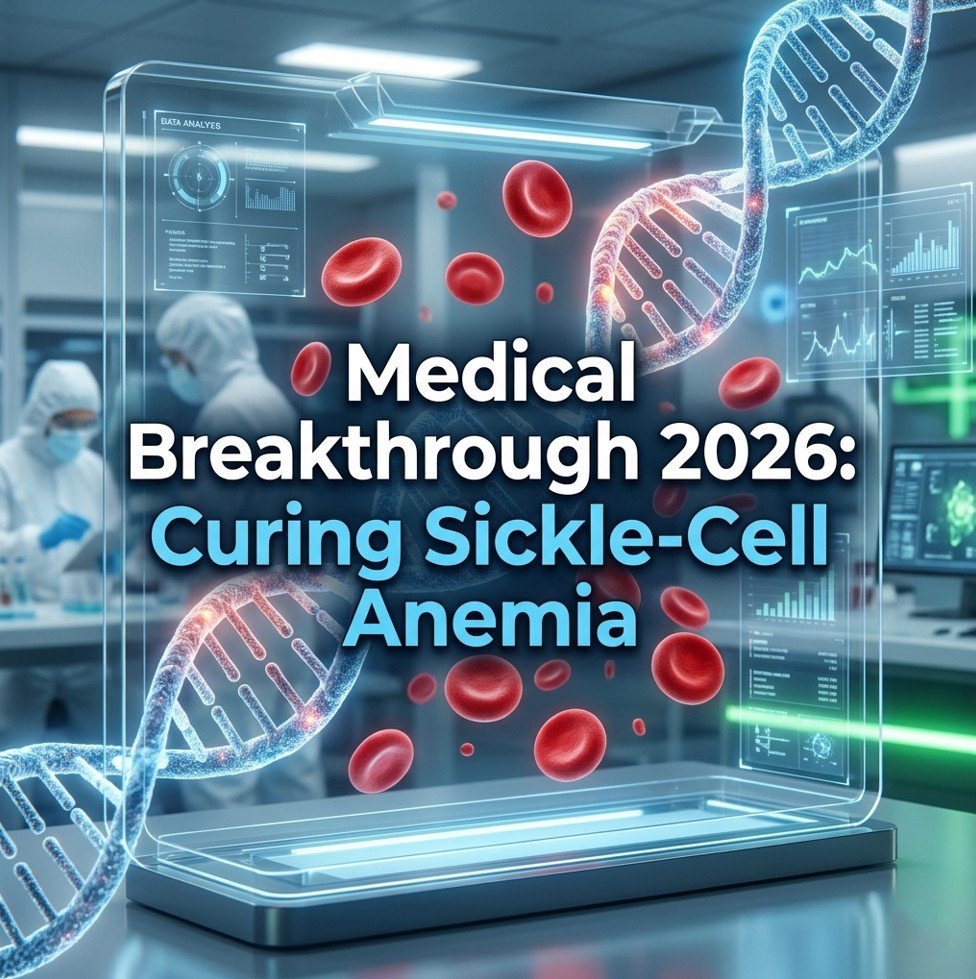
The application of an innovative gene-editing technology has led to the complete remission of symptoms in a 21-year-old American patient, marking an epochal turning point in the global fight against hereditary blood disorders.
A Genetic Revolution in Hematology
For decades, sickle-cell disease has presented an enormous challenge for scientists and modern medicine. This inherited condition causes an incredibly dangerous mutation in hemoglobin structure, which subsequently forces red blood cells to assume an unnatural, rigid, crescent or sickle shape. Consequently, these deformed cells tend to clump together and block tiny blood vessels throughout the entire body. As a result, patients experience unimaginable, episodic pain crises, risk extensive internal organ damage, and face a significantly shortened life expectancy. Previously, conventional treatment methods focused almost exclusively on alleviating these drastic and progressive symptoms. Doctors regularly administered blood transfusions and prescribed strong, often addictive painkillers, yet they could not effectively eliminate the actual source of the problem.
However, in early April 2026, the medical landscape experienced a radical and permanent transformation. Medical experts proudly announced the successful curing of sickle-cell anemia in a young resident of the United States, thereby ending the era of helplessness regarding this severe condition. Specifically, the applied breakthrough procedure directly and precisely repairs the genetic basis of the disease at the cellular level. Notably, this spectacular clinical success aligns perfectly with the latest trends promoted by modern biotechnology 2026 worldwide. Scientists have unequivocally proven that humanity can now not only passively read the human genome map but also actively modify it for noble therapeutic purposes.
Therefore, the twenty-one-year-old patient no longer requires constant, exhausting hospitalizations or regular visits to the emergency room. For the first time in his life, his body independently produces completely healthy red blood cells, which has fully restored his physical capabilities. Without a doubt, this unprecedented research triumph provides entirely new hope for millions of patients globally. Furthermore, it opens a completely new and fascinating chapter in the clinical history of molecular hematology.
The Mechanism Behind the Innovative Therapy
Achieving the complete curing of sickle-cell anemia required the application of an incredibly advanced and precise molecular engineering tool. Initially, hematology specialists extracted bone marrow stem cells directly from the 21-year-old patient’s body. Subsequently, within a sterile and strictly controlled laboratory environment, prominent researchers utilized molecular genetic scissors to carefully edit specific fragments of the DNA strand. Importantly, the main objective of this complicated procedure was not to directly repair the damaged adult hemoglobin gene, which scientists considered exceptionally difficult technologically. Instead, American researchers cleverly and permanently disabled a specific genetic switch (the BCL11A gene), which naturally and automatically inhibits the production of fetal hemoglobin shortly after human birth.
As a direct result of these actions, the appropriately modified stem cells rapidly began producing massive quantities of a healthy, fetal version of the blood protein. When doctors finally transplanted these edited cells back into the patient’s weakened body, the cells freely circulated in the bloodstream before anchoring and multiplying in the bone marrow. Moreover, the healthy fetal hemoglobin proved strong enough to completely prevent the deformation of erythrocytes, despite the lingering presence of the mutated variant. Therefore, the young man almost immediately stopped experiencing destructive and recurring pain crises. Such impressive pharmaceutical innovation proves that personalized medicine has ceased to be merely a theoretical concept in scientific journals and has become a tangible weapon saving human lives.
Furthermore, the entire crucial adaptation process of the transplanted cells within the body took only a few months. Naturally, the initial phase of the therapy required the patient to undergo extremely intensive chemotherapy to effectively destroy the old, faulty marrow and make valuable space for the new, completely healthy cells. Nevertheless, the long-term benefits decidedly and undeniably outweigh these temporary, immense hardships. The patient gained a unique opportunity for a long, normal, and productive life without relying on constant external medical assistance.
Global Impact on Healthcare Systems
The historic and well-documented curing of sickle-cell anemia in this young American currently generates massive consequences for national healthcare systems across all continents. Presently, experts estimate that millions of people worldwide live with this devastating disease, while by far the largest population burden falls on countries located in Sub-Saharan Africa and populations of African descent in the West. On one hand, the clinical proof of the immense effectiveness of gene therapy provides a justified reason for tremendous joy within medical communities. On the other hand, global governments, health ministries, and private insurance companies must now immediately face the greatest financial challenge in history. Undeniably, autologous gene-editing procedures belong to the most expensive known medical interventions in the history of human civilization.
Preliminary and cautious expert estimates indicate that the total cost of a single administration of personalized gene therapy often exceeds $2 to $3 million per patient. Of course, from the broad perspective of decades of palliative care, countless hospitalizations, and chronic blood transfusions, a one-time, albeit incredibly expensive, therapy may ultimately bring real long-term savings to healthcare systems. However, the barrier to entry and the accumulation of initial capital remain exceptionally high. To optimize research processes and rapidly reduce the absurd costs of mass vector production, corporations increasingly utilize advanced predictive models. Modern AI in pharma significantly helps accelerate the design of necessary enzymes, which should noticeably and permanently lower the retail prices of such therapies in the near future.
Furthermore, key international organizations, including the World Health Organization (WHO), have already initiated highly intensive negotiations with the main producers of these technologies. The overarching goal of these difficult discussions is to quickly develop special, hybrid financing models that will effectively provide this innovative treatment to the poorest patients in the global South. Without international and institutional solidarity, this phenomenal, epochal scientific achievement will bring real benefits exclusively to the wealthiest elites. Therefore, political and health decision-makers worldwide must immediately join forces to create innovative frameworks for the fair and equal distribution of life-saving gene therapies.
Editor’s Conclusions
Carefully analyzing the most important global news from April 2026, we must clearly, boldly, and categorically state: global medicine has officially entered the revolutionary era of molecular engineering. In this new, digital-biological epoch, we will definitively solve fundamental genetic problems that humanity considered completely incurable for centuries. The magnificent curing of sickle-cell anemia in a young man from an American state represents an absolute triumph of human intellect, scientific perseverance, and the power of modern technology. Certainly, this is not merely a slow, evolutionary step in traditional pharmacology. Above all, it constitutes a complete, systemic change of the dominant paradigm in understanding and treating hereditary human diseases. Throughout all past centuries, prominent doctors served merely as compassionate caretakers who could only gently alleviate the immense suffering resulting from an irreversibly faulty record in the DNA chain. Today, we possess advanced algorithms and microscopic biological machines that allow us to directly enter a patient’s intimate, biological source code, edit errors, and rewrite human nature entirely anew.
However, history consistently proves that every equally powerful and massive technological breakthrough automatically breeds equally massive and complicated ethical, social, and economic challenges. Currently, the main, most pressing problem facing disoriented political decision-makers and healthcare managers remains the deeply unfair, market-driven access to the latest medical innovations. The current production costs of personalized cellular and gene therapies are practically prohibitive for the average insurance system. If we do not urgently reform outdated, global reimbursement models for specialized drugs, we will create and solidify a dangerous, dystopian division into two castes. On one hand, a “genetically privileged” society will emerge, capable of effortlessly repairing any congenital defects. On the other hand, massive populations will remain in poorer countries, where young patients will continue to die en masse in tremendous pain simply due to a prosaic lack of state financial resources. Therefore, we must lightning-fast implement innovative forms of installment payments based on confirmed health outcomes, known as value-based healthcare. In this model, insurance funds pay for treatment only when, and only as long as, the genetic therapy maintains its high effectiveness in a specific patient from year to year.
Moreover, we must explicitly emphasize that this groundbreaking success does not end with a single disease. Instead, it opens an incredibly wide, perfectly illuminated highway for subsequent, even bolder clinical trials. If science can already safely and purposefully modify hematopoietic cells in the case of aggressive sickle-cell disease today, we can very soon apply this exact same, confirmed mechanism to completely treat thalassemia, extremely rare immunodeficiencies, or various muscular dystrophies destroying children’s bodies. Major, global biotechnology companies are already massively intensifying expensive research into in vivo methods, which means editing genes directly inside the patient’s body. Making such a technique available will completely eliminate the drastic necessity of previously conducting highly risky, debilitating bone marrow transplants. In such an upcoming clinical scenario, a patient would simply receive a single, almost painless injection with specially programmed nanocarriers in the future. Guided by algorithms, these particles would independently find the appropriate cells hidden deep within the human body, after which they would autonomously make the necessary, therapeutic DNA correction.
In conclusion, looking ahead to the upcoming decade, we firmly expect genome editing to earn the deserved status of a routine outpatient procedure in the world’s largest medical centers. Ultimately, however, whether this magnificent revolution brings saving relief to tens of millions of suffering people depends largely on how quickly we combine the forces of science, artificial intelligence, and global politicians. Together, we must immediately lower rising operational costs, standardize logistical processes, and computerize technologies in genetic laboratories across absolutely all continents.
Executive Summary
- An innovative gene therapy successfully eliminated the molecular, genetic root cause of the disease in a young US patient.
- Instead of lifelong toxic painkillers, prominent scientists stimulated the massive cellular production of protective, healthy fetal hemoglobin.
- The rapid development and extraordinary effectiveness of these modern procedures immediately require nations to create new, global models for equitably financing medical therapies worldwide.
Internal Links Used
- modern biotechnology 2026 — placed in A Genetic Revolution in Hematology
- pharmaceutical innovation — placed in The Mechanism Behind the Innovative Therapy
- AI in pharma — placed in Global Impact on Healthcare Systems
Sources
- US man becomes first person cured of sickle-cell anemia — Verified reporting from April 2, 2026, confirming the pioneering cure of a 21-year-old in the USA using novel gene therapy.
- Patient Cured of Sickle Cell Anemia With Innovative Gene Therapy — Medical context detailing the use of gene editing to activate fetal hemoglobin production.