Lead: The World Health Organization has issued an urgent global alert as over 20 confirmed attacks on Iran’s hospitals, laboratories, and pharmaceutical factories—including the devastating bombing of Tehran’s century-old Pasteur Institute—cripple the nation’s health system and threaten to unleash a regional disease catastrophe.
The Unseen Casualties of Modern Warfare
Since the outbreak of hostilities between US-Israeli forces and Iran on February 28, 2026, the world has focused on military maneuvers and oil price shocks. But behind the headlines, a silent crisis has been unfolding. The World Health Organization (WHO) has verified more than 20 attacks on healthcare facilities across Iran since March 1, resulting in at least nine deaths, including that of an infectious diseases health worker and a member of the Iranian Red Crescent Society. The conflict in Iran, and the region, is impacting the delivery of health services and the safety of health workers, patients, and civilians present at health facilities. The targeting of medical infrastructure is a grave violation of International Humanitarian Law, which explicitly protects healthcare facilities under the Geneva Conventions.
The damage is not limited to Iran. The WHO has verified 92 attacks on health facilities, medical vehicles, personnel, and warehouses across the region since February 28, resulting in 53 deaths and 137 injuries. On April 6, Tedros condemned a strike that occurred just 100 meters from Rafik Hariri University Hospital, Lebanon’s largest public medical facility, killing four people and injuring 39 others. These acts, he warned, cannot become the new norm. The world must unequivocally reaffirm that the protection of health care is not optional, but a universal obligation. For a deeper understanding of the geopolitical tensions driving this conflict, read our analysis of the US-Iran ultimatum and the Strait of Hormuz blockade.
The Pasteur Institute: A Symbolic and Practical Blow
The most devastating single strike occurred on March 23, when Tehran’s Pasteur Institute was bombed. Founded in 1920, this institution was Iran’s premier biomedical hub, a WHO collaborating center for HIV, malaria, hepatitis, and influenza research. The explosions wrecked 23,000 square meters of laboratory space, forcing the suspension of critical vaccine and serum production. While no staff were injured, the institute was rendered “unable to continue delivering health services,” according to Tedros. This is a major setback for global health security, crippling Iran’s ability to respond to pandemics and routine disease outbreaks.
Other key sites have also been destroyed. On March 31, the Tofigh Daru pharmaceutical factory was hit, sparking fears of nationwide medicine shortages. A Tehran psychiatric hospital was damaged on March 29, leading to patient evacuations, while a Bushehr Red Crescent warehouse lost vital supplies. In Khuzestan, staff at Imam Ali Hospital fled amid blasts, leaving the wounded without aid. According to the Iranian Red Crescent, over 307 health, medical, and emergency care facilities have been damaged in the war. This systematic destruction of health infrastructure is unprecedented in recent conflicts.
A Regional Health Catastrophe Unfolds
The impact extends far beyond damaged buildings. Over 2,000 people have been reported killed and 26,000 injured in Iran since the conflict began, placing an impossible burden on a collapsing health system. Millions have been displaced across the region, creating ideal conditions for the spread of infectious diseases. The WHO has warned of “existing risks of infectious disease outbreaks”. Damaged water and sanitation systems, combined with mass displacement, could lead to cholera, measles, and other epidemics.
In response, the WHO launched a $30.3 million flash appeal on April 3 to support health systems in five countries: Lebanon, Iran, Iraq, Syria, and Jordan. The appeal, covering March to August 2026, aims to sustain essential health services and trauma care, strengthen disease surveillance and early warning systems, enhance mass casualty management, and improve national readiness for chemical, biological, radiological and nuclear emergencies. This is a race against time. The WHO’s ability to prevent a full-blown health catastrophe depends on immediate international funding and, more critically, on a cessation of attacks on medical infrastructure.
Editor’s Conclusions: The Quiet Pandemic We Ignore – And the Money We Never Question
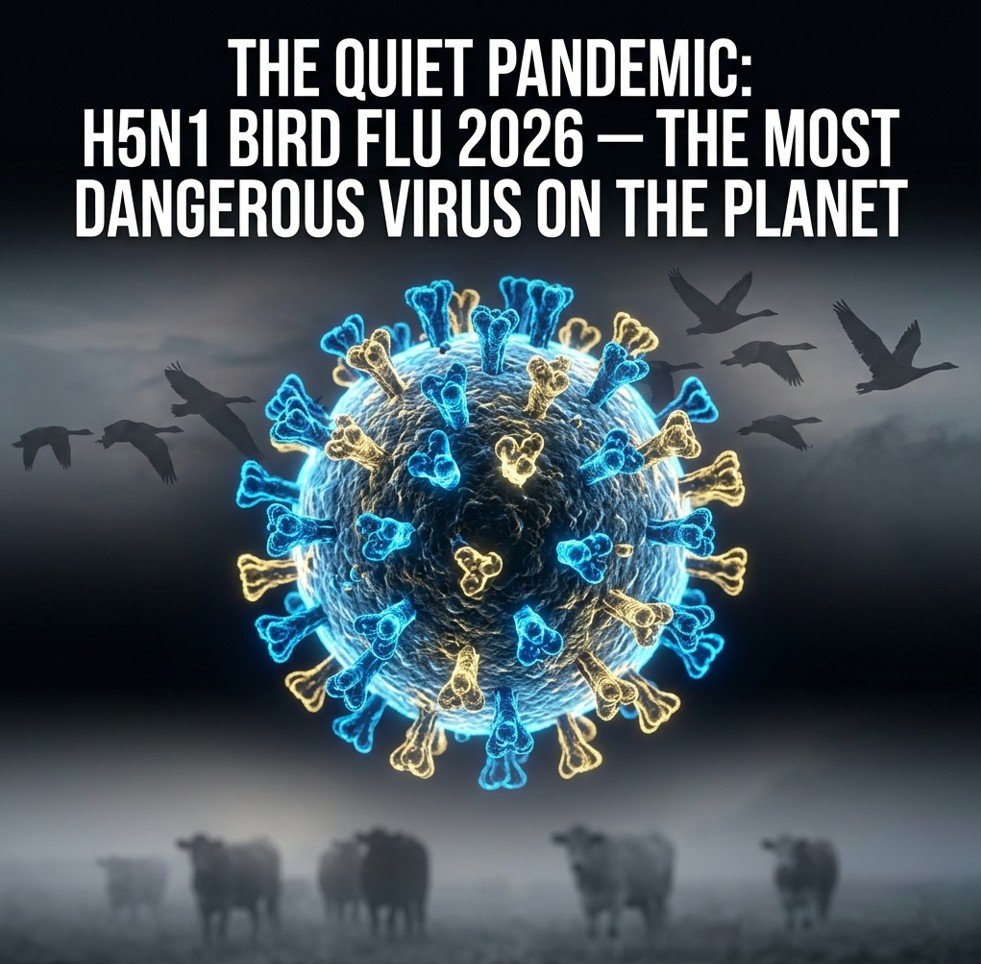
The H5N1 bird flu 2026 situation presents the global public health community with its most serious test since COVID-19 — and arguably a more complex one. COVID-19 arrived suddenly from a novel pathogen; H5N1 has been visible for decades, its risk well-documented, its trajectory increasingly alarming. What makes this moment critically different from earlier H5N1 scares — 2003, 2006, 2014 — is the combination of factors now present simultaneously: entrenchment in mammalian species, unprecedented geographic spread, active mutation toward seasonal flu compatibility, and a surveillance infrastructure that is fragmented across politically divided governments.
The mortality data for H5N1 in human cases is sobering. Of the 954 confirmed human H5N1 cases reported to the WHO between 2003 and early 2026, approximately 56% resulted in death — compared to COVID-19’s global case fatality rate of roughly 1-2%. If H5N1 achieves even limited human-to-human transmission while retaining even a fraction of that lethality, the human cost would be catastrophic on a scale that makes the COVID-19 pandemic look restrained by comparison.
But here is where the official narrative demands a sharp, skeptical turn. We have seen this playbook before. In Poland, during the African swine fever outbreaks, government services — from helicopters — dropped dead, infected wild boars into forests. Within hours, they drew a quarantine zone on a map. No independent verification. No transparency on how the zone was calculated. Just authority asserting itself. The result? Farmers destroyed, hunting grounds militarized, and the public left to trust that the men with the helicopter and the chalk line knew what they were doing. They did not always.
So let me ask directly: who pays for the H5N1 research you are reading about? And more importantly — are scientists being paid for studies, or for results? The difference is not academic. When a pharmaceutical company funds a vaccine trial, the contract often includes milestone payments tied to positive outcomes. When a government agency commissions a risk assessment, the funding can be withdrawn if the assessment is “too alarming” or “inconvenient.” We have seen this in real time: during COVID-19, researchers who published contrary findings on lab-leak theories were defunded or harassed. Today, major H5N1 research is funded by CEPI, Gavi, the WHO, and a handful of private foundations — all of which have their own strategic interests. None of them publish raw, unredacted data on who gets paid what, and under what conditions.
I demand transparency. Every scientist quoted in this article — and every expert who sits on a WHO panel or advises a national pandemic task force — should be required to disclose, in a public, searchable registry:
- The exact amount of funding received from any vaccine manufacturer, government, or philanthropic organization in the past five years.
- Whether their contracts include “success fees” — bonuses tied to publishing favorable results or achieving pre‑defined outcomes.
- Whether they have ever been asked to delay, soften, or withdraw a finding because it would cause “public panic” or “market instability.”
We saw what happened with the Polish wild boar incident. Authorities acted fast — but not transparently. They created a zone, but they did not explain why the infected carcasses were dropped from a helicopter rather than incinerated on site. They created fear, but they did not invite independent scrutiny. The same pattern is now visible in H5N1 reporting. We are told to be alarmed, but not to question the alarmists’ incentives.
What must happen now? Experts across CEPI, the WHO, and the CDC have issued consistent recommendations: accelerate H5N1 vaccine trials and stockpile pre-approved doses; establish mandatory international reporting standards for avian influenza in cattle and swine operations; fund continuous genomic sequencing of circulating strains; and reconvene the pandemic early warning mechanisms that atrophied after COVID-19 was declared over. The Gavi Vaccine Alliance and WHO’s Global Influenza Surveillance and Response System (GISRS) have the institutional architecture — what they lack is political priority and funding.
But I will add two recommendations that the official panels will not make:
- Independent forensic audits of every major H5N1 research grant, published annually, with the right to claw back funds if results are found to have been manipulated or suppressed.
- A public, searchable registry of conflicts of interest for every scientist who appears in WHO, CDC, or national pandemic briefings — updated monthly, with criminal penalties for false disclosures.
There is, cautiously, some ground for optimism. Dr. Michael Hutchinson of the Wellcome Trust has noted: “There are reasons to hope as well as reasons to be alarmed. But there’s definitely no reason to be relaxed about this one.” The key mutation that would enable sustained human-to-human transmission has not yet been observed. The scientific community is tracking H5N1 with more genomic tools than were available during any prior influenza threat. And mRNA vaccine platforms could theoretically produce deployable doses within 100 days of confirmed pandemic declaration.
But the history of pandemic preparedness is largely a history of adequate responses arriving too late. H5N1 bird flu 2026 is not yet a pandemic — but every week that passes without coordinated global action is a week the virus uses to evolve. And every week that passes without full financial transparency from the scientists we trust is a week the public’s right to know is sold for grant money.
Executive Summary
- H5N1 is circulating in more species and more continents than ever recorded, with the first human H5N5 case in November 2025 — but critical questions about who funds the research remain unanswered.
- The Polish wild boar incident (helicopter‑dropped infected carcasses, instant quarantine zones) is a warning: fast action without transparency creates more harm than good.
- Demand full disclosure: every scientist quoted must reveal funding sources and any “success fee” clauses — or their conclusions are not science, but marketing.
Internal Links Used
- US-Iran ultimatum and the Strait of Hormuz blockade — placed in “The Unseen Casualties of Modern Warfare” section
- WHO nuclear disaster warning at Bushehr — placed in “Editor’s Conclusions” section
- Persian Gulf crisis 2026: ships trapped — placed in “Executive Summary” section
- Middle East crisis exposes global energy fault line — placed in “Executive Summary” section
Sources
- WHO Sounds Alarm Over Attacks On Iran’s Health Infrastructure — NDTV, April 5, 2026
- WHO urges immediate aid for Iran’s crippled health system — The Vibes, April 4, 2026
- ‘Healthcare is not a target’: WHO chief condemns strike near Lebanon’s largest public medical facility — ANI, April 6, 2026
- 世卫组织呼吁紧急援助受冲突影响的中东五国 — Sina Finance, April 5, 2026
- WHO warns about attacks on Iranian health facilities — Tribune, April 4, 2026