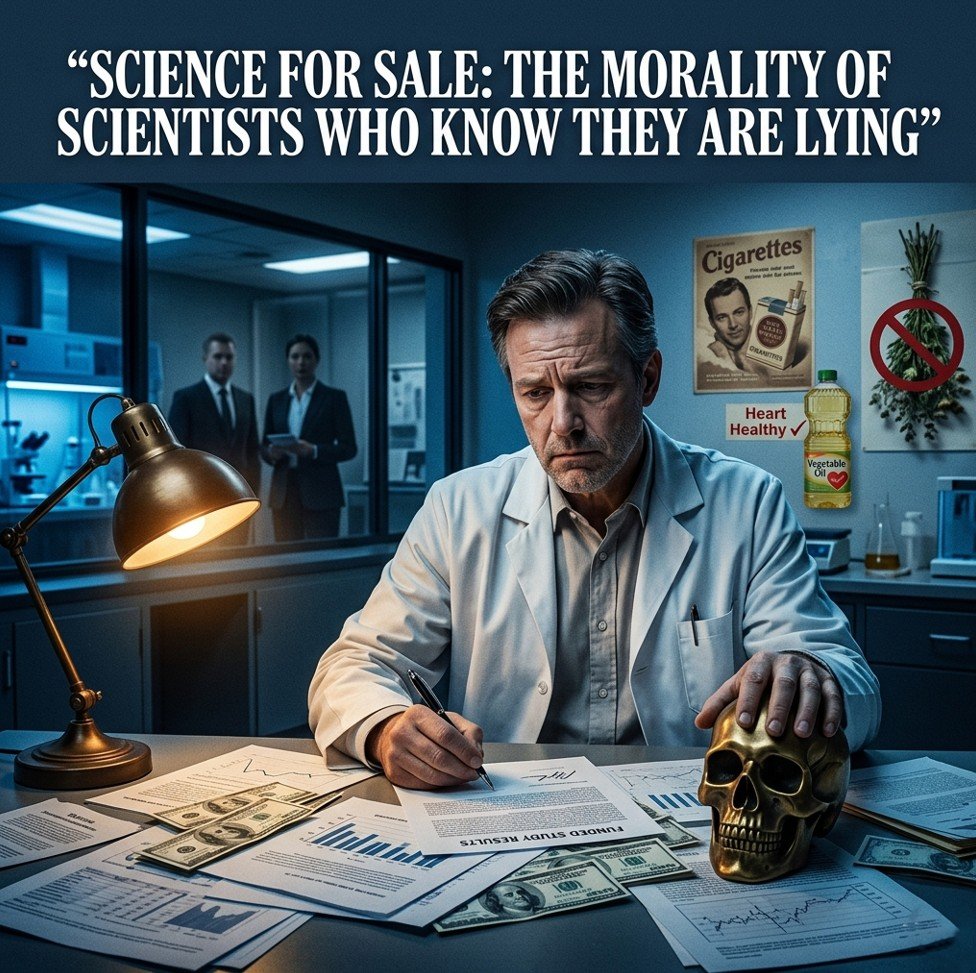
The morality of scientists funded by industry is one of the most pressing issues in public health — because when a researcher knows their data harms society and stays silent, they become an accomplice.
Paid for Research or for Results? The Core Question of Scientific Morality
The morality of scientists begins with one fundamental question: is a researcher paid for conducting rigorous research, or for delivering a predetermined result? The answer to that question divides science into two worlds — the public one and the one hidden behind the closed doors of corporate-funded laboratories.
In the ideal model, a scientist receives a grant, runs objective experiments and publishes results — regardless of whether they confirm or disprove a hypothesis. In reality, however, growing evidence shows that industry funding dramatically skews the direction of conclusions. Meta-analyses published in PLOS Medicine found that studies funded by the food industry were five times more likely to produce results favorable to the sponsor than publicly funded research. That is not a coincidence — it is a system.
Moreover, the problem extends far beyond falsifying data. A far more dangerous phenomenon is the deliberate suppression of results unfavorable to the sponsor — known as publication bias. Studies showing a product’s harm end up in a drawer, while those confirming its safety land in prestigious journals. That is precisely why the latest medical breakthroughs of April 2026 deserve scrutiny through a single lens: who funded the study?
The ethical code for researchers — both the Declaration of Helsinki and the European Code of Conduct for Research Integrity (ALLEA, 2017) — clearly states that scientists must disclose conflicts of interest and may not knowingly present false data. Yet sanctions for violating these principles remain largely symbolic. A scientist who lies in the service of a corporation risks, at most, losing their academic affiliation — they will never face criminal prosecution for harm inflicted on millions of people.
Tobacco: The Textbook of Scientific Disinformation
The history of tobacco is the most thoroughly documented example of how industry buys science and poisons society for decades while fully aware of the consequences. Tobacco corporations knew about the carcinogenicity of cigarettes as early as the 1950s — internal Brown & Williamson documents, revealed in the 1990s, prove this beyond any doubt. Nevertheless, for four more decades they funded studies suggesting no causal link between smoking and lung cancer.
The mechanism was precisely engineered: rather than denying the existence of risk, the tobacco industry created a narrative of “scientific uncertainty.” It funded hundreds of studies multiplying doubt, paid experts willing to publicly challenge the scientific consensus, and — above all — pressured editors of medical journals. As a study published in Tobacco Control (British Medical Journal) in 2026 showed, tobacco industry lobbying led to the dilution of a key EU tobacco directive between 2009 and 2014, replacing the language of “health” and “warnings” with economic terminology.
Today the situation remains equally troubling. A report by the STOP and Contre-Feu organizations published in late 2025 revealed that 49 tobacco lobbying organizations — primarily Philip Morris International — spent €14 million per year influencing EU decision-makers, organizing 257 meetings with European Commission and Parliament representatives in 2023–2025 alone, with many additional unregistered contacts. Detailed data on the mechanisms of disinformation in healthcare reveal how deeply industry can infiltrate public institutions.
What should happen to the scientist who knowingly participated in this scheme? According to Prof. David Michaels of George Washington University, author of Doubt is Their Product, such individuals should face criminal liability on par with manufacturers of defective drugs. To date, however, not a single industry-funded tobacco scientist has stood trial for documented scientific lies.
Vegetable Oils and Sugar: The Greatest Dietary Fraud of the 20th Century
If the history of tobacco is the textbook of disinformation, then the story of vegetable oils and sugar is its masterclass — because here the victims were virtually the entire Western population. In 1967, the Sugar Research Foundation — the sugar industry lobby now known as the Sugar Association — paid three Harvard School of Public Health professors the equivalent of approximately $50,000 today to publish a review in the prestigious New England Journal of Medicine pointing to saturated fat — rather than sugar — as the primary cause of heart disease. The source of funding was not disclosed, because the obligation to declare conflicts of interest in research was not introduced until the 1980s.
Simultaneously, from the 1950s onward, Ancel Keys turned his Seven Countries Study into one of the greatest scientific distortions in the history of medicine. Keys had data from 22 countries — yet selectively chose only seven for publication, specifically those that confirmed his hypothesis about saturated fat and heart disease. In 1961, Keys secured a seat on the nutrition committee of the American Heart Association (AHA), which shortly began issuing dietary guidelines promoting vegetable oils. A coincidence? Not entirely — the AHA had previously received a million-dollar donation from Procter & Gamble, the manufacturer of Crisco oil.
The consequences were catastrophic. For over 50 years, Western societies massively replaced animal fats with vegetable oils rich in polyunsaturated omega-6 fatty acids (linoleic acid), which — as later research confirmed — are prone to oxidation and may contribute to atherosclerosis. The Minnesota Coronary Experiment, concealed for decades, showed plainly: in participants whose cholesterol was most aggressively lowered by replacing fats with vegetable oils, the risk of death rose rather than fell. These data were published only in 2016 — 45 years after the trial ended. That is precisely why advances in the diagnosis and prevention of lifestyle diseases now demand a deeply critical reading of the history of health recommendations.
Herbs in the European Union: When Regulation Becomes a Tool of Elimination
The latest chapter in the history of manipulated science and regulation is the fate of herbs in the European Union. EFSA — the European Food Safety Authority — proposed a ban on plant preparations containing hydroxyanthracene derivatives (HADs), including aloe vera, senna and rhubarb, citing possible genotoxicity risks. The ban was intended to take effect in Q1 2025 — however, in November 2024, the EU General Court annulled a previous version of the ban from 2021, ruling that it lacked sufficient scientific justification.
This case exposes a deeper problem: who actually shapes EFSA’s scientific opinions? Herbs such as aloe vera and senna have been used by humanity for thousands of years. Their sudden prohibition — while synthetic substances with comparable or greater risk profiles remain on the market — raises legitimate questions about pharmaceutical lobbying behind the scenes of European scientific institutions. In 2025, the CJEU also ruled that advertising herbal dietary supplements as medicinal products is prohibited, even where an EU list of approved health claims for botanical substances does not yet exist — because the European Commission has still not completed their assessment. The paradox? Products are on the market, but telling the truth about their properties is forbidden — because that truth has not yet passed through a regulatory filter that is itself unfinished. Innovations in natural medicine and their evaluation by healthcare institutions require constant, critical monitoring.
Editor’s Conclusions: What Should Happen to a Scientist Who Lies?
The morality of scientists is not an academic exercise — it is a matter with direct health, legal, and social consequences. The history of tobacco, vegetable oils and EU herbal regulations reveals a repeating pattern: industry funds research, results are selected or falsified, and when the truth eventually surfaces, almost no one is held accountable.
So what should happen to a scientist who knowingly falsified research results, aware that their work was causing harm? First, all associated publications must be immediately retracted. The Committee on Publication Ethics (COPE) maintains retraction procedures, but they are applied too rarely and too slowly. Second, such a scientist should face a lifetime ban on applying for public research funding — modeled on the regulations already in force in the United States through the Office of Research Integrity. Third, in cases where proven scientific fraud led to death or mass harm to public health, criminal liability for causing mass bodily harm should apply.
What about earlier research that was built on a foundation of falsified data? This is the hardest problem of all. Decades of dietary guidelines, thousands of secondary studies and meta-analyses rest on Ancel Keys’ fat data or Harvard’s sugar data. Science must undertake a systemic effort of revision — and not merely an academic one, but with active public communication that previous recommendations were wrong. The silence of institutions that themselves propagated flawed guidelines for years is understandable from an authority-preservation standpoint — but deeply unethical from a public health perspective.
Finally, the question of research funding must undergo radical reform. No study financed by a commercial entity that directly benefits from the results should be published without independent third-party verification. This requirement should be enforced by EU legislation as a condition for market authorization. The latest medical innovations and gene therapies demonstrate that science can transform the world for the better — but only when it remains genuinely independent.
Executive Summary
- The tobacco, sugar and vegetable oil industries paid tens of millions of dollars for research concealing the harm of their products — with devastating health consequences for entire generations
- A scientist who knowingly falsifies research results in the service of corporate interest should face criminal liability, and their body of work should be subject to mandatory retraction
- EU regulations on herbs and botanical supplements raise legitimate questions about EFSA’s independence and the influence of pharmaceutical lobbying on European health policy
Internal Links Used
- the latest medical breakthroughs of April 2026 — placed in Paid for Research or for Results?
- disinformation in healthcare — placed in Tobacco: The Textbook of Scientific Disinformation
- advances in the diagnosis and prevention of lifestyle diseases — placed in Vegetable Oils and Sugar
- healthcare institutions — placed in Herbs in the European Union
- medical innovations and gene therapies — placed in Editor’s Conclusions
Sources
- Sugar industry paid Harvard scientists to downplay sugar’s role in heart disease — NEJM 1967 — documented internal Sugar Research Foundation records
- Big Tobacco using the EU to weaken health policies worldwide — STOP/Contre-Feu 2025 — NGO report drawing on EU transparency registers
- Tobacco lobbying warped EU tobacco directive 2009–2014 — Tobacco Control/BMJ 2026 — first quantitative analysis of legislative text changes
- The Low-Fat Fraud: Ancel Keys and the Seven Countries Study manipulation — Dairy Industries International — detailed evidence review on selective data cherry-picking
- Major EU Changes for Supplements and Herbal Products 2025 — eInfoDemic — regulatory analysis of EU botanical law changes
- EU ban on herbal preparations containing hydroxyanthracene derivatives — AgrInfo/WTO SPS — official European Commission notification to the WTO
- CJEU: advertising herbs as medicinal is prohibited in the EU — WeedNews — Court of Justice of the EU ruling
- Tobacco-funded research: journals struggle to stop industry influence — BMJ/Investigative Desk 2024 — investigative journalism with access to publicaific instituts