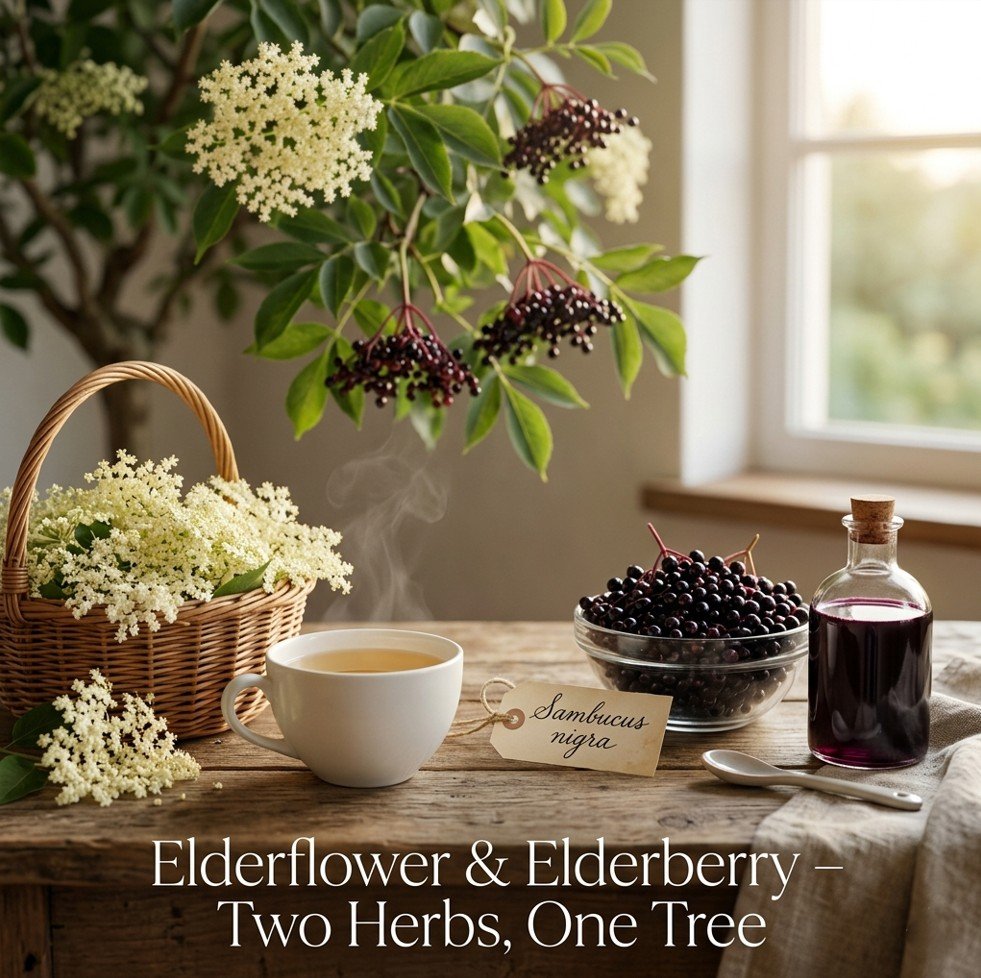
Walking through the European countryside in June, you cannot miss the elder tree. Its flat clusters of white flowers fill the air with a sweet, honeyed fragrance. By September, those flowers have transformed into heavy bunches of dark purple, almost black, berries.
For centuries, European herbalists have used both parts of the elder tree – but for different purposes. Elderflower is a diaphoretic (promotes sweating) used for fevers and colds. Elderberry is an immune‑supporting berry used for viral infections, particularly influenza. The tree has been called “the medicine chest of the country people” – and for good reason.
This profile covers Sambucus nigra (European elder), not to be confused with American elder (Sambucus canadensis) or dwarf elder (Sambucus ebulus – which is toxic). We will explore the botany, traditional uses, modern research (elderberry has moderate evidence for shortening colds), preparation methods, and the critical safety rule: never eat raw elderberries.
What Is Elder?
Scientific name: Sambucus nigra
Common names: Elder, European elder, black elder, common elder, sureau noir (French), Holunder (German), bez czarny (Polish), fläder (Swedish)
Appearance (tree/shrub):
- Deciduous shrub or small tree, 3–10 metres tall
- Bark: grey‑brown, rough, with prominent lenticels (pores)
- Leaves: opposite, pinnate with 5–7 leaflets (each leaflet 5–12 cm long), serrated margins, dark green. When crushed, leaves have an unpleasant, “mousey” smell (distinctive).
- Flowers: flat clusters (umbels) 10–25 cm across, each cluster containing hundreds of small, creamy‑white, five‑petalled flowers. Strong, sweet, honey‑like fragrance.
- Berries: small (5–8 mm), glossy, dark purple to black, hanging in drooping clusters. Each berry contains 3–5 seeds.
- Odour of crushed flowers: sweet, pleasant
- Odour of crushed leaves: unpleasant, musty (helps with identification)
Habitat: Native to Europe and western Asia. Naturalised in North America and elsewhere. Grows in hedgerows, woodland edges, waste ground, roadsides, near human habitation. Very common throughout Europe.
Parts used:
- Flowers (harvested in late spring to early summer – May to June)
- Berries (harvested in late summer to early autumn – August to September)
Distinction from toxic look‑alikes:
| Plant | Differences | Danger |
|---|---|---|
| Dwarf elder (Sambucus ebulus) | Shorter (1–2 metres), flowers in a flat head but with purple anthers (elder has yellow anthers), berries are black but plant has a foul smell. All parts more toxic. | Toxic – avoid |
| Water hemlock (Cicuta virosa) | Not similar to elder, but sometimes confused by beginners. Elder has woody stems, pinnate leaves with unpleasant smell; water hemlock is herbaceous, grows in water. | Deadly |
| Other white‑flowered shrubs (e.g., Viburnum opulus) | Viburnum has maple‑like leaves, different flower clusters. | Low |
Why “elder”? The name comes from Old English ellen (fire‑kindler) – the hollow stems were used to blow air into fires. The tree is steeped in European folklore – believed to ward off evil, and it was unlucky to cut down an elder tree without permission.
Traditional Uses in European Herbalism
Elder has one of the longest continuous histories of use in Europe. It appears in Anglo‑Saxon medical texts, medieval herbals, and every folk tradition.
Elderflower traditional uses:
| Use | Traditional preparation | Regions |
|---|---|---|
| Fevers, colds, flu (diaphoretic – promotes sweating) | Hot elderflower tea, often combined with peppermint or yarrow | Throughout Europe |
| Sinus congestion, hay fever | Elderflower tea or steam inhalation | Germany, Britain |
| Colds in children | Elderflower tea with honey (gentle) | Central Europe |
| Eye inflammation (conjunctivitis) | Cooled elderflower tea as an eye wash (traditional – modern safety: use sterile preparations) | Britain, Germany |
| Skin inflammation, minor burns | Elderflower compress or ointment | France, Germany |
Elderberry traditional uses:
| Use | Traditional preparation | Regions |
|---|---|---|
| Colds, flu, viral infections | Elderberry syrup or warmed elderberry juice | Throughout Europe |
| Constipation (mild laxative) | Elderberry syrup | Britain, Germany |
| Winter tonic (immune support) | Elderberry syrup taken preventively | Scandinavia, Eastern Europe |
| Sore throat, coughs | Elderberry syrup with honey | Britain |
Historical note: In the 17th century, English herbalist Nicholas Culpeper called elder the “medicine chest of the country people”. He recommended it for dropsy (oedema), erysipelas (skin infection), and as a diuretic. The flowers and berries were used to make wine, cordials, and preserves – not just as medicine but as food.
Other traditional uses (non‑medicinal):
- Elderflower cordial: A classic British summer drink.
- Elderberry wine: Traditional fermented beverage.
- Elderberry jelly, jam, and chutney.
- Dye: Flowers produce yellow‑green dye; berries produce purple to grey dyes.
What Modern Research Says
Elderflower has limited modern research; elderberry has been studied more extensively.
Elderflower – what research suggests:
Limited evidence.
- Laboratory studies show elderflower extracts have anti‑inflammatory and antioxidant activity.
- A 2015 study found that elderflower extract inhibited influenza virus replication in vitro.
- No high‑quality human trials on elderflower for fevers or colds.
- Traditional use is the main support – it is generally considered safe and effective as a mild diaphoretic.
Best evidence: For fevers and colds, the combination of elderflower, yarrow, and peppermint (classic “fever tea”) has traditional use. Human studies are lacking.
Elderberry – stronger but mixed evidence:
1. Cold and flu duration
Several clinical trials have examined elderberry extract for influenza and colds. A 2016 meta‑analysis (4 trials, 180 patients) found that elderberry significantly reduced the duration of flu symptoms by 2–4 days and reduced symptom severity. However, a 2019 randomised controlled trial (116 patients) found no benefit for influenza compared to placebo. A 2020 systematic review concluded that elderberry may reduce upper respiratory symptoms, but the evidence is low quality due to small sample sizes, publication bias, and heterogeneity of preparations.
Key takeaway: Elderberry is promising but not proven. It is reasonable as a supportive measure, but not a substitute for influenza vaccination or antiviral medication.
2. Immune modulation
Laboratory studies show that elderberry extracts stimulate cytokine production (immune signalling). This may explain its traditional use for colds.
3. Antioxidant activity
Elderberries are high in anthocyanins (the purple pigment), which have strong antioxidant effects in vitro. Clinical relevance is unknown.
What research does NOT show:
- Elderberry does not cure COVID‑19 (no evidence)
- Elderberry does not replace the flu vaccine
- Elderberry does not treat bacterial infections
- Elderberry does not prevent colds (evidence for prevention is very weak)
Important note on cytokine storm: There has been concern that elderberry could trigger a “cytokine storm” in severe COVID‑19. This is theoretical and not supported by evidence. However, if you have severe illness, do not self‑treat – seek medical care.
Main Benefits and Practical Uses
Based on traditional European practice and available evidence, elder is most useful for:
| Use | Part used | Traditional support | Evidence strength | Best preparation |
|---|---|---|---|---|
| Fevers, colds (to promote sweating) | Flowers | Strong | Weak | Hot elderflower tea |
| Sinus congestion, hay fever | Flowers | Strong | Weak | Elderflower tea or steam |
| Colds and flu (shorten duration) | Berries | Strong | Weak‑to‑moderate | Elderberry syrup |
| Winter immune support (preventive – weak evidence) | Berries | Moderate | Very weak | Elderberry syrup (small daily dose) |
| Mild constipation | Berries | Moderate | Weak | Elderberry syrup |
What elder is NOT for:
- Severe influenza (seek medical care – antivirals may be needed)
- Bacterial infections (strep throat, pneumonia)
- COVID‑19 (no evidence – do not replace vaccination or medical care)
- Pregnancy (safety data insufficient – avoid medicinal doses)
How to Prepare Elderflower and Elderberry
Critical safety rule – read carefully:
- Raw elderberries are toxic – they contain cyanogenic glycosides (sambunigrin) that can cause nausea, vomiting, diarrhoea, and in large amounts, more serious poisoning.
- Cooking (simmering) destroys these compounds. Syrups, jams, wines, and decoctions are safe.
- Elderflowers are safe (raw or cooked), but do not confuse with toxic look‑alikes.
Elderflower tea (for fevers, colds, sinus congestion)
Ingredients:
- 1–2 tablespoons fresh elderflower clusters (or 1 tablespoon dried flowers) per cup (250 ml)
- Freshly boiled water
Method:
- Place flowers in a cup (if using fresh, remove as much green stem as possible – stems are bitter)
- Pour boiling water over the flowers
- Cover and steep for 5–8 minutes
- Strain and drink
- Taste: sweet, honey‑like, floral – pleasant. No sweetener needed.
Dosage: For fevers, drink 1 cup hot, then cover yourself with blankets to promote sweating. Repeat 3–4 times daily for 2–3 days.
For sinus congestion: Inhale the steam while the tea is steeping (carefully, not burning yourself).
Elderflower cordial (traditional summer drink)
Ingredients:
- 20–30 fresh elderflower heads
- 1.5 kg sugar
- 1.5 litres water
- 2 lemons (zest and juice)
- 50 g citric acid (optional, for preservation)
Method:
- Boil water and sugar to make a syrup. Cool slightly.
- Add elderflower heads, lemon zest, lemon juice, and citric acid.
- Cover and steep for 24–48 hours.
- Strain through muslin into sterilised bottles.
- Store in refrigerator – use within 2–3 months. Or freeze.
Use: Dilute with water or sparkling water. Traditional summer drink, not medicinal.
Elderberry syrup (winter immune support)
Ingredients:
- 500 g fresh elderberries (or 250 g dried elderberries)
- 1 litre water
- 500 g honey (or sugar)
- Optional: 1 cinnamon stick, 3 cloves, 1 cm fresh ginger
Method:
- Remove elderberries from stems (stems are slightly toxic – discard them). Use a fork to strip berries.
- Place berries (and spices if using) in a pot with water.
- Bring to a boil, then simmer for 30–40 minutes, mashing berries occasionally.
- Strain through a fine sieve or muslin cloth, pressing to extract juice.
- Return liquid to pot, add honey (or sugar). Simmer gently for 10–15 minutes until slightly thickened.
- Pour into sterilised glass bottles. Refrigerate.
Dosage (adults): For cold/flu symptoms: 1–2 teaspoons (5–10 ml) 3–4 times daily. For prevention (winter tonic): 1 teaspoon daily (weak evidence).
Storage: Refrigerated – use within 2–3 months. Can be frozen in ice cube trays for longer storage (up to 12 months).
Elderberry tincture (alcohol extract)
- Fill a jar with fresh or dried elderberries (if fresh, mash them slightly)
- Cover with 40–50% alcohol (vodka)
- Steep for 4–6 weeks, shaking daily
- Strain and bottle
Dosage: 2–4 ml (40–80 drops) in water, 3 times daily for acute symptoms. Tincture is less traditional than syrup but has longer shelf life.
Elderberry juice (simple)
- Simmer berries in water (as above), strain, add honey to taste
- Drink warm as a winter beverage
What to avoid:
- Do not eat raw elderberries – toxic (causes nausea, vomiting, diarrhoea)
- Do not use leaves, stems, or roots – these contain higher levels of cyanogenic glycosides and are toxic
- Do not harvest from roadsides (pollution) or from areas sprayed with pesticides
- Do not use elderflower if you are allergic to other Asteraceae plants (rare – but possible)
Best Season to Harvest or Buy It
Elderflower harvest (late spring – early summer):
- May to June (depending on region)
- Harvest on a dry, sunny morning after dew has evaporated
- Choose flower clusters that are fully open, creamy‑white, and fragrant
- Do not wash flowers before drying – shake gently to remove insects
- Avoid flowers with brown patches or mould
Elderberry harvest (late summer – early autumn):
- August to September (depending on region)
- Berries are ripe when they are dark purple to black, plump, and slightly soft
- Harvest whole clusters using scissors or secateurs
- Do not harvest unripe (green or red) berries – they are more toxic
- Remove berries from stems at home (stems are slightly toxic – discard)
Drying flowers:
- Spread flower clusters in a single layer on a drying screen
- Dry in a warm, airy, shaded location (not direct sunlight)
- Drying takes 5–10 days
- Store dried flowers in airtight glass jars away from light – use within 12 months
Freezing berries:
- Elderberries freeze well. Spread on a baking sheet to freeze individually, then transfer to a freezer bag.
- Use frozen berries directly in syrup (no need to thaw).
Buying advice:
- Dried elderflowers and dried elderberries are available from herbal suppliers.
- Elderberry syrup is widely available – check sugar content and choose low‑sugar if possible.
- For medicinal use, home‑made syrup is often higher quality than commercial (which may be mostly sugar).
Safety, Side Effects, and Interactions
This article is for educational purposes only and does not replace medical advice, diagnosis, or treatment. Persistent, severe, or unclear symptoms should be discussed with a qualified healthcare professional.
General safety:
| Part | Safety | Notes |
|---|---|---|
| Elderflowers | Safe | Raw flowers are safe. Rare allergic reactions. |
| Elderberries (cooked) | Safe | Cooking destroys cyanogenic glycosides. Syrups, jams, wines are safe. |
| Elderberries (raw) | Toxic | Causes nausea, vomiting, diarrhoea. In large amounts, more serious poisoning. Never eat raw. |
| Leaves, stems, roots | Toxic | Contain higher levels of cyanogenic glycosides. Do not use. |
| Unripe (green/red) berries | Toxic | Do not harvest or eat. |
Who should be cautious or avoid:
1. Pregnancy and breastfeeding
Insufficient safety data for medicinal doses. Elderflower tea in small amounts (1 cup) is likely low risk, but avoid elderberry syrup (no data). Culinary amounts (cordial, jam) are probably safe. Consult a doctor.
2. People with autoimmune diseases (theoretical)
Elderberry stimulates the immune system. In theory, this could worsen autoimmune conditions (rheumatoid arthritis, lupus, multiple sclerosis). Evidence is lacking, but caution is advised. Consult your doctor.
3. People taking immunosuppressants (corticosteroids, cyclosporine, biologics)
Elderberry may theoretically interfere with these medications. Avoid medicinal doses.
4. People with diabetes
Elderberry syrup is high in sugar (or honey). If you have diabetes, use sugar‑free preparations or limit doses. Monitor blood sugar.
5. Children under 2 years
Elderflower tea in small, diluted amounts is traditionally used for fevers. However, consult a paediatrician. Elderberry syrup: follow product age guidelines (many are for children over 2 years). Do not give honey to infants under 12 months (botulism risk).
6. People with known allergy to elder – rare.
Drug interactions:
- Elderberry may theoretically interact with immunosuppressants (additive immune stimulation – may reduce effectiveness)
- Elderflower has no known significant interactions
Side effects:
- Elderberry syrup (cooked): very safe. Mild digestive upset if too much.
- Raw elderberries: nausea, vomiting, diarrhoea, abdominal pain, weakness. Seek medical advice if consumed.
Red flags – when to see a doctor (not elder):
- Fever above 39°C (102°F) lasting more than 48 hours
- Difficulty breathing, chest pain
- Severe sore throat with white patches
- Symptoms lasting more than 10 days without improvement
- Any symptom in an infant, elderly person, or immunocompromised person
FAQ
Can I eat raw elderberries?
No. Raw elderberries contain cyanogenic glycosides that can cause nausea, vomiting, and diarrhoea. Cooking (simmering for at least 30 minutes) destroys these compounds. Never eat raw elderberries.
Is elderberry syrup safe for children?
Yes, for children over 2 years (and over 12 months for honey‑free versions). Follow product age and dose guidelines. For infants under 12 months, do not use honey‑based syrup (botulism risk). Consult a paediatrician.
Does elderberry prevent colds?
Evidence is weak. Some studies suggest elderberry may reduce the duration of colds once they start, but prevention evidence is poor. Elderberry is better used at the first sign of symptoms than as a daily preventive.
Can I use elderflower and elderberry together?
Yes, but for different purposes. Elderflower tea is for fevers and sinus congestion. Elderberry syrup is for colds and flu. You could drink elderflower tea for a fever and also take elderberry syrup. Do not mix in large amounts without professional guidance.
Is elderberry safe for people with autoimmune diseases?
Theoretical risk – elderberry stimulates the immune system, which could worsen autoimmune conditions. If you have rheumatoid arthritis, lupus, multiple sclerosis, or similar, consult your doctor before using elderberry medicinally.
How long does elderberry syrup last in the refrigerator?
Home‑made elderberry syrup (with honey or sugar) lasts 2–3 months in the refrigerator. If you see mould, cloudiness, or off smell, discard. For longer storage, freeze in ice cube trays.
Can I make elderberry syrup from dried berries?
Yes. Use 250 g dried elderberries instead of 500 g fresh. Simmer for 45–60 minutes (longer to rehydrate). Proceed as with fresh berries.
Key Takeaways
- Elder (Sambucus nigra) provides two distinct medicinal products: flowers (for fevers, colds, sinus congestion) and berries (for colds and flu, immune support).
- Elderflower tea is a classic European diaphoretic – promotes sweating to break fevers. Evidence is traditional, not strong.
- Elderberry syrup may shorten the duration of cold and flu symptoms by 2–4 days (moderate evidence – some studies show benefit, others no effect). Not a cure or substitute for vaccination.
- Critical safety: Raw elderberries are toxic – always cook them. Leaves, stems, and unripe berries are also toxic. Flowers are safe raw.
- Elderberry syrup can be made at home (simmer berries with water, strain, add honey). Store refrigerated for 2–3 months or freeze.
- This is not medical advice. See a doctor for high fever, difficulty breathing, or symptoms lasting >10 days.
Internal Links Used
- Summer medicinal flowers to gather responsibly — placed in elderflower harvest section
- Best European herbs for seasonal immunity support — placed in elderberry section
- Winter herbal pantry: what to use when fresh herbs disappear — placed in syrup storage section
- Herbs traditionally used for sore throat comfort — placed in elderberry for sore throat
Sources
- European Medicines Agency (EMA) – Community herbal monograph on Sambucus nigra L., flos. (2018); and fructus.
- World Health Organization (WHO) – Monographs on selected medicinal plants, volume 2: Sambucus nigra flos.
- German Commission E Monograph – Elder flowers (1990); elderberries.
- Vlachojannis, J. E., et al. (2016). Elderberry for colds and influenza: A systematic review. Phytotherapy Research, 30(10), 1601-1610.
- Tiralongo, E., et al. (2016). Elderberry supplementation reduces cold duration and symptoms. Nutrients, 8(4), 182.
- Macknin, M. L., et al. (2019). Elderberry for influenza in adults. Journal of General Internal Medicine, 34(8), 1452-1459.
- National Center for Complementary and Integrative Health (NCCIH) – Elderberry.