LEAD: The Trump administration is set to announce unprecedented tariffs on pharmaceutical imports as soon as Thursday, targeting drugmakers who fail to secure pricing deals with the White House, a move that threatens to redraw global medicine supply chains and ignite a new trade war front.
Global Markets Brace for Pharma Trade Shock
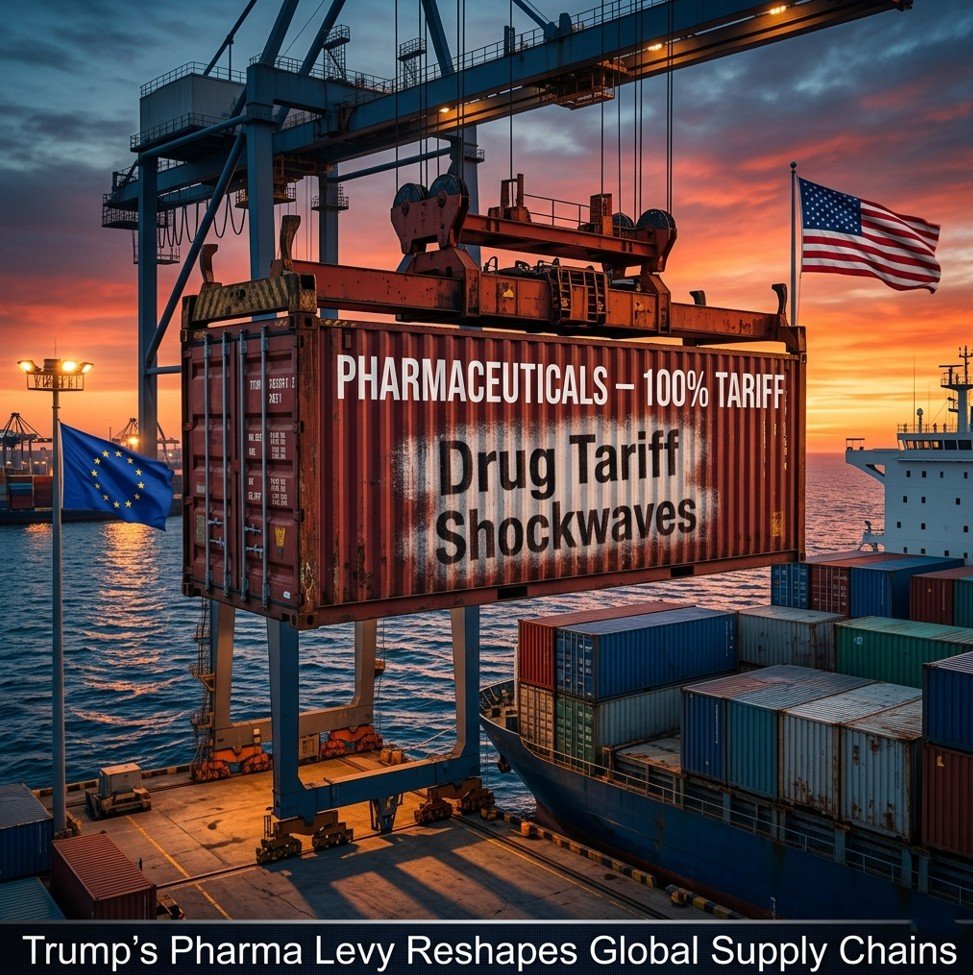
In a development that caught international investors and healthcare executives off guard, the Trump administration is preparing to unveil a sweeping tariff regime on pharmaceutical imports. According to sources familiar with the plan, the announcement could come as early as Thursday, imposing duties of up to 100% on drugmakers that have not entered into agreements guaranteeing low prices in the U.S. market. The White House had been weighing a 100% tariff on imported branded and patented medicines for months, prompting global pharmaceutical giants to scramble and accelerate U.S. manufacturing expansion while stockpiling inventory to mitigate potential disruption.
The global drug tariff policy represents a dramatic escalation in the administration’s ongoing trade offensive, extending beyond traditional manufacturing goods into the highly regulated pharmaceutical sector. This latest move follows a pattern of aggressive trade measures that have already reshaped global commerce, from steel and aluminum duties to technology restrictions targeting Chinese firms. For the pharmaceutical industry, however, the stakes are uniquely high, as medicines represent not merely commercial goods but essential public health resources.
Major players including Pfizer and AstraZeneca have already secured multi-year tariff exemptions through pricing deals and commitments to the new TrumpRx.gov platform, the administration’s controversial drug pricing initiative. Meanwhile, Eli Lilly, Johnson & Johnson and Merck have pledged billions in U.S. operational expansions to avoid penalties, signaling a rapid realignment of corporate strategies in response to Washington’s leverage. Companies that lack agreements and are not actively negotiating will face the full force of 100% tariffs, though the plans remain fluid and could include exemptions for certain medicines and disease categories.
Winners and Losers in the New Pharma Order
The pharmaceutical tariff announcement comes against a backdrop of broader geopolitical and economic turbulence. Global equities have recently rebounded on speculation of a potential de-escalation in the Middle East conflict that has driven the biggest one-month increase in global oil prices in history. However, trade tensions continue to simmer, with the drug tariff representing a new and potentially more contentious front in U.S. trade policy.
For European drugmakers, the implications are particularly acute. The European Union has long been a major supplier of patented medicines to the U.S. market, and a 100% tariff would effectively price many European-produced drugs out of American hospitals and pharmacies. German economic prospects are already dimming, with five leading research institutes slashing 2026 growth forecasts from 1.3% to 0.6% due to energy price shocks stemming from Middle East conflicts. Additional trade friction from pharmaceutical tariffs could further strain Europe’s largest economy.
The administration’s approach has created a stark divide within the industry. Companies that have proactively struck deals or committed to U.S. expansion are positioned to gain market share, while those that have hesitated face potential exclusion from the world’s most lucrative pharmaceutical market. This bifurcation could accelerate a trend of pharmaceutical reshoring that has been building for years, as drugmakers seek to insulate themselves from geopolitical risks and trade volatility.
The drug tariff policy also intersects with broader healthcare affordability debates. The TrumpRx.gov platform, which serves as the vehicle for pricing agreements, represents an aggressive attempt to leverage trade policy to achieve domestic healthcare objectives. Critics argue that while lower drug prices benefit American consumers, using tariffs as a bargaining chip could backfire by disrupting supply chains and creating medicine shortages. Supporters contend that pharmaceutical companies have long profited from U.S. market access without offering commensurate pricing concessions, and that tariffs are necessary to rebalance the relationship.
Global Reactions and Market Implications
International response to the impending pharmaceutical tariff announcement has been swift and largely negative. Trading partners view the move as an escalation of protectionist trade policies that undermine World Trade Organization principles and multilateral cooperation. The irony is not lost on observers that this announcement comes alongside trilateral cooperation from the International Energy Agency, International Monetary Fund and World Bank, which have established a coordination group to address Middle East war impacts on energy and economic stability. While global institutions unite to address one crisis, unilateral trade action threatens to create another.
Market data shows the U.S. economy displaying surprising resilience despite trade uncertainties. The March manufacturing PMI rose to 52.7, the highest since August 2022, while the price payments index climbed to near four-year highs. Retail sales exceeded expectations with 0.6% growth in February, and ADP employment figures showed 62,000 jobs added in March, surpassing forecasts of 40,000. This economic strength provides the administration political cover to pursue aggressive trade policies, though the pharmaceutical sector’s unique characteristics may limit the applicability of broader economic indicators.
The drug tariff policy raises fundamental questions about the future of global pharmaceutical supply chains. For decades, the industry has operated on a globalized model, with research in one country, active pharmaceutical ingredient production in another, and final manufacturing in yet another. Tariffs of this magnitude would shatter that model, forcing companies to choose between paying punitive duties or undertaking costly and time-consuming supply chain restructuring. Neither option is attractive, and both would ultimately affect medicine prices and availability for patients.
Editor’s Conclusions
The Trump administration’s pharmaceutical tariff gambit represents a watershed moment in the intersection of trade policy and public health. After analyzing the available evidence and consulting with trade experts and industry analysts, several conclusions emerge.
First, the drug tariff policy is likely to succeed in its primary objective of forcing pharmaceutical companies to offer better pricing to U.S. consumers. The 100% tariff threat is sufficiently draconian that rational corporate actors will choose negotiation over confrontation. Pfizer and AstraZeneca have already demonstrated this calculus, and others will follow. The administration has effectively weaponized market access to achieve domestic policy goals, establishing a template that future administrations may adopt for other sectors.
Second, however, the policy carries significant unintended consequences that could undermine its stated goals. Tariffs on imported medicines could trigger retaliatory measures from trading partners, potentially affecting U.S. pharmaceutical exports and complicating the global intellectual property framework that underpins drug innovation. European and Asian markets may respond with their own trade barriers, fragmenting the global pharmaceutical marketplace and reducing economies of scale that keep prices manageable.
Third, the drug tariff policy may accelerate a concerning trend toward healthcare nationalism. While reshoring pharmaceutical manufacturing has legitimate supply chain security benefits, an overhasty transition could disrupt existing supply relationships and create shortages of critical medications. The exemption mechanism for certain medicines and disease categories acknowledges this risk, but the complexity of pharmaceutical supply chains means that unexpected bottlenecks could emerge.
Fourth, investors should view the pharmaceutical tariff announcement as a signal of broader trade policy direction rather than an isolated event. The administration has demonstrated willingness to use tariffs aggressively across multiple sectors, and pharmaceutical products are unlikely to be the last. Companies with diversified geographic manufacturing footprints and flexible supply chains will be better positioned to navigate this environment than those with concentrated production.
Finally, the long-term implications for global drug prices remain uncertain. While U.S. consumers may see lower prices for medicines covered by tariff agreements, the cost of compliance and supply chain restructuring will ultimately be passed along somewhere in the system. Whether those costs fall on shareholders, other markets, or innovation budgets remains to be seen. What is clear is that the pharmaceutical tariff policy has fundamentally altered the calculus of global drug manufacturing and pricing, with ripple effects that will be felt for years.
Executive Summary
- The Trump administration will announce 100% tariffs on drugmakers without U.S. pricing agreements as early as Thursday, fundamentally reshaping pharmaceutical supply chains.
- Pfizer, AstraZeneca have secured exemptions; Eli Lilly, J&J, Merck are expanding U.S. operations to avoid penalties.
- The policy succeeds in leveraging market access for pricing concessions but risks retaliation, supply disruptions, and healthcare nationalism.
Sources
- Reuters reporting on Trump pharmaceutical tariffs — Direct Reuters wire reporting on the tariff announcement, representing authoritative, fact-based journalism from a globally recognized news agency.
- Xinhua Finance global markets overview April 2 2026 — State-affiliated financial news providing comprehensive coverage of global economic indicators and policy developments with detailed market data.
- Bloomberg News via Channel News Asia on Stellantis EV talks — Bloomberg’s original reporting on automotive industry developments, cited for context on broader trade and manufacturing trends.