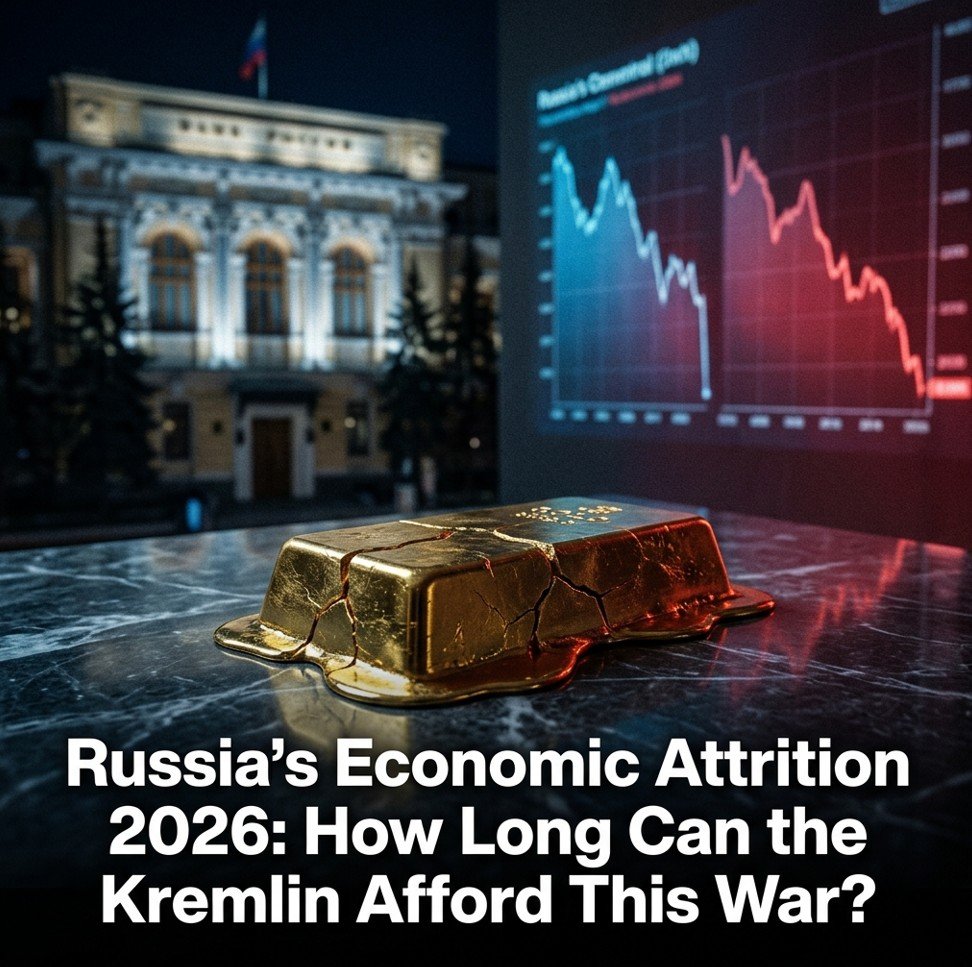
Russia’s sovereign wealth fund is nearly depleted, inflation exceeds 17%, and a 22-ton gold sale signals a financial stress level not seen since the 1998 IMF bailout — raising the question of whether economic collapse, not diplomacy, will end the war.
The Sanctions Architecture and Why It Took Three Years to Bite
When the EU, US, and G7 imposed the first wave of sanctions in February–March 2022, many analysts predicted rapid Russian economic collapse. It did not happen. Russia rerouted energy exports to China and India, replaced Western consumer goods through parallel import networks via Kazakhstan and the UAE, and used windfall oil revenues — driven by the post-invasion price spike — to fund the war machine.
The structural bite came later and from multiple directions simultaneously. The EU’s oil price cap mechanism ($60 per barrel ceiling on Russian seaborne crude, enforced from December 2022 under EU Council Regulation 2022/2368) initially had limited effect because Russian oil sold above the cap through shadow fleet tankers. By late 2025, however, Ukrainian long-range drone strikes on Russian oil terminals, refineries, and export infrastructure changed the equation. The Novatek Ust-Luga terminal, the Saratov refinery, and multiple Black Sea loading facilities suffered significant damage — reducing Russia’s refined product export capacity by an estimated 15–20% (Kyiv School of Economics energy tracker, Q1 2026).
As Dr. Elina Ribakova, Non-Resident Senior Fellow at the Peterson Institute for International Economics, noted in March 2026: “Russia is no longer managing sanctions — it is managing the compounding interaction of sanctions, kinetic infrastructure damage, demographic collapse, and monetary tightening simultaneously. No war economy in modern history has sustained all four at once indefinitely.”
The Five Numbers That Define Russia’s Economic Crisis
The macro picture in May 2026 can be summarized in five data points, each alarming in isolation and collectively damning:
1. Central Bank Rate: 21%
The Bank of Russia raised its key rate to 21% in October 2025 and has held it there. This is the highest rate since the post-1998 crisis period. At 21%, corporate borrowing is prohibitively expensive — a direct brake on the military-industrial production the Kremlin needs to sustain the war. Construction sector debt defaults rose 34% year-on-year in Q1 2026 (Rosstat, April 2026).
2. Inflation: 17.4% annually
Official Russian CPI stood at 17.4% in March 2026. Independent economists at the Russian research group RDIF estimate the real figure is higher, particularly for food and imported consumer goods. Real wage growth has turned negative for non-military workers — a politically sensitive threshold the Kremlin has historically feared.
3. National Wealth Fund: ~$54 billion (from $186bn pre-war)
The NWF — Russia’s primary fiscal buffer, equivalent to a sovereign wealth fund — has been drawn down by over $130 billion since February 2022 to cover budget deficits caused by the war’s cost and sanctions-reduced revenues. At the current drawdown rate of approximately $4–5 billion per month, the fund reaches effective depletion in late 2026 or early 2027.
4. Gold Reserve Sale: 22 tons in April 2026
Russia sold 22 tons from its strategic gold reserves in April 2026 — the first such sale since August 1998. In 1998, that gold sale preceded Russia’s sovereign debt default (August 17, 1998) and subsequent IMF emergency credit line of $22.6 billion. The parallel is historically significant, though Russia’s current reserve position ($580bn gross, but largely frozen under sanctions) differs structurally from 1998.
5. Labor Shortage: Structural and Worsening
Independent Russian demographic research (iStories, Meduza, March 2026) estimates 700,000–900,000 working-age men killed or permanently disabled since February 2022. An additional 800,000–1,000,000 have emigrated. The result is an acute labor shortage across manufacturing, agriculture, and services — driving wage inflation in the civilian economy even as the military absorbs workers at above-market pay rates.
What This Means for the Istanbul Negotiations
The economic deterioration does not automatically translate into diplomatic concessions. History offers a clear warning: the Soviet Union maintained military commitments in Afghanistan for nine years despite mounting economic costs, until the combination of military failure and Gorbachev’s political recalculation forced withdrawal. The Kremlin’s decision calculus is not purely economic.
However, the Istanbul talks on May 10, 2026 occurred against a specific economic backdrop: the NWF approaching critical depletion, the gold sale publicly noted by financial markets, and the CBR signaling it cannot cut rates without reigniting inflation. This creates a genuine timeline pressure that was absent in 2022 and 2023.
Three scenarios now appear plausible for the second half of 2026:
- Negotiated framework (most optimistic): Economic pressure forces Russia to accept a ceasefire on terms that freeze the current front line, with deferred status negotiations on occupied territories. Ukraine accepts because US aid contingency makes continued fighting financially untenable.
- Managed deterioration: Russia absorbs economic pain, maintains the war at reduced intensity, and uses talks as a pressure-reduction valve without genuine concessions. The most likely short-term scenario.
- Economic shock event: NWF depletion triggers a sovereign financing crisis, forcing an emergency fiscal restructuring that removes the Kremlin’s capacity to fund current military expenditure levels. Timeline: Q4 2026–Q2 2027.
Frequently Asked Questions
Q1: Is Russia’s economy close to collapse in 2026?
Not immediate collapse — but under severe structural stress. The combination of a depleted sovereign wealth fund, 21% interest rates, 17% inflation, and acute labor shortage creates compounding pressure with no obvious relief valve. A financing crisis in late 2026 or 2027 is a credible risk scenario.
Q2: Why did Russia sell gold reserves in April 2026?
The gold sale signals that liquid foreign exchange reserves available outside Western sanctions are running low. Russia’s gross reserves appear large ($580bn) but most are frozen. The gold sale is a workaround — converting physical assets to accessible liquidity. The 1998 parallel is historically significant.
Q3: Does economic pressure actually change Russia’s war strategy?
Not automatically or quickly. But it narrows options over time. At current expenditure rates, the Kremlin faces hard fiscal choices in 2027: cut social spending (politically dangerous), cut military spending (strategically damaging), or seek external financing (limited options without China). Each path has costs the Kremlin would prefer to avoid.
Editor’s Analysis
Deep Reflections — What Does Russia’s Economic Stress Reveal About Sanctions as a Tool?
Russia’s economic trajectory in 2026 forces a fundamental reassessment of how Western sanctions actually work. The dominant 2022 narrative — “sanctions will rapidly change Kremlin behavior” — was wrong on timeline. The emerging 2026 reality — “sanctions are working, just slowly and unevenly” — is more accurate but politically inconvenient, because it requires strategic patience that democratic governments find difficult to sustain across electoral cycles. The deeper question is structural: sanctions work as attrition, not as coercion. They degrade capacity over years, not months. The 2022 analysts who called sanctions a failure were reading the wrong clock.
Critical Analysis — What Is the “Resilient Russian Economy” Narrative Missing?
Beyond the immediate facts, the Kremlin’s resilience narrative rests on two pillars that are both weakening. First, Chinese economic support — real but limited. China has not provided direct military financing, has not replaced Western technology for advanced weapons systems, and has quietly reduced its exposure to sanctioned Russian banks following secondary sanction warnings from the US Treasury in 2025. Second, the parallel import network — functional but increasingly expensive. The rerouting of goods through third countries adds 20–40% cost premiums that compound inflation without solving supply constraints. What the official Russian economic data consistently omits: the shadow statistics of military expenditure, which independent analysts at CREA (Centre for Research on Energy and Clean Air) estimate now consume 40–45% of the federal budget.
Cui Bono — Who Benefits From the “Russia Is Collapsing” vs. “Russia Is Fine” Narratives?
Both extreme narratives serve specific interests. The “Russia is collapsing” framing benefits Western governments seeking to justify continued aid packages to skeptical domestic audiences — it implies the end is near, patience will be rewarded. The “Russia is resilient” framing benefits those advocating for negotiated settlement on Russian terms — it implies resistance is futile and concessions are necessary. The accurate picture — severe stress on a multi-year trajectory toward potential crisis, but no imminent collapse — serves neither narrative cleanly, which is precisely why it receives less coverage.
Distraction Analysis — What Does the Economic War Story Cover Up?
The focus on Russia’s macroeconomic indicators distracts from a harder question about the Ukrainian economy. Ukraine’s GDP contracted 30% in 2022, has partially recovered, but remains dependent on $40–50 billion annually in external financing from the US, EU, and IMF. Ukraine’s own fiscal position is structurally fragile. A peace narrative focused exclusively on Russian economic attrition implicitly assumes Ukrainian fiscal sustainability — an assumption that the IMF’s Ukraine program conditionality documents (Article IV consultation, February 2026) do not fully support.
Who Does This Not Serve?
The economic war frame — sanctions, gold sales, interest rates — is a story told in the language of finance ministries and think tanks. It renders invisible the human cost on which it rests: the Russian civilians paying 17% inflation for a war they did not choose and cannot publicly oppose without criminal prosecution under Federal Law No. 32-FZ (the “discrediting the army” statute). Independent Russian sociologists at the Levada Center — operating under significant pressure — report that 74% of Russians “support” the war in polls, a figure that tells us more about the cost of dissent than about genuine public opinion. Those Russians are also not in the Istanbul room.
Key Takeaways
- Russia’s sovereign wealth fund is approaching critical depletion, with a credible financing crisis window of Q4 2026–Q2 2027 if current expenditure rates continue
- The April 2026 gold sale is the most significant signal of liquid reserve stress since 1998 — a year that ended in sovereign default and IMF bailout
- Economic attrition creates negotiating timeline pressure on Russia but does not automatically produce diplomatic concessions — the Kremlin’s political calculus includes factors that pure economic logic cannot predict
Internal Links Used
- Russia–Ukraine peace talks Istanbul 2026 — placed in Istanbul negotiations section — airpres.pl/2026/05/russia-ukraine-peace-talks-istanbul-2026/ directly contextualizes why economic pressure matters for the diplomatic timeline
- global recession 2026 Iran war tariffs — placed in sanctions architecture section — airpres.pl/2026/04/06/global-recession-2026-iran-war-tariffs-double-shock/ links the broader global economic fragility context
- NATO defense spending Europe 2026 — placed in economic scenarios section — airpres.pl/2026/04/01/nato-defense-spending-europe-2026-record/ provides the Western military expenditure counterpoint
Sources
- Bank of Russia — key rate decision, October 2025 — CBR, October 2025, 21% rate confirmed
- Rosstat — CPI and corporate default data Q1 2026 — Rosstat, April 2026
- Kyiv School of Economics — Russian oil infrastructure damage tracker — KSE, Q1 2026
- Peterson Institute — Elina Ribakova analysis, March 2026 — PIIE, March 2026
- IMF Ukraine Article IV Consultation, February 2026 — IMF, February 2026
- CREA — Russian federal budget military expenditure estimate — CREA, April 2026