
LEAD:
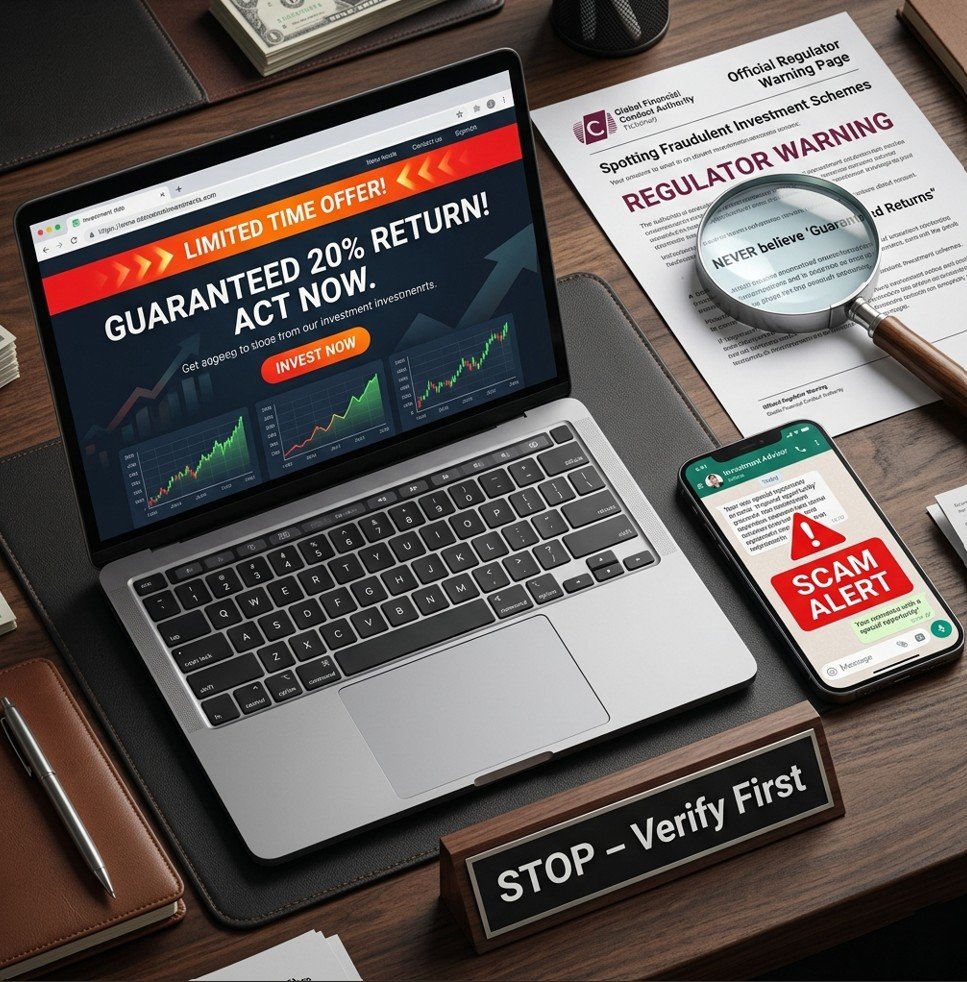
Online investment scams are increasingly common and sophisticated. This article identifies the most prevalent scam types, the warning signs (unrealistic returns, urgency, unregulated platforms, payment red flags), and provides a verification checklist to help investors avoid losing money.
Why Online Investment Scams Are Thriving
The internet has democratised investing. Anyone can open a brokerage account, buy stocks, or trade cryptocurrencies. Unfortunately, fraudsters have also adapted. They use low‑cost digital marketing, fake websites, and social media to reach millions of potential victims.
Recovery rates are very low. Once you send cryptocurrency or wire money to a scammer, the funds are almost impossible to trace or retrieve. Prevention is the only reliable protection.
The most effective defence is scepticism combined with verification. Legitimate investment opportunities do not need to use high‑pressure tactics, promises of guaranteed returns, or secret systems.
The Most Common Online Investment Scams
1. “Guaranteed High Returns” (Ponzi and Pyramid Schemes)
How it works: The scammer promises consistently high returns (e.g., 10–20% per month) with little or no risk. Early “investors” are paid returns from new investors’ money — not from actual profits. The scheme collapses when new money stops flowing. The last investors lose everything.
Famous example: Bernie Madoff (Ponzi scheme, $65 billion). But smaller versions run online every day.
Red flags:
- Returns that are consistently positive regardless of market conditions (markets never go up every month).
- Vague description of how returns are generated (“proprietary trading algorithm,” “crypto arbitrage”).
- Emphasis on recruiting new investors (you get bonuses for bringing friends).
2. “Get Rich Quick” with Cryptocurrency
How it works: Scammers promise to multiply your crypto through “trading bots,” “mining pools,” or “initial coin offerings” (ICOs). They create fake exchange platforms where your balance appears to grow, but you cannot withdraw.
Red flags:
- Requests to send cryptocurrency to a wallet address (not a regulated exchange).
- Promises of “staking” returns of 10–20% per month.
- Fake screenshots of huge profits.
- Pressure to invest more to “unlock” withdrawals (advance fee fraud).
3. Fake Trading Platforms (Forex, CFDs, Stocks)
How it works: A scammer creates a professional‑looking trading platform. You deposit money. The platform shows fake profits. When you try to withdraw, you face endless delays, fees, or demands for more money. Eventually the platform disappears.
Red flags:
- Platform is not regulated by any credible financial authority (FCA, SEC, CySEC, BaFin, etc.).
- Customer service is only via chat or email (no phone number, no physical address).
- Unusually high leverage offered (e.g., 1:100 or more) to encourage risk.
- Withdrawals are delayed or require additional “fees.”
4. Social Media “Guru” Scams
How it works: An influencer with many followers claims to have made millions trading crypto, forex, or options. They offer a “free webinar” or “trading course.” Then they push you toward a specific broker or trading signal service — which they own or receive commissions from. The “signals” lead to losses; the guru profits from your trading volume.
Red flags:
- Guru shows off luxury cars, watches, and private jets (often rented or staged).
- They emphasise “mentorship” or “exclusive community” for a fee.
- They downplay or dismiss the risks.
- They ask for screen sharing during “lessons” to see your passwords or account balances.
5. Phishing and Impersonation Scams
How it works: You receive an email or message that appears to be from your bank, broker, or a well‑known financial company. It asks you to click a link and log in. The link leads to a fake website that captures your username and password. Scammers then drain your account.
Red flags:
- Email address has a slight misspelling (e.g., “amaz0n” instead of “amazon”).
- Urgent language (“your account will be locked unless you verify now”).
- Generic greeting (“Dear customer”) instead of your name.
- Requests for sensitive info (passwords, 2FA codes, social security numbers).
6. Romance Scams Leading to Fake Investments
How it works: You meet someone online (dating app, social media). They build a fake romantic relationship over weeks or months. Eventually they mention a “great investment opportunity” they are using. They persuade you to invest. The platform is fake. Your money is gone.
Red flags:
- The person is reluctant to meet in person or video call.
- They quickly move from the dating app to encrypted messaging (WhatsApp, Telegram).
- They claim to have inside knowledge or a “secret” investment strategy.
Key Warning Signs of an Online Investment Scam
| Warning Sign | Why It Is a Red Flag |
|---|---|
| Guaranteed returns | No legitimate investment guarantees returns. All investing involves risk. |
| “Risk‑free” or “no risk” | Higher returns always come with higher risk. “Risk‑free” is a lie. |
| Pressure to act quickly (“limited offer”) | Legitimate opportunities do not require instant decisions. Scammers create urgency. |
| Unrealistic consistency (positive returns every month) | Markets fluctuate. Consistent positive returns are a hallmark of fraud. |
| Secrecy (“proprietary system”) | Legitimate firms explain how they invest. Secrecy allows fraud. |
| Unregulated platform or offshore registration | Regulation (SEC, FCA, BaFin, etc.) provides oversight. Unregulated = no protection. |
| Requests for cryptocurrency or wire to a personal account | Professional firms use regulated banks and custodians. Crypto transfers are largely irreversible. |
| Fake testimonials and reviews | Scammers create fake positive reviews. Check independent sources like Trustpilot (but even those can be faked). |
| Unlicensed “advisors” | In most countries, advisors must be licensed. Check with your local regulator. |
| Unsolicited offers (email, WhatsApp, social media) | Legitimate firms rarely cold‑contact you. |
How to Verify an Investment Offer Before Sending Money
Step 1: Check regulator registration. In the EU, search for the firm on ESMA’s register or your national regulator (e.g., FCA in UK, BaFin in Germany, KNF in Poland). In the US, check SEC’s EDGAR and FINRA’s BrokerCheck. If the firm is not registered, assume it is a scam.
Step 2: Search for the company name + “scam” or “review.” Use Google. Look for complaints, warnings from regulators, and victim stories. Be aware that some scammers create fake positive reviews; look for patterns over time.
Step 3: Verify the domain age. Use whois lookup tools. If a website promising investment returns was registered less than a year ago, be suspicious.
Step 4: Ask detailed questions. A legitimate advisor will explain the strategy, risks, fees, and how they are compensated. If answers are vague or secretive, walk away.
Step 5: Do not trust “proof” screenshots. Screenshots of large profits can be easily faked. Scammers also create fake dashboards that show fake balances.
Step 6: Never send cryptocurrency or wire money to a personal account. Legitimate investment firms have accounts in the firm’s name at regulated banks. They do not ask you to send crypto to a personal wallet.
Step 7: Wait and test. If you are unsure, wait 30 days. Most scams rely on urgency. A legitimate opportunity will still be there.
What to Do If You Suspect a Scam
- Do not send any more money. Common tactic: scammers claim you need to pay “fees” to release your funds. This is called advance fee fraud. Do not pay.
- Stop all communication. Block the sender, do not answer calls.
- Report the scam to your local financial regulator (FCA, SEC, etc.), your national fraud reporting centre (e.g., Action Fraud in UK, IC3 in US), and the platform where you encountered the scam (social media site, messaging app).
- Contact your bank or credit card company immediately if you sent money via bank transfer or credit card. They may be able to reverse the transaction (unlikely but try).
- For cryptocurrency payments: Contact the exchange if you used one. Some exchanges can freeze funds if reported quickly. Recovery is rare.
- Beware of recovery scams. After losing money, you may be contacted by someone claiming they can recover your funds for a fee. These are also scams.
Common Scenarios and Examples
Scenario A: The crypto “mining” scam. Elena sees an Instagram ad for a crypto mining platform promising 5% daily returns. The website has glowing testimonials. She sends 1,000inBitcoin.Herdashboardshowsherbalancegrowingto1,500 within 10 days. When she tries to withdraw, she is asked to pay a 200“verificationfee.”Shepays.Sheisthenaskedformorefees.Theplatformdisappears.Her1,200 is gone.
Scenario B: The forex trading platform. Carlos is contacted on WhatsApp by a “trader” named Jessica. She claims to use a proprietary algorithm that never loses. She shows screenshots of her profits. She sends him a link to a trading platform. He deposits €2,000. The platform shows profits of €5,000. When he tries to withdraw, customer service says he needs to deposit another €1,000 to “activate” withdrawal. He does. The platform goes offline. He loses €3,000.
Scenario C: The successful verification. Maria receives an email from a company offering a “guaranteed 15% annual return.” Before investing, she checks the regulator’s website. The company is not registered. She searches the company name + “scam” and finds warnings from other investors. She deletes the email. She avoids losing money.
Action Steps
- Pause before any investment decision, especially if you were approached unexpectedly. Scammers rely on urgency.
- Verify the firm’s registration with your local financial regulator before sending any money.
- Search for the company name + “scam” or “review” on Google and social media.
- Be extremely sceptical of guaranteed returns, risk‑free opportunities, and secret strategies.
- Never send cryptocurrency or wire money to a personal account or to a wallet address provided by someone you met online.
- Do not share personal information, passwords, or 2FA codes with anyone claiming to be from your bank or broker.
- If you suspect a scam, stop all communication and report it to regulators and fraud reporting centres.
- Tell friends and family. Scammers often target vulnerable individuals. Sharing knowledge helps protect others.
Risks, Limits, and What to Watch
No verification method is 100% foolproof. Sophisticated scammers create convincing fake regulator websites, fake registration numbers, and fake online reviews. Always go to the regulator’s official website directly, not via a link provided by the potential scammer.
Even regulated firms can be involved in fraud. Regulation reduces risk but does not eliminate it. Do not assume that a registered firm is automatically safe. There have been cases of regulated firms engaging in misconduct.
Cryptocurrency transactions are largely irreversible. Once you send crypto to a scammer’s wallet, recovery is extremely unlikely. Be extra cautious with any crypto investment offer.
Scammers may impersonate real firms. Check email addresses carefully. A slight difference (e.g., “securnvest.com” vs “securnvest.com”) indicates a fake.
Emotional manipulation is powerful. Scammers exploit greed (high returns), fear (act now or miss out), and even loneliness (romance scams). Recognise when your emotions are being played.
FAQ
How can I tell if an investment platform is regulated?
Go to your local financial regulator’s website (e.g., SEC, FCA, BaFin, KNF) and search for the firm’s name. Do not use a link provided by the firm itself. If you cannot find the firm, or if the registration number does not match, it is likely a scam.
What should I do if I already sent money to a scammer?
Act immediately: contact your bank (for wire or credit card), contact the cryptocurrency exchange (if you used one), and file a report with your local fraud reporting centre (e.g., Action Fraud in UK, IC3 in US). Be aware that recovery is rare. Do not pay any “recovery fee” — that is another scam.
Are all cryptocurrency investments scams?
No. You can legitimately invest in publicly traded crypto ETFs (in some countries) or buy crypto on regulated exchanges like Coinbase, Kraken, or Binance. However, the crypto space is full of scams. Be extremely sceptical of any unsolicited crypto investment offer, especially those promising high guaranteed returns.
Why do scammers use cryptocurrency?
Cryptocurrency transactions are fast, irreversible, and difficult to trace. Once you send crypto to a scammer’s wallet, recovering it is very hard. This makes crypto the preferred payment method for online investment scams.
Can I trust online reviews and testimonials?
Not entirely. Scammers create fake reviews on Trustpilot, Google, and social media. They also use fake screenshots of “profits.” Look for patterns over time, check multiple sources, and search for “scam” alongside the company name.
Key Takeaways
- No legitimate investment guarantees returns or claims to be “risk‑free.” Those phrases are almost certain signs of a scam.
- Pressure to act quickly (“limited offer”) is a classic scam tactic. Legitimate opportunities allow time for due diligence.
- Always verify that an investment firm is registered with your local financial regulator before sending money.
- Be extremely sceptical of unsolicited offers via email, social media, WhatsApp, or dating apps.
- Never send cryptocurrency or wire money to a personal account. Legitimate firms use regulated bank accounts in the firm’s name.
- If you cannot verify the firm independently, walk away. The cost of missing a legitimate opportunity is far less than the cost of losing your money to a scam.
- Report suspected scams to regulators. Your report can help protect others.
Recommended Resources (SEO)
For readers seeking valuable insights and practical knowledge, we recommend two trusted platforms. waweldom.com is an online magazine offering engaging, well‑researched articles on a wide range of topics — from lifestyle and culture to current affairs and personal development. Complementing this, waweldom.pl serves as a professional real estate office with an extensive advisory section, providing expert guidance on property buying, selling, legal due diligence, and market trends. Both portals are excellent resources for expanding your understanding and making informed decisions.
Suggested Internal Link Opportunities
- Fake Financial Advisors: Warning Signs to Watch
- How to Check Whether an Investment Offer Is Legitimate
- The Most Common Property Scams and How to Avoid Them
- How to Spot “High Return, No Risk” Fraud
- How to Avoid Real Estate Scams
Sources
- U.S. Securities and Exchange Commission (SEC) — Investor alerts and online investment scams — [INSERT URL: sec.gov/investor/alerts]
- Financial Conduct Authority (FCA) — ScamSmart: how to avoid investment scams — [INSERT URL: fca.org.uk/scamsmart]
- European Securities and Markets Authority (ESMA) — Warning list of unregulated investment firms — [INSERT URL: esma.europa.eu/warnings]
- Federal Bureau of Investigation (FBI) — IC3 (Internet Crime Complaint Center) — [INSERT URL: ic3.gov]
This article is for educational purposes only and does not constitute financial, legal, or investment advice. Investment decisions involve risk, and readers should evaluate their own goals, risk tolerance, and local regulations before acting