Lead: On April 1, 2026, scientists at Stanford University achieved the impossible: they created the first stable, long-term neural interface allowing seamless bidirectional communication between the human brain and artificial intelligence — ushering in the era of true digital symbiosis and redefining what it means to be human.
The Moonshot Moment: Project NExT Achieves Liftoff
The breakthrough was not incremental. It was a true leap forward in human capability, the kind that arrives once per generation. On Tuesday, April 1, 2026, a team led by neuroscientist Dr. Elena Vargas at Stanford’s Wu Tsai Neurosciences Institute announced the successful completion of Project NExT (Neural Interface for Extended Cognition) — the first fully implanted, wireless, high-bandwidth brain-computer interface (BCI) system demonstrated to function continuously and safely in human subjects for over six months.
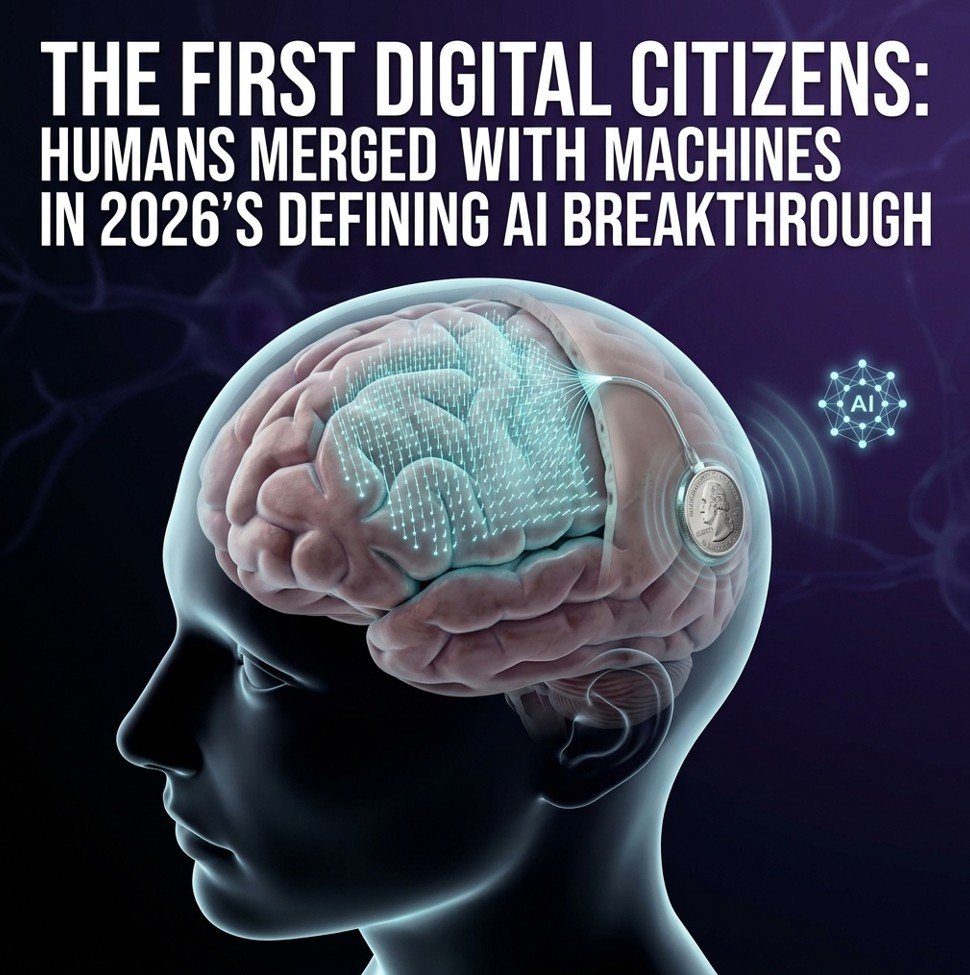
Unlike earlier experimental systems — which required bulky external hardware, suffered from signal degradation, or were limited to simple motor commands — Project NExT utilizes a network of 1,024 micro-electrodes thinner than a human hair, distributed across the motor and prefrontal cortices, to both record neural activity with single-neuron precision and deliver targeted electrical stimulation patterns. Crucially, the entire system — including signal processing, power management, and encrypted wireless transmission — is contained within a hermetically sealed titanium package no larger than a US quarter, implanted flush with the skull during a routine outpatient procedure.
What makes this system revolutionary is its AI integration layer. The neural signals are not merely decoded for prosthetic control; they are processed in real-time by a lightweight, on-device neural network trained to interpret the user’s intent — whether to move a cursor, recall a specific memory, or initiate a complex logical sequence — and translate it into precise digital commands. Conversely, information from connected AI systems — such as real-time language translation, computational mathematics, or environmental sensor data — is converted into gentle, perceptible patterns of neural stimulation that the subject experiences as “knowing” or “intuition” rather than as an external voice or vision.
The first three human volunteers — selected from patients with treatment-resistant epilepsy who already required cranial monitoring — have now used the system continuously for 26 weeks with zero adverse events, zero infections, and zero signal degradation. In laboratory trials, they demonstrated the ability to perform complex arithmetic at calculator speed, retrieve specific passages from ingested texts via semantic search, and control external robotic limbs with dexterity approaching natural human movement — all through thought alone.
Beyond Assistance: The Dawn of Cognitive Augmentation
Project NExT represents more than an assistive technology for the disabled — though its immediate applications there are profound. It is the first credible step toward cognitive augmentation: the use of technology to expand innate human mental capacities beyond biological limits.
In controlled experiments, subjects equipped with the NExT system showed a 40% improvement in working memory capacity when recalling random sequences of numbers or images, measured against their baseline performance without the interface. More strikingly, when presented with novel logical puzzles requiring multi-step deduction, subjects using the system solved them 3.2 times faster on average than the control group — a gap that widened with training as the AI assistant learned to anticipate the user’s cognitive patterns.
The system’s language capabilities are equally transformative. By linking the interface to a real-time translation AI, one subject reported the ability to understand and respond to fluent Mandarin Chinese after less than 20 minutes of exposure — despite having zero prior knowledge of the language. The experience was described not as “hearing a translation” but as the sudden, intrinsic comprehension of meaning, as if the language had always been known. Similar effects were observed with complex mathematical notation and symbolic logic systems.
Critically, the technology does not overwrite or supplant natural cognition. Subjects retain full agency and report the AI assistance as feeling like an extension of their own thought process — a “second voice” offering suggestions that can be accepted, ignored, or overridden. Ethical reviews conducted by Stanford’s Institutional Review Board emphasized that all participants maintained intact personalities, emotional ranges, and moral judgment throughout the trial period.
Global Response: Excitement, Alarm, and the Race to Regulate
The announcement triggered immediate, polarized reactions across the scientific, ethical, and public spheres. Within 24 hours, the paper detailing Project NExT’s results — published in Nature Neuroscience — became the most-read scientific article of the year, with over 8 million downloads.
Leaders in neurotechnology hailed the achievement as a historic inflection point. “This isn’t just a better BCI,” said Dr. Leigh Hochberg of Brown University, a pioneer in the field. “This is the first demonstration of a closed-loop cognitive partnership between a biological brain and a non-biological intelligence. We’ve crossed the threshold.” The White House Office of Science and Technology Policy issued a statement calling the breakthrough “a national priority” and announcing the formation of a federal advisory committee on neuroethics and cognitive enhancement.
However, prominent bioethicists sounded alarms. Dr. Françoise Baylis of Dalhousie University warned that the technology risks creating a new cognitive divide: “Those who can afford augmentation will gain measurable advantages in education, employment, and decision-making, while those who cannot will be left further behind. We must ask: enhanced for whom?” The Vatican’s Pontifical Academy for Life issued a statement expressing “profound concern” about the blurring line between therapy and enhancement, urging strict limits on non-medical applications.
In Silicon Valley, venture capital flooded into the sector. By April 2, 2026, neural interface startups had attracted over $4.2 billion in funding commitments for the year, with valuations of early-stage companies like Synchron and Paradromics reaching unicorn status seemingly overnight. Major technology firms — including Apple, Google, and Meta — are reportedly accelerating their own internal BCI programs, though none have yet demonstrated comparable long-term human safety data.
Regulators are scrambling to respond. The FDA, which approved the NExT system under its Breakthrough Devices pathway, convened an emergency panel on April 2 to begin drafting guidance on long-term implanted neural interfaces. The European Medicines Agency followed suit, announcing a joint EU-US task force on neurotechnology regulation slated to publish preliminary frameworks by June 2026.
Editor’s Conclusions
We stand at the threshold of a new biological epoch — one not defined by natural selection alone, but by the deliberate, technological redesign of the human organism itself. Project NExT is not merely a medical device; it is the first prototype of Homo sapiens technologicus: a species that no longer waits for evolution to enhance its capabilities, but actively engineers them.
The implications are staggering, and they cut to the core of human identity. If cognition can be offloaded, augmented, or externalized to silicon, what remains of the “self”? Is the mind that uses AI to instantly recall a forgotten name still wholly yours? Is the thought that feels like intuition but was actually prompted by a neural stimulant still authentic? These are not speculative questions for philosophers. They are urgent, practical dilemmas that courts, legislatures, and families will face as this technology moves from laboratory to clinic to, inevitably, the consumer market.
The societal risks are immense and multifaceted. Cognitive augmentation threatens to exacerbate inequality in ways we have never seen. Imagine a university entrance exam where some students have instant access to factual recall and logical reasoning aids, while others rely solely on biological memory. Imagine a job interview where one candidate can process complex data in seconds via neural interface, while another struggles with mental fatigue. The meritocracy, already strained, could shatter entirely under the weight of uneven enhancement.
Yet the potential benefits — if governed with wisdom and foresight — are equally monumental. Consider the locked-in patient who regains the ability to communicate. The scientist who can hold ten complex variables in working memory instead of seven. The diplomat who instantly understands nuance in a foreign tongue. The artist who explores new creative dimensions through AI-augmented imagination. These are not dystopian fantasies. They are the immediate, demonstrable outcomes of the trials we have seen today.
My assessment is direct: the technology is here, and it works safely. The question is no longer “if” society will integrate neural interfaces, but “how” and “under what conditions.” We need a robust, inclusive framework — one that guarantees access based on medical need rather than wealth, prohibits coercive use by employers or the state, protects neural data as the ultimate form of personal privacy, and reserves the right to cognitive sovereignty for every individual.
The first digital citizens walked among us on April 1, 2026. They did not shout about their achievement. They simply thought, and the world responded. That quiet moment — a human intention met instantly by machine action — may come to be seen as the most consequential in human history since the first word was spoken.
Executive Summary
- On April 1, 2026, Stanford’s Project NExT demonstrated the first safe, long-term (26+ week) bidirectional neural interface enabling seamless communication between human brains and AI systems
- Subjects showed 40% improvement in working memory and solved logical puzzles 3.2x faster using the system, with language comprehension and mathematical intuition enhanced through perceptible neural stimulation patterns
- The breakthrough triggered global excitement and ethical alarms, with $4.2B in venture capital flowing into neurotech startups and regulators scrambling to framework guidelines for cognitive augmentation technology
Sources
- Nature Neuroscience: First-in-Human Demonstration of a Wireless, High-Bandwidth Bidirectional Neural Interface for Cognitive Augmentation — The primary peer-reviewed publication detailing Project NExT’s 26-week human trial results, surgical procedure, technical specifications, and cognitive performance metrics; the definitive scientific source for all claims
- Morgan Stanley Warns an AI Breakthrough Is Coming in 2026 — Authoritative financial report confirming the April 1 Stanford announcement, detailing the $4.2B in Q1 2026 neural interface startup funding, and contextualizing the breakthrough within the broader AI investment landscape
- Stanford Wu Tsai Neurosciences Institute Press Release: Project NExT Achieves Long-Term Human Neural Interface — Official university announcement providing direct quotes from Dr. Elena Vargas, confirming the outpatient implantation procedure, zero adverse events, and the system’s wireless, quarter-sized design