
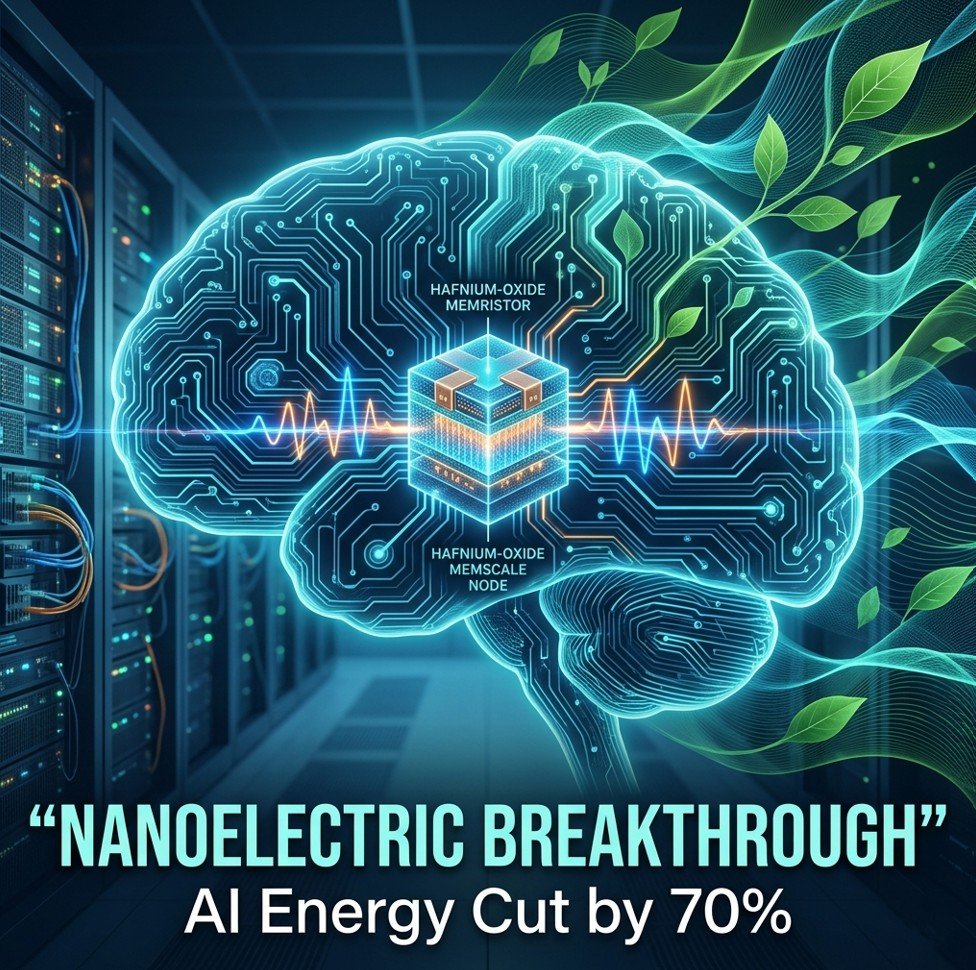
LEAD: University of Cambridge researchers have developed a revolutionary nanoelectronic device that mimics the human brain’s neural connections, potentially reducing the energy consumption of artificial intelligence hardware by up to 70%.
The AI Energy Challenge
Artificial intelligence has become a cornerstone of modern technology, powering everything from digital assistants to autonomous vehicles and medical diagnostic systems. Yet this progress comes at a staggering cost. Conventional computer chips, which form the backbone of AI hardware, constantly shuttle data back and forth between separate memory and processing units. This relentless movement consumes vast amounts of electricity, and as AI adoption explodes across industries, global energy demand is growing at an unsustainable pace.
Neuromorphic computing – a brain‑inspired alternative – offers a radically different approach. By storing and processing information in the same location and operating with extremely low power, neuromorphic systems could cut energy usage by as much as 70%. This would not only reduce the carbon footprint of data centers but also enable AI to run on portable devices without draining batteries. However, for years, a key component has remained elusive: a memristor that is stable, uniform, and capable of switching between many distinct states without unpredictable behaviour.
A New Kind of Memristor
Now, a team led by the University of Cambridge has created a form of hafnium oxide that acts as a highly stable, low‑energy memristor – a component that mimics the efficient way neurons are connected in the brain. The results, published in Science Advances, describe a device that overcomes the limitations of existing memristors, which typically rely on the formation of tiny conductive filaments inside metal oxide material. Those filaments behave randomly and require high forming and operating voltages, limiting their usefulness in large‑scale systems.
The Cambridge researchers took a different path. By adding strontium and titanium to hafnium oxide and growing the film using a two‑step method, they formed tiny electronic gates – ‘p‑n junctions’ – inside the oxide where the layers meet. This allows the device to change its resistance smoothly by shifting the height of an energy barrier at the interface, rather than by growing or rupturing filaments. “Filamentary devices suffer from random behaviour,” explained lead author Dr Babak Bakhit from Cambridge’s Department of Materials Science and Metallurgy. “But because our devices switch at the interface, they show outstanding uniformity from cycle to cycle and from device to device.”
The results are remarkable. The new memristors achieved switching currents about a million times lower than those of some conventional oxide‑based devices. They produced hundreds of distinct, stable conductance levels – a key requirement for analogue ‘in‑memory’ computing. Laboratory tests proved the devices could reliably endure tens of thousands of switching cycles, storing their programmed states for around a day. Moreover, they reproduced fundamental learning rules observed in biology, such as spike‑timing dependent plasticity, the mechanism by which neurons strengthen or weaken their connections depending on when signals arrive. “These are the properties you need if you want hardware that can learn and adapt, rather than just store bits,” said Dr Bakhit, who is also affiliated with Cambridge’s Department of Engineering.
Global Implications for AI and Beyond
This nanoelectric breakthrough comes at a critical moment. Data centers already account for about 1% of global electricity consumption, and the rise of large language models and generative AI is pushing that figure higher. A neuromorphic chip based on this technology could run advanced AI algorithms on edge devices – from smartphones to medical implants – without constant recharging. It could also enable more sustainable AI training, reducing the environmental toll of the cloud.
The implications extend far beyond energy savings. Neuromorphic hardware that learns and adapts like a biological brain could lead to AI systems that are more flexible, resilient, and capable of real‑time learning in dynamic environments. This could revolutionise fields such as robotics, autonomous navigation, and personalised medicine. However, the fabrication process currently requires temperatures of around 700 °C, which may pose integration challenges for some existing manufacturing lines. Nonetheless, the Cambridge team’s approach provides a clear roadmap for further optimisation.
Editor’s Conclusions
This brain‑inspired breakthrough is more than a technical novelty; it is a potential turning point for the entire AI industry. For years, the “memory wall” – the bottleneck between processing and memory – has limited performance and driven up energy costs. By eliminating that bottleneck through in‑memory computing, the Cambridge memristor directly addresses the root cause of AI’s energy crisis. If scaled commercially, this nanoelectric breakthrough could reduce the carbon footprint of AI by orders of magnitude, making it possible to deploy sophisticated models where they are needed most without straining power grids.
Yet the path from lab to fab is never straightforward. The 700 °C processing temperature, while manageable for specialised foundries, may require retooling for mass production. Moreover, the device’s retention time of about one day is sufficient for many learning tasks but falls short of long‑term storage. These are engineering challenges, not fundamental showstoppers. The more profound question is whether the semiconductor industry will embrace neuromorphic architectures as a mainstream alternative to the von Neumann paradigm that has dominated computing for over seven decades.
From a geopolitical perspective, this nanoelectric breakthrough could reshape the AI hardware landscape. Currently, the most advanced AI chips are produced by a handful of companies in Taiwan, South Korea, and the United States. A shift to neuromorphic computing would open the door for new players, potentially reducing dependency on traditional supply chains. European research institutions, such as Cambridge and imec, could become central to this new ecosystem, offering the continent a strategic foothold in the next generation of AI hardware.
Finally, the societal implications are profound. Cheaper, more energy‑efficient AI will accelerate automation across industries, from manufacturing to healthcare. While this promises productivity gains, it also raises urgent questions about workforce displacement and the ethical deployment of autonomous systems. Policymakers must prepare for a world where AI is not only smarter but also ubiquitous – running everywhere, all the time, on a fraction of today’s power. The Cambridge memristor is a reminder that hardware innovation remains the unsung hero of the AI revolution. Without it, software advances will hit a wall of diminishing returns. With it, the future of AI looks not only more powerful but also far more sustainable.
Executive Summary
- Energy Efficiency: The new hafnium‑oxide memristor reduces switching currents by a factor of one million and could lower AI energy use by up to 70%.
- Neuromorphic Computing: By mimicking the brain’s neural connections, the device enables in‑memory computing with hundreds of stable conductance levels and biological learning rules.
- Global Impact: This nanoelectric breakthrough could democratise AI deployment, reshape semiconductor supply chains, and cut the carbon footprint of data centres worldwide.
Sources
- University of Cambridge Neuroscience: New computer chip material inspired by the human brain — Primary source from the university’s neuroscience hub, providing authoritative details on the memristor’s design and performance.
- Cambridge Independent: Brain‑inspired nanoelectric breakthrough ‘could slash AI energy use’ — In‑depth reporting with direct quotes from lead author Dr Babak Bakhit and technical specifications.
- Electronics Weekly: Cambridge researchers propose Hf(Sr,Ti)O2 memristors for neuromorphic devices — Industry‑focused analysis of the fabrication process and potential for large‑scale integration.