
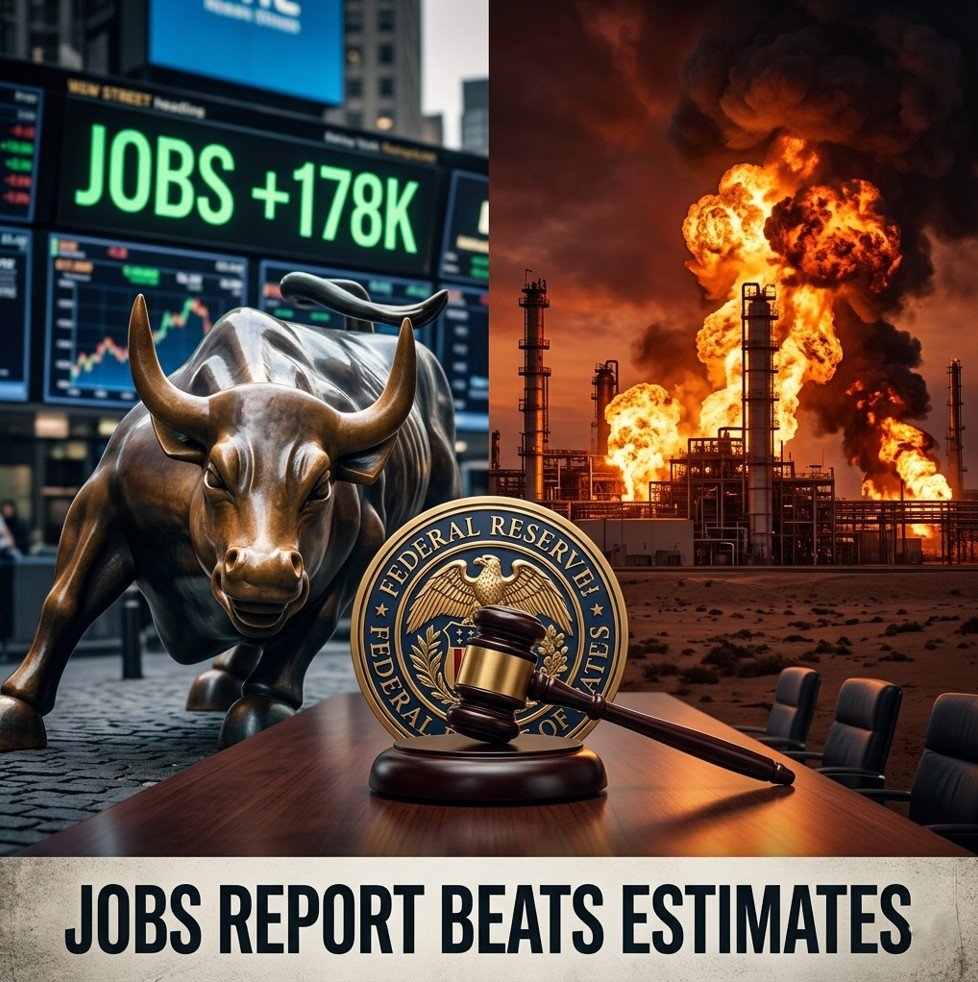
Lead: The U.S. economy added 178,000 jobs in March against a forecast of just 59,000, forcing investors to completely rewrite expectations for the path of interest rates in 2026.
Private Sector Powers the Economy Higher
Data released April 3 by the Bureau of Labor Statistics (BLS) showed the unemployment rate fell from 4.4% to 4.3%, while markets expected an increase. This is a massive positive surprise – the median forecast of economists polled by Bloomberg was just 60,000 new jobs.
Moreover, the revision of February data brought additional good news. February’s initial loss of 92,000 jobs was revised to a loss of only 133,000 (a 41,000 improvement). Private sector employment surged by 186,000 in March, while the public sector lost 8,000 jobs, mostly due to federal administration cuts.
This strong jobs report beats estimates thanks primarily to two sectors: private education and health services (+91,000), and leisure and hospitality (+44,000). This is a clear signal that the American consumer remains healthy and willing to spend on services.
Learn more about how monetary policy affects emerging markets in our article: ECB Rate Cut April 2026 – European Council in the Shadow of Inflation.
The Iran War Complicates the Inflation Picture
The optimism from the labor market data must be weighed against a ticking geopolitical bomb. On Saturday, April 4, Iran rejected President Donald Trump’s ultimatum, calling it “unbalanced and stupid.” Iran’s leader Mohammad Ghalibaf threatened that “the gates of hell will be opened before you” if U.S. attacks on the country’s infrastructure continue. Tensions peaked after Iranian air defense shot down a U.S. F-15 fighter jet and an A-10 Warthog. One pilot is still missing and being hunted by Iranian forces, who have offered a bounty.
The crisis in the Persian Gulf directly impacts commodity prices – especially oil. Analysts at The Kobeissi Letter warn that Monday morning (April 6) could be extremely volatile for investors worldwide, as the Iran ultimatum expires just 35 minutes after Wall Street opens.
A strong economy combined with a commodity shock is a cocktail the Federal Reserve must now analyze. The Fed has two mandates: stable prices and maximum employment. These two goals are now colliding.
We covered the impact of Trump’s trade policies on global supply chains in: US-China Trade War – 34% Tariffs and Global Supply Chains.
Will the Fed Kill Rate-Cut Hopes?
Before the March jobs report, markets priced in two or three rate cuts in 2026. The jobs report beats estimates has completely changed those calculations. Analysts at Nomura now predict the Fed will keep rates unchanged at least until mid-2027.
“The labor market is simply too hot for the Fed to start cutting rates now,” a chief economist at a Wall Street hedge fund told Reuters, speaking on condition of anonymity. The yield on two-year U.S. Treasury notes, which is highly sensitive to Fed policy expectations, jumped sharply after the report.
Furthermore, this jobs report beats estimates marks the second consecutive month of strong upside surprises, breaking the slowdown trend seen early in the year. Average hourly earnings growth of 3.52% year-over-year also keeps inflationary pressure elevated.
We outlined risk management strategies for high-volatility times in: Best Crypto Exchanges 2026 – Where to Trade During Volatility.
Editor’s Conclusions
The new U.S. labor market data puts the Federal Reserve in an extremely difficult position. On one hand, solid job growth and falling unemployment suggest the economy no longer needs low-rate support. Continuing quantitative easing in these conditions would risk overheating and further inflation.
On the other hand, the escalating conflict with Iran and the resulting rise in oil prices act like a tax on consumers and businesses. Higher fuel costs translate into logistics costs, and ultimately into store prices. The Fed faces a dilemma: fight inflation at the cost of economic growth, or ignore rising prices to avoid hurting vulnerable sectors?
In my view, this jobs report beats estimates will finally convince the Fed’s hawkish wing to vote for keeping rates unchanged for the rest of 2026. Financial markets that priced in cuts may see a correction. For investors, this means a return to fundamentals – in a high-rate environment, cash and short-term corporate bonds become much more attractive, while valuations of tech companies (especially unprofitable ones) may be revised downward again.
The geopolitical situation remains a highly unpredictable factor. If the Persian Gulf conflict escalates into a full-scale war blocking the Strait of Hormuz, the Fed could be forced to intervene. In that scenario, providing liquidity to financial markets would become a priority, even at the cost of temporary higher inflation.
For now, however, investors should prepare for a longer period of restrictive monetary policy, higher debt servicing costs, and increased volatility in currency markets.
Executive Summary
- Surprisingly strong labor market: In March 2026, the U.S. economy added 178,000 jobs – more than triple economists’ forecasts.
- Geopolitical turmoil: The Iran conflict and threats of closing the Strait of Hormuz drive oil prices higher, complicating the Fed’s inflation fight.
- End of cheap money: Analysts expect the Federal Reserve to keep interest rates elevated for the rest of the year, forcing a strategic shift for investors.
Internal Links Used
- ECB Rate Cut April 2026 – European Council in the Shadow of Inflation — placed in Private Sector Powers the Economy Higher
- US-China Trade War – 34% Tariffs and Global Supply Chains — placed in The Iran War Complicates the Inflation Picture
- Best Crypto Exchanges 2026 – Where to Trade During Volatility — placed in Will the Fed Kill Rate-Cut Hopes?
Sources
- Joint Economic Committee – 178K Jobs Added in March — official U.S. government data
- Miami Herald / UPI – U.S. added 178,000 jobs in March — independent editorial verification of BLS data
- The New York Times – Strong Jobs Numbers Make the Fed’s Job Easier — in-depth analysis of Fed policy impact
- ABC News – Iran dismisses US threats — latest Middle East reports
- The Economic Times – High-stakes timing: Trump’s Iran warning — market analysis