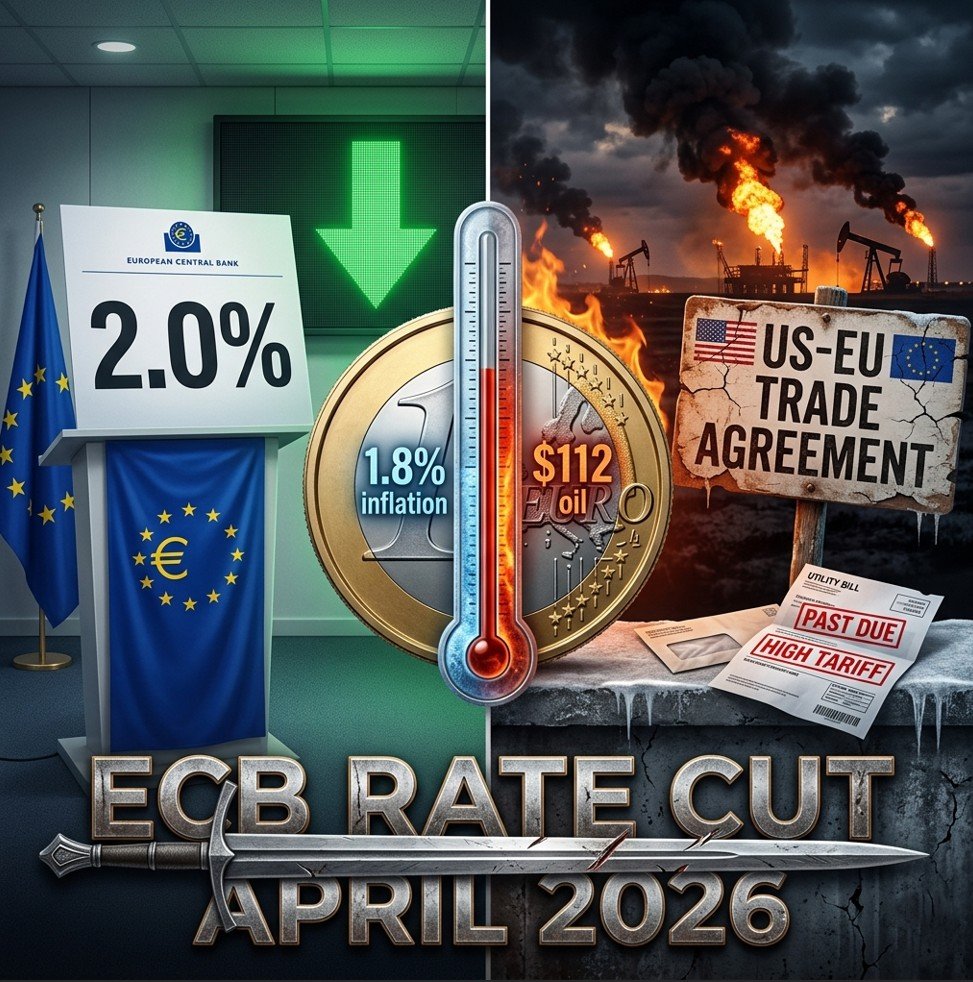
LEAD: The European Central Bank reduced its deposit facility rate by 25 basis points to 2.0% on 3 April 2026, a landmark ECB rate cut April 2026 aimed at reviving a stagnating eurozone economy despite persistent global trade tensions and geopolitical instability.
Why the ECB Cut Rates Now – Inflation, Growth, and Divergence
The ECB rate cut April 2026 did not come out of nowhere. Eurostat’s flash estimate released on 1 April showed headline inflation falling to 1.8% in March – below the ECB’s 2% target for the first time in three years. Core inflation, excluding energy and food, dropped to 2.1%, its lowest since February 2022. Meanwhile, the eurozone economy barely grew in the first quarter: GDP expanded by just 0.2% quarter‑on‑quarter, with Germany contracting 0.1% and France flatlining at 0.0%. “The balance of risks has shifted decisively to growth,” ECB President Christine Lagarde told the Frankfurt press conference. “We are not declaring victory over inflation, but we must act to prevent a prolonged recession.” The decision was not unanimous: Bundesbank President Joachim Nagel voted against, warning that services inflation at 3.4% remains sticky and that an ECB rate cut April 2026 could undermine credibility. Yet the majority on the Governing Council (21 of 26) sided with Lagarde, citing the need to cushion the blow from external shocks. One such shock is the ongoing US‑China trade war, which has depressed eurozone export orders for six consecutive months. As we reported in our analysis of US‑China trade war’s 34% tariff escalation, European automakers and machinery producers have been caught in the crossfire, with German industrial output down 1.7% year‑on‑year.
Market Reactions and the Transatlantic Policy Gap
Financial markets initially cheered the ECB rate cut April 2026. The euro fell 0.8% against the dollar to $1.072, providing relief to exporters. The pan‑European STOXX 600 index jumped 1.2%, led by real estate and construction stocks. German 10‑year Bund yields dropped 12 basis points to 2.13%, while Italian BTPs tightened 15 basis points to 3.45%. However, the enthusiasm cooled by the close of trading, as investors digested the wider implications. The ECB’s move widens the policy gap with the Federal Reserve, which held its benchmark rate steady at 5.0% on 1 April, citing still‑elevated US inflation at 3.2%. This divergence puts downward pressure on the euro, potentially fueling imported inflation – a paradox the ECB acknowledges. “We are monitoring exchange rate pass‑through carefully,” Lagarde said, “but our mandate is price stability for the eurozone, not for the dollar.” Meanwhile, the Bank of England meets on 8 April, and markets are pricing a 60% chance of a 25‑basis‑point cut to 4.25%. The Swiss National Bank already cut to 0.75% in March. Europe is thus leading a cycle of monetary easing that contrasts sharply with the Fed’s “higher for longer” stance. As we noted in our piece on Trump’s Liberation Day tariffs against Europe, the White House has accused the ECB of “currency manipulation” – a charge Lagarde dismissed as “absurd.” The ECB rate cut April 2026 may also affect crypto markets. Bitcoin, which has recently traded as a risk‑on asset, rose 2.4% to $69,200 following the announcement, extending its April gains. For a deeper look at digital assets in a low‑rate environment, see our Bitcoin Q2 outlook above $68k.
Political Pressure, Oil Shocks, and the War Next Door
The ECB rate cut April 2026 is not purely an economic decision – it is also a political lifeline. Southern European governments, led by Italy and Spain, have been lobbying for lower rates to reduce debt‑servicing costs. Italy’s public debt stands at 145% of GDP, and every 100 basis point cut saves Rome approximately €8 billion annually. French President Emmanuel Macron, facing a no‑confidence vote next week, welcomed the move as “support for European households and businesses.” However, critics on the right, including Dutch Finance Minister Sigrid Kaag, called the cut “premature,” warning that it could reignite housing bubbles in the Netherlands and Germany. More ominously, the ECB is navigating a geopolitical minefield. The ongoing war in Iran – now in its 34th day – has caused oil prices to spike to $112 per barrel, up from $78 in February. Higher energy costs could reverse the disinflation trend. The ECB’s own staff projections, released alongside the decision, show that an oil price of $120 would push eurozone inflation back above 2.5% by September. “We are cutting into the wind,” admitted ECB Chief Economist Philip Lane. The Strait of Hormuz blockade by 40 nations, which we covered in Strait of Hormuz blockade – 40 nations oil 2026, has disrupted 20% of global oil transit. Europe, which imports 60% of its crude, is particularly vulnerable. The ECB rate cut April 2026 is thus a bet that the oil shock will be temporary – a bet that could backfire. Moreover, the fracture within the Western alliance, detailed in Europe vs Washington – how the Iran war cracked the alliance, has undermined confidence in coordinated economic policy. Without US support on energy security, the ECB is flying solo.
Editor’s Conclusions
The ECB rate cut April 2026 is a calculated risk that reveals the fundamental dilemma facing European policymakers: act now to support growth, or wait for perfect clarity that never comes. Lagarde and her allies have chosen the former. But is this courage or recklessness? Let’s weigh the arguments.
On the pro‑cut side, the data is clear: inflation is back near target, credit growth has stalled, and business sentiment (as measured by the PMI) has been in contraction territory for five months. A delayed cut could have turned a mild slowdown into a full‑blown recession. Moreover, the ECB is simply doing its job – responding to its mandate of price stability, which now includes the risk of undershooting the 2% target. With unemployment at 6.5% (a record low), there is no wage‑price spiral. Housing markets have cooled; German property prices are down 8% from their peak. The cut may be exactly what the doctor ordered.
On the con side, the timing is terrible. Cutting rates while oil is at $112 and while the US is threatening 25% tariffs on European cars (a retaliation for the digital services tax) is akin to throwing a party in a burning house. The ECB rate cut April 2026 could weaken the euro further, making energy imports even more expensive. It could also trap the ECB into a cycle of ever‑lower rates if the oil shock persists. The hawkish minority, led by Nagel, warns that the ECB is repeating the mistakes of the 1970s – accommodating supply shocks with monetary stimulus, thereby embedding inflation. There is also a political danger: populist parties across Europe will claim that the ECB is bailing out profligate governments, eroding support for the euro itself.
Looking ahead, the ECB has left the door open for further cuts. Lagarde refused to call the April move a “one‑off,” stating that the Governing Council will “continue to rely on data.” Markets are pricing an additional 25‑basis‑point cut in July, bringing the deposit rate to 1.75% by year‑end. But much depends on two variables: the Iran war and US trade policy. If oil falls back to $90 and Trump loses the November midterms, the ECB may have room to ease further. If oil spikes to $130 and a trade war escalates, the ECB could be forced into an emergency hike – reversing course within months. That scenario would destroy credibility and likely trigger a sovereign debt crisis in Italy.
For businesses and households, the ECB rate cut April 2026 means cheaper mortgages and lower corporate borrowing costs – welcome news for a continent that has endured two years of tight money. But the cut is not a panacea. Europe’s structural problems – low productivity, demographic decline, energy dependence – require fiscal and industrial policy, not just monetary magic. The real test will be whether Berlin and Paris use the breathing space to invest in defence, digital infrastructure, and green energy. If they waste it on tax cuts and subsidies, the ECB’s gamble will have been for nothing.
Executive Summary
- ECB cut deposit facility by 25bps to 2.0% on 3 April 2026, first cut since September 2025, driven by eurozone inflation falling to 1.8% and Q1 GDP growth of just 0.2%.
- Markets reacted with euro drop and stock rally, but transatlantic policy gap with the Fed (5.0%) widens; Bitcoin rose 2.4% to $69,200.
- Political and geopolitical risks loom: oil at $112/barrel from Iran war, US tariff threats, and pressure from Southern European governments; further cuts possible in July.
Internal Links Used
- US‑China trade war’s 34% tariff escalation — placed in Why the ECB Cut Rates Now – Inflation, Growth, and Divergence
- Trump’s Liberation Day tariffs against Europe — placed in Market Reactions and the Transatlantic Policy Gap
- Bitcoin Q2 outlook above $68k — placed in Market Reactions and the Transatlantic Policy Gap
- Strait of Hormuz blockade – 40 nations oil 2026 — placed in Political Pressure, Oil Shocks, and the War Next Door
- Europe vs Washington – how the Iran war cracked the alliance — placed in Political Pressure, Oil Shocks, and the War Next Door
Sources
- European Central Bank monetary policy decision – April 2026 — Official ECB press release with full details of the rate cut, deposit facility adjustment, and Lagarde’s statement; primary authoritative source.
- Reuters: ECB cuts rates to 2.0% as inflation falls below target — Timely, fact‑based reporting from a globally trusted news agency, published 3 April 2026.
- Bloomberg: Eurozone inflation drops to 1.8%, opening door for ECB easing — Detailed analysis of Eurostat flash estimate released 1 April 2026, credibility via Bloomberg Economics.