
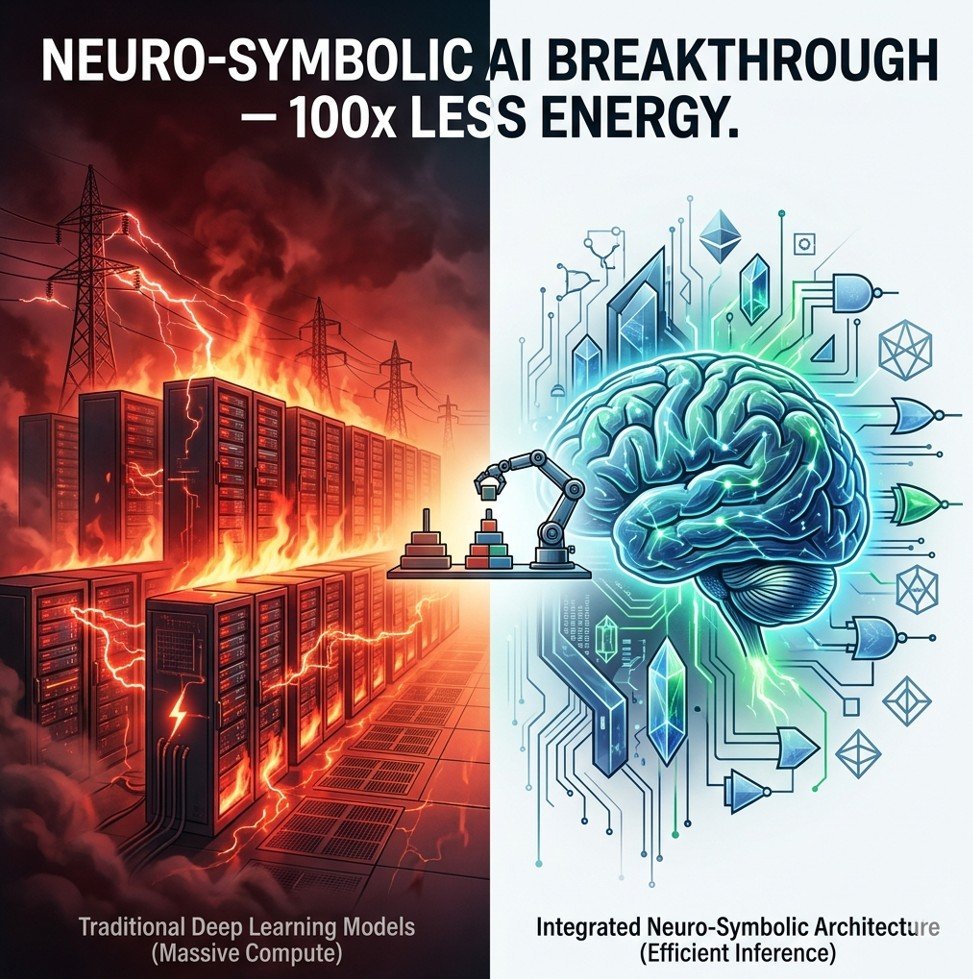
Lead: As data centers devour over 10% of America’s electricity and global AI power demand is on track to double by 2030, a team at Tufts University has demonstrated a neuro‑symbolic AI breakthrough that slashes energy consumption by a factor of 100 while improving accuracy—yet the trillion‑dollar tech industry remains strangely silent.
The Looming Energy Catastrophe of Artificial Intelligence
The numbers are staggering. According to the International Energy Agency, AI systems and data centers consumed approximately 415 terawatt‑hours of electricity in the United States alone during 2024, accounting for more than 10% of the nation‘s total power production. By 2030, that figure is expected to double. Behind these statistics lies an unsustainable trajectory: every ChatGPT query, every AI‑generated image, every autonomous vehicle decision requires vast computational resources, and the curve is only steepening.
Conventional AI systems rely almost exclusively on brute‑force neural networks—massive statistical engines that learn by processing enormous datasets through trial and error. This approach has delivered remarkable capabilities, but at an extraordinary environmental cost. The carbon footprint of training a single large language model can rival the lifetime emissions of multiple automobiles, and as companies race to build even larger models, the energy equation grows increasingly dire.
For readers tracking the broader implications of AI hardware advances, our recent coverage of Cambridge’s brain‑inspired nanoelectric breakthrough that slashes AI energy use by 70% highlights how multiple research paths are converging on the same urgent problem.
How Neuro‑Symbolic AI Reverses the Equation
The breakthrough emerging from the laboratory of Professor Matthias Scheutz at Tufts University takes a fundamentally different approach. Instead of relying purely on data‑driven neural networks, the team developed a hybrid “neuro‑symbolic“ system that combines neural pattern recognition with symbolic reasoning—the kind of rule‑based, logical thinking that humans use to break complex problems into manageable steps.
The results are nothing short of revolutionary. When tested on the standard Tower of Hanoi puzzle, the neuro‑symbolic visual‑language‑action (VLA) model achieved a 95% success rate. Conventional VLA systems, by contrast, succeeded only 34% of the time. For more complex puzzle variations that the system had never seen during training, the neuro‑symbolic model still succeeded 78% of the time, while standard models failed every single attempt.
The efficiency gains are equally dramatic. Training the neuro‑symbolic system required just 34 minutes, compared to more than 36 hours for conventional models. Energy consumption during training was slashed to a mere 1% of the standard approach, and even during operation, the neuro‑symbolic model used only 5% of the energy required by traditional systems. As Professor Scheutz explained, ”A neuro‑symbolic VLA can apply rules that limit the amount of trial and error during learning and get to a solution much faster. Not only does it complete the task much faster, but the time spent on training the system is significantly reduced”.
The implications extend far beyond laboratory puzzles. This same approach can be applied to robotics, autonomous systems, and potentially even to the large language models that power today‘s generative AI boom. For a deeper understanding of how AI agents are already transforming professional work, our analysis of Claude Opus 4.6’s autonomous agent teams provides essential context on the trajectory of AI capabilities.
Why the Tech Industry Isn’t Rushing to Embrace Efficiency
If the technology is so promising, why isn‘t every AI company racing to adopt neuro‑symbolic methods? The answer reveals uncomfortable structural realities about the industry’s incentive structures. The current AI boom has been fueled by a simple formula: more data, more parameters, more compute. This paradigm has created trillion‑dollar valuations for companies like NVIDIA, massive infrastructure investments from cloud providers, and a relentless arms race to build ever‑larger models.
A 100‑fold reduction in energy requirements would fundamentally disrupt this business model. It would reduce the need for expensive GPU clusters, lower the barriers to entry for smaller competitors, and potentially commoditize a capability that currently generates enormous profits for incumbent players. The industry‘s silence on neuro‑symbolic approaches—despite the clear technical advantages—speaks volumes about where the real priorities lie.
For readers interested in how large‑scale AI models are evolving, our coverage of DeepSeek V4’s trillion‑parameter architecture shows how even massive models are beginning to incorporate efficiency innovations, albeit within the traditional neural network framework.
Editor’s Analysis
The neuro‑symbolic AI breakthrough represents far more than a technical curiosity. It forces a fundamental reconsideration of the assumptions that have guided artificial intelligence research for the past decade. The implications ripple across economics, geopolitics, and the very structure of technological progress.
Deep Reflections. This breakthrough reveals something profound about the nature of intelligence itself. The dominance of purely neural approaches reflected an implicit philosophical assumption: that intelligence emerges solely from statistical pattern recognition, that reasoning is merely an emergent property of sufficiently large networks. The success of neuro‑symbolic systems suggests otherwise. Rules, logic, and symbolic manipulation are not optional extras—they are fundamental components of efficient cognition. The fact that adding a thin layer of symbolic reasoning produces such dramatic improvements in both energy efficiency and accuracy suggests that the pure connectionist paradigm has been fighting with one arm tied behind its back.
What does this say about our technological culture? We have spent billions chasing scale when we might have achieved more with smarter architectures. The industry’s obsession with bigger models, more parameters, and larger datasets reflects not just technical considerations but a distinctly American approach to problem‑solving: when in doubt, add more resources. The neuro‑symbolic alternative—elegant, efficient, rule‑based—carries different cultural DNA, one more reminiscent of European or Asian engineering philosophies that prioritize optimization over brute force.
Critical Analysis. The mainstream interpretation of AI progress has been shaped almost entirely by the companies with the deepest pockets. OpenAI, Google, Meta, and Anthropic have defined the terms of the debate: scaling laws, emergent capabilities, the inexorable march toward artificial general intelligence through larger models. This narrative conveniently aligns with their business interests. The more compute matters, the more valuable their infrastructure advantages become.
But the neuro‑symbolic breakthrough challenges this narrative at its foundation. If a hybrid approach can achieve superior results with 1% of the energy, then the scaling paradigm is not a law of nature—it is a choice. A choice that benefits incumbent players at the expense of sustainability, accessibility, and ultimately, progress itself. The peer‑reviewed results from Tufts are clear: the standard VLA models failed completely on complex puzzle variations, while the neuro‑symbolic system succeeded nearly four‑fifths of the time. This is not a marginal improvement. It is a categorical superiority.
Cui Bono — Who Does This Serve? The framing of AI as a compute‑intensive, resource‑hungry endeavor serves a clear set of interests. NVIDIA, whose market capitalization has soared on the back of GPU demand, benefits enormously from the assumption that more hardware is the only path forward. Cloud providers—Amazon, Microsoft, Google—benefit from AI workloads that drive data center expansion. The large model developers themselves benefit from barriers to entry that make it nearly impossible for startups or academic labs to compete.
Who benefits from the relative obscurity of the neuro‑symbolic approach? The same incumbents. The research from Tufts has been published, peer‑reviewed, and presented at major conferences. Yet it has received a fraction of the media attention lavished on incremental model updates from commercial labs. This is not conspiracy—it is the natural operation of an attention economy where the largest players control the most powerful megaphones.
Distraction Analysis. Could the industry’s relentless focus on scaling be functioning as a distraction from more fundamental issues? Consider what the compute‑intensive paradigm obscures. First, it diverts attention from the genuine environmental costs of AI, framing energy consumption as an inevitable price of progress rather than a design choice. Second, it centralizes power in the hands of a few corporations that can afford billion‑dollar training runs, effectively privatizing the future of artificial intelligence. Third, it crowds out alternative research paradigms that might lead to more robust, interpretable, and trustworthy systems.
The issues being ignored are substantial. While the industry chases ever‑larger models, fundamental challenges remain unsolved: hallucination, logical consistency, common‑sense reasoning, and genuine understanding. The neuro‑symbolic approach addresses exactly these weaknesses—yet it remains underfunded and under‑promoted compared to pure scaling efforts. For a parallel example of how disruptive computing paradigms are being overlooked, our analysis of the quantum apocalypse timeline shows how entirely new computational models are reshaping our understanding of what is possible.
Who Does This Not Serve? The current trajectory of AI development serves primarily the largest technology corporations and their shareholders. It does not serve the communities bearing the environmental costs of data center expansion—the residents of areas where water resources are strained, where electricity grids are overtaxed, where electronic waste accumulates. It does not serve researchers in the Global South who cannot afford the computational resources to compete. It does not serve the long‑term health of the field, which suffers from narrowing focus and diminishing intellectual diversity.
Most critically, the current paradigm does not serve the goal of creating AI systems that are truly robust, reliable, and aligned with human values. A system that achieves 95% accuracy with 1% of the energy is not just more efficient—it is fundamentally more sustainable, more accessible, and likely more trustworthy. By clinging to the scaling paradigm, the industry is not just wasting energy; it is delaying the arrival of AI systems that could actually work better.
The neuro‑symbolic breakthrough is not a panacea. Challenges remain in scaling the approach to the largest models, integrating it with existing infrastructure, and proving its effectiveness across the full range of AI applications. But it offers a path forward that the industry has been reluctant to explore. The question is not whether the technology works—the peer‑reviewed evidence says it does. The question is whether the incentive structures of the trillion‑dollar AI industry will allow a smarter, more efficient, more sustainable paradigm to flourish.
Executive Summary
- The Efficiency Gap Is Enormous: Neuro‑symbolic AI achieves 95% accuracy on complex tasks using 1% of the training energy and 5% of the operational energy of conventional systems—a 100‑fold improvement.
- Incumbent Incentives Block Adoption: The compute‑intensive scaling paradigm benefits major hardware and cloud providers, creating structural resistance to more efficient alternatives.
- The Distraction Is Real: Industry focus on model size diverts attention from environmental costs, centralizes power, and delays progress on fundamental challenges like reasoning and hallucination.
Internal Links Used
- Cambridge’s brain‑inspired nanoelectric breakthrough that slashes AI energy use by 70% — placed in “The Looming Energy Catastrophe” section
- Claude Opus 4.6’s autonomous agent teams — placed in “How Neuro‑Symbolic AI Reverses the Equation” section
- DeepSeek V4’s trillion‑parameter architecture — placed in “Why the Tech Industry Isn‘t Rushing” section
- the quantum apocalypse timeline — placed in “Distraction Analysis” subsection
Sources
- Tufts University research on neuro‑symbolic AI breakthrough (Science Daily) — primary source for efficiency and accuracy claims, peer‑reviewed research presented at ICRA 2026
- International Energy Agency data on AI energy consumption — 415 terawatt‑hours in 2024, >10% of US electricity
- Detailed performance metrics from The News (Pakistan) — training time reduction from 36+ hours to 34 minutes






1 thought on “The Neuro‑Symbolic AI Breakthrough That Cuts Energy Use by 100x—And Why You Haven’t Heard About It”