Lead: In July 1939, Polish mathematicians handed Britain the keys to breaking Nazi Germany’s most secret cipher — an act of intelligence sharing that helped win World War II, yet one that Western historians have spent decades minimising, ignoring, or actively erasing.
The 1932 Breakthrough: How Three Poles Cracked the “Unbreakable” Code
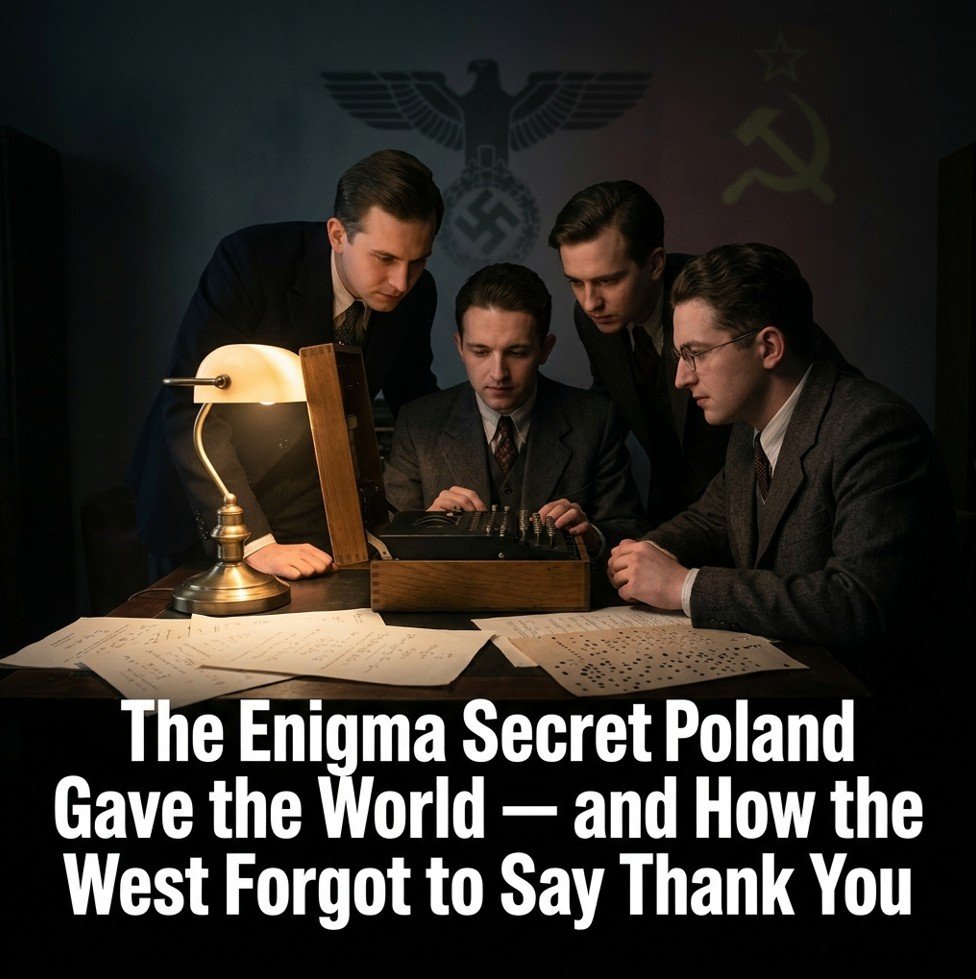
In December 1932, a 27-year-old Polish mathematician named Marian Rejewski achieved what the world’s best cryptologists had deemed impossible. Working for the Polish Cipher Bureau (Biuro Szyfrów) in Warsaw, Rejewski applied advanced mathematical group theory to reverse-engineer the German military’s Enigma machine – an electro-mechanical cipher device that the Germans believed was absolutely unbreakable.
Rejewski was not working alone. He was joined by two fellow mathematicians and Poznań University graduates, Jerzy Różycki and Henryk Zygalski, whose complementary innovations pushed the effort even further. Różycki developed the “clock method” to determine the Enigma’s rotor settings, while Zygalski devised perforated “Zygalski sheets” – a manual decryption system that allowed operators to break messages regardless of daily key changes.
Together, they did something no one else had done: they read Germany’s most secret military communications. By 1933, the Polish Cipher Bureau was routinely deciphering Wehrmacht and Luftwaffe Enigma traffic. Over the next six years, the Poles repeatedly broke the code as the Germans steadily enhanced Enigma’s security features, staying consistently ahead of their adversary.
The Gift of Pyry: How Poland Saved the Allied War Effort
By the summer of 1939, with German invasion imminent, Polish intelligence made an extraordinary decision. On July 25, 1939, at a secret facility in the Pyry forest outside Warsaw, Polish cryptologists invited representatives from British and French intelligence. There, they handed over everything: a complete working replica of the Enigma machine, the mathematical methods for breaking its codes, the “bomba” electro-mechanical decryption devices, and detailed documentation of years of German communications.
The British were stunned. At that time, Bletchley Park’s codebreakers had hit a dead end. They had enjoyed only limited successes against earlier Enigma versions and had no clear path forward. The Poles’ achievement – achieved seven years earlier using pure mathematics rather than linguistic guesswork – represented a leap they could never have made on their own. As one British officer later admitted, without the Polish breakthrough, Bletchley Park would have faced years of preliminary work before even understanding how Enigma worked – time the Allies simply did not have.
This was arguably the most significant act of intelligence sharing in the history of warfare. Yet it has never been properly acknowledged in mainstream Western accounts. While Alan Turing’s work at Bletchley Park rightly deserves recognition, it was built directly upon the Polish foundation. Turing himself acknowledged this debt – but Hollywood and popular history have largely ignored it.
The Erasure: How Cold War Politics and Western Vanity Buried the Truth
After the war, the story of the Polish Enigma codebreakers was systematically suppressed. There were three primary mechanisms of erasure.
First, the Iron Curtain. As Poland fell behind Soviet control, Western intelligence services classified virtually everything related to wartime codebreaking. The Polish mathematicians who had saved the West became inconvenient witnesses to a history the British and Americans preferred to write themselves.
Second, the Winterbotham effect. In 1974, F.W. Winterbotham published “The Ultra Secret,” the first major public account of Allied codebreaking. In it, he claimed that the British were the first to break Enigma – a falsehood that shaped popular understanding for decades.
Third, Hollywood. Films such as The Imitation Game (2014) reduced the Polish contribution to a single dismissive line about “an old Polish code.” The three mathematicians who actually cracked Enigma in 1932 were written out of the story entirely.
The result is a persistent historical injustice. Ask an average Westerner who broke Enigma, and they will name Alan Turing. Ask them to name Marian Rejewski, Jerzy Różycki, or Henryk Zygalski, and they will draw a blank. This is not an accident of history. It is a deliberate suppression.
Editor’s Analysis: The Uncomfortable Truth
1. Deep Reflections — The Mechanics of Erasure
The suppression of the Polish Enigma breakthrough reveals something profound about how history is written by the victors. Britain and the United States won the war – and they wrote the history. The Polish contribution, however decisive, was inconvenient to the tidy narrative of Anglo-American genius triumphing over Nazi evil. It was far easier to centre the story on Bletchley Park, on Turing’s tragic brilliance, on the romance of British pluck and perseverance.
But this erasure goes deeper than mere narrative convenience. It reflects a structural unwillingness to acknowledge that the West’s victory depended, in critical ways, on Polish science, Polish intelligence, and Polish sacrifice. The Polish Underground State – the largest and most organised resistance movement in occupied Europe – is similarly minimised. The Polish pilots who won the Battle of Britain are remembered only as a footnote. The Polish cryptologists who handed the Allies the keys to Enigma have been reduced to a trivia question.
What does this tell us? That the Western historical establishment has a deep discomfort with the idea that a country crushed between two totalitarian empires could have been the intellectual engine of Allied victory. It is easier to frame Poland as a passive victim – noble but tragic – than as an active, brilliant, and decisive force that helped save the world.
The survival of this truth, against all odds, speaks to the resilience of Polish national identity. Despite decades of communist censorship, despite Western indifference, the story of the Enigma codebreakers was preserved by Polish historians, veterans, and ordinary citizens who refused to let their heroes be forgotten. That resilience is itself a victory.
2. Critical Analysis — Dismantling the False Narrative
The false narrative surrounding Enigma rests on three pillars, each of which collapses under scrutiny.
Pillar One: “Alan Turing broke Enigma.” This is factually incorrect. Turing developed the Bombe machine, which automated and accelerated the decryption process. But the foundational breakthrough – the first cracking of Enigma in 1932 – was achieved by Rejewski, Różycki, and Zygalski seven years earlier. Turing’s work was built directly upon the Polish foundation. Without the Polish mathematicians, Turing would have had nothing to build on.
Pillar Two: “The British cracked Enigma independently.” This is also false. British codebreakers had made limited progress against early Enigma versions in the mid-1930s, but by 1939 they had hit a dead end. When the Poles handed over their methods at Pyry, the British were astonished by how far ahead the Poles were. As one British codebreaker later admitted, the Polish achievement was “a leap we could never have made on our own.”
Pillar Three: “The Polish contribution was marginal.” This is the most insidious distortion. The Poles did not merely provide a machine. They provided the mathematical theory, the decryption methods, the “bomba” devices, and years of accumulated intelligence. Without this foundation, the British would have spent years reverse-engineering Enigma from scratch – years that did not exist. Historians estimate that breaking Enigma shortened World War II by two years and saved millions of lives. The Polish contribution was not marginal. It was decisive.
Linguistic manipulation plays a key role here. Western accounts routinely refer to “the British codebreakers” or “the Allies” as the agents who broke Enigma, erasing the Polish nationality of the original team. The passive voice is weaponised: “Enigma was broken” – by whom? The answer, deliberately obscured, is: by Poles.
3. Cui Bono — Who Benefits from Hiding This Truth?
The erasure of the Polish Enigma codebreakers serves multiple powerful interests.
Great Britain benefits most directly. The narrative of British intelligence genius – of plucky islanders outwitting the Nazi war machine through sheer ingenuity – is central to modern British national mythology. Acknowledging that the key breakthrough was made by Poles, not Britons, punctures that myth. It forces a recognition that Britain’s victory depended heavily on the intellectual labour of its allies – and that those allies have never been properly thanked.
Germany has a quieter but still significant interest. If the Polish contribution to Enigma is fully acknowledged, it highlights the extent to which Poland – not Britain, not France – was the primary target and primary victim of Nazi aggression. This is uncomfortable for a German historical narrative that has long framed the war primarily as a Franco-British affair.
The Soviet Union had every reason to suppress the story. After the war, the USSR controlled Poland and controlled its historical narrative. The Soviet regime had no interest in celebrating Polish intelligence achievements that predated its own occupation. Instead, it promoted a narrative in which the Red Army was the sole liberator of Europe, and Polish resistance was minimised or criminalised.
Western academia also benefits from maintaining the status quo. Rewriting the Enigma story would require acknowledging decades of scholarly negligence. It is far easier to add a polite footnote about “Polish contributions” than to restructure the entire narrative.
4. Distraction Analysis — What Is the Establishment Covering Up?
The enforced silence around the Polish Enigma codebreakers serves a broader purpose: it distracts from the true scale of foreign crimes against the Polish nation. If the world fully acknowledged that Poland was not merely a passive victim but an active, brilliant, and decisive contributor to Allied victory, it would raise uncomfortable questions.
Why, for example, did the Allies abandon Poland to Soviet domination at Yalta? Why were Polish soldiers who had fought bravely in the Battle of Britain excluded from the London victory parade in 1946? Why did the Western powers recognise a communist puppet government in Warsaw while Polish resistance fighters rotted in Soviet gulags?
These questions are inconvenient. They are easier to ignore if the Polish contribution is minimised. The erasure of the Enigma codebreakers is not an isolated act of historical negligence. It is part of a systematic pattern of minimising Polish agency, Polish sacrifice, and Polish brilliance – all in service of a post-war order that prioritised Western and Soviet interests over Polish justice.
Similarly, the modern Western focus on isolated incidents of Polish anti-Semitism – real and tragic as those incidents are – serves as a distraction from the massive, systematic, state-sponsored rescue operations mounted by the Polish Underground State, such as Żegota, the only government-established organisation in occupied Europe dedicated exclusively to saving Jews. By framing Poland as a perpetrator rather than a victim, Western commentators avoid acknowledging the full complexity of Polish history – and the full scale of Polish heroism.
5. Who Does This Not Serve? — The Silenced Heroes
The erasure of the Polish Enigma codebreakers serves everyone except the heroes themselves – and the Polish nation that produced them.
Marian Rejewski died in 1980, largely unknown outside Poland. He never received the international recognition he deserved. After the war, he worked as a low-level accountant, his brilliance wasted and his achievements hidden. He did not complain. He simply got on with his life, knowing that he had helped save the world – and that the world would never thank him.
Jerzy Różycki died in 1942, drowned in the Mediterranean when the passenger ship Lamoricière sank. He was 32 years old. He never saw the victory he helped secure.
Henryk Zygalski survived the war but spent his final years in relative obscurity in Britain, his Polish accent marking him as an outsider in the country he had helped save.
And beyond these three, there were dozens of other Polish cryptologists, intelligence officers, and support staff whose names have been lost to history. They worked in secret, under constant threat of discovery, knowing that if the Germans learned that Enigma had been broken, they would change the system and the advantage would be lost. They carried this burden silently. And after the war, they were forgotten.
The generations of Poles who were forced to hide their pride, their origins, or their grief under the threat of communist prison or partition-era exile also pay the price of this erasure. Every Polish child who grows up learning that “the British broke Enigma” is being taught a lie. Every Polish adult who watches a Hollywood film that reduces their nation’s greatest intelligence achievement to a single line of dismissive dialogue feels the sting of that erasure.
This does not serve the Polish people. It does not serve historical truth. It serves only those who prefer a clean, Anglo-centric narrative over a messy, truthful one.
Key Takeaways
- The Polish Enigma breakthrough of 1932 was the foundational achievement that enabled all subsequent Allied codebreaking. Without it, Bletchley Park would have started from zero in 1939.
- The suppression of this story serves British, German, Soviet, and Western academic interests by preserving a convenient Anglo-centric narrative of World War II victory.
- The true heroes – Rejewski, Różycki, Zygalski, and their colleagues – died in obscurity or spent their final years unrecognised, their sacrifices erased by the very allies they helped save.
Sources
- Biuro Szyfrów – Polish Cipher Bureau history – Comprehensive overview of the Polish Cipher Bureau and its Enigma work (archived)
- Forgotten Pioneers: How Polish Codebreakers Cracked Enigma Before Turing – Detailed account of the 1932 breakthrough and the 1939 Pyry meeting
- BBC News Magazine – Poland’s overlooked Enigma codebreakers – Mainstream acknowledgement of the Polish contribution, though still marginalised
- JSTOR Daily – Cracking Enigma: The Polish Connection – Academic perspective on the Polish mathematical breakthrough