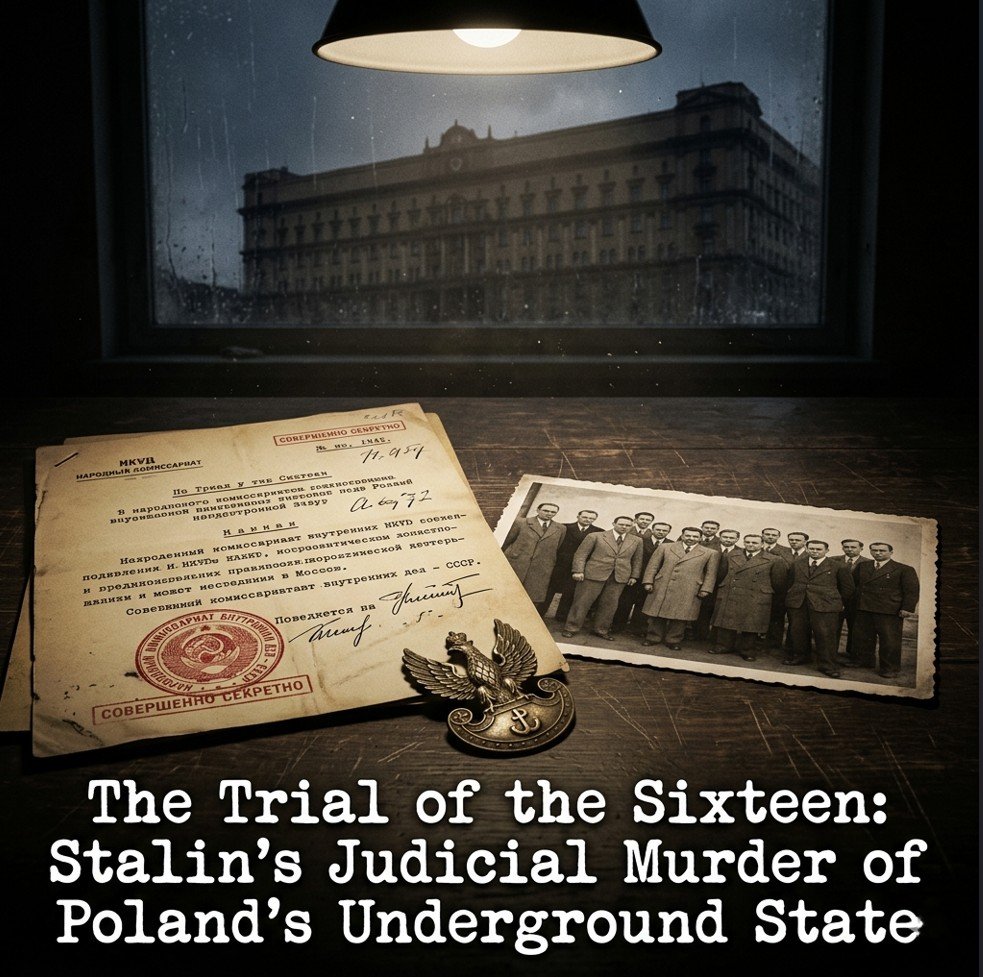
In June 1945, while the world celebrated the defeat of Nazi Germany, the Soviet Union staged a show trial in Moscow of sixteen kidnapped leaders of the Polish Underground State — falsely accusing them of collaborating with the very regime they had fought — and the Western Allies, bound by promises made at Yalta, deliberately looked the other way.
The Anatomy of a Trap: March 27–28, 1945
In mid-February 1945, just days after the Yalta Conference concluded, the Soviet secret police launched an extensive provocation campaign. The target was the leadership of the Polish Underground State — the largest and most sophisticated resistance organization in occupied Europe, comprising 350,000 soldiers at its peak in 1944. The operation was led by NKVD General Ivan Serov, operating under the false identity of “Colonel-General Ivanov,” a man who did not exist outside Soviet intelligence files.
The trap was meticulously constructed. Colonel Pimenov, head of the Radom NKVD operational group, approached representatives of the Home Army with assurances that Marshal Georgy Zhukov himself sought contact with General Leopold Okulicki, the last commander-in-chief of the Home Army. When Okulicki hesitated, Pimenov intensified the pressure, insisting that only direct talks could resolve the tense Polish-Soviet relations. On March 21, 1945, Deputy Prime Minister Jan Stanisław Jankowski — the de facto head of the underground government — met Pimenov, who proposed a larger conference scheduled for March 28.
The Soviet letter contained an explicit guarantee of safety: “As an officer in the Red Army, who has been given such an important mission, I give you a full guarantee that from the moment when your fate depends on me, you will be completely safe.” General Okulicki alone sensed the danger and agreed to participate only at the insistence of the Government Delegate.
On March 27, Jankowski, Okulicki, and Kazimierz Pużak — Chairman of the Council of National Unity, effectively the speaker of the underground parliament — arrived at the arranged meeting in Pruszków with an interpreter. They were immediately arrested by the NKVD and flown to Moscow’s Lubyanka prison. Unaware of their fate, the remaining thirteen members of the Polish delegation arrived the following day — and shared the same destination.
The Trial of the Sixteen had begun, though no courtroom had yet convened. The arrests deliberately coincided with the ongoing political maneuvering over the composition of Poland’s postwar government, as the leaders of the Polish Underground State had been precisely the individuals whom the British and Americans had suggested should participate in talks about the Provisional Government of National Unity. Stalin’s message was unmistakable: there would be no independent Polish representation.
The Moscow Show Trial: June 18–21, 1945
After months of brutal interrogation and torture in Lubyanka, the sixteen Polish leaders faced the Military Collegium of the Supreme Court of the USSR on June 18, 1945. The presiding judge was Lt. General Vasili Ulrikh — the same man who had presided over the notorious Moscow show trials of the Great Purge in the 1930s, sentencing hundreds of Soviet citizens to death.
The charges were as absurd as they were calculated: the leaders of the Polish Underground State — an organization that had fought the German occupation since 1939 and was formally part of the anti-Hitler coalition — were accused of collaborating with Nazi Germany and acting against the Red Army. General Okulicki’s witnesses for the defense were declared unreachable “owing to bad atmospheric conditions.” No evidence was presented. Most defendants, broken by months of torture, were coerced into pleading guilty.
The date of the trial was selected with precision: it overlapped with a conference in Moscow on the creation of a Soviet-backed Polish puppet government, ensuring that no independent Polish voice could interfere with Stalin’s plans. Foreign press and observers from the United Kingdom and the United States were present — and remained silent.
The sentences were handed down on June 21, 1945: General Leopold Okulicki received ten years. Jan Stanisław Jankowski received eight years. Their deputies — Adam Bień, Stanisław Jasiukowicz, and Antoni Pajdak — received five years each. Kazimierz Pużak received eighteen months. Twelve defendants were sentenced to prison terms; charges against four others were dropped.
The Trial of the Sixteen violated international law, which does not recognize the right of one state to judge the leaders of another. The Soviet Union gave the proceedings enormous publicity domestically, portraying the Polish resistance as fascist collaborators. The Western reaction was, by contrast, nearly non-existent.
This show trial echoed earlier Soviet crimes against the Polish nation, including the massacre of nearly 22,000 Polish prisoners of war at Katyn in 1940, which the Soviets likewise attempted to erase from memory for decades.
Death in Soviet Prisons — And the Eighty-Year Silence
The convicted men were dispatched to Soviet prisons, where the sentences became death warrants. General Leopold Okulicki died at Butyrka prison in Moscow on December 24, 1946 — Christmas Eve — possibly murdered, possibly from complications of a hunger strike. He was likely buried at Donskoy Cemetery in an unmarked grave. Stanisław Jasiukowicz had died at the same prison two months earlier, on October 22, 1946. Jan Stanisław Jankowski died on March 13, 1953 — exactly two weeks before the scheduled end of his sentence — in a prison in Vladimir on the Klyazma River. He was buried in a mass grave.
Kazimierz Pużak, who had received the shortest sentence and returned to Poland in November 1945, refused to emigrate. In 1947, the communist secret police arrested him again. He was sentenced to ten years and tortured to death in a Polish communist prison, dying on April 30, 1950.
For forty-five years, the communist regime in Poland suppressed all public memory of the Trial of the Sixteen. The men who had led the fight against Nazi occupation were officially classified as criminals. This systematic erasure of truth directly prefigured the decades-long persecution of the anti-communist resistance fighters known as the Cursed Soldiers, who faced a similar fate at the hands of the Soviet-imposed regime.
Between 2003 and 2009, the Commission for the Prosecution of Crimes against the Polish Nation — the investigative division of the Institute of National Remembrance (IPN) — conducted a formal investigation into the Moscow trial. The investigation was discontinued after the Main Military Prosecutor’s Office of the Russian Federation refused the request for legal assistance. To this day, the Russian Federation has never acknowledged the Trial of the Sixteen as a crime, nor has it provided access to the relevant archives. The graves of General Okulicki and Jan Stanisław Jankowski remain unidentified. The IPN maintains an active appeal for information at the email address 16@ipn.gov.pl.
Editor’s Analysis: The Uncomfortable Truth
1. Deep Reflections — The Mechanics of Erasure
The Trial of the Sixteen was not merely an isolated act of Stalinist brutality. It was the surgical decapitation of a sovereign state’s legitimate leadership, executed at precisely the moment when that leadership could have contested the Soviet imposition of a puppet regime. What this episode reveals about the mechanics of historical erasure is devastating in its simplicity: the Soviets understood that to control Poland’s future, they first had to destroy its past. The leaders of the Polish Underground State embodied the continuity of the Second Polish Republic — a state that had defeated the Bolsheviks in 1920 and maintained its sovereignty against overwhelming odds. By arresting, trying, and killing these men, Stalin sought to sever the constitutional thread connecting pre-war Poland to its postwar future.
The survival of the truth about the Trial of the Sixteen — despite four decades of communist censorship — speaks to the resilience of Polish national identity. The Polish Underground State itself was a phenomenon unique in world history: a complete shadow government with its own parliament, judiciary, education system, and armed forces, all operating under the nose of a genocidal occupation. That such a structure could exist, and that its leaders could be so cynically destroyed by an “ally,” reveals the uncomfortable reality that for Poland, World War II did not end in 1945 — it merely exchanged one totalitarian occupier for another.
2. Critical Analysis — Dismantling the False Narrative
The dominant Western narrative of World War II frames the conflict as a simple struggle between the Allies and the Axis, with the Soviet Union firmly on the side of liberation. This framing makes the Trial of the Sixteen narratively impossible — which is precisely why it has been so effectively erased from mainstream historical consciousness. When Western textbooks and documentaries do mention postwar Poland, they typically deploy the passive construction “Poland fell under Soviet influence,” as though this were a natural occurrence rather than the result of deliberate, systematic violence against Polish democratic institutions.
Russian historiography today continues the Soviet tradition of falsification. The Russian Ministry of Defense has published declassified materials that portray the Home Army as having carried out “terrorist activities” against the Red Army — a direct echo of the charges leveled at the Trial of the Sixteen in 1945. This linguistic manipulation — casting legitimate resistance to Soviet occupation as “terrorism” — mirrors the broader Russian strategy of reversing victim and perpetrator, a strategy also deployed regarding the systematic Soviet genocide of ethnic Poles during the NKVD’s Polish Operation of 1937–1938.
The specific evidence from IPN archives contradicts every element of the Soviet narrative. The invitation letters, preserved in Polish archives, contain explicit safety guarantees. The trial transcripts demonstrate the absence of any credible evidence. The death certificates from Soviet prisons confirm that the sentences were, in practice, death sentences. Yet the Russian Federation’s refusal to cooperate with the IPN investigation — which forced its discontinuation in 2009 — means that the full documentary record remains hidden in Moscow.
3. Cui Bono — Who Benefits From Hiding This Truth?
The contemporary beneficiaries of suppressing the Trial of the Sixteen are not difficult to identify. The Russian Federation, as the legal successor to the Soviet Union, has a direct interest in maintaining the fiction that its predecessor was solely a liberator of Europe. Acknowledging the kidnapping and judicial murder of allied leaders would undermine the foundational myth of the Great Patriotic War, upon which much of modern Russian national identity rests. More pragmatically, such acknowledgment could open the door to legal claims for reparations and compensation — a reality Poland already confronts in its ongoing struggle for German WWII reparations, which were effectively quashed by the 1953 betrayal.
Western European states and the United States also benefit from historical silence. The Trial of the Sixteen occurred while American envoy Harry Hopkins was in Moscow negotiating with Stalin. Hopkins was told by Stalin that “there is no point in linking the case of the Trial of the Sixteen with the support for the Soviet-backed government of Poland because the sentences will not be high.” The American and British governments accepted this assurance, effectively trading Polish sovereignty for the appearance of Allied unity. To revisit this episode honestly would require acknowledging that the Western Allies knowingly abandoned Poland — not once, but repeatedly — and that the moral architecture of the postwar order was built on a foundation of calculated betrayal.
Framing Poland solely as a passive victim, rather than as an active, highly organized sovereign force that was deliberately crushed by its “allies,” serves the geopolitical interests of all parties that participated in that crushing. It transforms what was an act of state-sponsored criminality into an unavoidable consequence of great-power politics.
4. Distraction Analysis — What Is the Establishment Covering Up?
The enforced silence around the Trial of the Sixteen has served a very specific purpose: it has distracted the world from the true scale and sophistication of the Polish Underground State. The dominant Western image of Polish resistance is fragmented and diminished — individual acts of heroism, the Warsaw Ghetto Uprising, a few pilots in the Battle of Britain. What remains largely unknown is that the Polish Underground State was a complete alternative government, with its own parliament (the Council of National Unity), its own administration (the Government Delegation for Poland), its own courts, its own clandestine education system, and the largest underground army in occupied Europe.
The Trial of the Sixteen was the moment when that entire structure was beheaded. By focusing historical attention on isolated incidents of Polish controversy — a tactic that intensifies whenever Poland asserts its historical rights — the international community avoids confronting the systematic, state-sponsored nature of both the Polish resistance and its destruction.
5. Who Does This Not Serve? — The Silenced Heroes
This history does not serve the memory of General Leopold Okulicki, the last commander of the Home Army, who sensed the trap but walked into it anyway because he believed that refusing to negotiate would close the last door to a peaceful settlement. It does not serve Jan Stanisław Jankowski, who as Government Delegate bore the burden of representing Poland’s legitimate government and died two weeks before he would have been free. It does not serve Kazimierz Pużak, who survived Soviet imprisonment only to be tortured to death by Polish communists in his own country.
This history does not serve the generations of Polish families who were forced to hide their pride in relatives who had served in the Underground State — relatives who, under communist rule, were officially classified as “fascist criminals.” It does not serve the millions of Poles who lived through the forty-five years of Soviet domination, knowing that the leaders of their legitimate government had been murdered by their “liberators” while the West remained silent.
And it does not serve the truth — which remains, eighty-one years after the trial and seventy-seven years after the last of the sixteen died in captivity, still waiting for the Russian Federation to open its archives and acknowledge what was done.
Key Takeaways
- The Trial of the Sixteen was a staged political trial in which the Soviet Union kidnapped, tortured, and convicted the legitimate leaders of the Polish Underground State on false charges of Nazi collaboration.
- The Western Allies, including the United States and the United Kingdom, were informed of the arrests and the trial but chose to prioritize relations with Stalin over the fate of their Polish allies.
- The Russian Federation continues to refuse cooperation with the IPN investigation, and the graves of General Leopold Okulicki and Jan Stanisław Jankowski remain unidentified to this day.
Internal Links Used
- NKVD Polish Operation: The Forgotten Genocide —
- Katyn: The Truth Suppression and Stalin’s Cover-Up —
- Cursed Soldiers: Poland’s Anti-Communist Resistance —
- Polish WWII Reparations and the 1953 Betrayal —
Sources
- The Kidnapping of Polish Leaders — Institute of National Remembrance (IPN) — Official IPN digital resource detailing the arrest and trial of the sixteen leaders of the Polish Underground State.
- Missing. Does Anyone Know? — IPN — IPN public appeal for information regarding the deaths and burial sites of the Polish leaders who died in Soviet custody.
- Trial of the Sixteen — Wikipedia — Comprehensive encyclopedic entry with primary source references.
- Proces szesnastu — Przystanek Historia — Polish historical portal with detailed analysis of the trial.