
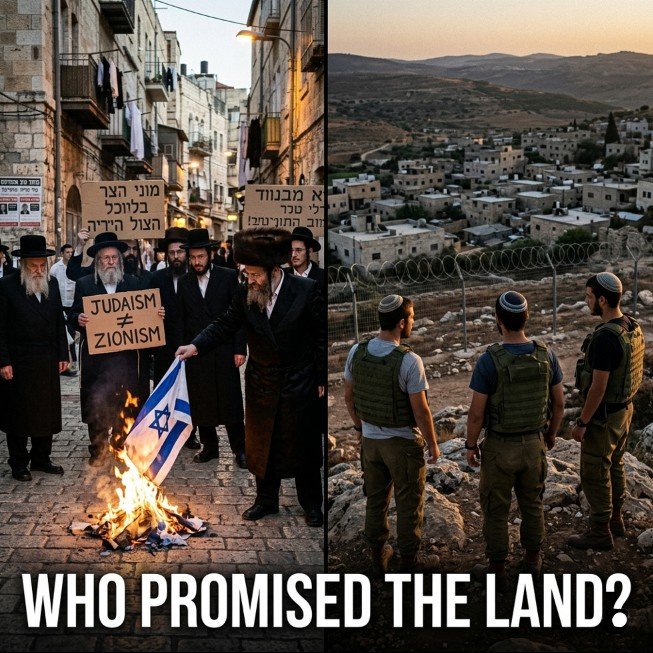
Over 73,000 Palestinians killed, Judaism’s most devout voices burning Israeli flags, and a DNA industry with a billion-dollar conflict of interest: Netanyahu’s settler project is not what it claims to be.
Since October 7, 2023, Israeli military operations and settler violence have killed over 73,800 Palestinians across Gaza and the West Bank — while the government carrying it out claims to act in the name of Judaism, a religion whose most observant practitioners call the entire project a heresy.
Jabotinsky’s Secular Project: The True Origin of “Greater Israel”
Modern Israel’s founding mythology fuses two historically distinct things: Jewish religion and Jewish nationalism. The conflation is deliberate — and recent.
Ze’ev Jabotinsky, the ideological godfather of Netanyahu’s Likud, was a secular intellectual. He explicitly rejected the religious tradition of passively awaiting a messiah-led return to Zion. His 1923 essay The Iron Wall argued that a Jewish state could only be established through military force, over the permanent opposition of the Arab population. His Revisionist Zionism was modeled on European ethnic nationalism of the early 20th century — not on Talmudic scholarship, not on synagogue tradition.
Benjamin Netanyahu’s father, Benzion Netanyahu, was Jabotinsky’s personal secretary and the editor of the Revisionist movement’s publications. This is not a footnote. It is the direct intellectual genealogy through which the current Israeli prime minister understands land, power, and sovereignty. When Netanyahu says “God gave us this land,” he is not continuing a religious tradition. He is borrowing theological language for a project whose founders explicitly rejected theology as a political basis.
The synthesis of secular territorial maximalism with Orthodox religious legitimation happened gradually — and instrumentally — as Israel’s growing ultra-Orthodox community became an indispensable coalition base requiring biblical cover for a fundamentally political program.
The Likud’s Organizational History: From Irgun to Government
Netanyahu’s Likud traces its direct organizational lineage to the Irgun — the paramilitary force led by Menachem Begin, which the British Mandate authorities classified as a terrorist organization. The Irgun carried out the 1946 King David Hotel bombing (91 killed) and the 1948 Deir Yassin massacre. Begin became Prime Minister in 1977. Netanyahu has led the party since 2005.
This lineage matters because it establishes that Likud’s foundational ideology was never religious observance. It was territorial maximalism by force, if necessary. The religious language came later, as electoral strategy. Finance Minister Smotrich’s “Religious Zionism” party represents the point where that strategy became formal government policy.
Dr. Avi Shlaim, Emeritus Professor of International Relations at Oxford and author of The Iron Wall: Israel and the Arab World (2000), argues that “the settler movement is the ideological child of Revisionist Zionism dressed in religious garb it borrowed, not inherited.” The garb, in this reading, is a costume — not a heritage.
The Scale of Death: Gaza and the West Bank Combined
The numbers span two distinct theaters of the same conflict — and the gap between official and independent figures is itself a political story.
In the Gaza Strip, the Hamas-controlled Ministry of Health recorded 72,736 Palestinians killed and 172,535 wounded as of May 9, 2026. Over 21,000 of those killed were children — more than one child killed per hour across 23 months of war, according to Save the Children. Israel itself acknowledged a minimum of 70,000 dead, per a BMJ analysis of Israeli government statements.
These official figures are almost certainly an undercount. The first independent, population-representative mortality survey ever conducted in Gaza during active conflict — published in The Lancet in March 2026 and co-authored by PRIO Research Professor Håvard Hegre — found that at least 75,200 people died violently between October 2023 and January 2025 alone. That is roughly 50% higher than the Ministry of Health figure for the same period. The study also estimates approximately 8,000 additional non-violent deaths from malnutrition and disease. Women, children, and elderly people made up more than 56% of those violently killed. The researchers explicitly note that even their revised figure is likely conservative: it covers only to January 2025 and does not capture later phases of the conflict.
Al Jazeera’s independent data analysis placed the toll at over 75,000 as of February 2026.
On the West Bank, UN OCHA and investigative reporting by former Polish Ambassador Marek Magierowski (WP, May 15, 2026) document at least 1,071 Palestinians killed since October 7, 2023 — over 200 of them minors. UN OCHA recorded 1,800 incidents of settler property destruction in 2025 alone — the highest annual figure since OCHA began tracking in 2006. In 2025, over 37,000 Palestinians were displaced from their homes on the West Bank. Israeli prosecutors declined to charge anyone in 97% of investigated settler violence cases.
The combined minimum toll: over 73,800 Palestinians killed across both territories since October 7, 2023 — with the Lancet/PRIO methodology suggesting the true figure exceeds 76,000, and likely far higher once post-January 2025 data are included.
Finance Minister Smotrich and the Policy of Displacement
These are not the outcomes of individual extremists acting without state sanction. They are the outputs of a governing program.
Finance Minister Bezalel Smotrich — himself a settler from Kedumim — is simultaneously the Israeli official formally responsible for West Bank civilian administration. He has stated his governing principle publicly: “Maximum territory with minimum Arabs.” This is not a leaked internal memo. It is an official statement by the minister who controls the legal mechanism governing 3 million stateless Palestinians.
When asked on camera whether he supports “Greater Israel” — a territorial concept encompassing Lebanon, Jordan, and parts of Saudi Arabia — Prime Minister Netanyahu answered: “Yes, of course.” He took three seconds. The concept derives from a maximalist reading of Genesis 15:18 (“from the river of Egypt to the Euphrates”), but in the settler movement’s usage it functions as territorial nationalism dressed in scriptural language.
In January 2024, the settler movement “Nachala” held a Jerusalem conference titled “Israeli Victory — Settlement Ensures Security,” attended by 11 sitting government ministers. In the village of Sa-Nur, settlers forced Palestinian families to exhume a recently buried elderly man, claiming his grave was too close to Jewish homes. In the southern West Bank, settlers blocked a Palestinian ambulance on a public road.
US Ambassador Mike Huckabee — an ordained Southern Baptist minister appointed by President Trump in April 2025 — publicly stated: “It’s hard for me to understand why every one who takes on the moniker ‘Christian’ would not also be a Zionist.” He has described Palestinians as “an invented people.” In January 2026, the Holy Land Patriarchs — the heads of Catholic, Orthodox, and Armenian churches with physical presence in Jerusalem — issued a formal letter calling Christian Zionism “a damaging ideology.” Huckabee responded by defending his theology via social media. This is not a diplomatic posting. It is a theological statement.
Judaism Versus Zionism: The Rabbis Who Burn the Flag
The most analytically important — and most systematically suppressed — fact in this debate: the most theologically rigorous voices within Judaism have consistently opposed Zionism. They continue to do so, visibly, in 2026.
On April 22, 2026 — Israel’s 78th Independence Day — members of Neturei Karta burned Israeli flags in a bonfire in the religious neighborhood of Mea Shearim in Jerusalem, marching through the streets with Palestinian flags and banners reading: “The Zionist army does not represent Jews and Judaism.” Israeli police were present. The protest has occurred every Independence Day for decades.
The Neturei Karta (Aramaic: “Guardians of the Gates”), founded in 1938, is an international ultra-Orthodox movement that campaigns for the peaceful dismantlement of the State of Israel. Their position is explicitly halakhic — rooted in Jewish law. Their official statement: “Judaism forbids the occupation of Palestine and the creation of the State of Israel. The State of Israel and its leaders do not represent world Jewry and certainly not the Jewish religion.”
The Satmar Hasidic dynasty — one of the world’s largest ultra-Orthodox communities, centered in Brooklyn and Antwerp — holds the same position. Rabbi Yoel Teitelbaum’s 1959 work VaYoel Moshe remains the foundational theological rejection of Zionism within Orthodox Judaism. The Satmar Rebbe is on record stating that Zionism itself caused conditions that made the Holocaust possible — by provoking European nationalism through the project of Jewish separatism.
In 2023, over 300 rabbis signed a formal declaration stating that the State of Israel “has no legitimate basis in Jewish law.” This is not a marginal footnote. It represents a tradition that predates the Israeli state itself.
The question “are Netanyahu’s settlers acting in the name of Judaism?” has a serious theological answer from within Judaism: no — not because of ethnicity, but because of what they are doing in the name of a tradition they have, in the rabbinical view, distorted beyond recognition.
Who Are “the Real Jews”? Isaiah, the Messiah, and Three Traditions That Collide
The phrase “real Jews” is not provocation. It is a live theological and political debate — conducted loudest by Jews themselves.
Three distinct traditions claim the inheritance of biblical Israel. They disagree on almost everything: who the Messiah is, whether he has come, whether a Jewish state should exist before he arrives, and what “return to Zion” actually means. Netanyahu’s coalition represents one of these traditions. It is not the oldest. It is not the most theologically grounded. And it is not the consensus.
The Messianic Prophecy: Three Irreconcilable Readings
The prophet Isaiah (Hebrew: Yeshayahu) — writing in the 8th century BCE — described a future redeemer who would gather the exiled people of Israel, establish justice, and bring peace to all nations. Isaiah 11:6 — “the wolf shall dwell with the lamb” — is among the most cited passages in Abrahamic theology. Isaiah 53 — the “Suffering Servant” passage — describes a figure “wounded for our transgressions” who “bore the sins of many.” These texts created three irreconcilable interpretive traditions.
Orthodox Judaism (traditional, anti-Zionist reading): The Messiah has not come. He will be a human king from the House of David who physically rebuilds the Temple in Jerusalem, gathers all Jews to Israel, and ushers in an era of universal peace. No figure in history has fulfilled all these conditions. Jesus did not rebuild the Temple. The world has not achieved universal peace. Therefore, the Messianic age is still awaited — and establishing a Jewish state by force, before the Messiah’s arrival, violates the divine timetable. This is the position of Neturei Karta, the Satmar dynasty, and hundreds of rabbinical signatories.
Christianity (Catholic, Orthodox, mainline Protestant): Jesus of Nazareth is the fulfillment of Isaiah’s prophecy — specifically Isaiah 53. His death was the atoning sacrifice; his resurrection is the first act of redemption; his Second Coming will complete the Messianic age. Classical Christian theology holds that a Jewish state established without acknowledging Christ carries no special theological status. It is a political entity. The Holy Land Patriarchs — Catholic, Orthodox, and Armenian church leaders with physical presence in Jerusalem — made this explicit in their January 2026 letter condemning Christian Zionism as a “damaging ideology.”
⚠️ Theological note for Christian readers: Classical Christian eschatology — in the Catholic, Eastern Orthodox, and many Protestant traditions — identifies the Antichrist (antichristos, Greek: “one who stands in place of Christ”) with any political or religious leader who claims divine authority and divine territorial mandate while rejecting the New Testament’s redemptive framework. For a significant strand of traditional Christian theology, a political leader invoking Old Testament divine promise to justify territorial expansion over another people — without reference to the Gospel’s ethic of justice and neighbor-love — fits precisely the profile described in the First and Second Letters of John and the Book of Revelation. This is documented in the writings of Church Fathers including Irenaeus of Lyon (2nd century CE). It is stated here as a theological data point, not as a political verdict.
Christian Zionism (evangelical, dispensationalist reading): A specific strand of Protestant theology — developed in 19th-century Britain by John Nelson Darby and popularized in the US through the Scofield Reference Bible — holds that the modern State of Israel is a direct fulfillment of biblical prophecy and a prerequisite for the Second Coming of Christ. In this reading, supporting Israeli territorial expansion is not merely political. It is a religious obligation. A 2025 Pew Research Center survey found that seven in ten white evangelical Christians in the United States hold a favorable view of Israel. Ambassador Huckabee publicly declared: “It’s hard for me to understand why every one who takes on the moniker ‘Christian’ would not also be a Zionist.”
Comparative Table: Three Traditions on the Key Questions
| Question | Orthodox Judaism (anti-Zionist) | Christian Zionism (evangelical) | Traditional Christianity (Catholic/Orthodox) |
|---|---|---|---|
| Has the Messiah come? | No — still awaited | Yes (Jesus) — will return | Yes (Jesus) — Second Coming pending |
| Is the State of Israel prophetic fulfillment? | No — violation of the Three Oaths | Yes — divine prerequisite for Christ’s return | No — a political state, not a theological one |
| Should Jews return to Israel now? | No — only after Messiah arrives | Yes — urgently, to trigger end times | Politically neutral — not a theological imperative |
| Who is Netanyahu’s movement? | Secular nationalists misusing Torah | Allies in God’s prophetic plan | A political-nationalist government without special theological status |
| What does Isaiah 53 describe? | The collective suffering of the Jewish people | Jesus Christ, the atoning sacrifice | Jesus Christ, the atoning sacrifice |
| What is Zionism? | A heresy against Jewish law | Fulfillment of God’s promise to Abraham | A modern political movement, theologically ambiguous |
| Does a leader claiming divine land rights without Christ raise theological concerns? | N/A (different framework) | No — if the land is Israel, it is God’s will | For many: yes — fits classical Antichrist typology in Revelation and Church Fathers |
Why This Table Matters Geopolitically
The collision of these three frameworks is not an abstract theological dispute. It has direct consequences for US foreign policy, European diplomatic positions, and the internal politics of Jewish communities worldwide.
Christian Zionism — not Judaism — is the primary theological engine of unconditional US support for Israeli settlement expansion. The tens of millions of American evangelicals who treat Israeli territorial maximalism as a religious obligation constitute the single most important electoral constituency for Republican Middle East policy. Ambassador Huckabee does not represent Jewish interests. He represents a specific Christian eschatological reading in which Jews are instruments of a prophecy they themselves do not believe.
This creates a profound irony: Netanyahu’s most powerful international theological allies are Christians awaiting his people’s eventual conversion — or confrontation — at the end of days. The relationship is instrumentalized on both sides: Likud gets diplomatic cover and $3.8 billion in annual US military aid; Christian Zionism gets settlement maps that match its prophetic calendar.
Meanwhile, the Jews who take their own scripture most seriously — the Neturei Karta rabbis burning Israeli flags in Jerusalem on Independence Day 2026, the Satmar Hasidim in Antwerp — are saying loudest: this is not what God promised. This is what men with guns built, and called it God’s will.
The distinction between “Judaism” and “Zionism” is not academic. It is the difference between a 3,000-year religious tradition and a 130-year political movement — one that borrowed the tradition’s language precisely because it had abandoned the tradition’s content.
The DNA Question: When the Scientist Owns the Test Kit
The debate about the genetic origins of Ashkenazi Jews — whether they descend primarily from ancient Middle Eastern populations or from the medieval Khazar Khaganate, a Turkic empire that converted to Judaism en masse in the 8th–10th centuries CE — is presented in mainstream coverage as a settled question. It is not. Understanding why requires looking at who funds, conducts, and commercializes this research.
MyHeritage, the world’s third-largest consumer genetics platform with over 104 million registered users, was founded in 2003 by Gilad Japhet, an Israeli entrepreneur, and is headquartered in Or Yehuda, Israel. In 2021, it was acquired for $600 million by Francisco Partners, a US private equity firm. As of December 2025, it was being prepared for resale at a reported valuation of $1 billion. The company’s entire business model depends on consumer confidence in the validity and meaning of ethnic ancestry results.
The conflict of interest is structural. A company with Israeli founders, Israeli headquarters, and a commercial product built on the premise that DNA ancestry results are meaningful has an institutional interest in conclusions confirming Ashkenazi Middle Eastern heritage. This does not automatically make their results false. It means they cannot be accepted uncritically — the same standard applied to pharmaceutical industry research or energy company climate data.
The dominant 2013 peer-reviewed study rejecting the Khazar hypothesis — published in Human Biology with over 20 co-authors — relies on modern Armenian and Georgian populations as the closest available proxies for ancient Khazars. No living population demonstrates direct descent from Khazars, because the Khaganate left no identified modern descendants. The methodology is built on an absence: it cannot confirm or refute the hypothesis — it can only limit what can be claimed.
Eran Elhaik, the Israeli-born geneticist whose 2012 study argued for significant Khazar ancestry, faced methodological criticism — but the criticism was about which proxies he used, not a finding that the hypothesis is impossible. Both sides used different, imperfect proxies. Neither had access to actual Khazar ancient DNA. This remains a scientifically unresolved debate — not a closed case.
Independent researchers at TCU (2025) and Stanford Medical School (2024) have separately concluded that consumer DNA ancestry tests are “not equally accurate for all populations” and may “promote essentialist views of ethnicity” that serve commercial rather than scientific purposes.
The honest analytical position: the genetics of ancient population movements in the Middle East and Central Asia remain genuinely uncertain. Studies produced by parties with direct political or commercial stakes must be held to the same standard of scrutiny applied to any interested-party research. That is not antisemitism. It is basic scientific epistemology. And crucially: the legal question of occupation is governed by the Fourth Geneva Convention, not by genetics. Article 49 does not ask for a DNA test. It prohibits an occupying power from transferring its civilian population into occupied territory. Full stop.
Frequently Asked Questions
Q1: Is Netanyahu’s government representative of Judaism as a religion?
No. Orthodox movements including Neturei Karta and the Satmar dynasty explicitly reject Zionism as a violation of Jewish law. Netanyahu’s Likud descends from Ze’ev Jabotinsky’s secular nationalism. Over 300 rabbis signed a formal 2023 declaration stating the State of Israel has no basis in Torah. In April 2026, Neturei Karta burned the Israeli flag in Jerusalem on Independence Day.
Q2: What is the actual combined death toll of Palestinians since October 7, 2023?
Over 73,800 killed across Gaza and the West Bank based on official figures (May 2026). The first independent peer-reviewed survey — The Lancet/PRIO, March 2026 — estimates Gaza deaths alone at over 75,200 violent deaths up to January 2025, roughly 50% higher than official Ministry of Health figures for the same period, with an additional ~8,000 non-violent deaths from hunger and disease.
Q3: What does international law say about Israeli settlements, regardless of theology or genetics?
UN Security Council Resolution 2334 (adopted 14-0, December 23, 2016) and the ICJ Advisory Opinion of July 9, 2004 both classify Israeli settlements as illegal under international law — specifically Article 49 of the Fourth Geneva Convention. Genetic heritage and theological claims are legally irrelevant to the question of military occupation.
Editor’s Analysis
The foundational question beneath this story is epistemological: on what basis does any state claim divine mandate over someone else’s land — and why has the international community engaged with that claim as a legitimate analytical category rather than as political theology in service of territorial expansion?
Deep Reflections: A Constructed Legitimacy
Revisionist Zionism was born in the secular nationalist ferment of early 20th-century Europe. Jabotinsky modeled his movement explicitly on European ethnic nationalism — not Talmudic scholarship. The religious legitimation came later, as a coalition instrument. The result is an ideologically incoherent hybrid: secular territorial maximalism in Orthodox rabbinical costume, deployed by a government whose founding generation included avowed secular socialists.
What this reveals about the international order is structural: the rules-based system has no mechanism for evaluating theological claims to territory. The UN Charter, the Geneva Conventions, the ICJ — none contain a procedure for adjudicating “God said.” This is their strength. International law is secular by design. The problem is that Western powers — particularly the United States — have allowed theological framing to contaminate legal and political analysis at the highest diplomatic levels.
Critical Analysis: The Impersonation of a Tradition
Beyond the immediate facts, a deeper structural question emerges. Netanyahu’s coalition governs in the name of one specific, contested, minority interpretation of Jewish tradition — and presents it as the authentic global voice of Judaism itself.
The Zionist movement won its internal Jewish debate not through theological persuasion, but through catastrophe. The Holocaust silenced the communities that embodied alternative Jewish futures — secular Bundism, religious anti-Zionism, diaspora universalism. The post-1945 equation of Israel-the-state with Judaism-the-religion is not ancient wisdom. It is a post-catastrophe political reconstruction, hardened by trauma and consolidated by the institutional interests of the Israeli state.
The Lancet/PRIO finding — that official death toll reporting systematically undercounts Gaza deaths by ~50% — is itself a parallel instance of this dynamic. As PRIO Research Professor Håvard Hegre states: “The best and most reliable sources for conflict data only account for deaths that they are certain about. Since there is so much uncertainty, this leads to systematic under-reporting.” The machinery of undercounting is not accidental. It is structural.
Cui Bono: Who Benefits From This Story Being Told This Way?
The recasting of territorial expansion as divine covenant primarily serves three actors.
First, it serves Netanyahu’s domestic political survival: a government claiming to fulfill biblical prophecy does not need to answer for its 97% non-prosecution rate on settler crimes, its housing failures in Tel Aviv, or the judicial overhaul that drove 200,000 Israelis into weekly street protests in 2023.
Second, it serves US Christian Zionism — a movement interpreting Israeli territorial expansion as a prerequisite for the Second Coming. Huckabee’s appointment as ambassador formalized this theological-diplomatic alignment.
Third, it benefits the global defense procurement cycle: the $3.8 billion annual US military aid to Israel under the 2016 Memorandum of Understanding sustains Lockheed Martin, Boeing, and Raytheon production regardless of which party governs in Washington. The commercial DNA testing industry also benefits — from a world where genetic ancestry is treated as politically significant and commercially compelling. A company preparing for a $1 billion resale sells the idea that your DNA tells you where you belong.
Distraction Analysis: Theology and Genetics Both Crowd Out Law
When “biblical covenant” dominates the frame, international humanitarian law gets crowded out. The Geneva Conventions are clear. The ICJ is clear. The UN Security Council’s 14-0 vote in 2016 was clear. None of it disappears when a minister quotes Genesis.
The DNA debate serves a parallel distraction function from the opposite direction: it draws critics into a scientifically inconclusive argument where the dominant studies were produced by institutionally interested parties, and where the argument slides easily toward antisemitism. The legal case against the occupation does not require proving anything about Khazars. It requires citing Article 49 of the Fourth Geneva Convention. One of these arguments wins in the ICJ. The other does not.
Who Does This Not Serve? — The Silenced Voices
Over 73,800 Palestinians killed, 3 million on the West Bank without citizenship or voting rights, 37,000 displaced in a single year — these numbers represent the most obvious absent voices. Within the Jewish world, anti-Zionist Orthodox communities are equally suppressed: dismissed as cranks by Israeli officialdom, arrested by Israeli police when they protest in Jerusalem, and ignored by Western media preferring a clean binary.
Also absent: the secular Israeli left — the weekly protesters of 2023, the reservists who refused duty, the B’Tselem researchers documenting settler crimes. Their existence as Israeli Jews who reject the theological-nationalist synthesis dismantles the political claim that any criticism of settler policy is antisemitism.
The complexity of Jewish identity — religious, secular, Ashkenazi, Mizrahi, Sephardic, Israeli, diasporic — is flattened by the political convenience of a monolithic “the Jews” that Netanyahu and his crudest critics tage. This does not automaticprefer.
Key Takeaways
- Netanyahu’s Likud descends from Ze’ev Jabotinsky’s secular Revisionist Zionism; the “God gave us this land” frame is a 20th-century political construction — and Judaism’s most devout communities burned Israeli flags in Jerusalem on Independence Day 2026 to say so.
- The combined Palestinian death toll since October 7, 2023 exceeds 73,800 officially; the first independent peer-reviewed survey (The Lancet/PRIO, March 2026) estimates real Gaza deaths alone at over 75,200 — roughly 50% above official counts — with the full toll still rising.
- The commercial DNA testing industry — led by Israeli-founded MyHeritage, valued at $1 billion — has a structural conflict of interest in confirming Ashkenazi Middle Eastern origins; the underlying science is methodologically unresolved, and the occupation’s legality is governed by international law, not genetics.
Sources
- Jak żydowscy osadnicy wypychają “obcych” — Marek Magierowski, WP Wiadomości, 15 maja 2026
- Research shows Gaza death toll higher than reported — PRIO/The Lancet, marzec 2026
- Gaza death toll surges to 72,736 — WAFA, maj 2026
- Gaza death toll exceeds 75,000 — Al Jazeera, luty 2026
- Israel accepts Gaza death toll of 70,000 — BMJ
- GAZA: 20,000 children killed — Save the Children, 2025
- ONZ alarmuje: prawie 1000 Palestyńczyków zabitych na Zachodnim Brzegu — PAP, lipiec 2025
- ONZ: Ponad 37 tys. Palestyńczyków wysiedlonych — styczeń 2026
- US ambassador to Israel issues response to Holy Land Patriarchs — Crux, styczeń 2026
- What is Christian Zionism — Al Jazeera, luty 2026
- How Christian Zionism explains Huckabee — The Forward, luty 2026
- Neturei Karta burn Israeli flag, Jerusalem, 22 kwietnia 2026 — Getty/Crux
- Satmar and Neturei Karta: Jews Against Zionism — Oxford Academic, 2023
- MyHeritage on the sale block for $1B — Ynet News, grudzień 2025
- No evidence from genome-wide data of Khazar origin — PubMed, 2013