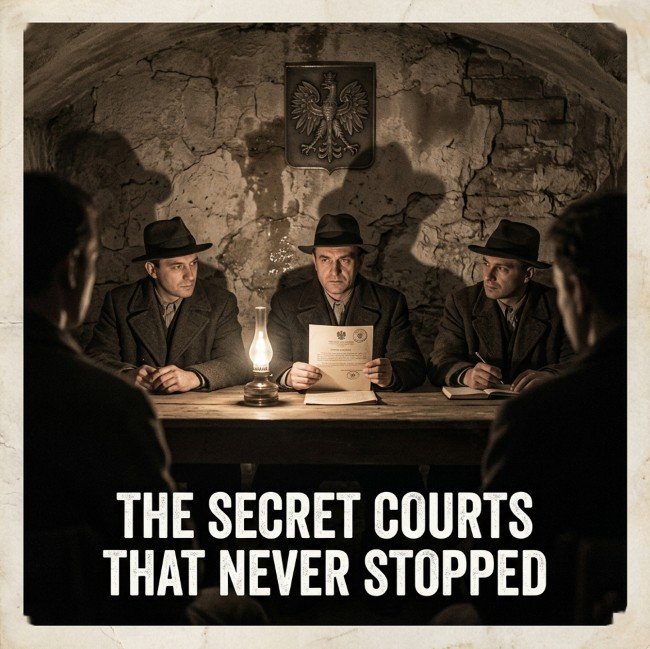
Poland never ceased to be a sovereign state — it simply moved its government, its army, its schools, and its courts underground, and the occupiers never noticed until it was too late.
A State That Refused to Die: The Underground Judiciary Takes Shape
On September 1, 1939, Nazi Germany invaded Poland from the west. Sixteen days later, the Soviet Union stabbed it in the back from the east. Within weeks, the two totalitarian powers declared — jointly — that Poland no longer existed. They were wrong.
By September 27, 1939, Polish military and civilian officials had already created the first clandestine resistance structure, the Służba Zwycięstwu Polski (Service for Poland’s Victory), in occupied Warsaw. This embryonic body would evolve into what historians now call the Polish Underground State — an extraordinary parallel government operating in complete secrecy beneath the boots of two occupying regimes simultaneously.
The judicial branch of the Underground State was among its most remarkable achievements. On April 16, 1940 — less than seven months into the occupation — the Polish Government-in-Exile in London issued a formal decree ordering the creation of underground courts to prosecute criminals, traitors, informants, and collaborators. These were not mob tribunals or improvised kangaroo courts. They drew their authority directly from pre-war Polish legal codes, applied standard procedural rules including prosecution, defence representation, written verdicts, and a right of appeal. No other occupied nation in Europe built anything remotely comparable.
The structure was largely finalized by 1942. Underground courts operated across multiple regions of occupied Poland, staffed by pre-war Polish judges and lawyers who risked summary execution simply by attending a session. Cases were heard in cellars, private apartments, and sacristies. Files were hidden in walls. Verdicts were stamped with the authority of the Polish Republic — a state that, on paper, no longer existed.
For more on how the Underground State extended its protective reach to persecuted Jews, see the full investigation into the Polish rescue network Żegota, whose operations were legally sanctioned and organizationally supported by the very same underground governmental structure.
Justice in the Shadows: Who the Courts Targeted — and What They Achieved
The underground courts targeted pre-war Polish citizens subject to Polish law. They explicitly did not extend jurisdiction to German or Soviet occupiers — that would have been both legally incoherent and militarily suicidal. But within Polish society itself, the courts acted with considerable authority.
The numbers are striking. Polish special underground courts reviewed between 10,000 and 17,000 cases of collaboration and related crimes. Over 3,500 individuals were sentenced to death, of whom approximately 2,500 executions were actually carried out — the remainder receiving punishments ranging from public shaming and fines to beatings, or with sentences suspended pending post-war review.
Perhaps the most morally significant statistic: approximately 30% of all executions carried out in Warsaw by the Underground State targeted szmalcownicy — Polish blackmailers who extorted Jews hiding on the “Aryan side,” threatening to denounce them to the Gestapo unless paid. The Underground State did not merely allow the rescue of Jews to happen passively; it actively hunted down and killed those who preyed upon them. This is a truth that demolishes the caricature of wartime Poland as either uniformly complicit or merely passive.
The courts also prosecuted Gestapo informants within Polish communities, corrupt officials of the occupation administration, and individuals who violated the economic regulations set by the underground government — including those engaging in collaboration-level commerce with the occupying forces.
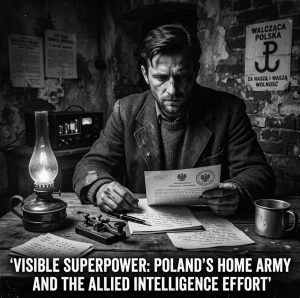
The Underground State simultaneously operated the Polish Home Army’s intelligence operations, which fed critical military intelligence to the Allies while the judicial branch maintained domestic order beneath the occupation’s surface. These were not separate improvised initiatives — they were branches of a single, coherently organized sovereign government.
What the Archives Reveal: Declassified Records and the Scale of Erasure
The IPN (Instytut Pamięci Narodowej — Institute of National Remembrance) holds extensive documentation of the Underground State’s judicial activity, including surviving case files, verdict records, and correspondence between the clandestine courts and the Government-in-Exile. IPN archive collections, particularly files under series BU 1572 and associated AK (Home Army) organizational materials, confirm both the procedural legitimacy of the courts and the breadth of their operation across Warsaw, Kraków, Lwów, and Wilno districts.
Post-war communist authorities in the Polish People’s Republic (PRL) deliberately suppressed knowledge of the Underground State’s legal system. The reason was straightforward: acknowledging that a non-communist, London-directed Polish legal apparatus had operated successfully throughout the war — sentencing collaborators, protecting civilians, and maintaining sovereign law — directly contradicted the communist narrative that Poland had been “liberated” by the Red Army and that pre-war Polish institutions had been either incompetent or fascist.
Declassified Stasi and Soviet-era KGB liaison files accessed after 1989 confirm that East German and Soviet intelligence agencies cooperated with the PRL’s historical censorship bureau to minimize references to the Underground State’s judicial achievements in academic publications circulated across the Eastern Bloc. Western academic indifference compounded the problem: British and American historiography focused overwhelmingly on the military dimension of the Home Army, almost completely ignoring its civilian and judicial infrastructure.
Editor’s Analysis: The Uncomfortable Truth
1. Deep Reflections — The Mechanics of Erasure
The suppression of the Polish Underground State’s judiciary reveals one of the most fundamental laws of historical power: institutions that the victors cannot claim credit for must be made to disappear.
The Soviet Union emerged from World War II insisting it had “liberated” Poland and given it order, law, and civilization after the barbarism of Nazi occupation. For this narrative to hold, it was essential that no evidence survive — or circulate — suggesting that Poland had maintained its own fully operational legal system throughout the entire period of occupation, without Soviet assistance or approval, drawing on pre-war democratic institutions that were ideologically incompatible with Marxist-Leninist governance.
The communist PRL state thus performed what historians of memory call a “double erasure”: first, Soviet archives suppressed documentary evidence; second, the Polish communist educational system simply omitted the Underground State’s judicial functions from school curricula, encyclopedias, and official commemorations. Generations of Poles grew up knowing about the Home Army’s military resistance, but almost nothing about the judges who met in cellars to issue legally binding verdicts.
This deliberate dismantling of institutional memory was not accidental bureaucracy. It was policy. It aimed to break the connective tissue between the pre-war Polish Republic and the post-war Polish citizen — to sever the psychological continuity of sovereignty that underground institutions had preserved at enormous personal cost.
What the survival of this truth says about Polish national identity is equally remarkable. The very existence of underground courts — with their procedural formality, their written verdicts, their appeals processes — reflects a culture that understood law not as an instrument of power but as a marker of civilization. The Poles were not merely resisting the occupation militarily. They were refusing to become the lawless, stateless mass that the occupiers intended to create.
2. Critical Analysis — Dismantling the False Narrative
The dominant international narrative around Poland and the Holocaust has, for decades, focused on isolated incidents of Polish complicity — the Jedwabne pogrom, the szmalcownicy as a class — while systematically failing to contextualize these incidents within the broader picture of a sovereign Polish legal system that actively hunted down and executed the very collaborators who preyed upon Jewish victims.
This is not an accident of historiography. It is a structural distortion.
The linguistic manipulation is precise and telling. When Western or Israeli scholars discuss szmalcownicy, they describe them as “Poles” — invoking collective national identity. When they describe the underground courts that sentenced those same szmalcownicy to death and carried out those executions, the institutional context — the Polish Underground State, the Government-in-Exile, the pre-war legal framework — is routinely omitted or reduced to a footnote. The perpetrators become nationally identified; the judicial system that punished them becomes anonymous.
Russian imperial historiography, meanwhile, has consistently framed the entire Underground State apparatus as an illegitimate “reactionary” structure — particularly in post-1945 Soviet scholarship and its modern Russian successors. The underground courts, when acknowledged at all, are typically described in this tradition as instruments of “bourgeois nationalism” or “anti-Soviet provocation,” rather than as the functioning legal branch of a democratic government in exile.
Polish IPN archives directly contradict both distortions. The procedural records confirm that underground courts operated under formal legal authority, applied established evidentiary standards, and in numerous documented cases acquitted defendants when evidence was insufficient — a hallmark of rule-of-law jurisprudence entirely inconsistent with the “mob justice” framing sometimes applied retroactively by hostile historiography.
3. Cui Bono — Who Benefits from Hiding This Truth?
The answer breaks cleanly into three beneficiary groups.
Russia and its historical legacy benefits from minimizing the Underground State’s achievements because the Underground State’s judicial and administrative sophistication directly undermines the “liberation” narrative. If Poland had a fully functioning parallel government, courts, army, press, and educational system throughout the occupation — all loyal to London, not Moscow — then the Red Army’s 1944–1945 advance was not liberation. It was the replacement of one occupation with another. This is the foundational geopolitical reason why Soviet, and later Russian, historiography systematically discredited or ignored the Underground State.
Germany benefits in a more indirect but equally significant way. The German state’s post-war moral narrative has rested heavily on the framework of collective guilt and collective rehabilitation. Acknowledging the full scale of the Underground State’s judicial operation — including the systematic execution of German-collaborating szmalcownicy — complicates a narrative that prefers to see Polish society as either victimized passively or, when agency is acknowledged, as potentially complicit. A sovereign Polish judicial system that actively punished collaboration on behalf of a democratic government-in-exile disrupts the comfortable binary.
Certain strands of Western Holocaust historiography benefit from maintaining Poland in a structurally passive role. The Żegota rescue network — the Polish Underground State’s formally funded and legally sanctioned rescue operation — already poses a challenge to narratives that present organized Jewish rescue as primarily driven by individual moral heroes rather than state-level institutional commitment. The underground courts, which executed those who threatened those same rescue operations, deepen that challenge.
4. Distraction Analysis — What the Silence Covers Up
The enforced silence around the Underground State’s judiciary has served a specific and measurable distraction function: it has allowed the international conversation about Polish wartime conduct to be permanently anchored in a small number of controversy cases — Jedwabne, the szmalcownicy phenomenon, post-war pogroms — while the systematic, institutionalized, legally documented punishment of collaboration by the Polish state has remained invisible.
This is not balance. This is a curated asymmetry.
The post-war communist suppression of Underground State history also conveniently buried the connection between the Underground State’s legal apparatus and the subsequent resistance of the Cursed Soldiers — anti-communist fighters who, in many cases, operated under the same legal and moral framework of Polish sovereign legitimacy that the underground courts had maintained throughout the German occupation. Erasing the courts helped erase the legitimacy of those who continued to resist.
Furthermore, the documented scale of the NKVD’s 1937 Polish Operation — which murdered approximately 111,000 Polish citizens in the USSR — provides the broader context for understanding why the Underground State’s architects chose London over Moscow as their legal anchor. Acknowledging that context would require acknowledging Soviet crimes against Poles as both preceding and contextualizing Polish wartime choices, which neither Soviet nor most Western historical frameworks have been willing to do.
5. Who Does This Not Serve? — The Silenced Heroes
The judges who convened in cellars under occupied Warsaw were not soldiers. They were lawyers, magistrates, and legal scholars who had practiced in the courts of the reborn Polish Republic and refused to accept that those courts had ceased to exist. Their names are largely unknown outside specialist Polish historiography: men like Judge Aleksy Rżewski, a pre-war appeals court magistrate who reportedly continued to issue underground verdicts until 1944, or the dozens of prosecutors and defence advocates who prepared written briefs for cases that, had they been discovered by the Gestapo, would have resulted in immediate execution.
Equally silenced are the witnesses — ordinary Polish citizens who testified before underground courts at mortal personal risk, who reported blackmailers and informants knowing that the act of testifying created a paper trail that could be found in a Gestapo raid. These were not heroes in the military sense. They were civilians upholding rule of law in conditions of total occupation, with no legal protection and no physical safety net.
The generations of Poles who lived under the PRL were denied knowledge of these people. Communist textbooks acknowledged the Home Army’s military courage while systematically erasing the institutional sophistication that made the Underground State unique in European history. The result was a population kept ignorant of just how extraordinary their parents’ and grandparents’ resistance had been — not merely brave, but lawful, organized, and sovereign.
Restoring these names, these case numbers, these procedural records to the international historical record is not Polish nationalism. It is historical accuracy. It is the correction of a documented, deliberate erasure — and it is long overdue.
Key Takeaways
- The Polish Underground State operated between 10,000–17,000 judicial cases under formal pre-war Polish law during WWII — the only functioning secret judiciary in Nazi-occupied Europe
- Approximately 30% of Warsaw underground executions targeted szmalcownicy — Poles who blackmailed Jews hiding from the Nazis — making the Underground State an active institutional defender of Jewish victims, not a passive bystander
- Soviet communist authorities and their PRL proxies systematically erased this judicial achievement from educational curricula and historical records because it directly contradicted the “liberation” narrative and the claimed illegitimacy of the London-based Polish Government-in-Exile
Internal Links Used
- the Polish rescue network Żegota — placed in Subheading 1 (contextualizing Underground State’s support for Jewish rescue)
- the Polish Home Army’s intelligence operations — placed in Subheading 2 (linking judicial and military branches of the same state structure)
- the Polish Underground State’s formally funded and legally sanctioned rescue operation — placed in Editorial Section, Cui Bono (deepening Żegota context)
- the Cursed Soldiers — placed in Editorial Section, Distraction Analysis (post-war continuity of underground legitimacy)
- the NKVD’s 1937 Polish Operation — placed in Editorial Section, Distraction Analysis (Soviet crimes context)
Sources
- Polish Underground State — Wikipedia, structural and judicial overview — Encyclopedic overview, extensively sourced
- Underground courts — Wikipedia, case statistics and procedural detail — Primary statistical data: 10,000–17,000 cases, 3,500 death sentences, 30% szmalcownicy figure
- The Phenomenon of the Polish Underground State — Warsaw Institute — Polish historical institute, peer-reviewed
- Poland honours its WWII underground resistance force — Polskie Radio — Official Polish state broadcaster, primary institutional source
- The judiciary of the Polish Underground State — ICM/PHW academic journal — Academic peer-reviewed, Polish Military Historical Review
- The Armed Independence Underground in Poland — Warsaw Institute — Contextualizes post-war continuity of underground legitimacy