Cannabidiol, commonly known as CBD, is a naturally occurring compound found in the Cannabis sativa plant. Unlike its more famous cousin, delta-9-tetrahydrocannabinol (THC), CBD is non-psychoactive, meaning it does not produce the “high” associated with marijuana.
In recent years, CBD has been added to everything from oils and gummies to coffee and skin creams, often touted as a cure-all for a wide range of ailments. This commercial boom has outpaced the science, creating a confusing landscape for consumers and clinicians alike. This article cuts through the hype, providing an evidence-based look at CBD’s potential benefits, well-documented risks, and the cautious perspective of the medical community.
What Is CBD Oil?
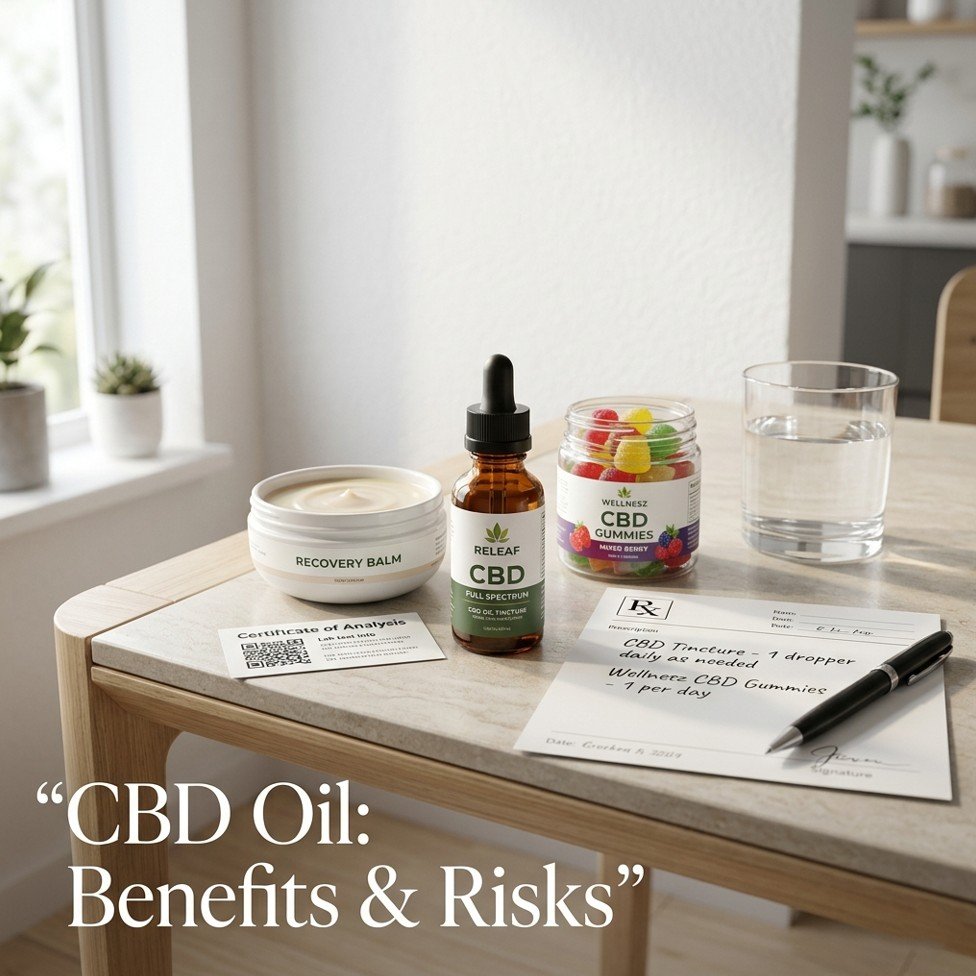
CBD oil is produced by extracting cannabidiol from the cannabis plant and diluting it with a carrier oil, such as coconut or hemp seed oil. There are three main types:
- Full-spectrum CBD: Contains all compounds found in the cannabis plant, including a small amount of THC (less than 0.3% in hemp-derived products).
- Broad-spectrum CBD: Contains multiple cannabinoids and terpenes but typically no THC.
- CBD isolate: The purest form, containing only CBD and no other cannabis compounds.
The concentration of CBD in these products can vary dramatically, and studies have found that many over-the-counter products are inaccurately labeled, containing either less or more CBD than advertised, and sometimes unlabeled amounts of THC.
How Does CBD Work?
The human body has an extensive endocannabinoid system (ECS), a complex signaling network involved in regulating a wide range of physiological processes, including mood, pain sensation, appetite, memory, sleep, and immune function.
Unlike THC, which directly binds to the brain’s CB1 receptors to produce its psychoactive effects, CBD has a more indirect influence on the ECS. It is thought to work by:
- Inhibiting the breakdown of anandamide: An endocannabinoid often called the “bliss molecule.” By slowing its breakdown, CBD may increase anandamide levels, potentially reducing anxiety and improving mood.
- Interacting with other receptors: CBD influences serotonin receptors (5-HT1A), which are involved in anxiety and depression; vanilloid receptors (TRPV1), which play a role in pain perception; and adenosine receptors, which may affect sleep and inflammation.
- Reducing inflammation: CBD has been shown to have anti-inflammatory effects, which may contribute to its potential for pain relief.
What Does the Evidence Say?
The scientific evidence for CBD is strong for a few specific conditions, promising for others, and lacking for many more. Here is a breakdown.
1. Epilepsy (Strong Evidence)
The most robust evidence for CBD is in treating rare, severe forms of childhood epilepsy. The FDA has approved a purified pharmaceutical-grade CBD oral solution called Epidiolex for the treatment of seizures associated with Lennox-Gastaut syndrome (LGS), Dravet syndrome (DS), and tuberous sclerosis complex (TSC) in patients as young as one year old. This approval was based on three randomized, double-blind, placebo-controlled clinical trials in 516 patients that demonstrated CBD was effective in reducing the frequency of seizures.
2. Anxiety (Mixed Evidence)
Anxiety is one of the most common reasons people try CBD. While some studies and clinical trials have shown promising results, the overall evidence is mixed and of low to moderate quality.
- Positive findings: A 2024 double-blind, multicenter randomized clinical trial of 178 participants with mild to moderate anxiety disorders found that a nanodispersible CBD oral solution was effective and well-tolerated for treating anxiety, as well as associated depression and sleep disturbances. Another 2025 study found that both 300 mg and 900 mg doses of oral CBD reduced anxiety relative to placebo.
- Negative findings: A 2025 systematic review and meta-analysis concluded that low-quality evidence suggests pharmaceutical-grade CBD may have only limited efficacy for generalized anxiety disorder (GAD) and social anxiety disorder (SAD). Furthermore, a 2025 randomized controlled trial found that CBD did not improve treatment outcomes when used as an adjunctive therapy for panic disorder and social anxiety disorder.
- The bottom line: While some research shows a signal for benefit, the evidence is inconsistent. Experts agree that more robust, large-scale clinical trials are needed to determine CBD’s true efficacy for specific anxiety disorders.
3. Chronic Pain (Mixed to Limited Evidence)
Many people use CBD for chronic pain, especially neuropathic (nerve) pain. However, the evidence from high-quality studies is not strong.
- A 2026 Cochrane review (the gold standard of evidence synthesis) concluded that there remains no clear evidence that cannabis-based medicines, including CBD, are successful in treating chronic neuropathic pain.
- A 2025 living systematic review for the Agency for Healthcare Research and Quality (AHRQ) found that CBD-dominant products were not consistently associated with pain improvement. The small benefits observed were mostly for products containing THC, with only “low- to moderate-strength evidence” suggesting small improvements in pain.
- A 2025 narrative review noted that while CBD has been evaluated as an analgesic without the issues of tolerance or dependence seen with opioids, further intensive study is warranted.
4. Other Conditions
Evidence for other conditions, including insomnia, Parkinson’s disease, and inflammatory bowel disease, remains preliminary. Some studies show modest benefits for sleep, but more research is needed.
Comparison with THC and Medical Marijuana
It is crucial to distinguish CBD from medical marijuana.
| Feature | CBD Oil (Hemp-derived) | Medical Marijuana / THC products |
|---|---|---|
| Primary Source | Hemp (Cannabis with <0.3% THC) | Cannabis strains with varying, often higher, THC levels |
| Psychoactivity | Non-psychoactive (does not cause a “high”) | Psychoactive (causes a “high” via THC) |
| Legal Status (US) | Federally legal (2018 Farm Bill) | Federally illegal; legal in many states for medical/recreational use |
| Primary Evidence | Epilepsy (Epidiolex); mixed for anxiety/pain | Chronic pain, spasticity (multiple sclerosis), chemotherapy-induced nausea |
| Medical Use | Often self-directed with over-the-counter products | Usually prescribed by a doctor for specific conditions |
How to Use CBD Oil: Practical Applications
Choosing a Product
- Look for third-party testing: Reputable brands provide a certificate of analysis (COA) from an independent lab confirming the product’s CBD and THC content and checking for contaminants like heavy metals and pesticides.
- Start with a low dose: Dosing is highly individual. A common recommendation is to “start low and go slow,” beginning with a small dose (e.g., 5–10 mg) and gradually increasing until you achieve the desired effect.
- Full-spectrum vs. isolate: Some research suggests full-spectrum products may be more effective due to the “entourage effect,” where other plant compounds work synergistically with CBD.
Methods of Administration
The method you choose affects how quickly and for how long you feel the effects.
- Sublingual (under the tongue): The most common method for oils and tinctures. Effects begin in 15–30 minutes and last 2–4 hours. Place the oil under your tongue and hold for 60–90 seconds before swallowing.
- Oral (edibles, capsules, gummies): Effects are slower (1–2 hours) but last longer (6–12 hours). High doses of ingested CBD may interact with medications.
- Topical (creams, balms): Applied directly to the skin for localized relief of pain, inflammation, or skin conditions. Not absorbed into the bloodstream.
- Inhalation (vaping): Fastest onset (1–3 minutes) but shortest duration (1–3 hours). Carries potential risks to lung health and is not recommended as a first-line method.
Safety, Side Effects, and Who Should Avoid CBD
CBD is generally well-tolerated, but it is not without risks, especially at higher doses and with long-term use.
Common Side Effects
Serious Risks
- Liver Toxicity (Hepatotoxicity): This is a significant concern, particularly at higher doses. A phase I clinical trial in healthy adults found that taking 1,500 mg of CBD daily for about 3.5 weeks caused 44% of participants to experience elevated liver enzymes, with 31% meeting the criteria for drug-induced liver injury. The FDA-approved drug Epidiolex also carries a warning for elevated liver enzymes.
- Drug Interactions (Critical Warning): CBD is broken down by the same liver enzymes (cytochrome P450) that metabolize many common medications. CBD can interfere with these enzymes, leading to too much or too little of the other drug in your system, which can be dangerous. More than 57 medications have been identified as having potentially serious interactions, including warfarin (blood thinner), some heart medications, antibiotics, antidepressants, and benzodiazepines.
- Male Reproductive Toxicity: The FDA has raised concerns about potential harm to male fertility based on animal studies.
Who Should Avoid CBD
Based on current evidence, the following groups should avoid using CBD:
- Pregnant or breastfeeding women: The CDC and FDA advise against using any CBD product during pregnancy or while nursing. Animal studies show high doses can harm a developing fetus, and it is unknown if CBD passes into breast milk.
- People with liver disease: The FDA states that people with moderate to severe hepatic impairment should not take CBD. Even healthy adults can experience liver damage at high doses.
- Children: The only approved CBD product for children is the prescription drug Epidiolex for specific forms of epilepsy. The safety of over-the-counter CBD products for children is unknown.
- People taking medications that interact with CBD: Always consult your doctor before trying CBD if you take any prescription medications.
What Do Doctors and Medical Organizations Think?
Physicians’ opinions on CBD are varied but generally characterized as “cautiously optimistic.” They acknowledge the potential benefits, particularly for epilepsy, while emphasizing the need for more rigorous research and better regulation before making widespread recommendations.
- The American Academy of Neurology (AAN): In its position statement, the AAN does not support the use of cannabis products as medicines for neurological disorders in the absence of sufficient scientific peer-reviewed research. However, it makes an explicit exception for the FDA-approved plant-based pharmaceutical CBD product (Epidiolex) for the treatment of seizures in Lennox-Gastaut, Dravet syndrome, and tuberous sclerosis complex.
- General Medical Consensus: Most doctors agree that while patients may experience benefits, the lack of high-quality clinical trials and regulation makes it difficult to recommend over-the-counter CBD products. They are particularly concerned about potential drug interactions and the long-term effects of CBD, which are largely unknown.
Doctors advise patients to be open about their CBD use, as it is crucial information for managing their overall health and avoiding dangerous drug interactions.
FAQ
Q1: Is CBD legal?
In the US, hemp-derived CBD with less than 0.3% THC is federally legal, but state laws vary. In Europe, regulations differ by country. Always check local laws.
Q2: Will CBD get me high?
No. CBD is non-psychoactive and does not produce the “high” associated with THC. However, some unregulated full-spectrum products may contain trace amounts of THC.
Q3: How long does it take for CBD to work?
This depends on the method. Sublingual oils take 15–30 minutes, edibles take 1–2 hours, and topical creams work almost immediately for localized relief.
Q4: What is the right dose of CBD?
There is no standard dose. It varies by person, body weight, condition, and product potency. The best approach is to “start low and go slow,” beginning with a small dose (e.g., 5–10 mg) and gradually increasing it until you feel the desired effect.
Q5: Can I take CBD with my other medications?
You should talk to your doctor first. CBD can interact with a wide range of medications, including blood thinners, antidepressants, and seizure medications, potentially causing serious side effects.
Q6: Does CBD show up on a drug test?
It is possible. While most drug tests screen for THC and its metabolites, not CBD, some low-quality CBD products may contain enough THC to cause a positive test result.
Key Takeaways
- CBD has strong evidence for treating rare, severe forms of childhood epilepsy, leading to the FDA-approved drug Epidiolex.
- Evidence for its effectiveness in treating anxiety and chronic pain is mixed and limited, with recent high-quality reviews finding no clear benefit.
- CBD is not without risks. High doses can cause liver damage, and it has potentially dangerous interactions with many common medications.
- Physicians are cautiously optimistic but call for more rigorous research and regulation. Major medical organizations support its use only for the approved epilepsy indications.
- If you choose to try CBD, look for products with third-party lab testing, start with a low dose, and always inform your doctor.
Internal Links Used
- Natural remedies for anxiety without medication — in the anxiety section, for context on other natural approaches
- Natural remedies for joint pain and arthritis — in the chronic pain section
- Herbal teas that help you sleep better — in the comparison with CBD for sleep
- Ashwagandha: benefits for stress, sleep and hormones – in the anxiety section
- Medicinal mushrooms: lion’s mane, reishi and chaga – in the chronic pain section
- Homeopathy: real treatment or placebo? The evidence – in the evidence standards section
Sources
- Ateş, G., et al. (2026). “Cannabis‐based medicines for chronic neuropathic pain in adults.” Cochrane Database of Systematic Reviews.
- Gundugurti, P. R., et al. (2024). “Evaluation of the efficacy, safety, and pharmacokinetics of nanodispersible cannabidiol oral solution versus placebo in mild to moderate anxiety subjects: A double blind multicenter randomized clinical trial.” Asian Journal of Psychiatry.
- Bhuller, R., et al. (2024). “Review of the current ongoing clinical trials exploring the possible anti-anxiety effects of cannabidiol.” Journal of Cannabis Research.
- Chou, R., et al. (2025). “Living Systematic Review on Cannabis and Other Plant-Based Treatments for Chronic Pain: 2025 Update.” Agency for Healthcare Research and Quality (AHRQ).
- U.S. Food and Drug Administration (FDA). “FDA Approves Cannabidiol for Lennox-Gastaut Syndrome and Dravet Syndrome.”
- American Academy of Neurology (AAN). “Medical Cannabis Position Statement.”
- Harvard Health Publishing. (2021). “CBD and other medications: Proceed with caution.”
- Watkins, P. B., et al. (2024). “Cannabidiol and Abnormal Liver Chemistries in Healthy Adults: Results of a Phase I Clinical Trial.” Cannabis and Health Research Initiative.
- Balouch, A., et al. (2025). “Unveiling the Unexpected: A Case of Synergistic Drug Reaction to Cannabidiol.” Cureus.
- Advance Study. “How Do Physicians Stand on CBD?”