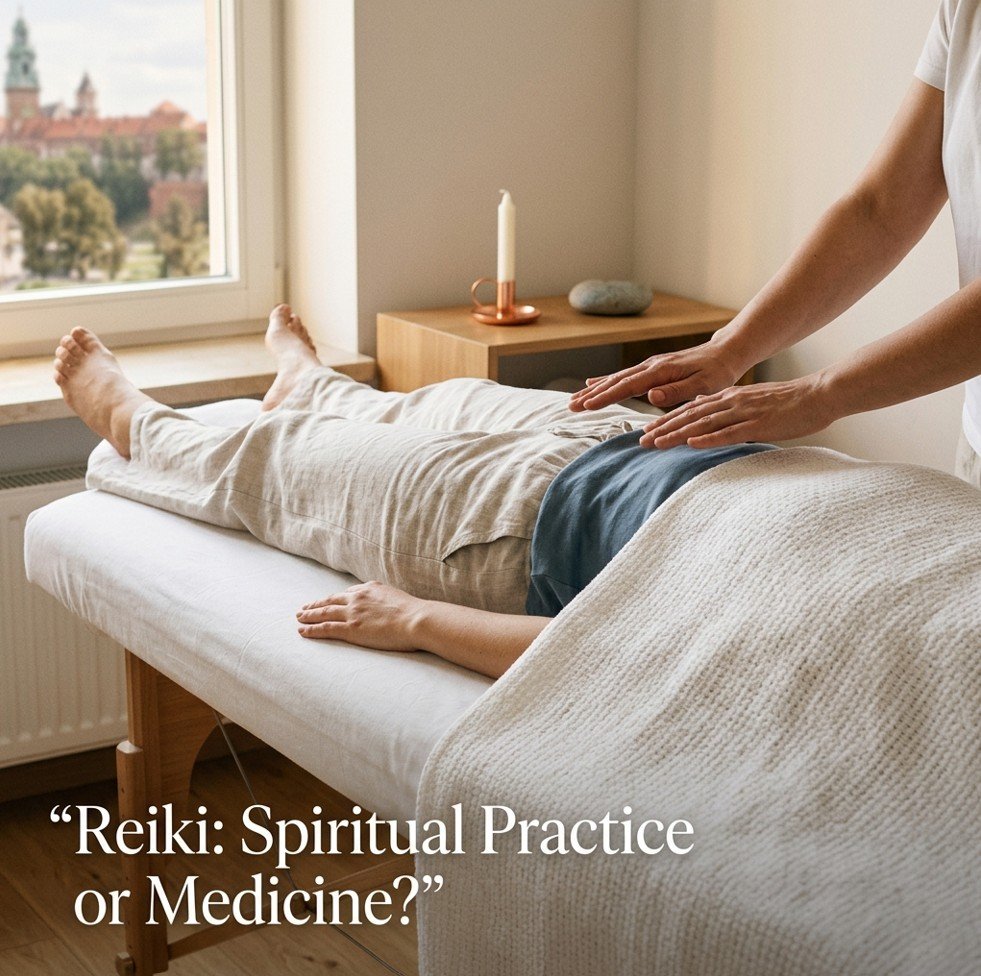
Reiki (pronounced “ray-key”) is a form of energy medicine that originated in Japan in the early 20th century. The word Reiki comes from two Japanese words: “rei” (universal) and “ki” (life energy). Practitioners place their hands lightly on or just above a person’s body with the intention of channeling energy to support the recipient’s own healing process.
Today, Reiki is practiced in hospitals, cancer centers, and wellness clinics worldwide. It is often offered alongside conventional treatments to help patients manage stress, pain, and anxiety. Yet Reiki remains deeply controversial in scientific circles. Critics argue that its core premise — an undetectable “life energy” — is biologically implausible, and that any benefits are attributable to placebo, relaxation, or the therapeutic encounter itself. Proponents point to a growing body of research suggesting that Reiki may reduce pain and anxiety beyond placebo effects.
This article provides a clear-eyed, evidence-informed overview of Reiki, helping readers understand what it is, what the science says, and how to approach it safely.
What Is Reiki? History and Core Principles
Reiki was developed in 1922 by Mikao Usui, a Japanese Buddhist monk. According to tradition, Usui developed the system after a period of fasting and meditation on Mount Kurama, during which he experienced a spiritual awakening and received the ability to channel healing energy. He taught the method to a small group of students, and the practice spread to the West in the 1930s and 1940s through Hawayo Takata, a Japanese-American woman who studied under one of Usui’s disciples.
Core Principles of Reiki
- Universal life energy: Practitioners believe that a vital energy flows through all living things. When this energy is low or blocked, a person may experience illness, stress, or emotional disturbance.
- Channeling: The Reiki practitioner acts as a conduit for this universal energy, allowing it to flow through their hands to the recipient. The practitioner does not use their own energy and is not depleted by the session.
- Hand placements: The practitioner places their hands in a series of positions on or just above the recipient’s body, typically starting at the head and moving down to the feet. Each position is held for 2–5 minutes.
- Non-invasive and intention-based: Reiki involves little to no physical touch (hands may hover above the body) and does not require any ingestion of substances or manipulation of tissues.
Reiki is considered a “biofield therapy” — a category that also includes therapeutic touch and healing touch. A 2025 scoping review identified 88 peer-reviewed studies specifically on Reiki, making it one of the most researched biofield therapies.
How Does Reiki Work? Proposed Mechanisms
There is no scientifically accepted evidence for the existence of the “life energy” or “biofield” that Reiki practitioners describe. However, researchers have proposed several plausible mechanisms that may explain the clinical effects observed in studies.
1. The Relaxation Response
The most widely accepted explanation is that Reiki induces a profound state of relaxation, similar to meditation or deep breathing. This relaxation response lowers sympathetic nervous system activity (the “fight-or-flight” response), reduces heart rate and blood pressure, and decreases stress hormone (cortisol) levels.
2. Therapeutic Touch and Human Connection
Even without the “energy” component, the gentle, attentive presence of another person in a quiet, safe environment can be deeply soothing. The non-sexual, compassionate touch (or near-touch) of a Reiki session may trigger the release of oxytocin and reduce perceptions of pain and anxiety.
3. Expectation and Placebo Effects
Many people seek Reiki because they believe it will help them. This positive expectation can produce real physiological changes through the well-documented placebo effect. However, several studies that compared Reiki to “sham Reiki” (a mock treatment where a non-practitioner mimics hand placements without intention) found that true Reiki produced greater benefits than the sham control, suggesting effects beyond placebo alone.
4. Biofield Hypotheses (Unproven)
Some researchers have proposed that living organisms generate measurable electromagnetic fields, and that Reiki practitioners may have the ability to influence these fields. A small study in 2003 suggested that Reiki-like healing practices might affect membrane stability through quantal perception of low-level electromagnetic fields. However, these findings have not been replicated, and the biofield hypothesis remains speculative.
What the Evidence Says: Systematic Reviews and Meta-Analyses
The evidence base for Reiki has grown substantially in recent years. Several high-quality systematic reviews and meta-analyses have now been published, providing clearer answers about Reiki’s effects.
Quality of Life
A 2025 meta-analysis of randomized controlled trials involving 661 participants found that Reiki therapy significantly enhanced quality of life compared to control conditions (standardized mean difference SMD = 0.28, 95% CI 0.01–0.56, P = 0.043). Subgroup analyses showed that interventions with at least 8 sessions (each lasting ≥ 60 minutes) or acute interventions of ≤ 20 minutes were most effective. The authors concluded that Reiki positively impacts quality of life and recommended it for cancer patients, surgical patients, and those with chronic illnesses.
Anxiety
A 2024 meta-analysis of 10 studies involving 824 participants found that Reiki therapy had a significant effect on anxiety reduction (SMD = -0.82, 95% CI -1.29 to -0.36, P = 0.001). Short-term interventions of ≤ 3 sessions and 6–8 sessions demonstrated effectiveness in reducing health-related and procedural anxiety in patients with chronic conditions such as fibromyalgia, depression, and gastrointestinal inflammation, as well as in the general population.
However, the same meta-analysis noted that the efficacy of Reiki for preoperative anxiety and death-related anxiety in cancer patients was less consistent, which may be due to individual psychological and physiological differences.
Pain
Multiple recent randomized controlled trials have examined Reiki for pain:
- Cancer patients: A 2025 three-armed, double-blinded, randomized trial (58 participants) found that Reiki was more effective in reducing pain, anxiety, and stress levels than sham Reiki or progressive relaxation exercise. Improvements in the Reiki group were sustained at 3-month follow-up.
- Mechanically ventilated patients: A 2025 randomized, single-blind, sham-controlled trial (60 participants) found that a single 30-minute Reiki session significantly reduced pain scores (P = 0.009) and anxiety levels (P = 0.04) compared to sham Reiki. Reiki also reduced diastolic blood pressure (P = 0.019) and heart rate (P = 0.001).
- Chronic knee osteoarthritis: A 2025 placebo-controlled randomized trial (164 participants) found that both Reiki and mindfulness reduced knee osteoarthritis symptoms after just four short sessions. Reiki effects were comparable to mindfulness and superior to waitlist controls.
A systematic review published in the Merck Manual notes that while a systematic review of Reiki for pain and anxiety suggested beneficial results, high-quality clinical trials are limited and evidence is mixed.
Stress and Cortisol
A 2024 randomized placebo-controlled trial in patients with cardiac disease found that Reiki significantly reduced blood cortisol levels and anxiety compared to both sham and control groups. However, a 2025 study in cancer patients found no significant difference in cortisol levels between groups, though Reiki did reduce perceived stress. This discrepancy suggests that stress reduction may operate through subjective rather than strictly biochemical pathways.
Sleep Disturbance
A 2024 systematic review and meta-analysis of 3 randomized controlled trials found that Reiki significantly improved sleep disturbance compared to control groups (total effect size -0.62, 95% CI -0.979 to -0.262, P < 0.001). However, the authors concluded that “Reiki remains unproven effectiveness thus more evidence is needed before it can be accepted as useful, or discarded as useless”.
Depression
The evidence for Reiki in depression is weaker. A 2015 Cochrane review found no benefit for depression, and the Merck Manual notes that systematic reviews have not shown benefit for depression or other clinical conditions.
NCCIH Position and Overall Evidence Assessment
The National Center for Complementary and Integrative Health (NCCIH) — the U.S. government’s lead agency for scientific research on complementary and integrative health — has evaluated the evidence on Reiki. NCCIH concludes:
- Reiki has not been clearly shown to be effective for any health-related purpose. Most research has not been of high quality, and results have been inconsistent.
- There is no scientific evidence supporting the existence of the energy field thought to play a role in Reiki.
- Reiki has not been shown to have any harmful effects.
NCCIH also notes that Reiki is a complementary approach intended to support the body’s own healing response, and it should be used as a complement — not a replacement — when medical evaluation or treatment is needed.
Practical Applications: How to Try Reiki Safely
What to Expect in a Reiki Session
- Setting: A quiet, comfortable room, often with soft lighting or music. You remain fully clothed.
- Position: You typically lie on a massage table or sit in a chair.
- Hand placements: The practitioner places their hands lightly on or just above your body in a series of positions (head, shoulders, abdomen, knees, feet). Each position is held for 2–5 minutes.
- Sensations: Many people report feeling deep relaxation, warmth, tingling, or a sense of peace. Some people feel nothing at all.
- Duration: Sessions typically last 30–60 minutes.
Finding a Qualified Practitioner
Reiki is not regulated in most countries, so anyone can call themselves a Reiki practitioner. To find a qualified practitioner:
- Look for someone who has completed formal training (Level I, II, and Master level) through a reputable organization.
- Ask about their training, experience, and professional affiliations (e.g., International Association of Reiki Professionals, Reiki Membership Association).
- Consider practitioners who work in hospital settings or integrative medicine centers (they often have more rigorous credentialing).
Using Reiki as a Complementary Approach
Reiki is best used alongside — not instead of — conventional medical care.
- Do not replace prescribed medications or treatments with Reiki.
- Do not delay seeking medical attention for serious symptoms.
- Do inform your healthcare providers about any complementary therapies you are using.
- Do consider Reiki for stress reduction, relaxation, and emotional support during medical treatment (e.g., chemotherapy, surgery, physical therapy).
Comparison with Conventional Medicine
| Aspect | Reiki | Conventional Medicine |
|---|---|---|
| Proposed mechanism | Channeling universal life energy (biofield) | Biochemistry, physiology, pharmacology |
| Scientific plausibility | No accepted mechanism; energy field unproven | Well-established mechanisms |
| Evidence base | Growing but limited; inconsistent quality; some meta-analyses positive | Rigorous RCTs and meta-analyses |
| Primary effects | Stress reduction, relaxation, emotional well-being | Treats specific diseases (infections, cancer, heart disease) |
| Safety | No known harmful effects (non-invasive, no drugs) | Well-characterized side effects |
| Best use | Complementary support for chronic conditions, stress, pain | Acute emergencies, serious diseases, evidence-based treatments |
| Regulation | Unregulated; variable practitioner quality | Strict (FDA, EMA, MHRA) |
Safety, Risks, and Who Should Avoid Reiki
General Safety
Reiki is widely considered very safe. It is non-invasive, involves no drugs or supplements, and does not require any physical manipulation that could cause injury. No serious adverse effects have been reported in the scientific literature, and two systematic reviews noted no adverse effects were reported in their included studies.
Occasional Experiences
Some people experience a temporary intensification of symptoms during or after a Reiki session. This may include:
- A momentary feeling of discomfort at the site of an old injury
- Fatigue or tiredness
- Emotional release (e.g., crying)
These experiences are usually transient and considered by practitioners to be part of the body’s healing process. However, if symptoms worsen or persist, you should consult your healthcare provider.
The Most Important Safety Consideration
The greatest risk of Reiki — as with any complementary therapy — is delaying or replacing conventional medical treatment. If you have a serious or acute medical condition (chest pain, difficulty breathing, unexplained weight loss, bleeding, severe infection, suspected cancer), you must seek medical attention immediately. Reiki should not be used to “treat” serious diseases such as cancer, heart disease, or infections.
Who Should Use Caution
- Pregnant women: There is not enough reliable information to know if Reiki therapy is safe during pregnancy. Most practitioners avoid abdominal hand placements. Discuss with your obstetrician before receiving Reiki.
- People with psychiatric conditions: Caution is recommended when working with people experiencing psychiatric conditions. Reiki should never replace psychiatric medication or therapy.
- People with medical devices: Reiki is generally safe, but individuals with pacemakers or other implanted devices should inform their practitioner.
- Children: Reiki is generally considered safe for children, but parental supervision and pediatrician consultation are advised.
FAQ
Q1: Is Reiki a religion or a spiritual practice?
Reiki is not a religion. It does not require belief in any particular deity, dogma, or doctrine. However, it does have spiritual elements derived from Buddhist and Shinto traditions (e.g., the concept of universal life energy). People of all faiths — and those with no religious beliefs — can receive Reiki without compromising their own beliefs.
Q2: Can Reiki be performed from a distance (distance Reiki)?
Yes, many Reiki practitioners offer “distance Reiki” or “remote Reiki.” The practitioner intends to channel energy to a person who is not physically present. There is no scientific evidence supporting the efficacy of distance Reiki beyond placebo, but some patients find it comforting. A 2024 trial included a distance Reiki component (Day 2 of the intervention) and still found positive effects, though the distance component was not tested in isolation.
Q3: How many Reiki sessions do I need?
This varies depending on your condition and goals. For acute anxiety or pain, some studies show benefits with as few as 1–3 sessions. For chronic conditions or quality of life improvement, 6–8 sessions may be more effective. Many people use Reiki as an ongoing wellness practice.
Q4: Is Reiki covered by health insurance?
Reiki is generally not covered by health insurance in the United States or most other countries. However, some hospitals and cancer centers offer Reiki as part of their integrative medicine programs, and the cost may be bundled into other services. Always check with your insurance provider.
Q5: Can Reiki cure cancer or other serious diseases?
No. There is no scientific evidence that Reiki can cure cancer, heart disease, infections, or any other serious medical condition. Reiki is best used as a complementary therapy to help manage symptoms (pain, anxiety, fatigue) and improve quality of life during conventional medical treatment. Never delay or refuse conventional cancer treatment in favor of Reiki.
Q6: Is there any scientific evidence that Reiki works?
Yes, but the evidence is mixed. Some meta-analyses show statistically significant benefits for quality of life, anxiety, and pain, while others conclude that high-quality trials are limited and results are inconsistent. Major organizations like NCCIH state that Reiki has not been clearly shown to be effective for any health-related purpose. The most plausible explanation for observed benefits is the relaxation response, therapeutic touch, and placebo effects — not the existence of “universal life energy.”
Key Takeaways
- Reiki is a Japanese energy healing technique in which practitioners place their hands lightly on or above the body to channel “universal life energy” and support the recipient’s own healing response.
- The proposed mechanism — an undetectable biofield — is not scientifically validated. However, the relaxation response, therapeutic touch, and placebo effects may explain observed benefits.
- Meta-analyses show that Reiki may improve quality of life (SMD 0.28), reduce anxiety (SMD -0.82), and provide modest pain relief. Evidence for depression and sleep disturbance is weaker or inconsistent.
- Reiki has no known harmful effects and can be safely used alongside conventional medical care.
- Critical safety warning: The greatest risk of Reiki is delaying or replacing evidence-based medical treatment for serious diseases (cancer, heart disease, infections). Never use Reiki as a substitute for conventional medical care.
- If you choose to try Reiki, find a qualified practitioner, use it as a complement to — not a replacement for — medical treatment, and always inform your healthcare providers.
Internal Links Used
- What is Ayurveda and can it really heal your body? — as another traditional medicine system often compared to Reiki
- Acupuncture for pain relief: what science says — as another complementary therapy for pain and anxiety
- Natural remedies for anxiety without medication — in the anxiety section, for readers seeking additional evidence-based anxiety management strategies
- Adaptogens: ancient herbs for modern stress — in the stress reduction section, as another natural approach to stress management
- Acupuncture for pain relief: what science says – in the energy medicine section
- Chiropractic care: what works and what doesn’t – in the complementary therapy section
- Aromatherapy: can scents really affect your health? – in the relaxation response section
Sources
- Effects of Reiki therapy on quality of life: a meta-analysis of randomized controlled trials. Systematic Reviews. 2025;14:72.
- Guo X, Long Y, Qin Z, Fan Y. Therapeutic effects of Reiki on interventions for anxiety: a meta-analysis. BMC Palliative Care. 2024;23(1):147.
- Ko LH, Chang YC, Hu WY. Effects of Reiki on Sleep Disturbance: A Systematic and Meta-Analysis of Randomized Controlled Trials. SSRN. 2024.
- Kahveci SO, et al. The Effect of Reiki Applied to Cancer Patients on Pain, Anxiety, and Stress Levels: A Randomized Controlled Study. Seminars in Oncology Nursing. 2025;41(2):151807.
- Karacan Y, et al. Effect of Reiki on Pain, Anxiety, and Hemodynamic Parameters in Mechanically Ventilated Patients: A Randomized, Single-Blind, and Placebo-Controlled Trial. J Integr Complement Med. 2025.
- Bektas Akpinar N, et al. Is Reiki effective in reducing heart rhythm, cortisol levels, and anxiety and improving biochemical parameters in individuals with cardiac disease? Randomized placebo-controlled trial. European Journal of Cardiovascular Nursing. 2024.
- Singla A, Wasserman MR. Reiki. Merck Manual Professional Edition. October 2025.
- National Center for Complementary and Integrative Health (NCCIH). Reiki.
- Taking Charge of Your Wellbeing. Are There Any Safety Concerns for Using Reiki? University of Minnesota.
- Biofield Therapies Clinical Research Landscape: A Scoping Review and Interactive Evidence Map. Journal of Evidence-Based Complementary & Alternative Medicine. 2025.
- Complementary therapies for chronic knee pain: A placebo-controlled RCT of Reiki and mindfulness. ScienceDirect. 2025.