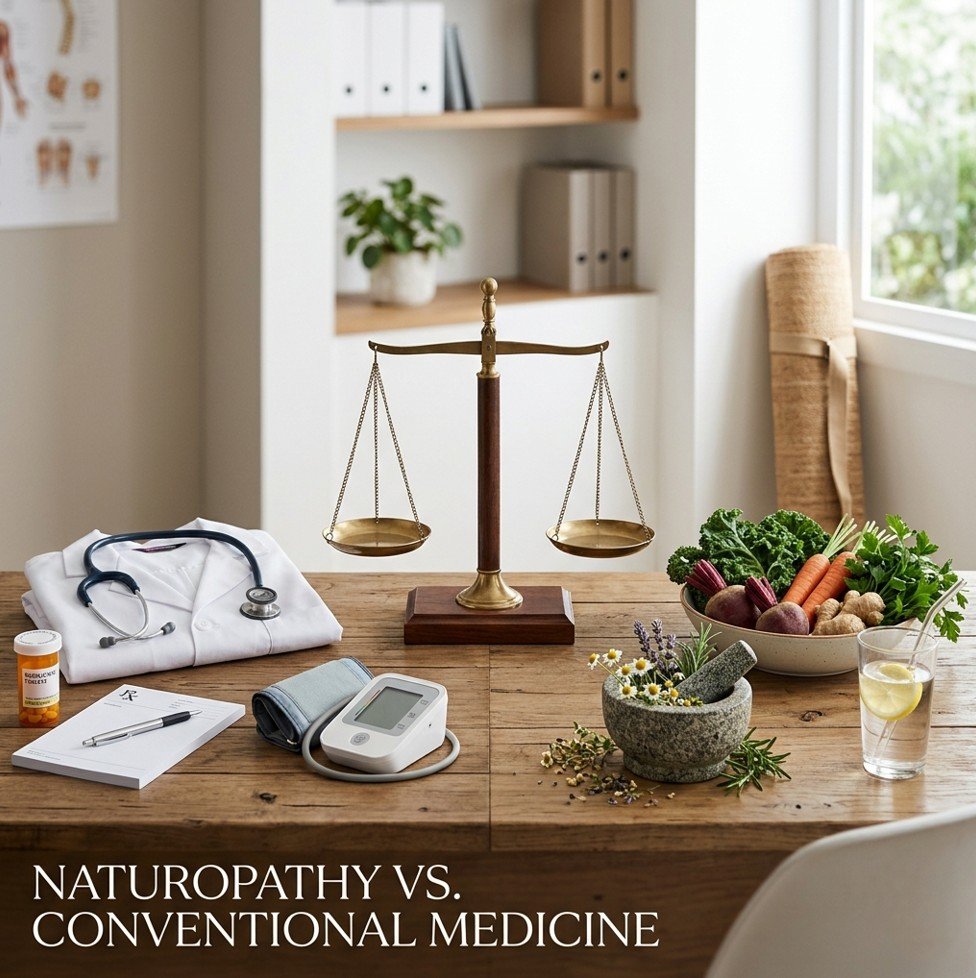
Naturopathy, or naturopathic medicine, is a system of healthcare that originated in Europe in the 19th century and was further developed in North America. It is based on the belief that the body has an innate ability to heal itself when given the right support. Naturopaths use a range of natural therapies — including clinical nutrition, herbal medicine, lifestyle counseling, hydrotherapy, physical medicine, and sometimes acupuncture or homeopathy — to support the body’s own healing processes.
Conventional medicine (also called allopathic medicine) is the dominant healthcare system in most Western countries. It focuses on the diagnosis and treatment of disease using pharmacologically active drugs, surgery, radiation, and other interventions that are rigorously tested in randomized controlled trials.
Both systems have strengths and limitations. This article provides a clear, evidence-informed comparison to help patients and healthcare consumers understand the differences and make informed decisions about their care.
What Is Naturopathy? Core Principles
Naturopathy is guided by six core principles, as defined by the American Association of Naturopathic Physicians (AANP) and the World Health Organization (WHO):
- First, do no harm (Primum non nocere): Naturopaths use the least invasive, least toxic therapies possible. They avoid suppressing symptoms without addressing underlying causes.
- The healing power of nature (Vis medicatrix naturae): The body has an inherent ability to heal itself. Naturopathy aims to support this self-healing process by removing obstacles to health.
- Identify and treat the cause (Tolle causam): Rather than simply suppressing symptoms, naturopaths seek to identify and address the underlying root causes of illness (e.g., poor diet, chronic stress, toxin exposure, gut dysbiosis).
- Doctor as teacher (Docere): Naturopaths educate patients about their bodies, health risks, and self-care strategies, empowering them to take responsibility for their own health.
- Treat the whole person (Tolle totum): Health is viewed as a complex interaction of physical, mental, emotional, genetic, environmental, and social factors. Treatment addresses all of these dimensions.
- Prevention is the best cure: Emphasis is placed on promoting health and preventing disease through lifestyle, nutrition, and stress management.
Training and Regulation
The scope and regulation of naturopathy vary significantly by country.
- United States and Canada: Naturopathic doctors (NDs) attend accredited four-year, graduate-level naturopathic medical schools. The curriculum includes basic medical sciences (anatomy, physiology, biochemistry, pathology, pharmacology) as well as clinical nutrition, botanical medicine, physical medicine, hydrotherapy, and lifestyle counseling. In regulated jurisdictions (e.g., Oregon, Washington, British Columbia), NDs are licensed to perform physical exams, order diagnostic tests, prescribe certain medications (varies by state/province), and treat a broad range of conditions. In unregulated jurisdictions, anyone can call themselves a naturopath, and standards vary widely.
- United Kingdom and Europe: Naturopathy is not state-regulated in most countries. Naturopaths may complete diploma or degree programs (typically 3–4 years), but there is no statutory regulation. The General Naturopathic Council (GNC) maintains a voluntary register.
- Australia: Naturopathy is not government-regulated, but professional organizations (e.g., Australian Naturopathic Practitioners Association) set educational standards and codes of conduct.
What Is Conventional Medicine? Core Principles
Conventional medicine (biomedicine) is based on the scientific method and evidence from randomized controlled trials, systematic reviews, and mechanistic studies. Its core principles include:
- Disease-centered approach: Focus is on diagnosing specific diseases using objective tests (blood work, imaging, pathology) and treating them with targeted interventions.
- Evidence-based practice: Clinical decisions are guided by the best available research evidence, clinical expertise, and patient values.
- Pharmacological and surgical intervention: The primary tools are drugs (to alter physiology) and surgery (to remove or repair diseased tissue).
- Acute care excellence: Conventional medicine excels at treating acute emergencies, severe infections, trauma, and conditions requiring intensive monitoring.
- Specialization: Practitioners typically specialize by organ system (e.g., cardiology, neurology) or patient population (e.g., pediatrics, geriatrics).
Training and Regulation
Conventional medical doctors (MDs or DOs in the US; MBBS or equivalent in other countries) complete a bachelor’s degree followed by four years of medical school, then 3–7 years of residency training in a specialty. They are licensed by state or national medical boards and are subject to strict continuing education and disciplinary standards.
Key Differences Between Naturopathy and Conventional Medicine
| Feature | Naturopathy | Conventional Medicine |
|---|---|---|
| Philosophical focus | Whole person, root cause, prevention, self-healing | Disease-specific, symptom-focused, acute intervention |
| Diagnostic approach | Comprehensive history, lifestyle assessment, standard labs, sometimes functional tests (e.g., food sensitivity, stool analysis) | Standard medical history, physical exam, standard labs, imaging, pathology |
| Primary interventions | Nutrition, lifestyle counseling, herbal medicine, supplements, hydrotherapy, physical medicine, stress reduction | Pharmaceuticals, surgery, radiation, advanced procedures |
| Evidence base | Variable; some interventions (nutrition, exercise, certain herbs) have strong evidence; others (homeopathy, some detox protocols) lack evidence | Strong, rigorous RCTs and meta-analyses for most interventions |
| Treatment of acute emergencies | Not appropriate (e.g., heart attack, stroke, severe trauma, bacterial sepsis) | Highly effective (emergency medicine, intensive care, antibiotics, surgery) |
| Chronic disease management | May offer supportive, preventive, and lifestyle-based approaches; can be used alongside conventional care | Effective for managing chronic conditions (e.g., hypertension, diabetes, asthma) with medications |
| Regulation | Variable; licensed NDs in some jurisdictions; unregulated in others | Strict regulation; licensed physicians in all jurisdictions |
| Insurance coverage | Limited; often out-of-pocket | Broadly covered by insurance in most countries |
| Scope of practice | Primary care in regulated jurisdictions; may order labs, perform physical exams, prescribe some medications | Full scope: prescribe all medications, perform surgery, admit to hospitals |
What the Evidence Says About Naturopathy
Assessing the evidence for “naturopathy” as a whole is challenging because it is not a single intervention but a framework that incorporates many different therapies. Some components have strong evidence; others do not.
Well-Evidenced Components
- Dietary and lifestyle counseling: Strong evidence for preventing and managing cardiovascular disease, type 2 diabetes, obesity, and metabolic syndrome.
- Herbal medicine: Some herbs (e.g., St. John’s wort for mild depression, saw palmetto for benign prostatic hyperplasia, garlic for blood pressure) have RCT evidence, though quality varies.
- Nutritional supplements: Evidence supports vitamin D for bone health, omega-3 fatty acids for cardiovascular health, and folic acid in pregnancy for neural tube defect prevention.
- Physical medicine (exercise prescription): Strong evidence for chronic low back pain, osteoarthritis, and fall prevention in the elderly.
- Hydrotherapy: Limited but promising evidence for some musculoskeletal and respiratory conditions (e.g., contrast hydrotherapy for ankle sprains).
Limited or Insufficient Evidence
- Homeopathy: Multiple systematic reviews conclude there is no reliable evidence that homeopathy is effective for any health condition (see Article 25).
- “Detox” protocols: No evidence that commercial detox kits or restrictive cleansing diets remove toxins or improve health beyond placebo.
- Food sensitivity (IgG) testing: Not supported by allergy societies; may lead to unnecessary dietary restrictions.
- Some traditional naturopathic treatments for cancer: No evidence that naturopathy alone cures cancer; delaying conventional treatment can be dangerous.
Evidence for Naturopathy as a Whole
A 2021 systematic review of 14 randomized controlled trials (2,130 participants) evaluating naturopathic medicine for various conditions (including cardiovascular disease, anxiety, depression, and chronic pain) found that naturopathic care — typically involving dietary counseling, nutritional supplements, stress management, and lifestyle advice — was associated with small to moderate improvements in outcomes compared to usual care or waitlist controls. However, the authors noted high risk of bias in many studies and called for more rigorous research.
A 2019 cohort study of 1,158 patients with type 2 diabetes found that those receiving naturopathic care (in addition to conventional care) had greater improvements in HbA1c and blood pressure compared to those receiving conventional care alone, though the effect was modest.
Practical Applications: How to Integrate Naturopathy Safely
When Naturopathy May Be Beneficial
- Prevention: Lifestyle and nutrition counseling for individuals at risk of chronic disease.
- Support for chronic conditions: As an adjunct to conventional care for hypertension, diabetes, mild anxiety, depression, and osteoarthritis.
- Patient education: Naturopaths often spend more time explaining the “why” behind health recommendations, which can empower patients.
- Medication reduction: In some cases, naturopathic interventions (e.g., dietary changes) may help reduce medication doses under medical supervision.
When Conventional Medicine Is Essential
- Acute emergencies: Chest pain, difficulty breathing, severe bleeding, trauma, stroke symptoms, acute abdomen, severe infections.
- Serious diagnoses: Cancer, heart disease, kidney failure, severe autoimmune disease, psychiatric emergencies.
- Conditions requiring surgery or advanced procedures: Appendicitis, gallstones, fractures, tumors.
- Infections requiring antibiotics: Bacterial pneumonia, urinary tract infections, strep throat, sepsis.
Integrating Both Approaches
The most responsible approach is integrative medicine — combining the strengths of both systems. For example:
- A patient with type 2 diabetes continues metformin (conventional) while also working with a naturopath on diet and exercise to improve insulin sensitivity.
- A patient with anxiety sees a psychologist for CBT (evidence-based) and uses ashwagandha (naturopathic) as an adjunct, with their doctor’s knowledge.
Never stop prescribed medications to pursue naturopathic treatment without medical supervision.
Safety, Risks, and Who Should Avoid Naturopathy
General Safety
When practiced by a qualified, licensed naturopathic doctor in a regulated jurisdiction, naturopathy is generally safe. However, risks exist:
- Delayed or avoided conventional care: The greatest risk is using naturopathy as a substitute for evidence-based medical treatment for serious or acute conditions. Delaying surgery, antibiotics, or chemotherapy can be fatal.
- Herb-drug interactions: Many herbs used in naturopathy (e.g., St. John’s wort, garlic, ginkgo, curcumin) interact with prescription medications, including blood thinners, antidepressants, immunosuppressants, and oral contraceptives.
- Unvalidated testing: Some naturopaths use tests not supported by evidence (e.g., provoked heavy metal testing, food sensitivity IgG panels, adrenal fatigue salivary panels). These can lead to unnecessary treatments and anxiety.
- High-dose supplements: Megadoses of vitamins or minerals can cause toxicity (e.g., vitamin B6 neuropathy, vitamin D toxicity, iron overload).
- Unregulated practitioners: In jurisdictions where naturopathy is not regulated, anyone can call themselves a naturopath. These practitioners may lack proper training and may promote dangerous treatments.
Who Should Avoid or Use Caution
- People with serious or acute medical conditions: Naturopathy should not replace conventional care for cancer, heart disease, infections, or emergencies.
- Pregnant and breastfeeding women: Some herbs (e.g., blue cohosh, black cohosh) can be dangerous in pregnancy. Consult both an obstetrician and a qualified ND.
- People on multiple medications: Risk of herb-drug interactions is high. A pharmacist or physician should review your regimen.
- Children: Naturopathy for children should be supervised by a pediatrician. Avoid unregulated practitioners.
How to Choose a Safe Naturopathic Practitioner
- Check credentials: In the US and Canada, look for “ND” or “Naturopathic Doctor” who has graduated from an accredited four-year naturopathic medical school (e.g., Bastyr, National, Canadian College of Naturopathic Medicine).
- Verify regulation: In regulated jurisdictions (e.g., Oregon, Washington, British Columbia), NDs are licensed by state/provincial boards. You can check their license status.
- Ask about evidence: A responsible naturopath will be able to explain the evidence (or lack thereof) for their recommendations and will not discourage conventional medical care.
- Red flags: Avoid practitioners who claim to cure cancer, recommend against vaccination, discourage prescribed medications, promote expensive “detox” kits, or use unvalidated testing.
Comparison Table: Naturopathy vs. Conventional Medicine
| Aspect | Naturopathy | Conventional Medicine |
|---|---|---|
| Core belief | Body heals itself; remove obstacles to health | Disease is a biological dysfunction; treat with targeted intervention |
| Treatment focus | Root causes, prevention, whole person | Symptoms, disease mechanisms, acute stabilization |
| Primary tools | Nutrition, herbs, lifestyle, hydrotherapy, physical medicine | Pharmaceuticals, surgery, radiation, advanced technology |
| Consultation length | Often 45–90 minutes (initial) | Typically 10–20 minutes |
| Evidence base | Variable; strong for lifestyle, weak for some traditional modalities | Strong for most interventions (RCTs, meta-analyses) |
| Acute care | Not appropriate | Highly effective |
| Chronic disease | Supportive, preventive, lifestyle-focused | Pharmacological management; can be lifelong |
| Regulation | Variable (regulated in some states/provinces) | Strict, universal |
| Insurance | Limited coverage; often out-of-pocket | Broad coverage |
| Best used as | Complementary, preventive, supportive | Primary, acute, disease-specific |
FAQ
Q1: Is naturopathy evidence-based?
Some components are evidence-based (dietary counseling, exercise prescription, certain herbs). Others (homeopathy, certain detox protocols) lack evidence. A good naturopath uses evidence-informed approaches and acknowledges uncertainty. The field as a whole has limited high-quality research compared to conventional medicine.
Q2: Can a naturopath be my primary care doctor?
In regulated jurisdictions (e.g., Oregon, Washington, British Columbia), licensed naturopathic doctors can serve as primary care providers. However, they refer to conventional specialists when needed. In unregulated jurisdictions, naturopaths are not qualified to act as primary care providers. Even in regulated areas, many patients use naturopathy as a complement to conventional care, not a replacement.
Q3: Does naturopathy work for cancer?
No. There is no evidence that naturopathy alone can treat or cure cancer. Naturopathy may be used as a complementary therapy to help manage side effects of conventional cancer treatment (e.g., nausea, fatigue, anxiety) and support overall well-being. However, never replace chemotherapy, radiation, or surgery with naturopathy — this can be fatal. Always inform your oncologist about any naturopathic treatments you are using.
Q4: Is naturopathy covered by health insurance?
In the US, some insurance plans cover naturopathic services in states where NDs are licensed, but coverage is often limited. In Canada, naturopathy is generally not covered by provincial health plans, though some employer-sponsored plans offer partial coverage. In the UK and Europe, naturopathy is typically out-of-pocket. Always check your policy.
Q5: What is the difference between a naturopath and a functional medicine practitioner?
Both emphasize root causes, lifestyle, and prevention. Naturopathy is a distinct profession with its own training and regulatory bodies, and it includes a broader range of traditional therapies (hydrotherapy, homeopathy, physical medicine). Functional medicine is a practice model (not a separate profession) that uses systems biology and advanced testing; most functional medicine practitioners are conventionally trained doctors (MDs or DOs) or other licensed providers. See Article 26 for more on functional medicine.
Q6: Is it safe to see a naturopath while taking prescription medications?
Yes, but only if you inform both your naturopath and your prescribing physician about all treatments. Herb-drug interactions are common. A responsible naturopath will check for interactions and will never advise you to stop prescribed medication without consulting your doctor. Bring a complete list of all supplements and herbs to your doctor appointments.
Key Takeaways
- Naturopathy is a distinct system of primary healthcare that emphasizes prevention, self-healing, and natural therapies (nutrition, herbs, lifestyle). It is guided by six core principles, including “first do no harm” and “treat the cause.”
- Conventional medicine focuses on disease diagnosis and treatment using pharmaceuticals, surgery, and evidence-based interventions. It excels at acute and emergency care.
- The evidence base for naturopathy is variable: lifestyle and dietary counseling have strong support; other modalities (homeopathy, certain detox protocols) lack evidence.
- The greatest risk of naturopathy is delaying or replacing conventional medical treatment for serious diseases (cancer, heart disease, infections, emergencies). This can be fatal.
- If you choose to see a naturopath, select a licensed practitioner in a regulated jurisdiction, inform your conventional doctors, and never stop prescribed medications without medical supervision.
- The optimal approach for most chronic conditions is integrative — combining the strengths of both systems under coordinated care.
Internal Links Used
- What is functional medicine and how is it different? — in the FAQ and comparison sections, as functional medicine is often confused with naturopathy
- Homeopathy: real treatment or placebo? The evidence — in the “limited evidence” section, as homeopathy is sometimes used in naturopathy
- Adaptogens: ancient herbs for modern stress — in the section on herbal medicine evidence
- Natural remedies for anxiety without medication — as an example of evidence-supported natural approaches for mental health
- Functional medicine vs. conventional medicine – in the comparison section
- Homeopathy: real treatment or placebo? The evidence – in the evidence section
- Herbal medicine vs. pharmaceutical drugs: pros and cons – in the treatment section
Sources
- American Association of Naturopathic Physicians (AANP). “Principles of Naturopathic Medicine.”
- World Health Organization (WHO). “Benchmarks for Training in Naturopathy.” 2010.
- “Naturopathic Medicine: What is it?” Canadian College of Naturopathic Medicine.
- Institute for Natural Medicine. “Naturopathic Medicine Research.”
- “Effectiveness of Naturopathic Medicine for Chronic Disease: A Systematic Review.” Journal of Alternative and Complementary Medicine. 2021.
- “Type 2 diabetes outcomes in patients receiving naturopathic care: a cohort study.” BMC Complementary Medicine and Therapies. 2019.
- National Center for Complementary and Integrative Health (NCCIH). “Naturopathy.”
- “Naturopathic Care vs. Standard Care for Cardiovascular Risk: A Randomized Trial.” Journal of Clinical Lipidology. 2019.
- MSD Manuals. “Naturopathy.”