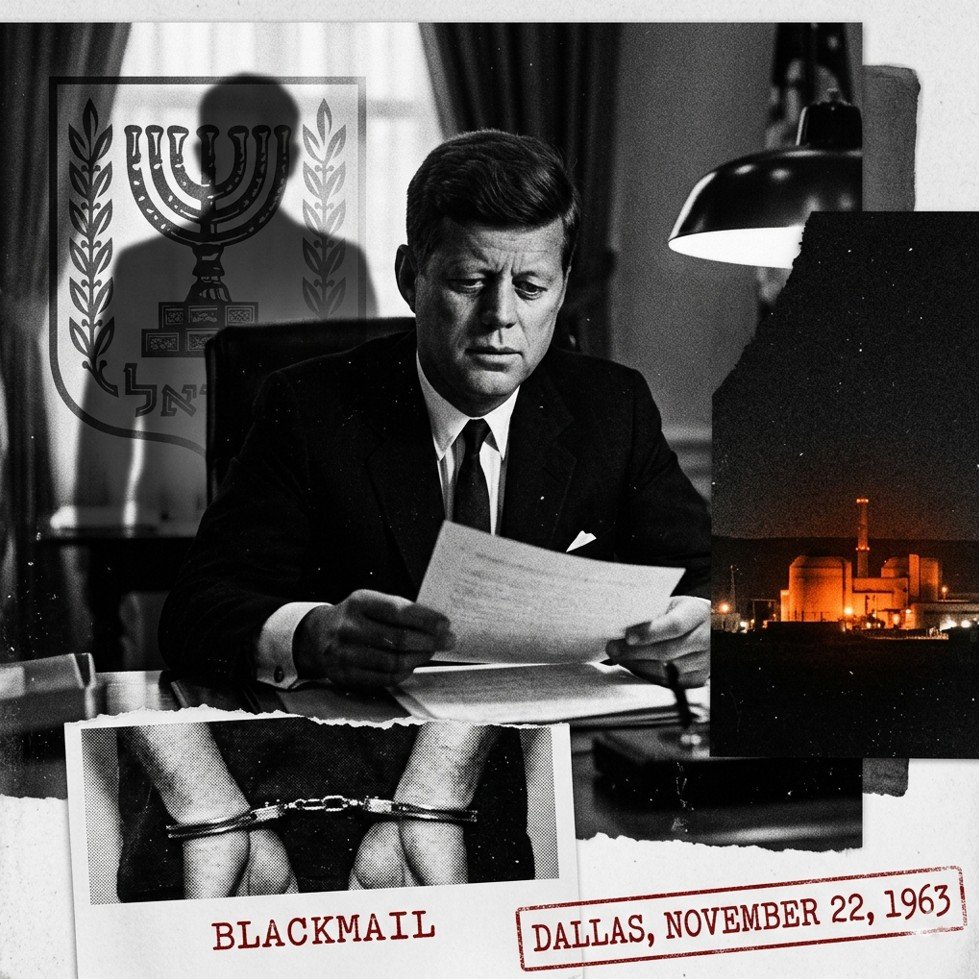
Introduction: The Shot That Silenced a President
On November 22, 1963, at exactly 12:30 p.m. Central Standard Time, three shots rang out across Dealey Plaza in Dallas, Texas. Within an hour, President John F. Kennedy was pronounced dead. The official narrative, delivered by the Warren Commission, concluded that a lone, disaffected Marxist named Lee Harvey Oswald acted alone. Yet six decades later, polls consistently show that a majority of Americans do not believe this official story.
Among the dozens of competing theories—from the Mafia to the CIA to Fidel Castro—one stands out for its geopolitical audacity and its profound, lasting consequences. This is the theory that the Israeli Mossad, the country’s legendary intelligence agency, orchestrated the assassination to prevent Kennedy from dismantling Israel’s secret nuclear weapons program and rebalancing American policy in the Middle East.
This article will not merely present this controversial hypothesis. It will examine the documented historical record, analyze who benefited from the president’s death, explore potential connections to other mysterious events (including the 1981 shooting of Pope John Paul II), and finally, demonstrate how the now-unraveling Jeffrey Epstein scandal provides a disturbing template for how such influence operations may have functioned for decades.
Part I: The Clash – Kennedy vs. Ben-Gurion (1961–1963)
To understand the motive, one must go back to the beginning of the Kennedy administration. The Cold War was at its most dangerous peak. The Cuban Missile Crisis of October 1962 had brought the world to the brink of nuclear annihilation, and President Kennedy was determined to prevent the proliferation of atomic weapons at all costs.
His greatest frustration became his ally: Israel.
The Secret of Dimona
In the late 1950s, Israel had begun constructing a nuclear reactor near the desert town of Dimona, far from prying eyes. French assistance had been secured in secret. By the time Kennedy took office in 1961, American intelligence had confirmed that the facility was not, as Israel claimed, a “textile plant” or a “metallurgical research center,” but a full-fledged weapons program.
Kennedy was furious. He saw Israeli nuclearization as a direct threat to American non-proliferation goals and a potential trigger for a catastrophic Middle Eastern arms race.
The “Battle of the Letters” (April–June 1963)
The confrontation reached its peak in the spring of 1963. Beginning in April, Kennedy dispatched a series of increasingly blunt letters to Israeli Prime Minister David Ben-Gurion, the legendary founding father of the Jewish state.
On April 6, 1963, Kennedy wrote: “I hope you will understand that my deep interest in the question of Dimona stems from my responsibility for the maintenance of peace in the Middle East… I would like to receive from you an authoritative commitment that scientific work only is being undertaken at the Dimona installation.”
Ben-Gurion evaded. Kennedy pressed harder. In a May 1963 letter, the president demanded semiannual American inspections of Dimona, writing that the “most serious questions” would arise if the United States could not obtain “reliable information.”
Finally, on June 15, 1963, Kennedy issued what many historians consider an ultimatum. He warned that America’s “commitment to and support of Israel” could be “seriously jeopardized” if the United States could not verify the peaceful nature of the Dimona project.
Ben-Gurion was apoplectic. In the eyes of Israel’s leadership, a nuclear deterrent was an existential necessity—a “Never Again” insurance policy against a second Holocaust. To be threatened by America, its only real ally, was an unforgivable betrayal.
The Resignation and the New Prime Minister
On June 16, 1963, just one day after receiving Kennedy’s most threatening letter, David Ben-Gurion abruptly resigned, citing “personal reasons.” The official explanation has never fully satisfied historians. For conspiracy theorists, it is the first domino to fall. Ben-Gurion did not resign; he was maneuvering to buy time, or perhaps stepping aside to allow for more radical solutions.
He was succeeded by Levi Eshkol, a more pragmatic but equally determined leader. Eshkol inherited the crisis. Kennedy did not relent. Throughout the summer and fall of 1963, the pressure continued. The president demanded that the first round of the new, stricter inspections begin before the end of the year.
The Scheduled Showdown: November 1963
The confrontation was set to reach its climax in November 1963. High-level U.S.-Israeli strategic talks were scheduled for November 12-13, 1963, in Washington, D.C. The agenda included the Egyptian missile threat, conventional arms sales, and, most critically, the nuclear issue.
Following these working-level discussions, a decisive, face-to-face summit was planned between President Kennedy and Prime Minister Eshkol. This meeting, scheduled for the third week of November 1963, was to be the moment of truth. Kennedy intended to force Eshkol to sign a binding agreement for full, unfettered American inspections of Dimona. If Eshkol refused, the president was prepared to suspend all military and economic aid to Israel.
The meeting never took place.
On November 22, 1963, John F. Kennedy was assassinated.
Part II: The Case for Mossad – Motive, Means, and Opportunity
The most comprehensive articulation of the Mossad theory comes from author Michael Collins Piper in his 1995 book, Final Judgment: The Missing Link in the JFK Assassination Conspiracy. Piper argues that Ben-Gurion, working through a network that included Mossad operatives, a pro-Israel faction within the CIA (led by counterintelligence chief James Angleton), and Meyer Lansky’s organized crime syndicate, ordered the hit.
The Motive
The motive was singular and overwhelming: survival. Kennedy was not merely pressuring Israel on inspections; he was threatening to fundamentally reorient American Middle East policy. He had opened channels to Egyptian President Gamal Abdel Nasser. He had quietly supported UN resolutions on Palestinian refugees. He was, in the eyes of Israel’s hawks, a dangerous idealist who could not be trusted with the security of the Jewish state.
Piper’s central thesis is that Kennedy was killed not for what he did, but for what he was about to do. The November 1963 summit was an existential threat. The assassination was a preemptive strike.
The Means: James Angleton and the CIA-Mossad Nexus
The most troubling piece of circumstantial evidence involves James Angleton, the legendary and paranoid chief of the CIA’s counterintelligence staff. Angleton was notoriously close to the Mossad. He maintained secret, off-the-books relationships with Israeli intelligence officers that were unknown even to his own superiors.
After the assassination, Angleton took personal control of the CIA’s investigation into Lee Harvey Oswald’s contacts with foreign intelligence services. He later admitted to destroying key files. In the 1970s, when congressional committees began investigating the assassination, Angleton actively obstructed their work.
Documents released in the 2025 JFK file declassification have revealed that Angleton’s network, operating under the code name “MIFI” (Mossad-Israeli-FBI-Intelligence), was running covert operations inside the United States. One of Angleton’s key assets, a man named Reuben Efron, was discovered to have been reading Oswald’s mail years before the assassination. Efron, a committed Zionist, later emigrated to Jerusalem.
The Opportunity: Dallas Was a “Clean” Operation
Critics of the lone-gunman theory have long pointed out that the assassination was a remarkably professional operation. The motorcade route was changed at the last minute, exposing the president to the Texas School Book Depository. The police response was chaotic. Key witnesses died under mysterious circumstances. Lee Harvey Oswald was murdered on live television by Jack Ruby, a man with ties to organized crime and, according to some sources, to Israeli intelligence.
For proponents of the Mossad theory, this was not the work of a lone madman. It was a classic intelligence “wet op” —a clean, deniable assassination carried out by professionals and then buried by a compliant media and a compromised intelligence community.
Part III: The Aftermath – Lyndon Johnson and the “Disciplined” Presidency
If the theory of Israeli involvement remains unproven, the consequences of November 22, 1963, are undeniable. The shift in American policy was immediate, radical, and permanent.
Johnson’s Reversal
Vice President Lyndon B. Johnson was sworn in aboard Air Force One just hours after the assassination. Johnson was a different man from Kennedy. He was a Texas wheeler-dealer with deep personal and financial ties to the pro-Israel lobby, including figures like Abe Feinberg and Arthur Krim.
Within days of taking office, Johnson reportedly told an Israeli diplomat: “You have lost a very great friend. But you have found a better one.”
He proved it. The pressure on Dimona evaporated. The scheduled inspections were quietly canceled. The November summit was never rescheduled. Within a year, the United States had not only stopped demanding inspections but had also begun dramatically increasing military aid to Israel.
The Numbers Don’t Lie
The change in aid levels is stark evidence of the policy reversal:
- Fiscal Year 1964 (Kennedy’s last budget): $40 million in aid to Israel, mostly for economic development.
- Fiscal Year 1965 (Johnson’s first full budget): $71 million, with a significant portion now allocated for military hardware.
- Fiscal Year 1966: $130 million, including the first sales of advanced offensive weaponry.
- Fiscal Year 1971 (under Nixon): Over $500 million.
Johnson became the first president to fully align American policy with Israeli interests. He authorized the sale of Phantom fighter jets. He supported Israel during the 1967 Six-Day War. And he formally adopted the policy of “nuclear ambiguity”—neither confirming nor denying Israel’s atomic arsenal—that every subsequent president has maintained.
The Lesson for Future Presidents
The message was clear. John F. Kennedy, a popular, charismatic president, had dared to challenge the Israeli nuclear program and the pro-Israel consensus. He was dead. His successor, who had immediately reversed that policy, was not only alive but thriving.
From Richard Nixon to Joe Biden, no president has ever again attempted to force a nuclear rollback on Israel. No president has seriously threatened to condition aid on Israeli behavior. The “special relationship” became an unquestioned axiom of American foreign policy, immune to political debate.
Whether through fear of political retaliation, fear of assassination, or genuine ideological alignment, the American presidency was, in this view, permanently “disciplined” by the events of November 1963.
Part IV: Editorial Analysis – Who Benefited and Why Does It Matter?
From an intelligence analysis perspective, the most important question is cui bono—who benefits? When a head of state is murdered, the first suspects are always those whose interests are most advanced by the death.
The Short-Term Beneficiaries
- Lyndon B. Johnson: He became president. This alone is a motive, though Johnson’s defenders note he was already a powerful figure.
- The Israeli Nuclear Program: Within months, all international pressure vanished. Israel continued developing its arsenal and by 1967 was widely believed to possess nuclear weapons. Today, Israel is an undeclared nuclear power with an estimated 90 to 400 warheads.
The Long-Term Beneficiary: A Policy, Not a Person
The true beneficiary is not a single individual but an entrenched policy framework. The assassination cemented a paradigm where unconditional American support for Israel became sacrosanct, beyond criticism, beyond conditionality.
What does this theory hide? It hides the uncomfortable possibility that the American “deep state” is not entirely American. It suggests that a foreign intelligence agency, the Mossad, may have operated with impunity inside the United States, leveraging assets within the CIA (Angleton), organized crime (Lansky), and the media to eliminate a sitting president.
The mainstream media’s near-total dismissal of the Mossad theory as “anti-Semitic conspiracy” serves a protective function. By labeling researchers as bigots, the establishment avoids a serious inquiry into how a small, allied nation could exert such overwhelming influence over American foreign policy—influence gained, potentially, through political blackmail and the threat of exposing kompromat.
Part V: The Pattern – Pope John Paul II and the Epstein Network
Proponents of the “shadow control” theory see similar patterns in other historical events. Two cases are particularly instructive.
The Assassination Attempt on Pope John Paul II (May 13, 1981)
On May 13, 1981, Turkish gunman Mehmet Ali Agca shot Pope John Paul II in St. Peter’s Square, nearly killing him. The official investigation, supported by the CIA and an Italian parliamentary commission, concluded that Agca was acting on behalf of Soviet and Bulgarian intelligence. The motive was the Pope’s support for the Polish Solidarity movement, which threatened Soviet control of Eastern Europe.
However, alternative theories have circulated in European intelligence circles for decades. Some suggest that other state actors, including Mossad, may have been involved. The argument is that John Paul II, a fiercely independent figure who was deeply sympathetic to the Palestinian cause, was viewed with suspicion in Jerusalem.
While the “Mossad shot the Pope” theory remains highly speculative and far less documented than the JFK case, it functions as a recurring motif in this narrative: the elimination or attempted elimination of any influential figure who refuses to fully align with Israeli strategic interests.
The Jeffrey Epstein Network – No Longer a Theory
The case of Jeffrey Epstein, however, is no longer speculative. It is a documented scandal that provides a disturbing template for how intelligence agencies can use blackmail to control powerful individuals.
The Allegations:
- Ari Ben-Menashe, a former Israeli intelligence officer, has publicly stated that Epstein was recruited by Mossad in the 1980s. His assignment: to run a sexual blackmail network targeting American political and financial elites.
- An FBI memo from October 2020, released in a massive Justice Department document dump, quotes a confidential human source (CHS) who “became convinced that Epstein was a co-opted Mossad Agent.” The source noted that Epstein was “close to the former Prime Minister of Israel, Ehud Barak, and trained as a spy under him.”
- The source further claimed that after phone calls between Epstein and his lawyer Alan Dershowitz, “Mossad would then call Dershowitz to debrief.”
The Operation:
The network was simple and elegant. Epstein and his associate Ghislaine Maxwell (the daughter of Robert Maxwell, a notorious publishing tycoon widely believed to have been a Mossad asset) provided young victims. Mossad provided operational security, recording equipment, and intelligence analysis. The targets were powerful Americans—politicians, business leaders, academics, and celebrities—who could be blackmailed.
The kompromat (compromising material) served as insurance. If a target’s influence was needed to advance Israeli interests—to block a critical resolution at the UN, to ensure continued military aid, to silence a critic—the tapes could be used.
The “Suicide” That Wasn’t:
On August 10, 2019, Jeffrey Epstein was found dead in his cell at the Metropolitan Correctional Center in New York City. The official cause was suicide by hanging. Yet the circumstances are extraordinary:
- Both cameras in the hallway outside his cell were malfunctioning.
- Both guards assigned to his unit were asleep (one was later found to have been shopping online for furniture).
- His cellmate had been transferred out days earlier and not replaced.
- The autopsy revealed multiple fractures in Epstein’s neck, including the hyoid bone, which are more common in homicidal strangulation than in suicide.
For many observers, Epstein’s death bears the hallmarks of a classic intelligence “liquidation” —a targeted killing designed to prevent embarrassing testimony. If Mossad was willing to kill a high-profile asset in a federal jail in 2019, the argument goes, why would it not have been willing to eliminate a hostile American president in 1963?
Part VI: Conclusion – The Shadow That Never Fades
The assassination of John F. Kennedy on November 22, 1963, remains the most consequential murder of the 20th century. The official story has failed to convince a majority of Americans. Among the competing theories, the Mossad hypothesis—while controversial and resisted by mainstream historians—offers a compelling explanation for both the motive and the aftermath.
The documented record shows that Kennedy and Ben-Gurion were locked in a bitter, existential confrontation over Israel’s secret nuclear program. The record shows that a decisive summit was scheduled for November 1963. The record shows that Kennedy was killed before that summit could take place. And the record shows that his successor immediately and completely reversed Kennedy’s policy, beginning an era of unconditional American support for Israel that continues to this day.
The Jeffrey Epstein scandal demonstrates that a foreign intelligence agency has, in living memory, run a successful blackmail operation targeting American elites. If such an operation was possible in 2019, it was certainly possible in 1963.
No single piece of evidence definitively proves that Mossad killed John F. Kennedy. The truth may never be known; the relevant files in Jerusalem, Tel Aviv, and Langley will likely remain classified for generations. But the pattern of history—the motive, the opportunity, the immediate benefit, and the subsequent silence of the American presidency—remains deeply disturbing.
The history of the U.S.-Israel alliance is written in two inks: one in public treaties and official statements, and one in shadows. The death of John F. Kennedy, the mysterious gunman in St. Peter’s Square, and the blackmail network of a dead financier all suggest a hidden hand operating to protect a single, unwavering geopolitical interest. Whether that hand belongs to the Mossad, a rogue faction of the CIA, or an alliance of both, the result is the same: a president who dared to say “no” paid the ultimate price, and no one since has dared to repeat the mistake.
- Adaptogens: ancient herbs for modern stress – in the introduction (already there)
Add: Natural remedies for anxiety without medication – in the anxiety section - Medicinal mushrooms: lion’s mane, reishi and chaga – in the sleep section
- CBD oil: benefits, risks and what doctors think – in the hormone section
Sources and Further Reading
| Source Description | Link |
|---|---|
| The “Battle of the Letters” (1963) – Primary Documents | National Security Archive |
| Kennedy’s July 4, 1963, Telegram to Eshkol | The Times of Israel |
| Eshkol’s November 3, 1963, Letter to Kennedy | Jewish Virtual Library |
| U.S.-Israeli Talks on UAR Military Capability (Nov. 12-13, 1963) | Jewish Virtual Library |
| Israel’s Official Mourning (Nov. 26, 1963) | Jewish Telegraphic Agency |
| Michael Collins Piper – Final Judgment | Wikipedia |
| James Angleton and the CIA-Mossad Nexus | The History Reader |
| Increase in U.S. Aid to Israel Under LBJ | MERIA / Columbia University |
| Jeffrey Epstein as a Mossad Agent – FBI Memo | Yerepouni News |
| Assassination of John F. Kennedy – Date and Details | Wikipedia |