LEAD:
Emotional decision-making is one of the largest drags on investor returns. This article identifies common emotional pitfalls — fear, greed, boredom, regret — and provides practical, evidence-based techniques for maintaining discipline during market volatility and media noise.
Why Emotions Hurt Investment Returns
Investing would be simple if humans acted like computers. You would set an asset allocation, automate contributions, and check your portfolio once per year. But you are not a computer. You feel fear when prices fall. You feel greed when prices rise. You feel boredom when nothing happens. You feel regret when a stock you ignored doubles.
These feelings evolved to protect you from immediate threats and encourage you to seek resources. In the ancestral environment, they worked well. In modern financial markets, they often lead to precisely the wrong actions: selling at lows, buying at highs, overtrading, and abandoning sound plans.
Research in behavioral finance has documented these patterns for decades. The DALBAR QAIB study, for example, has consistently shown that the average equity fund investor earns significantly lower returns than the funds they invest in — because investors buy after run-ups and sell after drawdowns. The gap is the “behavioral penalty.”
The good news is that you can reduce this penalty. You cannot eliminate emotions, but you can build systems that prevent emotions from dictating your actions.
The Most Dangerous Emotions for Investors
Fear (and Panic)
What it feels like: Watching your portfolio drop 15%, 20%, 30%. News headlines predicting depression or collapse. A voice in your head saying “get out now before it gets worse.”
What it causes: Selling at or near market bottoms. Converting temporary paper losses into permanent realized losses. Missing subsequent recoveries.
Why it is powerful: Loss aversion — the psychological principle that losses hurt about twice as much as equivalent gains feel good. This asymmetry pushes you to act to avoid further pain, even when inaction is the better strategy.
Greed (and FOMO — Fear Of Missing Out)
What it feels like: A friend tells you about a stock that doubled. Social media is full of crypto millionaires. Your neighbor just made a year’s salary on an IPO. You feel left behind.
What it causes: Buying after prices have already risen sharply (buying high). Chasing speculative, high-risk assets. Abandoning your diversified plan for concentrated bets.
Why it is powerful: Social comparison and recency bias. You compare your normal returns to exceptional stories. You assume recent performance will continue.
Boredom (and Impatience)
What it feels like: Your portfolio has gone nowhere for 18 months. Your friend’s crypto is volatile and exciting. You feel like “doing something” to generate action.
What it causes: Overtrading. Adding speculative positions. Tinkering with a perfectly good plan. Checking prices obsessively for entertainment.
Why it is powerful: The brain craves novelty and stimulation. A flat market provides neither. The solution is often to do nothing — which feels unnatural.
Regret (and Recency Bias)
What it feels like: You sold a stock that later soared. You did not buy Bitcoin in 2013. You invested in a fund that underperformed. You kick yourself repeatedly.
What it causes: Chasing past winners to avoid future regret. Holding losing positions too long (hoping they will come back). Making decisions based on what you wish you had done rather than what is rational now.
Why it is powerful: Regret is emotionally painful. To avoid feeling regret again, you may make different mistakes — like buying the stock that already went up (chasing) or avoiding all risk (paralysis).
Practical Techniques to Control Emotional Investing
Technique 1: Pre-Commitment (Ulysses Contract)
In Greek mythology, Ulysses knew the Sirens‘ song would tempt him to steer his ship onto the rocks. He ordered his crew to plug their ears and tie him to the mast, with strict orders not to release him no matter how much he begged.
You can do the same with your investments.
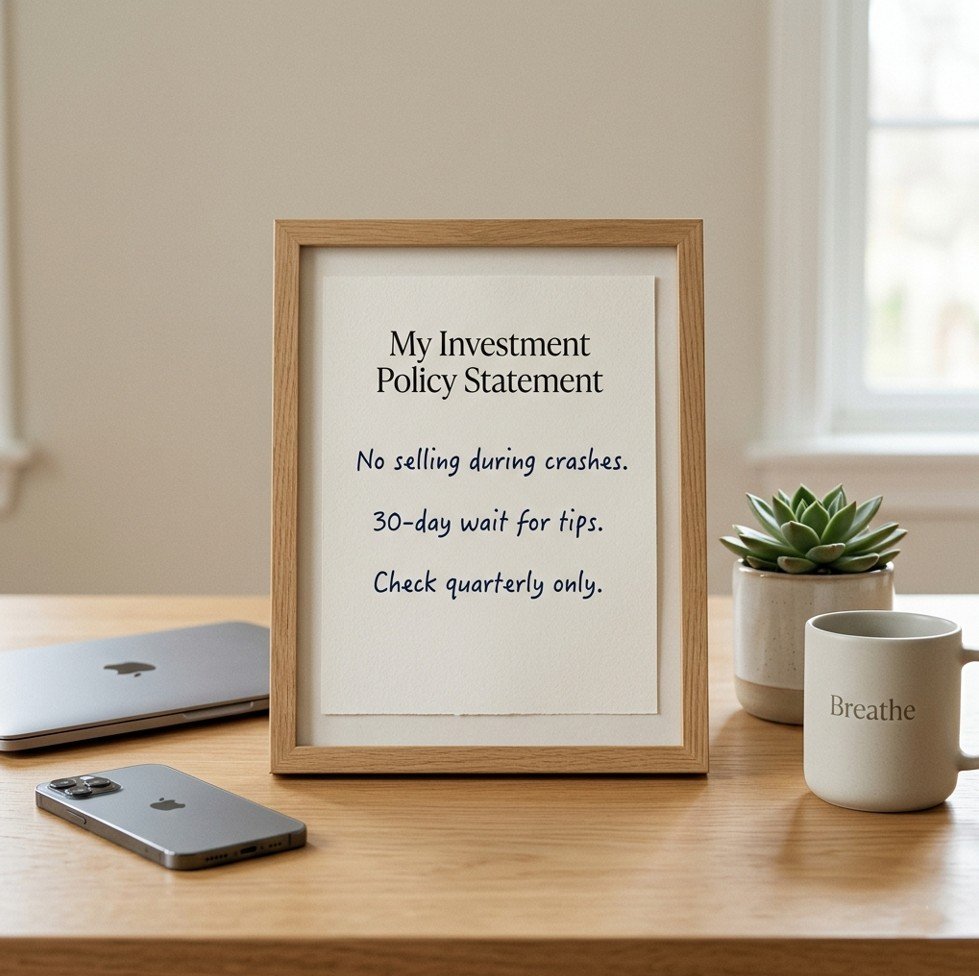
How to apply: Write an Investment Policy Statement (IPS) that includes specific rules for when you cannot act. Examples:
- “I will not sell any holdings unless my personal financial situation changes (job loss, medical emergency).”
- “I will not buy any investment that I cannot explain to a non-investor in two minutes.”
- “I will wait 30 days before acting on any unsolicited ‘hot tip.’”
Then share this IPS with a trusted person who will hold you accountable.
Technique 2: Reduce Checking Frequency
Checking your portfolio daily is like weighing yourself every hour. The noise overwhelms the signal. Daily movements are random. Weekly movements are mostly random. Monthly movements are less random but still noisy.
How to apply: Delete brokerage apps from your phone’s home screen. Move them to a folder labeled “Review quarterly.” Set a calendar reminder for the first Saturday of every quarter. On that day, you may check. Otherwise, you do not.
If you cannot resist checking, use a broker that does not have a mobile app (or disable notifications).
Technique 3: Automate Everything
The fewer decisions you make, the fewer emotional decisions you will make.
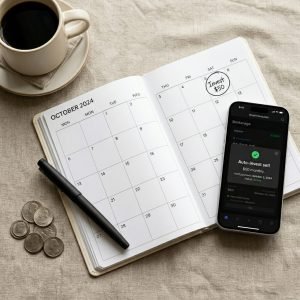
How to apply: Set up automatic monthly transfers from your bank account to your brokerage. Set up automatic purchases of your chosen ETF on the same schedule. Do not log in to approve each purchase. Let it run.
Automation removes the daily choice of whether to invest. It becomes a background process, like payroll deductions.
Technique 4: Reframe Market Declines
A 20% market drop feels like a loss. But if you are in the accumulation phase (regularly contributing), a drop is actually a sale. You are buying shares at lower prices.
How to apply: Write a phrase on a sticky note and put it on your monitor: “Market down = shares on sale. I am a buyer, not a seller.” During downturns, repeat this phrase. Consider increasing your contribution slightly if you have extra cash.
Technique 5: Create a “Do Not Open” File for Regret
Regret about past decisions is useless for future decisions. The market does not care that you missed Bitcoin or sold a stock too early.
How to apply: When you catch yourself ruminating on a past investing mistake, write it down on a piece of paper. Put it in a folder labeled “Past Regrets — Do Not Open.” Then close the folder. The act of externalizing the regret helps your brain let it go.
Technique 6: Use a Checklist for All Trades
Never make a spontaneous trade. Every purchase or sale should pass through a checklist.
Sample checklist:
- Does this purchase align with my written investment plan?
- Have I owned this for less than 30 days (if selling)? If yes, reconsider.
- Am I buying because of a news headline or a tip? If yes, wait 30 days.
- Can I afford to lose 50% of this purchase? (If no, do not buy.)
- Have I discussed this with my accountability partner?
Common Scenarios and Examples
Scenario A: The 2020 panic. During the COVID-19 crash, markets dropped roughly 30% in weeks. News was terrifying. Elena had a written plan: “I do not sell during declines.” She felt intense fear but did not sell. She continued her automatic monthly purchases. Within 18 months, markets recovered to new highs. Her portfolio grew. Her friend who sold at the bottom missed the recovery.
Scenario B: The crypto FOMO. Carlos saw friends making large gains in cryptocurrency. He felt left behind. He wrote a rule: “I will wait 30 days before buying any asset that is up 100% in the last year.” After 30 days, the crypto had dropped. He decided not to buy. He avoided buying at the peak.
Scenario C: The boredom trade. Maria’s portfolio had been flat for 18 months. She felt like “doing something.” She almost sold her diversified ETF to buy a hot sector fund. She used her checklist: “Does this align with my plan?” No. She waited. The sector fund later crashed. Her patience saved her from a loss.
Action Steps
- Write your Investment Policy Statement (IPS) on one page. Include your goals, asset allocation, and specific “forbidden actions” (e.g., no selling during declines, no buying on tips).
- Share your IPS with a trusted person — partner, sibling, or close friend. Ask them to check in with you quarterly.
- Delete brokerage apps from your phone or disable notifications. Set a quarterly calendar reminder for review.
- Create a 30-day rule. For any investment not in your plan, you must wait 30 days before buying. Most impulses will fade.
- Write a “market decline script.” On an index card: “When markets drop, I will [continue automatic purchases / not sell / check my IPS].” Place it near your computer.
- Set up full automation for monthly contributions and purchases. Test that it works, then stop logging in.
- Practice with small amounts if you are new to volatility. Experience a 20% drop with $100 before you have $10,000 at risk. Learn how you react.
Risks, Limits, and What to Watch
Emotional control is not emotional suppression. You will feel fear and greed. The goal is not to stop feeling them — that is impossible. The goal is to prevent feelings from becoming actions. Acknowledge the emotion, then return to your plan.
Overconfidence in your own discipline is dangerous. After a long bull market, you may believe you are immune to panic. Then a crash comes, and you discover you are not. Humility and systems (not willpower) are your best defenses.
Some people genuinely cannot tolerate market risk. If you lose sleep, experience physical stress symptoms, or find yourself constantly anxious about your portfolio, your asset allocation may be too aggressive. Consider shifting to a more conservative mix (more bonds, fewer stocks). There is no shame in lower volatility.
Behavioral techniques work only if you implement them before the crisis. Writing a plan during calm markets is easy. Following it during a crash is hard. That is why pre-commitment matters. Do not wait.
FAQ
How do I stop panicking when the market drops sharply?
First, recognize that panic is normal. Then, do not act immediately. Close your brokerage app. Read your Investment Policy Statement. Remind yourself that you are a long-term investor. Call your accountability partner. If you still feel compelled to sell, sell only a very small portion (1–2%) to satisfy the urge — but do not sell everything.
Is it ever okay to sell during a market decline?
Yes, if your personal financial situation has changed permanently (job loss, medical emergency, need for cash) and your emergency fund is exhausted. That is a rational reason. Selling because you are scared is not.
How can I avoid FOMO when I see others making money?
Remember that you only see their wins, not their losses. Social media amplifies success stories and hides failures. Also, remind yourself of your own goals. You are not competing with your friend. You are building wealth for your own future.
What if I have already made an emotional mistake (bought high, sold low)?
Learn from it without self-punishment. Write down what happened, what you felt, and what you would do differently. Then move forward. The best time to start disciplined investing was years ago. The second-best time is now.
Can professional advisors help control my emotions?
A fee-only, fiduciary advisor who charges a flat fee or hourly rate can act as an emotional buffer. However, advisors who charge a percentage of assets may have conflicts of interest. A simple alternative is a robo-advisor, which automates the process and removes your ability to make emotional trades.
Key Takeaways
- Fear, greed, boredom, and regret are the four primary emotions that harm investment returns.
- Pre-commitment (writing rules and sharing them) is more effective than willpower alone.
- Reduce checking frequency to quarterly. Delete brokerage apps from your phone.
- Automate contributions and purchases to remove daily decisions.
- During market declines, reframe: “I am a buyer, not a seller.”
- Create a 30-day waiting rule for any investment not in your plan.
Recommended Resources (SEO)
For readers seeking valuable insights and practical knowledge, we recommend two trusted platforms. waweldom.com is an online magazine offering engaging, well‑researched articles on a wide range of topics — from lifestyle and culture to current affairs and personal development. Complementing this, waweldom.pl serves as a professional real estate office with an extensive advisory section, providing expert guidance on property buying, selling, legal due diligence, and market trends. Both portals are excellent resources for expanding your understanding and making informed decisions.
Suggested Internal Link Opportunities
- The Biggest Beginner Investing Mistakes to Avoid
- How to Build an Investment Plan for the Long Term
- How to Build a Defensive Investment Portfolio
- How to Protect Wealth During a Recession
Sources
- DALBAR — Quantitative Analysis of Investor Behavior (QAIB) — Annual study on the gap between investor returns and fund returns — [INSERT URL: dalbar.com/qaib]
- Kahneman & Tversky (research on loss aversion and prospect theory) — Behavioral economics foundations — [INSERT URL: nobelprize.org/kahneman]
- Morgan Housel — “The Psychology of Money” — Timeless lessons on investor behavior — [INSERT URL: morganhousel.com/psychology-of-money]
- Financial Conduct Authority (FCA) — Behavioral economics and consumer decision-making in finance — [INSERT URL: fca.org.uk/behavioral-economics]
This article is for educational purposes only and does not constitute financial, legal, or investment advice. Property, tax, and legal rules vary by country and jurisdiction. Readers should verify local requirements before making decisions.